
Misophonia and Noise pollution is more dangerous than global warming But not getting any attention
My everyday suffering with noise pollution

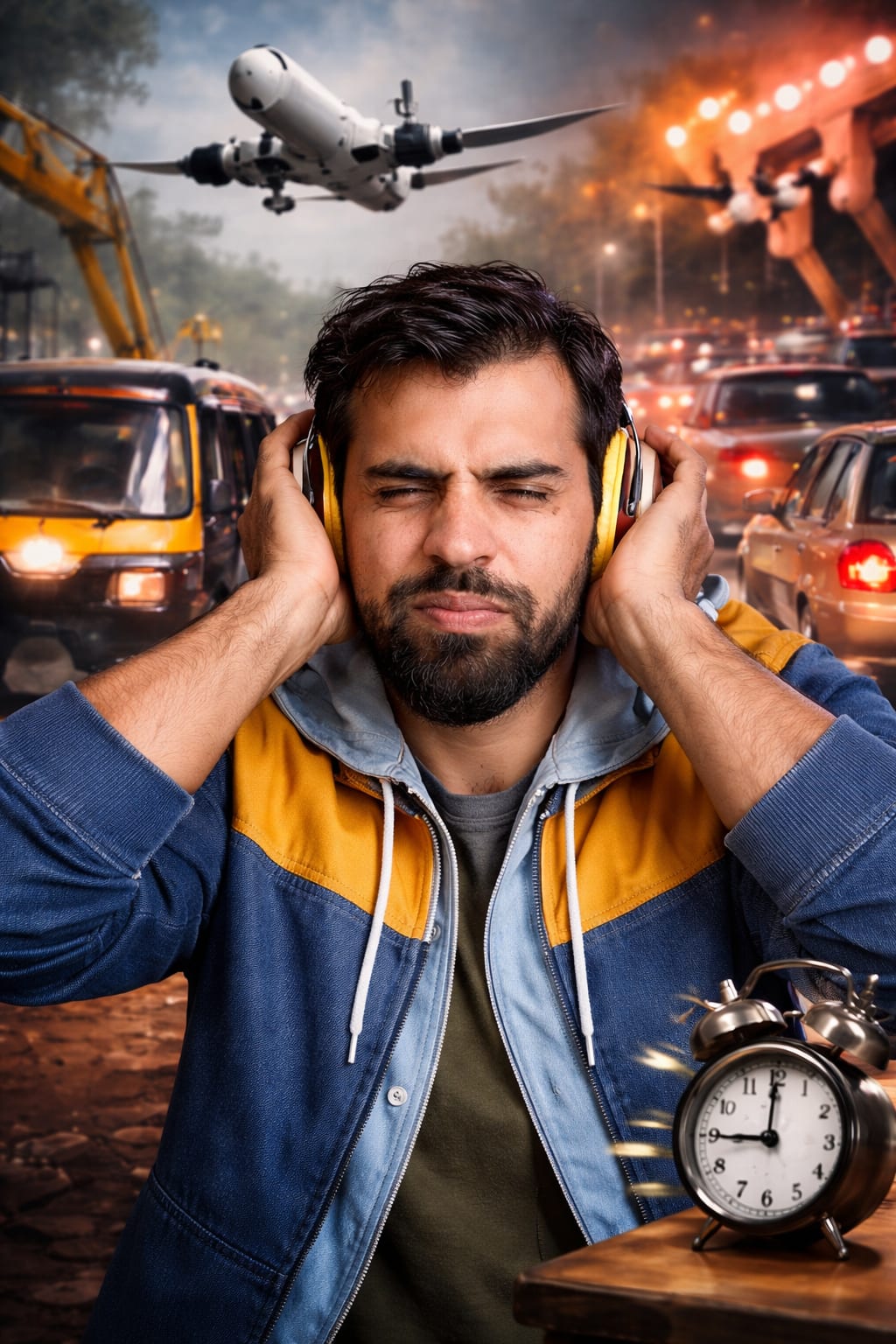
Misophonia and Noise pollution is more dangerous than global warming But not getting any attention Abstract This extensive inquiry explores Misophonia—Selective Sound Sensitivity Syndrome—not merely as a clinical neurological condition, but as a profound visceral response to the "auditory imperialism" of modern urban life. Drawing from years of personal lived experience and intense struggle in high-density urban environments, the author analyzes how the global preoccupation with macro-environmental crises has marginalized the immediate, corrosive impact of noise on human mental and physiological health. By framing silence as a "class-based luxury" and a "fundamental human right," this paper calls for a radical global movement toward "Acoustic Dignity" and sensory justice, challenging the current neoliberal urban design that prioritizes mechanical movement over human serenity. I. The Personal Cage: A Testimony of Neurological Distress My life has been lived behind an invisible, yet impenetrable, wall of neurological distress. In the high-density urban sprawl of major metropolises like Alexandria and Cairo, the air is thick with more than just dust; it is saturated with a relentless, unregulated cacophony of sound. For someone living with Misophonia, the world is not a neutral space; it is a hostile environment. I do not just "hear" the world—I am systematically assaulted by it. Misophonia is often misunderstood by the public as a mere "irritation" or a lack of patience. However, as someone who navigates this "minefield" daily, I can testify that it is an involuntary, visceral eruption. When I hear the rhythmic, mechanical tapping of a neighbor’s repair work, or the distorted, amplified screech of a street vendor's microphone, my body does not process these as "background noise." It processes them as existential threats. This is the "Acoustic Self" under siege. The psychological boundaries of the individual are breached without consent, leading to a state of permanent "sensory exposure" that drains the soul’s energy long before the day is over. II. The Physiological Siege: Beyond the Ears We must move beyond the subjective feeling of annoyance and look at the cold, hard data of biology. Noise pollution is a public health crisis that is being willfully ignored by global health organizations. While we discuss the long-term effects of carbon emissions, we ignore the "cortisol flood" occurring in the veins of urban dwellers every single second. The science of Misophonia and noise stress reveals a harrowing reality. When the brain perceives a "trigger" sound, the amygdala—the brain's emotional alarm system—triggers an immediate state of emergency. This is the "Fight-or-Flight" response, a relic of our primitive ancestors meant for escaping predators. But in a modern city, there is no predator to flee and no enemy to fight; there is only the sound. This chronic activation of the stress response leads to what I call "Systemic Biological Erosion." Drawing from medical research, we know that constant noise exposure is a direct precursor to: Cardiovascular Decay: The relentless surge of adrenaline causes permanent damage to the heart and arteries, leading to chronic hypertension (high blood pressure). Metabolic Disruption: High cortisol levels associated with noise stress interfere with insulin regulation, significantly increasing the risk of Type 2 Diabetes. Sleep Fragmentation: Even when we sleep, our ears remain "open." The subconscious processing of urban noise prevents the brain from entering deep REM cycles, leading to chronic fatigue and immune system collapse. III. The History of Silence: A Lost Human Heritage To understand the "Dictatorship of Noise," we must look back at what we have lost. Throughout human history, silence was the default state of the world. It was the canvas upon which human thought, prayer, and philosophy were painted. Great thinkers like Arthur Schopenhauer once remarked that "the amount of noise that anyone can bear undisturbed stands in inverse proportion to his mental capacity." Schopenhauer’s critique was not just an elitist complaint; it was an ontological observation. He argued that noise is a "torture for intellectual people" because it shatters the unity of thought. In the pre-industrial era, the sounds of the world were organic—the wind, the rain, the distant call of an animal. These sounds are "rhythmic" and "natural," allowing the human brain to synchronize with its environment. In contrast, modern noise is "mechanical," "erratic," and "aggressive." The industrial revolution did not just bring machines; it brought a permanent end to the "Human Right to Silence." We have traded our internal peace for external efficiency, and the cost has been our collective mental health. IV. Auditory Imperialism: The Class-Based Distribution of Quiet There is a profound, and often unaddressed, socio-economic injustice in how noise is distributed in modern society. In the 21st century, silence has been commodified. It is no longer a natural state; it is a premium product. The Proletariat of Noise: In lower-income, high-density districts, silence is non-existent. The poor are forced to live in "sensory slums." They are subjected to the loudest industrial sounds, the most congested traffic, and the least amount of architectural protection. Their lives are "loud" not by choice, but by a lack of capital. The Aristocracy of Stillness: Conversely, the elite purchase their silence. They move to "Gated Communities," they install triple-glazed windows, and they design their workspaces with acoustic perfection. The Global Policy Bias: Why is there no "Acoustic Paris Agreement"? Because the people who write global laws are the ones who can afford to escape the noise. They do not hear the 4:00 AM mechanical roar of an unregulated factory situated ten meters from a residential bedroom. They don't live in the third world where noise is all over the place.To them, noise is a "minor nuisance," while for the common citizen, it is a form of auditory imperialism that dictates their quality of life. V. The Siren Paradox: A Symptom of Urban Decay One of the most glaring examples of our failed urban logic is the emergency siren. It is a paradox of modern "care." To potentially save one life, a siren psychologically terrorizes tens of thousands of people along its path. In a city designed with intelligence—with dedicated emergency lanes or silent signaling systems—the siren would be unnecessary. Instead, we use "acoustic terrorism" as a substitute for infrastructure. The siren is a primitive scream used to cut through a concrete jungle that was never designed for human serenity. Every time a siren blares, it sends a wave of anxiety through the elderly, the sick, and the neurodivergent. It is a confession of systemic failure, where we prioritize the "emergency" over the "essential" peace of the collective. VI. The Assassination of the "Thinking Human" Beyond physical health, the dictatorship of noise is an attack on the human intellect. Deep work—the state of total immersion required for creativity, scientific inquiry, and philosophical reflection—requires a "protected auditory space." The modern world, with its "Open Office" plans and communal living without acoustic regulation, has effectively assassinated the "Thinking Human." When a person cannot find a single hour of silence in their own home, they lose the ability to read deeply, to reflect on their own existence, and to develop a coherent inner life. We are becoming a society of "reactive" beings—constantly distracted by the next bleep, honk, or shout—rather than "proactive" creators. VII. A Manifesto for Acoustic Dignity: The Path Forward We are at a crossroads. We can continue to normalize sensory violence, or we can demand a new "Right to Stillness." Individuals with Misophonia are not "broken"; we are the "human radars" signaling that the world has become too loud for the human spirit to inhabit. Our suffering is the "canary in the coal mine" for a society that is losing its grip on sanity. I propose the First International Convention on Acoustic Justice, which must advocate for: The Legal Right to Silence: Classifying unregulated noise not as a nuisance, but as a criminal assault on public health, punishable by significant fines and structural mandates. Sensory Urbanism: Mandatory acoustic insulation in all residential constructions, treating "silence" as a basic human utility, no less important than water, electricity, or internet access. Workplace Neurodiversity: Legally recognizing Misophonia as a neurodivergent condition that requires employers to provide quiet zones and sensory-safe environments for their staff. Technological De-escalation: Shifting the focus of engineering from "faster and louder" to "silent and efficient." Silence should be the ultimate mark of technological advancement. Conclusion Silence is not the absence of sound; it is the presence of the self. In the roar of the modern machine, we have lost our ontology—our very sense of being. My struggle with Misophonia is not a solitary medical journey; it is a microcosm of a global crisis. It is time for the world to stop screaming and start listening. We must decontaminate our auditory space and reclaim our right to stillness before the human soul is permanently drowned out by its own inventions. The future of our sanity depends on our ability to turn down the volume of the world and rediscover the quiet strength of the human spirit.
About the Creator
Enjoyed the story? Support the Creator.
Subscribe for free to receive all their stories in your feed.
Comments
There are no comments for this story
Be the first to respond and start the conversation.