
Manufacturing Offense: The Political Economy of Free Speech
From the Jester’s Licence to the Algorithmic Economy of Grievance: How the Right to Offend Became a Commodity of the Global Stage (Online Media Ecology Series)

Abstract
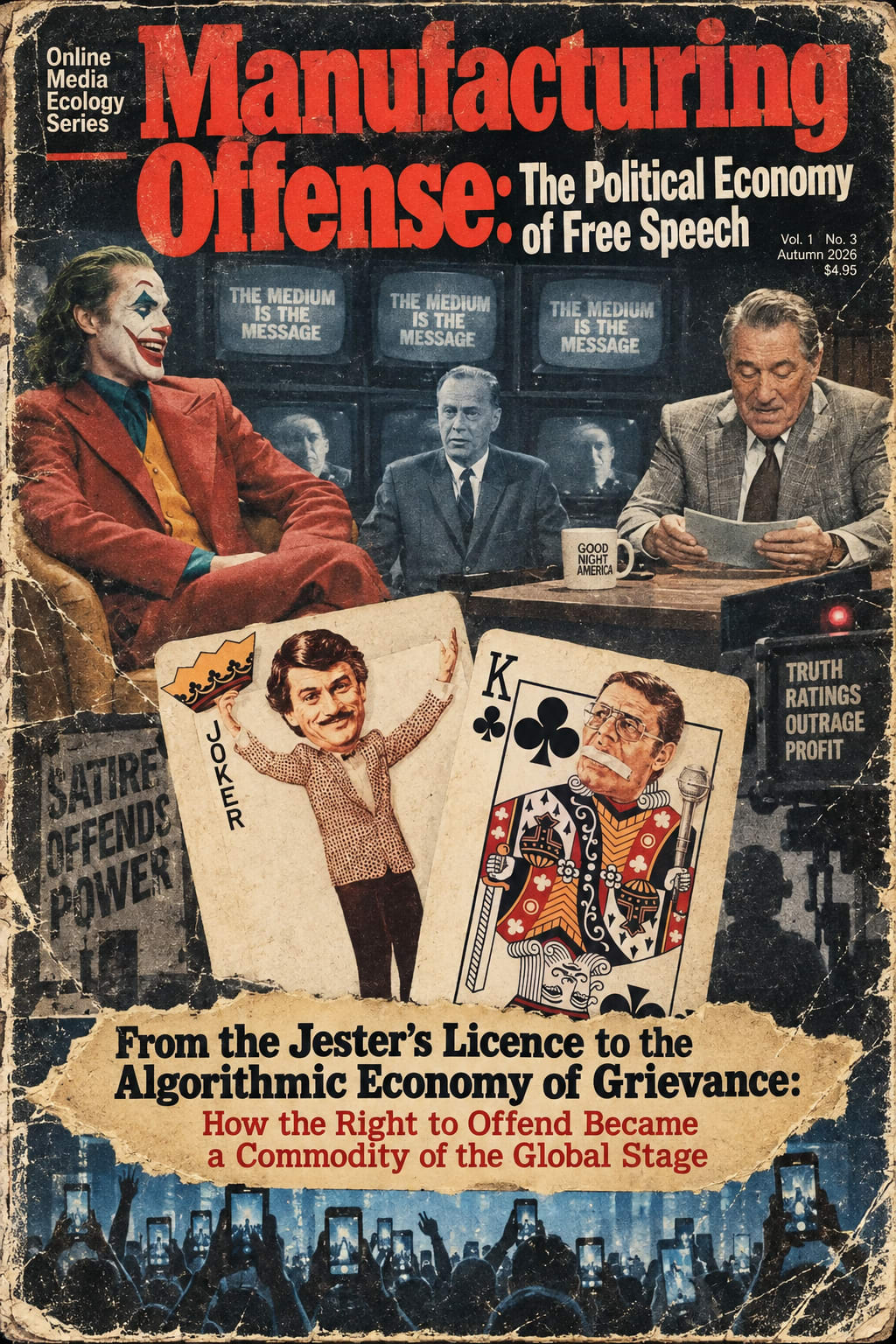
Freedom of speech has never meant an unlimited freedom to say anything, anywhere, to anyone without consequence. Every communicative order establishes boundaries between permissible expression and utterances understood as threat, coercion, defamation, incitement or other forms of actionable conduct; paradoxically, however, freedom of speech becomes politically meaningful precisely because speech possesses the capacity to offend, disturb, humiliate and provoke. This article examines that paradox from the perspective of Online Media Ecology and argues that digital media have introduced a historically distinctive transformation: offence has become not merely a possible consequence of communication but a potentially profitable commodity. Beginning with the bounded licence of the trickster, court jester, carnival fool and stand-up comedian, the article traces the exceptional social spaces in which linguistic transgression could be temporarily permitted and contained. It then examines the limits of this licence through modern conflicts surrounding offensive expression, including Larry Flynt and Hustler Magazine, Inc. v. Falwell and the lethal attack on Charlie Hebdo, treating these cases not as evidence that offence necessarily produces violence but as extreme demonstrations of the capacity of symbolic conflict to acquire material consequences. The article subsequently turns to contemporary digital media, where traditional boundaries separating performer from spectator, stage from audience and private reaction from public performance increasingly collapse. Extending Marshall McLuhan’s movement from “job taking” towards “role playing,” it proposes that the Global Village is mutating into a Global Stage in which visibility itself becomes social currency. Drawing upon Peter Ayolov’s work on the attention economy, manufactured dissent, rage bait, anger and the commodification of outrage, the article argues that contemporary media systems can profit from selecting provocative speech, amplifying offence, circulating antagonistic reactions and preventing grievance from dissipating. The classical political question of where society should establish the limits of free speech is therefore joined by another: who profits from continually approaching, contesting and moving those limits? This transformation is conceptualised as an emerging Economy of Grievance in which offence becomes content, reaction becomes engagement, and unresolved antagonism acquires economic value.
Keywords
free speech; offence; political economy; Online Media Ecology; attention economy; Peter Ayolov; Marshall McLuhan; Global Stage; court jester; stand-up comedy; satire; right to offend; manufactured dissent; outrage; rage bait; yellow media; social media; algorithmic amplification; Charlie Hebdo; Larry Flynt; Economy of Grievance
Introduction: The Most Dangerous Commodity Is a Word
“Truth indeed is seldom palatable to the ears of kings; yet fools have so great a privilege as to have free leave.”
— Desiderius Erasmus (1509), The Praise of Folly.
Freedom of speech acquires meaning at precisely the point at which somebody wishes that something had not been said. Speech that pleases everybody requires little protection; the political problem begins with the sentence, image, joke, caricature or insult capable of producing anger. Yet modern discussions of free speech frequently contain a peculiar contradiction. Speech is defended as though words were merely harmless sounds or abstract propositions, while human history repeatedly demonstrates that signs can produce extraordinarily material consequences. People laugh because of words, blush because of words, lose employment because of words, vote because of words, march because of words, sue because of words and, under extreme ideological and social conditions, kill because of meanings communicated through words and images. Human beings can fight not only over bodies, territories and possessions, but over representations of gods, nations, identities, histories and themselves. The shootings of Larry Flynt and the journalists and cartoonists of Charlie Hebdo represent radically different historical circumstances and must not be reduced to a common causal explanation, yet both expose the dangerous frontier between symbolic provocation and physical consequence. Civilisation has therefore never solved the problem of offensive speech by making speech absolutely free. It has constructed complicated boundaries around it: laws, manners, conventions, rituals, genres, institutions and exceptional spaces within which linguistic transgression may become temporarily permissible. The fool, the court jester, the carnival performer, the satirist and eventually the stand-up comedian received forms of bounded licence to say what ordinary speakers could not. Their freedom was never absolute. It depended upon a stage, a role, an audience and an implicit understanding that the violation of ordinary speech conventions occurred inside a recognisable frame. The comedian may use a handful of words to make an audience furious for several seconds and then convert precisely that tension into laughter. The offence is produced, experienced and discharged. The social achievement is not the abolition of offence but its containment: words are permitted to become dangerous without necessarily becoming bullets.
The contemporary media environment fundamentally alters this ancient arrangement because it weakens the boundaries separating stage from audience, performer from spectator and exceptional speech from everyday communication. Marshall McLuhan’s movement from the specialised world of “job taking” towards electronic “role playing” acquires a new significance in an environment where almost every individual carries a camera, microphone, editing suite and distribution network in a pocket. The Global Village increasingly resembles a Global Stage. The theatre spectator can become the performance; the airline passenger can become the broadcaster; the customer can become the critic; the insulted person can become the protagonist; and the apparently private confrontation can suddenly become entertainment for millions of absent spectators. Kirsty Sedgman’s description of contemporary audiences as a “canary in the coal mine” is particularly revealing here. Public disruption is not simply evidence that modern people have inexplicably become less civilised. It exists within a broader transformation in which political, technological and economic incentives have increasingly favoured individualistic behaviour, while social media rewards the conversion of experience into content and offers the possibility that conspicuous behaviour will be filmed, circulated and noticed. The old social punishment—everyone is looking at you—can consequently reverse its meaning. In an attention economy, negative attention remains attention. The person who is mocked, condemned, dissed or publicly reprimanded has nevertheless achieved something increasingly valuable: visibility. Don Rickles already revealed the comic paradox in miniature. To be insulted by the celebrated insult comedian could simultaneously be to receive his attention; humiliation and recognition momentarily occupied the same transaction. Digital media universalises this paradox while removing the walls of the comedy club. Everybody can become the comedian, heckler, offended spectator, prosecutor and performer, while every public environment can become somebody’s stage. The problem is no longer simply that everybody may become the jester. It is that nobody can be certain where the carnival ends.
The political economy of this transformation constitutes the central problem of this article. Ayolov’s analyses of online media, manufactured dissent, rage bait and the attention economy suggest a communicative environment in which anger is not merely an unfortunate by-product of unsuccessful communication but a resource capable of generating attention, circulation and economic value. The classical free-speech problem asks where the permissible limits of expression should be drawn. The emerging media-economic problem is different: who benefits from repeatedly approaching, violating, defending and moving those limits? Contemporary yellow media, social platforms, political entrepreneurs, influencers and algorithmic distribution systems do not necessarily need to invent grievances from nothing. Something more efficient is possible: select an already provocative utterance, remove or compress its original context, deliver it to audiences likely to interpret it antagonistically, publicise their anger, circulate the counter-reaction and transform the resulting confrontation into another cycle of content. The right to offend and the right to be offended then cease to function merely as opposing moral positions and begin to operate as mutually productive components of the same attention system. The provocateur declares, “I have the right to offend”; the offended party answers, “You have no right to say that”; and the media economy effectively replies, “Continue.” This article therefore distinguishes the freedom to offend, the freedom to reject offence and the industrial manufacture and amplification of offence. Its argument is not that grievances are necessarily artificial, nor that offensive expression inevitably causes violence, but that a communication system can acquire structural incentives to select, intensify and prolong antagonistic reactions that previous communicative institutions often attempted to contain. The comedian manufactures offence and releases it through laughter; the propagandist can weaponise offence; the contemporary attention system can monetise the reaction itself. What emerges beyond Debord’s Society of the Spectacle is therefore an Economy of Grievance: an environment in which offence becomes content, anger becomes engagement and reconciliation threatens to terminate a profitable transaction. The political economy of free speech begins at precisely this disturbing point—when somebody discovers that another human being’s anger has exchange value.
Part I: Licensed to Offend: From the Sacred Fool to the Stand-Up Comedian
“All politeness is owing to liberty. We polish one another, and rub off our corners and rough sides by a sort of amicable collision.”
— Anthony Ashley Cooper, 3rd Earl of Shaftesbury (1709), Sensus Communis: An Essay on the Freedom of Wit and Humour.
Long before freedom of speech became a constitutional principle, societies had already discovered that they needed exceptional people who could say exceptional things. The trickster, sacred fool, carnival performer and court jester occupied ambiguous positions between insider and outsider, wisdom and stupidity, obedience and rebellion. Their apparent foolishness created a peculiar communicative privilege: precisely because the fool was not expected to speak according to the ordinary rules of seriousness, he could sometimes articulate what serious people could not. Erasmus made this paradox central to The Praise of Folly, while the later European carnival tradition institutionalised temporary inversions of dignity, hierarchy and decorum. Bakhtin’s analysis of the carnivalesque is particularly important because carnival did not simply abolish order; it suspended and inverted parts of that order within a recognisable temporal and symbolic frame. Kings could become fools, fools could imitate kings, obscenity could invade respectable speech and the grotesque body could replace official dignity, but carnival eventually ended. The transgression was powerful because a boundary remained against which it could operate. The same principle applies to the jester. The familiar image of the fool possessing an unlimited right to insult the sovereign should not be mistaken for a universal historical rule; such licence was contingent, precarious and dependent upon patronage, circumstance and convention. Nevertheless, the figure embodies an enduring communicative principle: societies can construct exceptional roles in which offensive or dangerous speech becomes more permissible than it would be in ordinary interaction. The jester therefore represents not absolute free speech but licensed transgression. This distinction is fundamental. His freedom exists because there are limits, just as carnival acquires meaning because ordinary life continues outside it. The social function of the offensive joke consequently depends upon an architecture of boundaries: someone is temporarily permitted to cross a line because everybody recognises that a line exists. The jester has a costume, carnival has a calendar, theatre has a stage and satire has a genre. What modern political language retrospectively calls the “right to offend” was therefore historically closer to a conditional licence to disturb. The offence could expose vanity, ridicule pretension, reverse status and release accumulated tension without necessarily abolishing the social relationship between offender and offended. In this sense the history of offensive speech begins not with unlimited liberty but with containment. Society created a small protected zone in which words could become dangerous while the danger itself remained, at least ideally, bounded.
Modern stand-up comedy inherits this architecture while transforming the sacred fool into a professional specialist in controlled verbal transgression. Lenny Bruce, Richard Pryor, George Carlin and later generations of comedians expanded the range of subjects that could be publicly transformed into comic material, but their importance lies not simply in having “said the unsayable.” Stand-up constitutes a peculiar communicative contract. A person entering a comedy club knowingly enters a space in which ordinary expectations concerning politeness, embarrassment, sexuality, religion, politics, identity and personal insult may temporarily be loosened. This does not create unlimited permission. The comedian remains constrained by law, venue, audience, reputation, context and, above all, the architecture of comedy itself. Even radical comedy requires distinctions between joke and threat, provocation and harassment, comic cruelty and ordinary cruelty. Nor can the popular contemporary formula of “punching up” provide an absolute boundary. Great comedians have mocked presidents and priests, but they have also mocked audiences, families, ethnic stereotypes, sexuality, weakness, stupidity, themselves and everyday human absurdity. What transforms potentially offensive language into comedy is therefore not simply the social status of its target but framing, timing, reciprocity, expectation and artistic transformation. The comedy club becomes something resembling a consensual laboratory for dangerous language. Words that would create hostility in an office, funeral or railway carriage can produce laughter in a room where participants understand that linguistic boundaries are deliberately being tested. The comedian possesses the extraordinary capacity to make people mad for a few seconds. A sentence can trigger shock, embarrassment, anger or disgust before another sentence rearranges the meaning of the first and releases the accumulated tension through laughter. The temporal structure matters: offence → shock → recognition → laughter → release. The successful comic does not necessarily eliminate the offensive thought; rather, the performance allows the audience to experience and survive it. Offence becomes controlled combustion. This explains why an absolutely inoffensive comedian would paradoxically surrender one of comedy’s oldest functions. If no expectation can be violated, there is little possibility of transgression; if no sacred object can be approached, there is no jester’s licence to exercise. Freedom within comedy consequently depends upon the possibility of offence, but the possibility of offence depends equally upon the continued existence of boundaries. Absolute licence would ultimately destroy the very distinction that gives transgression its meaning.
Don Rickles reveals an additional paradox that connects this older economy of comedy directly with the contemporary attention economy. His insult comedy transformed apparent degradation into a peculiar form of recognition. To be singled out by the performer was to become part of the performance; the insult that nominally lowered the target could simultaneously elevate that person by granting attention. A celebrity or audience member mocked by Rickles was no longer merely watching the spectacle but had briefly entered it. The transaction therefore contained two contradictory messages: “You are ridiculous” and “You are important enough for me to notice.” This contradiction becomes enormously consequential once attention itself acquires economic and social value. Traditional shame depended partly upon the assumption that hostile public attention diminished status. Under conditions of radical visibility, however, the polarity can reverse. Being mocked, criticised, “dissed” or publicly reprimanded may still hurt, yet it can simultaneously provide recognition, circulation and evidence of relevance. Sedgman’s discussion of contemporary live audiences identifies a related desire to break through the fourth wall and register upon the consciousness of the performer, “even if only for a second,” while social media creates incentives for conspicuous acts to be filmed and converted into content. The spectator therefore begins to desire what the traditional theatre carefully prevented: entry into the spectacle. McLuhan’s transition from the specialised world of “job taking” towards electronic “role playing” reaches an extraordinary culmination here. The audience member no longer has to remain an audience member. The spectator can heckle, film, upload, react, accuse, parody and become a performer before an invisible networked audience far larger than the physical gathering. The smartphone consequently universalises something resembling the jester’s technological capacity without preserving the jester’s social boundaries. The medieval fool had a court; carnival had a calendar; Rickles had a stage; the stand-up comedian has a club. The networked provocateur potentially has everywhere. A restaurant, aeroplane, university lecture, pavement, workplace or private disagreement can instantly become a performance environment. This is the decisive mutation from bounded offence to ubiquitous performance, and from McLuhan’s Global Village towards the Global Stage. The crisis is therefore not simply that contemporary society has lost respect for the jester’s right to offend. It is almost the reverse: the exceptional licence is becoming generalised while the exceptional space is disappearing. Everybody can become the comedian, everybody can become the heckler, everybody can become the offended spectator, and everybody can demand an audience. The ancient mechanism survives, but its containment does not. The problem begins when everybody becomes the jester and nobody knows where the carnival ends.
Part II: Words, Bullets and Boundaries: Why Absolute Free Speech Cannot Exist
“All politeness is owing to liberty. We polish one another, and rub off our corners and rough sides by a sort of amicable collision.”
— Anthony Ashley Cooper, 3rd Earl of Shaftesbury (1709), Sensus Communis: An Essay on the Freedom of Wit and Humour.
The historical licence of the fool and the comedian reveals a paradox that becomes unavoidable once free speech is treated not as an abstract slogan but as an actual communicative condition: absolutely free speech is impossible. No functioning society treats every possible utterance as equally permissible in every place, relationship and circumstance, because language is not merely a collection of harmless sounds passing between autonomous minds. Words participate in actions. A promise creates an obligation; testimony can determine a verdict; an order can move an army; a fraudulent statement can transfer property; a threat can produce fear; defamation can damage reputation; an incitement can contribute to collective action. J. L. Austin’s theory of speech acts made this problem explicit by demonstrating that speaking can itself constitute doing: certain utterances do not simply describe a social reality but participate in producing it (Austin, 1962). The political question therefore cannot be reduced to whether “words are free.” It concerns the point at which saying becomes doing and the institutions authorised to determine that threshold. John Stuart Mill’s defence of liberty remains indispensable precisely because it was never a theory of unlimited action. Mill (1859) sought the widest possible domain for individual liberty while locating its limit in harm to others. Karl Popper’s later paradox of tolerance similarly addressed the vulnerability of an open order confronted by movements prepared to destroy the conditions of openness itself (Popper, 1945). Popper’s argument should not be simplified into a licence to suppress every intolerant opinion; his concern becomes acute where persuasion gives way to coercion and where opponents of tolerance refuse the reciprocal conditions that make argument possible. The same structural problem appears in ordinary communication. A comedy club, courtroom, funeral, university seminar, military command post and family dinner cannot operate according to identical rules of speech because utterances acquire meaning partly from the environments in which they occur. Freedom of expression consequently exists within an ecology of speech rather than outside one. The right to offend cannot logically entail a right to compel an audience to listen, a right to immunity from criticism, a right to freedom from social consequences, or a right to transform every human environment into one’s personal theatre. The historical jester had something that the contemporary digital provocateur increasingly lacks: a stage with edges. The existence of boundaries did not negate his freedom; boundaries made his exceptional freedom intelligible.
The modern conflict surrounding Larry Flynt offers an unusually clear demonstration of this distinction because the controversy eventually forced American constitutional law to confront the deliberate production of offence itself. Hustler Magazine published a parody depicting the televangelist Jerry Falwell through an intentionally grotesque fictional scenario. Falwell sued, and although the jury rejected his libel claim, it awarded damages for intentional infliction of emotional distress. In Hustler Magazine, Inc. v. Falwell (1988), the United States Supreme Court unanimously reversed that award, holding that a public figure could not circumvent the constitutional protections surrounding parody and criticism merely by reframing the injury as emotional distress without satisfying the relevant constitutional standard. The importance of the case lies not in establishing an unlimited legal “right to offend,” but in recognising that satire can be deliberately outrageous, humiliating and emotionally disturbing while remaining within a protected domain of public expression. The constitutional system thus constructed legal territory for a modern jester precisely because democratic criticism would become extraordinarily fragile if public figures could suppress ridicule simply by demonstrating that ridicule had caused anguish. Yet the broader history surrounding Flynt also illustrates why symbolic and physical violence must remain analytically distinct. Flynt was shot and permanently paralysed in 1978, years before the Supreme Court’s Falwell decision; the shooting and the Falwell litigation were separate events and should not be merged into a single narrative of offence and retaliation. Their juxtaposition is nevertheless revealing at another level. The cultural representation of Flynt in The People vs. Larry Flynt dramatised the unsettling proposition that the defence of free expression becomes most difficult precisely when the expression being defended is vulgar, offensive or contemptuous. A society does not seriously test its commitment to expressive liberty when protecting universally admired sentences. The test arrives when it encounters the sentence it would prefer not to hear. This produces the central contradiction of the right to offend: if speech were incapable of provoking anger, disgust or moral injury, its protection would often be politically trivial. Yet the fact that speech can provoke these responses is exactly what prevents any serious communicative order from pretending that language exists without consequences. Freedom of speech therefore cannot mean freedom from the ecology of speech. It describes a negotiated territory in which the freedom of the speaker encounters the freedom of the listener to reject, condemn, ridicule, ignore, leave, answer or seek lawful remedy.
The massacre at Charlie Hebdo in Paris on 7 January 2015 exposes the outer and most horrifying edge of this territory. Twelve people were killed at the magazine’s offices, including journalists, cartoonists and police officers, in an attack associated with the publication’s controversial satirical depictions of the Prophet Muhammad. The event should not be converted into the crude proposition that “offended people kill.” Millions experience religious, political, cultural and personal offence without committing violence, and the transition from symbolic injury to murder requires ideological, organisational, psychological and historical conditions far beyond the experience of being offended. Charlie Hebdo nevertheless demonstrates something essential about the material power human beings can attribute to signs. A drawing consists physically of marks upon a surface; a spoken insult consists physically of transient vibrations in air. Neither remains socially reducible to those physical properties once interpreted. A sign is recognised, connected to a sacred object, identity, prohibition or collective memory, experienced as an attack, and potentially incorporated into a chain of mobilisation and retaliation. Human beings can therefore kill not only over bodies, territories and possessions, but over meanings. The civilisational achievement was never the elimination of offensive words. It was the construction of institutions capable of preventing words from becoming bullets. Law, argument, counter-speech, satire, withdrawal, social convention and peaceful protest provide different mechanisms through which symbolic conflict can remain symbolic. The right to offend and the right to be offended can coexist only where neither is transformed into a presumed right to coercive violence. This distinction becomes crucial for understanding the contemporary media economy. The ordinary communicative sequence may allow offence to fade: a statement is heard, rejected, perhaps answered, and eventually forgotten. Digital circulation can do something radically different. It can extract the statement from its original environment, preserve it indefinitely, place it before audiences who never encountered its original context, identify the constituencies most likely to react, publicise their anger, provoke a counter-reaction and return the transformed offence to the original side. The commodity is therefore no longer simply the offensive sentence. The commodity is the reaction. At this point three phenomena that are frequently confused must be separated: the right to offend, the right to be offended, and the industrial manufacture and amplification of offence. The first two belong to the unavoidable friction of human communication. The third belongs increasingly to its political economy. The comedian manufactures an offence that should last seconds; the propagandist weaponises offence; yellow media monetises offence. The classical question—who determines the limits of free speech?—has therefore acquired a darker companion: who profits from continually moving those limits?
Part III: Everybody Is on Stage: Manufacturing Offence in the Economy of Grievance
“The spectacle is not a collection of images; rather, it is a social relationship between people that is mediated by images.”
— Guy Debord (1967), The Society of the Spectacle.
The transition from McLuhan’s Global Village to what may now be called the Global Stage represents more than a metaphorical change in the description of electronic society. The village still presupposed inhabitants who communicated with one another; the stage presupposes performers, spectators, visibility and competition for attention. Digital media increasingly superimpose the second structure upon the first. The smartphone does not merely connect its owner to other people. It equips the individual with a permanently available camera, microphone, editing device, broadcasting station and potential global audience, thereby weakening the historical distinction between experiencing an event and producing an event for spectators. McLuhan’s movement from “job taking” towards “role playing” consequently acquires an unexpectedly literal dimension: social existence increasingly includes the continuous production, adjustment and exhibition of roles. A customer can become a reviewer, a passenger a reporter, a pedestrian a commentator, a student a broadcaster, a victim a protagonist and an ordinary argument a globally distributed performance. The physical environment, however, continues to operate according to inherited expectations of restraint, reciprocity and courtesy. The digital environment introduces a different incentive structure. Courtesy is socially useful but frequently produces little spectacular content. A person who waits patiently, lowers the voice, avoids humiliating a stranger and quietly resolves a disagreement may contribute to the successful functioning of public life while generating almost nothing worth recording. Disruption has the opposite informational property. The shouting passenger, provocative customer, outrageous speaker, public heckler or furious opponent produces an event. Sedgman’s account of audiences as a “canary in the coal mine” is illuminating precisely because she refuses the simplistic assumption that contemporary public misbehaviour appeared from nowhere. Complaints about unruly audiences are ancient, but Sedgman identifies a broader environment in which political, economic and technological forces have increasingly encouraged individualistic behaviour and in which social media forms part of what she describes as a “disconnection economy” (Thompson, 2024). When content production itself becomes a career, conspicuous behaviour may acquire an additional value simply because it can be filmed. The old disciplinary warning—“everyone is looking at you”—can therefore mutate into an aspiration: “everyone is looking at me.” Shame and visibility no longer necessarily point in opposite directions. In an economy governed by attention, even condemnation can certify existence. To be attacked is to be noticed; to be offended is to acquire a story; to provoke offence is to create an event. The Global Stage therefore does not require everybody to become famous. It requires only that everybody become potentially performative.
The transformation becomes politically significant when the distribution system itself acquires an interest in reactions. The classical communication model could be represented simply as speaker → message → audience. The contemporary digital sequence is potentially much longer: speaker → provocation → selection → decontextualisation → target audience → outrage → response → counter-response → recirculation → monetisation. Not every platform, journalist or algorithm intentionally manufactures this entire chain, and it would be analytically careless to imagine a single conspiratorial intelligence directing it. The more disturbing possibility is structural rather than conspiratorial. A system organised around attention can reward participants for discovering material that already possesses a high probability of generating reaction. Ayolov’s analysis of the manufacture of dissent describes an online-media economy in which anger can increase consumption and conflict can therefore become economically useful (Ayolov, 2023). Under such conditions, the offensive statement is only raw material. Its economic potential emerges through selection and distribution. A provocative sentence originally addressed to several dozen people can be extracted from a longer conversation, compressed into a headline or short video, deprived of qualifications and circulated among thousands or millions of people who were never part of the original communicative situation. Distribution technologies can further facilitate the segmentation of audiences according to behavioural patterns, interests and previous engagement, creating the possibility that provocative material will disproportionately reach those most inclined to react to it. The crucial commodity is therefore not necessarily the statement itself but the measurable activity surrounding it: viewing, sharing, commenting, condemning, defending, parodying and responding. This is where the political economy of free speech diverges from the classical philosophy of free speech. Mill asked how far society could legitimately interfere with individual expression. The contemporary system adds another question: what happens when third parties derive value from keeping speaker and offended audience in permanent collision? The provocateur gains recognition from hostile attention; the offended group gains visibility, solidarity and an occasion for collective response; commentators receive a controversy; platforms receive engagement; competing media receive counter-content; and the original provocateur can finally react to the reaction. What appears to be a conflict between two parties may therefore become a transaction involving an entire economic ecology. Hostility does not prevent exchange. Hostility is the thing being exchanged.
This mechanism helps explain the transition from Debord’s Society of the Spectacle towards what can be described as an Economy of Grievance. Debord (1967) diagnosed a social order increasingly mediated by representations; the contemporary attention system adds an economic incentive to ensure that these representations continuously produce affective reaction. Offence is especially valuable because it is renewable. Entertainment ends, information becomes obsolete and novelty decays, but grievance can be repeatedly reactivated by presenting the original symbolic injury to new audiences or by circulating each subsequent response as a new offence. The process therefore resembles a supply chain. First comes selection: an extreme statement, provocative personality, offensive joke, symbolic transgression or culturally antagonistic image is identified because it possesses high reaction potential. Then comes amplification: the material is given visibility disproportionate to its original communicative environment. Next comes antagonistic distribution: the statement reaches people for whom it carries particular symbolic significance. Reaction follows, but reaction itself immediately becomes new content. The angry answer is shown to the original speaker or sympathetic audience, where it may be interpreted as censorship, persecution or proof of the opponent’s irrationality. The counter-reaction can then be returned to the first audience, producing another cycle. Nobody needs to resolve the dispute because resolution would terminate the informational productivity of the grievance. The comedian operates according to the opposite temporal logic. Comedy produces tension in order to discharge it: OFFENCE → AROUSAL → RECOGNITION → LAUGHTER → RELEASE. The Economy of Grievance has no equivalent moment of release. Its ideal sequence is OFFENCE → AROUSAL → IDENTITY → AMPLIFICATION → COUNTER-OFFENCE → RECIRCULATION → MONETISATION → RENEWED OFFENCE. The comedian manufactures offence. The propagandist weaponises offence. Yellow media monetises offence. This does not mean that the grievances circulating through such systems are imaginary, nor that audiences are passive victims incapable of genuine moral judgement. Manufacturing offence means something more precise: communicative systems can select, intensify, distribute and prolong real antagonisms because those antagonisms generate attention. The decisive commodity is therefore not anger alone but unresolved anger. A society once created the fool, carnival and comedy club as bounded environments in which dangerous speech could be permitted and dissipated. The Global Stage reverses this architecture by removing the edges of the stage while preserving the incentive to perform. The classical political problem was who possesses the authority to determine the limits of permissible speech. The political economy of the Global Stage introduces a more unsettling question: who profits from continually moving those limits?
Conclusion: Don’t Let Them Laugh: Free Speech at the End of the Global Village
“The aim of a joke is not to degrade the human being, but to remind him that he is already degraded.”
— George Orwell (1945), ‘Funny, But Not Vulgar’.
The central problem of free speech has changed because the environment in which speech circulates has changed. The traditional philosophical conflict concerned liberty and prohibition: what may be said, what must remain protected, and at what point expression crosses into an act that a society may legitimately restrict. Those questions remain indispensable, but they no longer describe the whole problem. Between the person who speaks and the person who hears now stands an enormous technological and economic apparatus capable of recording, selecting, ranking, reproducing and redistributing their encounter. This third participant changes the political meaning of offence. A quarrel that once exhausted itself between several people can be detached from its original circumstances and returned repeatedly to public attention. A forgotten joke can be rediscovered; an obscure speaker can be elevated into a symbolic enemy; a momentary insult can become evidence in a larger cultural narrative; an angry response can acquire greater visibility than the expression that produced it. Time itself is transformed. Human beings forget, forgive, become bored and move on, whereas digital archives preserve the material from which antagonism can later be reconstructed. The decisive question is consequently no longer only whether a particular expression should have been permitted. It is why that expression continues to circulate after the original communicative event has ended. Free speech in the digital environment must therefore be understood not simply as a legal relationship between speaker and state but as an ecological relationship between expression, distribution, attention and memory. A society may formally protect freedom of expression while simultaneously developing a communication system that systematically rewards the most inflammatory uses of that freedom.
This distinction also clarifies what is meant by manufacturing offence. The concept does not require the assumption that anger is false, that grievances are invented, or that audiences have somehow lost the capacity to recognise genuine injustice. Manufacturing describes the organisation of visibility around conflict. The industrial process begins after human differences already exist. It discovers which differences attract attention, which symbols provoke emotional identification, which personalities divide audiences and which controversies can survive repeated exposure. In Ayolov’s political economy of online media, dissent acquires value because antagonistic attention can sustain consumption (Ayolov, 2023). The resulting transformation is subtle but profound. Earlier mass media certainly exploited scandal, sensationalism and moral panic, yet networked media dramatically increase the speed, persistence and participatory character of the process. The audience no longer merely receives a controversy manufactured elsewhere. It comments upon it, remixes it, condemns it, defends it, imitates it and supplies the next instalment. Production and consumption begin to converge around affect. Anger becomes particularly useful because it demands an object, establishes a position and encourages further communication. The offended subject therefore does not withdraw from the media process but can be incorporated more deeply into it. Even resistance supplies additional material. The system does not have to persuade all participants to agree; agreement may actually reduce its productivity. It needs them to remain sufficiently interested in one another to continue the confrontation. The Economy of Grievance is consequently not an economy in which everybody is permanently angry. It is an economy in which anger has become reproducible.
This is why the disappearance of context may prove more consequential than the expansion of expression itself. Earlier forms of social communication contained numerous signals explaining how an utterance should be interpreted: place, relationship, tone, ritual, physical presence, immediate response and shared knowledge of the situation. Digital circulation can preserve the words while destroying precisely these interpretative surroundings. The fragment survives the event. Once detached, it can enter entirely different moral environments and confront people for whom its original conventions have no authority. The right to offend therefore encounters a phenomenon that classical theories of expressive liberty could scarcely anticipate: the involuntary audience. One may choose to enter a theatre, purchase a satirical magazine or attend a provocative performance, but contemporary distribution increasingly brings provocative material towards people who never entered its original communicative space. At the same time, those audiences can immediately return their judgement to the speaker and to one another. The old distinction between performance and reception consequently becomes unstable. This is the deeper significance of the Global Stage. It is not simply that everybody performs. It is that performances, audiences and contexts are continuously recombined by systems of circulation that possess their own economic logic. The result is a peculiar inversion of the historical problem of censorship. Power once demonstrated itself primarily by making troublesome expressions disappear. The new power of attention can operate by making them impossible to disappear. Suppression and amplification are therefore no longer simple opposites. A campaign demanding that an offensive statement be removed may simultaneously reproduce that statement millions of times, while the attempt to condemn a marginal speaker can transform marginality into celebrity. Visibility becomes an unstable political force that neither speaker nor offended audience entirely controls.
The defence of free speech under these conditions requires something more difficult than choosing between permissiveness and prohibition. It requires recovering the possibility that communication can finish. Human social life depends not only upon the capacity to speak and answer but also upon the capacity to withdraw attention, abandon an argument, forget an insult and refuse another performance. These apparently passive acts acquire unexpected importance in an economy that treats continuous reaction as productive behaviour. Silence can cease to signify defeat and become a refusal to supply communicative labour. Indifference can become a defence against manufactured urgency. Context can become a form of resistance to the fragment. Laughter is particularly dangerous to the grievance economy because genuine laughter can alter the emotional status of an offence: it can reduce solemn antagonism to absurdity and deprive provocation of the seriousness upon which escalation depends. “Don’t let them laugh” can therefore be read as the implicit command of a system that requires conflict to remain morally charged, personally consequential and endlessly renewable. The greatest threat to such a system may not be censorship but exhaustion, perspective, humour and the human ability finally to cease responding. The future of free speech will consequently depend not only upon protecting the speaker from those who wish to silence offensive expression, but also upon protecting communication from institutions that cannot afford to let offence die. The fundamental political question of the Global Stage is no longer simply who has permission to speak. It is who possesses the power to keep everyone listening, reacting and performing after there is nothing left to say.
“The public have an insatiable curiosity to know everything, except what is worth knowing.”
— Oscar Wilde (1891), The Soul of Man under Socialism.
References
Ayolov, P. (2023) The Economic Policy of Online Media: Manufacture of Dissent. Abingdon and New York: Routledge.
Ayolov, P. (2026) Moral Outrage Networks: The Sociology of Digital Anger. Chisinau: Eliva Press.
Ayolov, P. (2026) Narrative Affect: The End of Public Opinion. Plovdiv: Samizdat.
Ayolov, P. (2026) Online Media Ecology. The Miscommunication Trilogy: The Entropy of Communication, Vol. II, Part 18. Plovdiv: Samizdat.
Ayolov, P. (2026) The Media Scenario: Scriptwriting for Journalists. Chisinau: Eliva Press.
Austin, J.L. (1962) How to Do Things with Words. Oxford: Clarendon Press.
Bakhtin, M.M. (1984 [1965]) Rabelais and His World. Translated by H. Iswolsky. Bloomington: Indiana University Press.
Debord, G. (1994 [1967]) The Society of the Spectacle. Translated by D. Nicholson-Smith. New York: Zone Books.
Erasmus, D. (1509) The Praise of Folly. Paris: Jehan Petit and Gilles de Gourmont.
McLuhan, M. (1964) Understanding Media: The Extensions of Man. New York: McGraw-Hill.
Mill, J.S. (1859) On Liberty. London: John W. Parker and Son.
Orwell, G. (1945) ‘Funny, But Not Vulgar’, Leader, 28 July.
Popper, K.R. (1945) The Open Society and Its Enemies. London: Routledge.
Sedgman, K. (2023) On Being Unreasonable: Breaking the Rules and Making Things Better. London: Faber & Faber.
Shaftesbury, A.A.C., Third Earl of (1709) Sensus Communis: An Essay on the Freedom of Wit and Humour. London.
Thompson, N. (2024) ‘Why Can’t People Be Normal in Public Anymore?’, VICE, 5 February.
United States Supreme Court (1988) Hustler Magazine, Inc. v. Falwell, 485 U.S. 46.
Wainwright, L.S. (1996) The People vs. Larry Flynt. Directed by Miloš Forman. Culver City, CA: Columbia Pictures.
About the Creator
Peter Ayolov
Peter Ayolov’s key contribution to media theory is the development of the "Propaganda 2.0" or the "manufacture of dissent" model, which he details in his 2024 book, The Economic Policy of Online Media: Manufacture of Dissent.
Enjoyed the story? Support the Creator.
Subscribe for free to receive all their stories in your feed.
Comments
There are no comments for this story
Be the first to respond and start the conversation.