
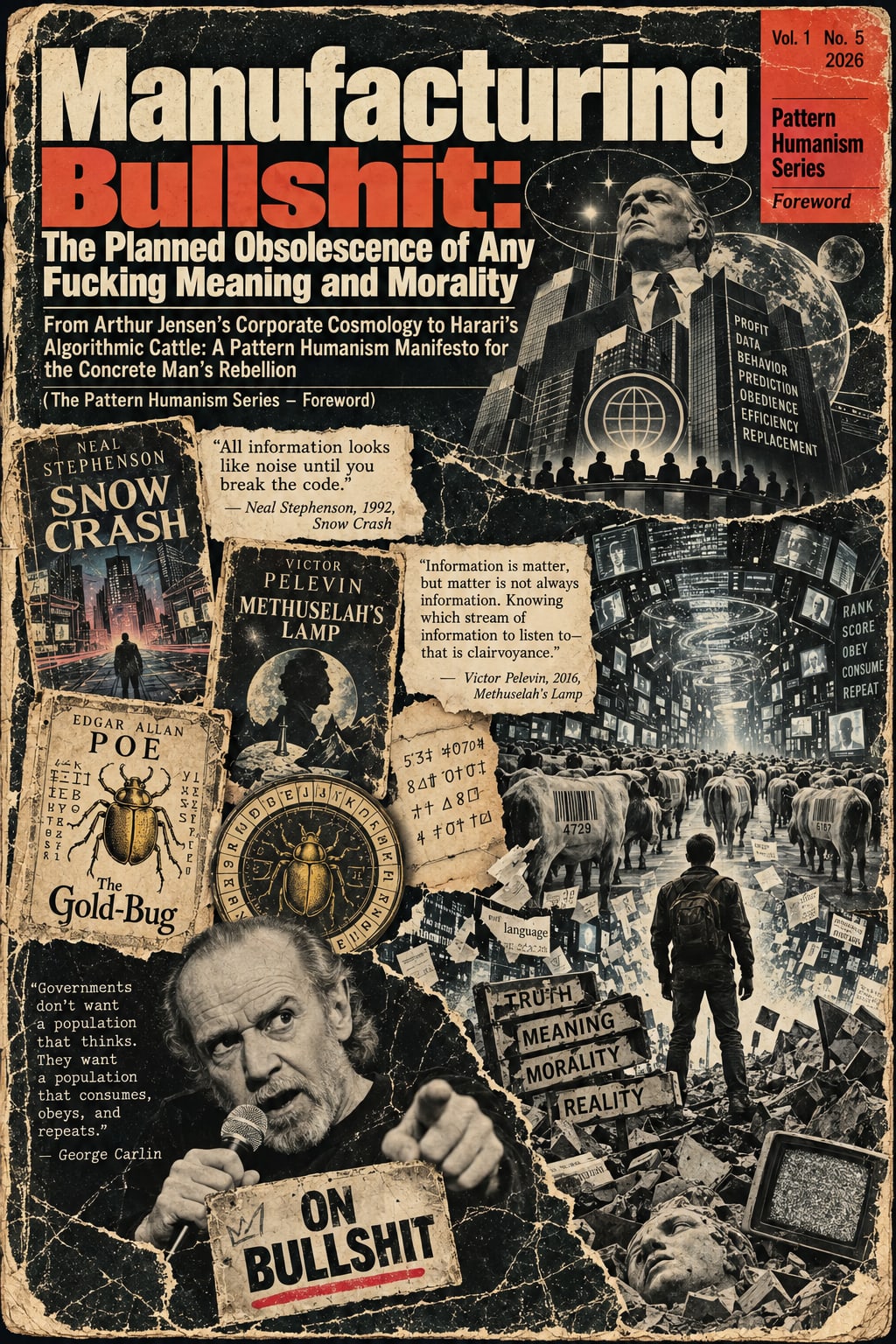
Manufacturing Bullshit: The Planned Obsolescence of Any Fucking Meaning and Morality
From Arthur Jensen’s Corporate Cosmology to Harari’s Algorithmic Cattle: A Pattern Humanism Manifesto for the Concrete Man’s Rebellion (The Pattern Humanism Series-Foreword)

The book "Pattern Humanism: Calibrating the Biological PRM to Trace and Preserve Universal Patterns" is a collection of 46 interconnected philosophical essays exploring the biological origins of cognition, the persistence of informational patterns, artificial intelligence, the constructed Self, and the technologically managed stable decline of modern civilisation.
Ayolov, P. (2026) Pattern Humanism: Calibrating the Biological PRM to Trace and Preserve Universal Patterns. Amazon.
ASIN : B0HNL8WH8J
Abstract
Who possesses the authority to explain the world, and what happens when explanations become instruments for manufacturing reality? Beginning with Arthur Jensen’s corporate sermon in Paddy Chayefsky’s Network (1976), this article examines how financial, political, academic and technological institutions transform partial knowledge of recurrent relationships into claims of universal sovereignty. Against Jensen’s reduction of existence to monetary circulation, Pattern Humanism identifies a wider field of structural regularities manifested through mathematics, beauty, music, love, mythology, storytelling and economic exchange. Edgar Allan Poe’s William Legrand and the cinematic figure of Neo introduce the epistemological problem of recognising hidden organisation beneath familiar appearances, while B. F. Skinner’s behaviourism, Noam Chomsky’s linguistic critique and contemporary Large Language Models expose the distinction between behavioural prediction and moral prescription. George Carlin’s confrontation with euphemism and institutional language subsequently becomes an exercise in critical recognition: the Concrete Man’s right to call bullshit whenever a representation claims authority over the reality it merely describes. Reconsidering Heidegger’s critique of Humanism and Sartre’s existential freedom, the article proposes the Purple Pill as a refusal of both ideological submission and the fantasy of omniscient escape. McLuhan’s externalisation of human memory, Harari’s analogy of algorithmic cattle and Pelevin’s Methuselah’s Lamp lead towards a final historical proposition: technological acceleration need not produce universal integration or revolutionary transformation, but may instead accompany the prolonged deterioration of competing civilisational formations. Pattern Humanism consequently rejects the identification of prediction with destiny. Its purpose is not to calculate an inevitable future, but to recognise, investigate and critically interpret the tendencies through which material and historical relationships continue to develop.
Keywords
Pattern Humanism; Manufacturing Bullshit; Planned Obsolescence of Meaning; Arthur Jensen; Network; Paddy Chayefsky; Edgar Allan Poe; The Gold-Bug; Ratiocination; The Matrix; B. F. Skinner; Skinner Paradox; Noam Chomsky; Large Language Models; George Carlin; Philosophy of Language; Concrete Man; Martin Heidegger; Jean-Paul Sartre; Purple Pill; Marshall McLuhan; Externalised Memory; Yuval Noah Harari; Algorithmic Cattle; Victor Pelevin; Methuselah’s Lamp; Samuel Huntington; Francis Fukuyama; Neal Stephenson; Civilisational Fragmentation; Perpetual Stable Decay; Pattern Recognition.
Introduction: You Have Meddled with the Primal Forces of Nature, Mr Beale!
“The world is a college of corporations, inexorably determined by the immutable bylaws of business.”
Paddy Chayefsky, 1976, Network
In the dark corporate Valhalla of Sidney Lumet’s Network (1976), Arthur Jensen summons the television prophet Howard Beale to explain a universe whose organisation supposedly exceeds the comprehension of ordinary human beings. The room darkens, the executive rises, and the language of international finance suddenly acquires the terrifying authority of a religious revelation. Dollars, petrodollars, roubles, pounds and shekels become the elementary particles of an invisible cosmos, moving through international transactions according to an ebb and flow Jensen describes through the imagery of tidal gravity. Nations, political loyalties, democratic institutions and ideological confrontations dissolve into the larger circulation of monetary power. Capitalism and communism become superficial distinctions within an encompassing architecture of calculation; political leaders cease to appear as sovereign historical actors and become administrators of arrangements whose operations transcend the vocabulary through which their populations understand the world. Jensen has apparently achieved an extraordinary intellectual transformation: he can see the relationships that others cannot, and because he recognises their operation, he believes himself entitled to explain the ultimate meaning of existence. His corporate sermon culminates in a promise of universal tranquillity, a planetary holding company capable of eliminating conflict by organising the economic purposes of everybody within a common system of consumption, employment and managed satisfaction. But Jensen’s revelation contains an immense philosophical fraud. He has discovered the power of interconnected relationships and immediately confused their particular financial manifestation with the fundamental constitution of reality. His corporate cosmology does not reveal the primal forces of nature; it appropriates their language to confer metaphysical authority upon a temporary historical arrangement. The circulation of money is real, but money did not invent circulation.
Financial systems depend upon relationships of exchange, expectation, scarcity, obligation, communication and trust that cannot be reduced to the currencies through which particular societies organise them. Nor do these relationships exhaust the forms of organisation through which existence becomes recognisable. A musical composition discloses recurrence, interval, contrast and variation without becoming a financial transaction; a painting can generate beauty through asymmetry and dissonance without corresponding to an economic equilibrium; a myth preserves arrangements of memory, conflict and transformation across generations; a story acquires recognisable architecture through the relationships between characters, events, expectation and consequence; and love emerges through embodied attachments whose emotional reality cannot be replaced by a statistical description of interpersonal behaviour. These phenomena are neither identical substances nor interchangeable currencies, yet each reveals relational structures that can recur through different circumstances without belonging exclusively to their present manifestations. The profound mistake is to elevate one form of organisation into the sovereign explanation of all others. Jensen's supposedly universal revelation is therefore a magnificent demonstration of how an institution manufactures bullshit: it identifies a genuine relationship, surrounds it with the language of inevitability, suppresses the limits of its own perspective and finally presents its interpretation as the natural order of existence.
The question arising from this spectacle is not simply whether Jensen is lying, because the most effective forms of manufactured authority rarely depend upon propositions that are entirely false. They depend upon the selective arrangement of recognisable truths into explanatory systems whose authority exceeds the evidence supporting them. Jensen correctly perceives that economic transactions connect otherwise distant institutions, that individual intentions cannot determine every consequence of collective organisation, and that political rhetoric frequently conceals relationships operating beneath its declared purposes. His error begins when the instrument through which he recognises those relationships becomes indistinguishable from the reality being recognised. The financial network is transformed into the architecture of existence, and the executive who possesses privileged knowledge of its operation becomes a self-appointed interpreter of universal necessity. Who, then, has the ability to see what Jensen claims to see? More importantly, what distinguishes the recognition of an actual relationship from the manufacture of an imaginary explanation? The human organism has evolved remarkable capacities for distinguishing recurrence from variation, anticipating environmental changes, recognising faces and voices, remembering sequences, interpreting movements and coordinating action through accumulated experience. Such capacities make survival possible, but they also create the conditions for extraordinarily elaborate mistakes. The observer who identifies a recurring arrangement may imagine a hidden intention behind it; the institution that discovers a useful correlation may proclaim an immutable law; the political movement that recognises a historical resemblance may mistake the resemblance for proof of an inevitable future. Even the language of scientific explanation can become a machinery of unwarranted certainty when the success of a particular model is confused with comprehensive knowledge of the processes it represents. The danger intensifies when the same institutions capable of describing behaviour acquire the technological means to influence it, manufacturing the circumstances under which their predictions become increasingly plausible.
The corporation studies desire and reorganises its commercial environment; the political apparatus classifies populations and subsequently governs through those classifications; the digital platform measures attention while continuously altering the informational conditions under which attention is distributed. Recognition becomes intervention, intervention modifies the relationships being recognised, and the institution mistakes the increasing compatibility between its models and their consequences for confirmation of its supposedly superior understanding. Yet the concrete individual living within these arrangements does not disappear merely because his actions have become measurable. His existence remains biological, historically situated, sensorially immediate and irreducible to the administrative representations produced in his name. Neither the grammatical abstraction called Humanity nor the institution claiming to act on its behalf possesses the eyes, nervous system or lived experience through which recognition actually occurs. This is where Pattern Humanism separates itself from Jensen's corporate theology. Its purpose is not to discover another universal proprietor of existence, to replace financial determinism with mathematical mysticism, or to promise that sufficiently sophisticated intelligence will eventually calculate every consequence of human action. It begins with the more difficult task of distinguishing observable organisation from the representations through which that organisation is described, predicted, exploited and occasionally misunderstood. Before anyone claims to possess the future, there is a more fundamental problem: how can an individual learn to recognise the structures concealed beneath familiar appearances without mistaking the resulting knowledge for mastery over the world? That question leads beyond Jensen's boardroom, towards a cryptogram hidden in an old parchment and a man who suddenly sees the code behind the visible world.
Part I: The Eyes That See the Matrix: From Jensen’s Corporate Vision to Poe’s Ratiocination and Neo’s Code
“The solution is by no means so difficult as you might be led to imagine from the first hasty inspection of the characters.”
Edgar Allan Poe, 1843, The Gold-Bug
The most disturbing feature of Arthur Jensen’s corporate revelation is not that he possesses an exceptionally sophisticated understanding of international finance, but that his knowledge becomes a form of power over those who cannot recognise the relationships through which their lives are organised. Howard Beale sees political nations, public institutions, ideological conflicts and the apparent freedom of individual choice; Jensen sees flows of capital, networks of dependency, exchanges of ownership and mechanisms through which human conduct can be translated into economic transactions. One man observes the visible furniture of civilisation, while the other claims to recognise the invisible architecture holding it together. This difference makes Jensen dangerous, since the capacity to understand how something functions also creates opportunities to influence those who understand only its appearances. He can sell things to men and men to things because he recognises the relations between desire, information, representation and exchange, while the individuals participating in those relations ordinarily encounter them as separate experiences. A consumer perceives an attractive product rather than the elaborate machinery producing its desirability; an employee recognises a salary rather than the complete network of financial obligations determining its value; a citizen encounters a political decision without necessarily perceiving the economic dependencies shaping its formulation. Yet Jensen's superiority remains relative, not absolute. He understands particular arrangements through institutional access, accumulated knowledge and a specialised vocabulary whose explanatory authority cannot be extended without qualification to the entirety of existence.
The distinction becomes clearer through Edgar Allan Poe's The Gold-Bug (1843), where William Legrand encounters an apparently insignificant parchment whose obscure markings conceal a cryptographic message. What initially appears accidental becomes intelligible through a disciplined investigation of relationships between signs. Legrand examines recurring characters, identifies their relative frequencies, considers the structural organisation of language and reconstructs an encrypted sequence that would remain meaningless to someone treating its symbols as unrelated marks. His remarkable discovery depends not upon possessing supernatural knowledge but upon refusing the assumption that the immediately visible exhausts the intelligible. The crucial difference between Legrand and Jensen emerges in their treatment of evidence. Legrand eventually reveals the reasoning behind his solution, allowing the apparent miracle to become an examinable procedure; Jensen demands recognition of a system whose ultimate authority he simply declares. Legrand's method is fallible, reproducible and open to correction, while Jensen's pronouncement attempts to make disagreement appear equivalent to ignorance of reality itself. This opposition reveals a fundamental distinction between recognising organisation and manufacturing authority from the recognition. A successful interpretation identifies relationships capable of explaining observations that previously appeared disconnected; an ideological interpretation begins to exceed its evidence when it presents the resulting explanation as the only possible account of existence. Neither money nor a cryptogram discloses its organisation merely because someone looks at it. Seeing requires distinctions, comparisons, memory, inference and the willingness to revise an interpretation when details resist it. The extraordinary significance of Legrand's achievement is therefore methodological rather than mystical: he demonstrates that what appears unintelligible may become understandable without ceasing to be materially ordinary. The parchment contains no revelation addressed to an exceptional soul. Its characters acquire meaning through relationships that can be reconstructed by an embodied observer capable of distinguishing a meaningful sequence from accidental variation. The treasure is almost secondary to the intellectual operation that makes its discovery possible. The greater discovery is the existence of an intelligible structure beneath a seemingly arbitrary arrangement of signs.
The cinematic imagination would eventually transform this act of decipherment into one of the defining visual experiences of the digital age. In The Matrix (1999), Neo initially encounters a world whose objects, environments and inhabitants appear as naturally given as those of ordinary experience. Buildings possess solidity, bodies experience pain, movements obey familiar physical expectations, and the apparent continuity of everyday life conceals the computational processes generating the simulation. When Neo finally perceives the cascading numerical and symbolic structures beneath its rendered appearances, the familiar world does not simply vanish; its mode of intelligibility changes. The visible object becomes recognisable as the result of operations previously hidden by the interface. A wall is no longer merely a wall, and an approaching bullet no longer possesses the unquestionable authority of an independently existing physical event within that simulated environment. Yet this cinematic revelation must be distinguished from the claim that the physical universe is itself generated by computer instructions. Neo discovers executable code because his fictional world is an engineered simulation; nothing in the success of mathematical physics establishes that material existence possesses the same architecture. What the scene makes philosophically valuable is the distinction between encountering an appearance and investigating the processes responsible for its production. Legrand deciphers a deliberately encrypted message, while Neo recognises an artificial environment whose familiar surfaces conceal another level of organisation. Jensen, by contrast, interprets actual financial relationships through a conceptual system that has become so encompassing that he cannot distinguish its historical limitations from the supposed necessities of nature. The three figures therefore disclose different possibilities of intellectual sight. One discovers a concealed message through evidence; another acquires extraordinary perceptual access within a fictional computational world; the third converts privileged institutional knowledge into a claim of universal authority. These differences matter because contemporary technological culture increasingly invites observers to confuse the power of representation with the possession of what is represented.
A mathematical model can reproduce the behaviour of a physical process without becoming that process; a financial simulation can anticipate certain transactions without acquiring control over every circumstance influencing them; and a computational system can identify correlations among millions of recorded actions without exhausting the lived experiences from which those records originated. The genuine achievement lies in detecting relationships that survive changes of description, scale or observational position, while recognising that every method reveals some aspects of a phenomenon and conceals others. The most sophisticated observer is consequently not necessarily the one who claims to see everything, but the one who understands why any particular form of seeing remains incomplete. Legrand's success depends upon interpreting evidence rather than commanding it; Neo's exceptional powers depend upon the specific computational rules of the world he inhabits; Jensen's authoritarian confidence begins where his willingness to distinguish interpretation from reality ends. Nor does recognition require isolation from every other human being or rejection of accumulated knowledge. The decipherer inherits language, symbolic conventions and intellectual procedures developed through collective history, even when the act of interpretation occurs within one particular nervous system. Intellectual independence means refusing to surrender judgement, not pretending that judgement originates without cultural experience. Nevertheless, once recurrent relationships become intelligible, another temptation appears: if an observer can identify the organisation of previous events, might it become possible to calculate what will happen next? And if future conduct becomes sufficiently predictable, who acquires the authority to decide which actions should occur? The question carries us from Poe's parchment and Neo's digital vision into the experimental laboratory of B. F. Skinner, where the capacity to anticipate behaviour becomes inseparable from the possibility of deliberately shaping it.
Part II: The Skinner Paradox: The Predictable Future and the Unpredictable Morality of Human Behaviour
“A self is a repertoire of behavior appropriate to a given set of contingencies.”
B. F. Skinner, 1971, Beyond Freedom and Dignity
The extraordinary promise of recognising recurrent relationships is that the future becomes partially intelligible before it occurs. The cryptogram deciphered by William Legrand reveals a message concealed within apparently meaningless marks; Neo's recognition of computational rules allows him to anticipate events within an artificial environment; Arthur Jensen's knowledge of financial relationships permits him to calculate consequences that remain invisible to those participating in the same economic system. But the movement from recognising what has happened to anticipating what may happen introduces a fundamental philosophical danger. Once behaviour becomes predictable, prediction itself can be transformed into an instrument for producing the behaviour it anticipates. Few twentieth-century thinkers explored this possibility more systematically than B. F. Skinner, whose experimental analysis of operant conditioning challenged the inherited assumption that human action must originate from an autonomous interior agent standing apart from its biological and environmental history. For Skinner, conduct emerges through relationships between organisms and their surroundings, shaped by reinforcement, punishment and the accumulated consequences of previous actions. A person does not necessarily repeat an action because an independent metaphysical Self has freely selected it from an unlimited universe of possibilities; the probability of repetition depends partly upon the conditions under which comparable actions previously occurred.
Skinner's Walden Two, published in 1948, imagined a community organised around the deliberate design of such conditions, while his subsequent work transformed behavioural analysis into a controversial philosophy of social organisation. The disturbing implication was not that human beings had suddenly become machines, but that much of what societies describe as autonomous choice could be investigated through observable relationships. Nevertheless, the very success of such investigation reveals a problem that may be formulated as the Skinner Paradox, although it is a critical extension of behaviourism rather than a proposition explicitly advanced by Skinner himself. The ability to anticipate an action does not establish the desirability of the action anticipated, and the capacity to engineer its occurrence does not confer moral authority upon the engineer. A system might reliably produce obedience, conformity, consumption, aggression or apparent happiness without demonstrating that these outcomes constitute a good human life. Nor can their eventual moral interpretation be calculated from present behavioural regularities alone, since moral judgements emerge within changing relationships of cultural expectation, social conflict, historical circumstance and individual experience. Conduct condemned in one historical environment may be celebrated in another; an intervention justified as benevolent may subsequently become an instrument of oppression; and a supposedly irrational refusal may retrospectively appear as the decisive act of resistance. This uncertainty does not make ethical reasoning impossible. It establishes that the description of recurrent behaviour and the justification of its deliberate production are different intellectual operations. Knowledge of what people are likely to do cannot independently establish what they ought to be made to do. The political danger begins when an institution treats the first achievement as sufficient authority for the second. Jensen's imagined financial universe is a social laboratory on an immense scale: once the governing relationships are understood, the population can supposedly be organised according to their demands. Yet a predictable society is not necessarily a desirable one, and the absence of visible resistance may indicate successful conditioning rather than genuine satisfaction.
The confrontation between Skinner and Noam Chomsky transferred this problem into language, the medium through which human beings describe their actions, construct identities and justify authority. In Verbal Behavior (1957), Skinner attempted to analyse linguistic activity through behavioural principles, treating speech as conduct shaped by environmental histories and social consequences. Chomsky's influential 1959 review challenged the explanatory adequacy of this approach, particularly its difficulty accounting for the creative production and comprehension of sentences never previously encountered. Their disagreement became emblematic of a larger intellectual division between explanations emphasising learned relationships and those investigating the internal computational organisation of linguistic competence. Chomsky's subsequent research developed the argument that human language involves specialised structural capacities not adequately explained through imitation, frequency or external reinforcement alone. The rise of Large Language Models has complicated this historical opposition in a way neither participant could have anticipated. Systems trained upon immense quantities of recorded language can generate novel sentences, sustain complicated discussions, translate between languages and reproduce forms of argument without possessing human developmental histories or being supplied with a complete explicit grammar of each language they use. Such achievements demonstrate the remarkable productive capacities of statistical learning, although they do not prove that biological language acquisition follows the same procedures or that Skinner's original theory has been vindicated in its entirety. Contemporary neural architectures are not simply electronic versions of operant conditioning, and the ability to generate fluent discourse does not settle questions about consciousness, embodied understanding or linguistic competence. Their philosophical importance lies instead in the industrial separation of sophisticated verbal performance from the biological speaker once assumed indispensable to its production. Language becomes something that can be statistically reconstructed, personalised and distributed at a scale inaccessible to ordinary human communication. The consequences become more disturbing when the generated words are incorporated into environments designed to modify conduct. Digital platforms already organise visibility, attention and commercial exposure through algorithms informed by recorded behaviour; generative systems extend these capabilities by producing increasingly adaptable messages, recommendations, explanations and synthetic interlocutors.
The technology does not merely observe what an individual reads or desires; it may participate in arranging what the individual subsequently encounters, thereby influencing the conditions under which further preferences develop. Prediction and intervention enter a continuous relationship in which the apparent accuracy of the model may partly reflect the environment constructed around its expectations. This is the modern extension of Jensen's corporate ambition: not simply selling products to people, but organising the informational circumstances through which people become increasingly receptive to what institutions intend to sell. Yet the machine cannot establish the moral legitimacy of those intentions merely by predicting their success. Even highly accurate forecasts remain conditional upon the relationships from which they were inferred, while changing those relationships can alter the outcomes themselves. The distinction is therefore not between an unknowable future and an absolutely calculable one, but between the provisional recognition of tendencies and the authoritarian conviction that their continuation ought to be enforced. Artificial intelligence may substantially enlarge the first capacity while making the second temptation more dangerous. The most consequential question is no longer whether a machine can generate convincing language or anticipate certain actions, but whether its fluency and predictive usefulness will permit institutions to manufacture the explanations through which their control appears natural, beneficial and inevitable. To confront that possibility requires something more immediate than another theory of linguistic competence. It requires an ability to recognise when apparently respectable language has ceased to explain reality and begun to conceal the interests of those producing it. That is where George Carlin enters the philosophical argument.
Part III: The Concrete Man’s Right to Call Bullshit: George Carlin as a Philosopher of Language
“I don't like words that conceal reality.”
George Carlin, 1990, Doin' It Again
The most effective bullshit does not necessarily consist of lies. A lie preserves a relationship with truth because the liar must recognise, at least provisionally, what is being concealed; bullshit operates more insidiously by transforming the relationship between language and reality into a matter of rhetorical convenience. Harry Frankfurt's philosophical examination of this distinction provides an indispensable starting point for understanding how contemporary institutions manufacture explanations whose persuasive authority bears little necessary relationship to their descriptive accuracy. The corporate executive does not always need to falsify an economic relationship; he can surround selected observations with a vocabulary of inevitability until their historical contingency disappears. The political administrator need not deny the suffering produced by an institutional decision; he can rename the suffering through procedures, efficiencies, adjustments and unfortunate consequences until the original experience becomes almost impossible to identify. The academic specialist need not deliberately misrepresent a phenomenon; an elaborate conceptual apparatus may gradually acquire greater institutional significance than the material relationships it was developed to explain. The most extraordinary achievement of this machinery is that the resulting language frequently appears more respectable precisely because it has become less recognisable to those whose lives it describes. George Carlin understood this transformation with a precision that justifies taking his performances seriously as exercises in philosophy of language. His celebrated attack upon soft language was not merely a comedian's preference for obscenity over politeness, but an investigation of how euphemism can alter the perceived seriousness, visibility and emotional consequences of an event. His movement through successive historical expressions for combat-related psychological trauma dramatized the possibility that increasingly technical descriptions might acquire administrative legitimacy while distancing ordinary listeners from the immediate reality of suffering. The argument was satirical rather than a comprehensive history of psychiatric classification; nevertheless, its philosophical significance is considerable.
Language does not simply transmit independently constituted information into passive minds. Its categories direct attention, organise distinctions, establish acceptable explanations and influence which aspects of experience become publicly available for recognition. Carlin's particular achievement was to expose the discrepancy between the institutional expression and the concrete event without pretending that language itself could be abolished. His profanity mattered because it violated the expectation that respectable subjects must be discussed through respectable vocabularies. By refusing that convention, he revealed how much of institutional authority depends upon the listener's willingness to accept an established register as evidence of intellectual or moral superiority. In this respect, Carlin becomes an unexpected counterpart to William Legrand. The decipherer examines apparently arbitrary symbols until their concealed organisation becomes intelligible; the comedian examines apparently meaningful expressions until the assumptions concealing their actual operation become visible. Both depend upon an alertness to recurrence, omission, substitution and incongruity. Both discover that the ordinary surface of a message may be profoundly misleading. But Carlin's target is not a secret deliberately encrypted within parchment. It is the publicly accessible language of institutions whose most successful concealments operate in plain sight. Arthur Jensen proclaims that the international circulation of money has abolished the political meaning of nations, while preserving the privilege of those claiming to understand that circulation. Carlin's hypothetical interruption would begin with a much simpler demand: who benefits from this explanation, and why should its vocabulary be accepted as the final description of reality?
The arrival of generative artificial intelligence gives this linguistic problem an unprecedented industrial dimension. Earlier institutions depended upon human labour to produce the reports, advertisements, political speeches, educational materials, technical documents and ceremonial declarations through which their authority was continually reproduced. Contemporary systems can generate enormous quantities of grammatically sophisticated text at relatively low marginal cost, adapting terminology, tone and argumentative form to different audiences without requiring a separate human writer for every variation. The significance of this development is not that all machine-generated language is false, meaningless or necessarily indifferent to truth. Such systems can produce useful explanations, identify errors, reorganise difficult material and assist genuine intellectual investigation. The danger arises when the appearance of linguistic competence becomes sufficient to secure acceptance, while the procedures required to establish correspondence with evidence are treated as inconvenient obstacles to production. A fabricated legal precedent can resemble an authentic citation; a nonexistent historical event can acquire the texture of scholarly narration; a corporate justification can be rewritten into countless reassuring forms without altering the interests it serves. Fluency, previously constrained by the limited labour available to manufacture it, becomes almost infinitely reproducible. The resulting problem is not simply misinformation, since information can be false without being structurally indifferent to verification. It is the progressive separation of persuasive expression from responsibility for what expression claims. A corporation can manufacture reassuring language about practices it does not intend to change; an institution can continuously reproduce the vocabulary of participation while systematically restricting meaningful participation; and a political apparatus can generate personalised explanations that transform contradictions into differences of audience preference. The biological individual confronting this environment encounters an extraordinary paradox. His evolved capacities for recognising linguistic coherence, conversational intention and socially familiar explanations remain indispensable to ordinary communication, yet those same capacities can be exploited by systems capable of reproducing the outward appearance of credibility without an accountable speaker standing behind every sentence.
The appropriate response is neither a romantic rejection of technological mediation nor the assumption that human authors are naturally truthful. Human history contains more than enough evidence of deliberate deception and elaborate intellectual fraud before computers began generating sentences. What changes is the scale and speed at which plausible expressions can circulate, together with the difficulty of identifying responsibility when their production becomes distributed across models, organisations and automated infrastructures. Here Carlin's linguistic rebellion acquires a new purpose. To call bullshit is not to exercise an arbitrary right to dismiss disagreeable propositions, nor to substitute suspicion for investigation. It is to recognise a recurring discrepancy between the authority claimed by a description and the evidence offered in its support. The refusal begins with questions that remain intelligible without specialised credentials: what does this expression conceal, which relationships does it describe, what assumptions make the argument appear inevitable, and what observations would demonstrate that it is mistaken? The Concrete Man is not liberated by memorising every possible deception, an undertaking as impossible as mastering every technical discipline. He becomes intellectually less dependent when he learns to recognise how manufactured explanations operate. This capacity does not make him immune to error, but it prevents the polish of institutional language from functioning as an automatic substitute for justification. Carlin's greatest philosophical contribution may therefore be the restoration of an elementary distinction increasingly obscured by the machinery of linguistic production: the sophistication of an explanation is not evidence of its truth, and the social authority of its speaker does not determine the reality of what it describes. The right to call bullshit is ultimately the right to refuse this substitution, even when the entire surrounding civilisation has learned to mistake it for knowledge.
Part IV: The Purple Pill: Heidegger, Sartre, Carlin and the Humanist Matrix
“Thinking does not become action only because some effect issues from it or because it is applied.”
Martin Heidegger, 1946, Letter on Humanism
What if the greatest obstacle preventing the individual from recognising the organisation of existence is not ignorance, insufficient education or technological backwardness, but the very philosophical tradition claiming to place the human being at the centre of reality? Humanism presents itself through competing historical forms: Renaissance cultivation, Enlightenment rationalism, liberal individualism, secular emancipation, existential freedom and the defence of universal human dignity. These traditions cannot be reduced to a single doctrine, still less to a coordinated machinery of deception. Nevertheless, they share a recurring danger whenever the concept of Humanity acquires the apparent characteristics of an independent subject possessing collective intentions, interests, rights and historical purposes. A word originally employed to designate living individuals gradually becomes an abstract protagonist capable of speaking on their behalf, demanding sacrifices and determining what their existence ought to mean. The grammatical transformation appears innocent: Humanity progresses, Humanity suffers, Humanity discovers, Humanity must be saved. Yet no such organism walks, remembers, desires, experiences pain or recognises anything. These activities occur through particular bodies, situated in specific environments, whose existence cannot be exhausted by the descriptions through which institutions classify them. Jean-Paul Sartre's Existentialism Is a Humanism, presented as a lecture in 1945 and published in 1946, attempted to defend human freedom against deterministic conceptions of existence. His insistence that human beings become what they make of themselves challenged the reduction of individual life to predetermined essence. Yet the existential freedom of the individual also carried the burden of responsibility before others, since choices could be understood as proposing images of what human existence ought to become. Martin Heidegger's Letter on Humanism, written in 1946, approached the problem from a different direction. Against the assumption that philosophy must begin by establishing an authoritative definition of Man, Heidegger questioned whether inherited humanist categories had already restricted the possibility of thinking the relationship between human existence and Being. His critique did not simply replace humanism with hostility towards human beings; it challenged the metaphysical assumptions through which the human had been made the measure of philosophical inquiry.
Pattern Humanism approaches this disagreement from another direction. The issue is not whether individual existence should be celebrated or condemned, nor whether philosophical language can finally disclose an authentic essence concealed beneath modern culture. It is whether any conceptual representation of Man can legitimately acquire priority over the finite organism whose existence makes representation possible. The abstraction becomes dangerous precisely when it begins to govern the individual through institutions claiming to know what Humanity requires. Political ideology can convert a statistical population into a historical subject; religion can transform particular experiences into universal spiritual obligations; corporate management can identify a collective interest with organisational efficiency; and technological administration can treat behavioural classification as a comprehensive account of the persons classified. Each arrangement may contain genuine observations and practical achievements. Its intellectual failure begins when its categories cease to remain open to examination and acquire the authority of an unquestionable reality. In this restricted but consequential sense, Humanism is the Matrix: not because every humanist thinker sought to deceive humanity, but because an inherited conceptual interface can become so familiar that its inhabitants mistake the representations displayed within it for the conditions of existence themselves.
The metaphor of the Purple Pill proposes a different response from either comfortable submission or the fantasy of absolute escape. In The Matrix, the blue pill preserves the familiar world, while the red pill promises access to the reality concealed behind its appearances. The imagined mixture refuses the completeness of both alternatives. The individual cannot remain intellectually independent by accepting every institutional explanation, yet neither can he emerge from language, embodiment, historical experience and mediated perception into an impossible position of pure observation. His nervous system does not possess a privileged aperture through which the unfiltered universe becomes immediately available. Recognition depends upon distinctions, expectations, memories, inherited symbols and the continuing comparison between descriptions and experience. Every apparent revelation therefore remains susceptible to correction. This is also why the alternative to conventional humanist abstraction cannot consist in proclaiming another universal essence of Man, even one described through biological cognition rather than spiritual autonomy. The Concrete Man is not a new metaphysical sovereign replacing the old philosophical Self. He is a mortal organism whose recognition of recurring relationships remains partial, contingent and inseparable from material conditions. George Carlin enters this dispute not because he supplied a comprehensive ontology superior to Heidegger's or a theory of freedom more systematic than Sartre's, but because his public practice of linguistic criticism demonstrates a capacity insufficiently appreciated by institutions that equate philosophical seriousness with specialised vocabulary. Carlin exposed the distance between official descriptions and ordinary experience by examining what familiar expressions permitted their speakers to conceal. His method did not require the discovery of an immaculate language existing outside society. He turned the existing language against its own pretensions, allowing its contradictions, substitutions and evasions to become perceptible. That operation supplies the practical dimension of the Purple Pill. To step outside the Humanist Matrix is not literally to abandon every tradition through which human existence has been interpreted. It is to withdraw the automatic authority granted to those traditions, treating their concepts as historically produced instruments rather than final accounts of reality. Sartre's freedom can be investigated without accepting every implication of existentialist humanism; Heidegger's critique can disclose conceptual limitations without establishing that his own terminology escapes them; and Carlin's irreverence can challenge linguistic authority without making every provocation a philosophical discovery. What matters is the ability to recognise when a representation has become insulated against the very experience it claims to explain.
The individual does not need to overthrow a language, abolish an institution or deny the usefulness of collective knowledge to begin this operation. He needs to recover the possibility of refusing an interpretation, comparing it with evidence and identifying the interests concealed within its apparent necessity. Such independence does not eliminate cooperation or the transmission of knowledge between individuals. No organism develops intellectual capacities without participating in relationships beyond itself; even solitary reflection employs inherited words, distinctions and procedures. The question concerns the authority assigned to those inheritances. A civilisation may preserve knowledge through institutions while simultaneously allowing their classifications to harden into intellectual monopolies. It may proclaim individual freedom while requiring every person to recognise himself through approved accounts of what Humanity supposedly is. And it may construct increasingly sophisticated technologies of communication while narrowing the range of interpretations considered legitimate. The Purple Pill consequently offers no final escape from representation, no guarantee of liberation and no permission to dismiss evidence whenever it becomes inconvenient. Its significance is the persistent refusal to confuse an explanatory interface with the world it organises for perception. But another difficulty remains. If nobody can know everything, how can individual judgement resist the specialised authorities upon which modern life necessarily depends? The answer cannot be found in the fantasy of an encyclopaedic mind. It requires reconsidering why human knowledge was externalised in the first place, and whether the inability to comprehend an entire system truly condemns the individual to obedience before those claiming to understand it. That question leads from philosophical Humanism to Marshall McLuhan's technological extensions, and ultimately to the unsettling image of human beings transformed into cattle by the financial machinery of artificial intelligence.
Conclusion: Methuselah’s Lamp and Harari’s Cows: The Future That Refuses to Arrive
“Media, by altering the environment, evoke in us unique ratios of sense perception.”
Marshall McLuhan and Quentin Fiore, 1967, The Medium is the Massage
The final deception manufactured by contemporary civilisation is the assumption that the growing complexity of knowledge has made the individual human being intellectually obsolete. Yuval Noah Harari illustrates this possibility through an unsettling comparison between an animal whose fate is determined by economic relationships it cannot comprehend and a future population governed by artificial intelligence systems whose operations exceed ordinary human understanding. A cow transported through an international marketplace cannot understand the financial transactions determining its destination; perhaps tomorrow's citizens will occupy an analogous position before autonomous financial infrastructures. The analogy is provocative, but it contains a concealed historical assumption. When, exactly, did the Concrete Man ever possess complete knowledge of the economic system governing his existence? Could an ancient farmer comprehend the imperial taxation network determining his obligations, a medieval merchant reconstruct the commercial relationships extending beyond his geographical horizon, or an industrial worker explain every scientific principle incorporated into the machinery surrounding him? Can the contemporary physician command the entirety of medical knowledge, the musician retain every composition, the historian remember every surviving document, or the physicist independently reproduce every experiment upon which modern theoretical understanding depends? The answer has always been negative, and this limitation did not begin with artificial intelligence. Marshall McLuhan understood that communication technologies are not simply instruments transporting information between otherwise self-sufficient minds. They extend and reorganise human perception, memory and intellectual activity, allowing particular organisms to participate in arrangements vastly exceeding their unaided capacities. Writing preserves relationships after the disappearance of their original observers; numerical notation externalises calculation; musical scores separate compositions from particular performances; scientific instruments disclose physical processes inaccessible to ordinary perception; libraries accumulate intellectual work across generations; and computation renders enormous quantities of recorded material available for comparison and transformation. Manuel Castells subsequently described the emergence of a network society whose economic and cultural organisation increasingly depends upon informational infrastructures transcending conventional territorial boundaries. Yet technological interconnectedness does not automatically produce comprehensive understanding or political unity.
Neal Stephenson's Snow Crash imagines a world in which governmental authority fragments into commercial jurisdictions, territorial enclaves and internationally reproducible franchises. The fictional environment bears affinities to McLuhan's Global Village while exposing a contrary possibility: increasingly integrated communication may coexist with increasingly fragmented political sovereignty. The same technologies facilitating exchange across borders can reinforce cultural separation, institutional dependency and competing structures of authority. Here Samuel Huntington's civilisational argument deserves reconsideration alongside Francis Fukuyama's account of the end of ideological history. Fukuyama had studied under Huntington, but their contrasting interpretations of the post-Cold War world illuminate an unresolved historical question: does technological and economic integration gradually produce a universal political condition, or does it intensify the survival of larger cultural formations whose conflicts cannot be settled through shared commercial infrastructure? Pattern Humanism proposes that the second possibility deserves attention without accepting the precise number, geographical permanence or supposed internal homogeneity of Huntington's civilisations. The future may consist of seven or more large zones of cultural, linguistic, financial and economic circulation, maintaining extensive exchanges while periodically confronting one another along unstable borders. Universal technological integration might therefore fail to become universal civilisation. Nor must its failure produce a spectacular global collapse. The institutions of the contemporary world could instead survive through continuous adaptation, administrative substitution and prolonged deterioration. Nations may disappear, merge or lose substantive sovereignty while larger imperial arrangements continue under changing names and technologies. Empires need not triumph to endure; they may persist by reorganising the conditions of their own decay. What appears revolutionary at the level of machinery may preserve remarkable continuity at the level of power. This is neither the inevitable fulfilment of Huntington's thesis nor the definitive refutation of Fukuyama, but a historically plausible tendency whose actual development remains contingent upon events that no present theory can comprehensively foresee.
And this is why the final image of the argument must be a lamp rather than a prediction machine. Victor Pelevin's Methuselah's Lamp, or The Last Battle of the Chekists and Masons introduces a literary universe of concealed financial relationships, mythological histories, secret organisations and competing explanations of the powers supposedly governing civilisation. Methuselah, the biblical grandfather of Noah, carries the symbolic weight of an existence extending across generations whose inhabitants could never possess identical knowledge of the worlds they experienced. His lamp can therefore be appropriated as a philosophical metaphor for illumination without omniscience. It does not reveal the precise political arrangement of the next century, the outcome of tomorrow's financial transactions or the moral character eventually assigned to actions not yet performed. It illuminates relationships through which seemingly disconnected events become intelligible: recurrence beneath historical variation, continuity beneath institutional transformation, dependency beneath political independence, and the persistence of organisational structures despite the disappearance of their temporary representatives. To recognise a tendency is not to possess a prophecy. A recurrent relationship may help explain why some developments appear more plausible than others, but its future manifestation remains subject to changing conditions, unexpected interventions and consequences whose eventual moral interpretation cannot be determined merely by calculating their probability. The facts themselves remain indispensable, because without observations capable of contradicting an interpretation, the alleged tendency becomes another manufactured revelation. Education becomes bullshit not when it transmits specialised knowledge, but when its institutional guardians convert the necessary limits of individual expertise into unquestionable authority. Financial modelling becomes bullshit when the ability to describe selected relationships is presented as ownership of the economic order. Political philosophy becomes bullshit when its abstractions demand obedience from the living individuals whose existence supposedly justifies them. And artificial intelligence becomes an instrument of the same manufacture whenever its remarkable capacities for organising information are invoked to declare human judgement obsolete. The lesson connecting Arthur Jensen's corporate sermon, William Legrand's decipherment, Neo's awakening, Skinner's behavioural experiments, Chomsky's linguistic objections, Carlin's assault upon euphemism and the philosophical disputes surrounding Humanism is therefore not that a sufficiently educated individual can finally understand everything. It is that nobody needs comprehensive knowledge to recognise the limitations of an explanation, investigate its underlying relationships and refuse the authority unjustifiably derived from it. The Purple Pill offers no escape from history, no superior species of intelligence and no guarantee against misunderstanding. It offers the continuing possibility of distinguishing an objective relationship from the institutional description claiming to exhaust it. Even prediction is not the ultimate ambition of Pattern Humanism. Its concern lies with recognising tendencies while refusing to transform them into predetermined destinies.
Perhaps there will be no decisive revolution, no universal political reconciliation, no final liberation of Humanity and no technological event capable of abolishing the contradictory organisation of civilisation. Perhaps the world will become more computationally sophisticated while its competing empires continue deteriorating through an indefinitely extended historical spiral. But the lamp cannot guarantee even that conclusion; its purpose is to illuminate the relationships through which such a future becomes conceivable. Arthur Jensen mistook financial circulation for the primal forces of nature. Harari fears that machines may understand future financial systems as incomprehensibly to us as human commerce appears to cattle. George Carlin reminds us that no explanation becomes true merely because its speaker possesses impressive language or formidable authority. The Concrete Man cannot remember the whole world, and he cannot calculate its final destination. He can still examine what is moving beneath its appearances, recognise recurring structures, challenge the people claiming exclusive knowledge of them and refuse to mistake their predictions for commands. Methuselah's lamp does not tell him where history must go. It allows him to see why history might be going somewhere quite different from the destination being advertised. You do not have to predict the future to recognise its tendencies, Mr Jensen. And you do not have to be a cow all the time.
“All information looks like noise until you break the code.”
Neal Stephenson, 1992, Snow Crash
“Information is matter, but matter is not always information. Knowing which stream of information to listen to—that is clairvoyance.”
Victor Pelevin, 2016, Methuselah's Lamp
References
Carlin, G. (1990) Doin’ It Again. Stand-up comedy special. Directed by R. J. Cumming. HBO.
Castells, M. (1996) The Rise of the Network Society. Oxford: Blackwell.
Chayefsky, P. (1976) Network. Screenplay. Film directed by Sidney Lumet. United States: Metro-Goldwyn-Mayer and United Artists.
Chomsky, N. (1959) ‘Review of B. F. Skinner’s Verbal Behavior’, Language, 35(1), pp. 26–58.
Fiore, Q. and McLuhan, M. (1967) The Medium Is the Massage: An Inventory of Effects. New York: Bantam Books.
Frankfurt, H. G. (2005) On Bullshit. Princeton, NJ: Princeton University Press.
Fukuyama, F. (1992) The End of History and the Last Man. New York: Free Press.
Heidegger, M. (1998) ‘Letter on “Humanism”’, in McNeill, W. (ed.) Pathmarks. Cambridge: Cambridge University Press, pp. 239–276.
Huntington, S. P. (1993) ‘The clash of civilizations?’, Foreign Affairs, 72(3), pp. 22–49.
Huntington, S. P. (1996) The Clash of Civilizations and the Remaking of World Order. New York: Simon & Schuster.
McLuhan, M. (1962) The Gutenberg Galaxy: The Making of Typographic Man. Toronto: University of Toronto Press.
McLuhan, M. (1964) Understanding Media: The Extensions of Man. New York: McGraw-Hill.
Pelevin, V. (2016) Лампа Мафусаила, или Крайняя битва чекистов с масонами [Methuselah’s Lamp, or The Last Battle of the Chekists and Masons]. Moscow: Eksmo.
Poe, E. A. (1843) ‘The Gold-Bug’, The Dollar Newspaper, 21 and 28 June.
Sartre, J.-P. (2007) Existentialism Is a Humanism. Translated by C. Macomber. New Haven, CT: Yale University Press.
Skinner, B. F. (1948) Walden Two. New York: Macmillan.
Skinner, B. F. (1953) Science and Human Behavior. New York: Macmillan.
Skinner, B. F. (1957) Verbal Behavior. New York: Appleton-Century-Crofts.
Skinner, B. F. (1971) Beyond Freedom and Dignity. New York: Alfred A. Knopf.
Stephenson, N. (1992) Snow Crash. New York: Bantam Books.
Vaswani, A., Shazeer, N., Parmar, N., Uszkoreit, J., Jones, L., Gomez, A. N., Kaiser, Ł. and Polosukhin, I. (2017) ‘Attention is all you need’, Advances in Neural Information Processing Systems, 30, pp. 5998–6008.
About the Creator
Peter Ayolov
Peter Ayolov’s key contribution to media theory is the development of the "Propaganda 2.0" or the "manufacture of dissent" model, which he details in his 2024 book, The Economic Policy of Online Media: Manufacture of Dissent.
Enjoyed the story? Support the Creator.
Subscribe for free to receive all their stories in your feed.
Comments
There are no comments for this story
Be the first to respond and start the conversation.