
Hephaestus’ Law: It’s Just Human Nature — But Why?
A follow up to “Why History Tells Us Every Invention Should Come with a Warning”.

Introduction
In my previous story I introduced a new adage which I called Hephaestus’ Law. To recap:
“Hephaestus’ Law: Whatever one person discovers or invents for good, another will have the opportunity and motive to exploit for evil.”
“Corollary: Any object can be used or adapted for a purpose contrary to the one for which it was designed, and sooner or later, someone will think of it.”
Hephaestus’ Law describes an uncomfortable truth about human nature. It suggests that the morality of a discovery or invention is ultimately defined not by its creator, but by its consumer.
Academics and engineers have touched on parts of this phenomenon before. In the philosophy of science, it is often referred to as the dual-use dilemma — the clinical recognition that advanced technologies can serve both peaceful and destructive purposes. In engineering, it mirrors the law of unintended consequences . Yet, these traditional frameworks treat technology like an unpredictable weather system, implying that things go wrong simply because systems are complex.
Hephaestus’ Law goes a step further. It is not passive; it is active and moral. It forces us to look past the machine and focus squarely on human agency, highlighting the deliberate transition from good to evil driven by active opportunity and motive.
While I gave three brief examples in my first story, I want to explore a more detailed example here to cement the idea: drones.
Drones
In 1999, the Canadian company Draganfly released the Draganflyer I, widely recognized as the first commercially successful quadcopter drone. It was initially used by researchers and hobbyists before law enforcement and forensic departments recognized its utility. As the attached timeline graphic shows, this simple, benign technology has been radically transformed.
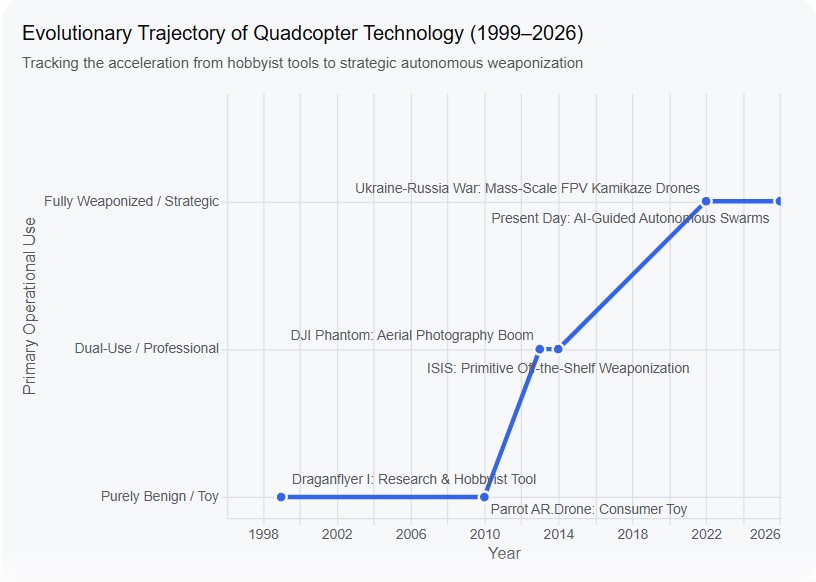
As the graphic shows, only two decades after their commercial launch drones have become standard weapons of war on the battlefield, where rapid improvisation has shifted their utility toward military operations. Beyond their use in warfare, criminals have actively exploited their ability to carry small loads to smuggle drugs into prisons and across borders.
Today, we are seeing the exact same trajectory repeat itself with Artificial Intelligence. Bad actors are already misappropriating, subverting, perverting, hijacking, and weaponizing its extraordinary potential for their own ends.
The Question of Human Nature
Existing concepts tell us what is happening, but they fail to explain why. While scientists call this “dual-use technology,” I believe it points to a deeper, more uncomfortable truth about human nature — what I call Hephaestus’ Law. Why is it inevitable that all things designed for benign purposes will eventually be misappropriated, adapted, or used for selfish and harmful ends?
I am neither a philosopher nor a psychologist, so I do not claim to have the definitive answer. My Christian background leans me toward the biblical narrative of the Fall to explain why human nature is fundamentally flawed or broken.
However, I am genuinely interested in alternative perspectives. If you are irreligious, a humanist, a physicalist, or look at this through the lens of evolutionary biology, I would love to read your thoughts and explanations in the comments below.
Postscript:
This article, like its predecessor, was first published on Medium. If you wish to share Hephaestus’ Law, please link back to this article. Thank you.
About the Creator
Enjoyed the story? Support the Creator.
Subscribe for free to receive all their stories in your feed.
Comments
There are no comments for this story
Be the first to respond and start the conversation.