
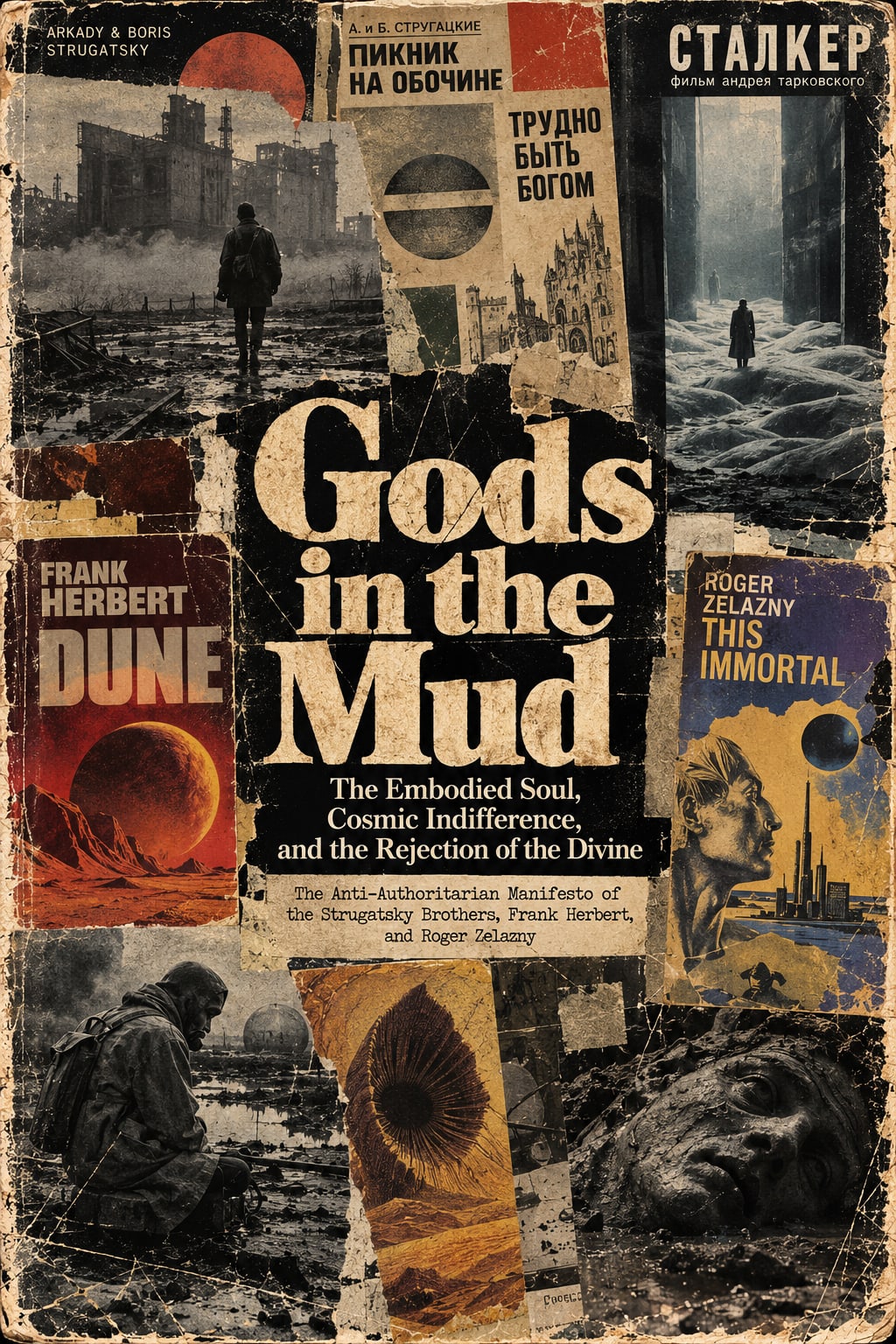
Gods in the Mud: The Embodied Soul, Cosmic Indifference, and the Rejection of the Divine
The Anti-Authoritarian Manifesto of the Strugatsky Brothers, Frank Herbert, and Roger Zelazny (Pattern Humanism Series)

The book "Pattern Humanism: Calibrating the Biological PRM to Trace and Preserve Universal Patterns" is a collection of 46 interconnected philosophical essays exploring the biological origins of cognition, the persistence of informational patterns, artificial intelligence, the constructed Self, and the technologically managed stable decline of modern civilisation.
Ayolov, P. (2026) Pattern Humanism: Calibrating the Biological PRM to Trace and Preserve Universal Patterns. Amazon. B0HNL8WH8J
Abstract
This article examines four landmark works of twentieth-century science fiction—Arkady and Boris Strugatsky’s Roadside Picnic (1972) and Hard to Be a God (1964), Frank Herbert’s Dune (1965), and Roger Zelazny’s This Immortal (1966)—as a collective literary challenge to divine authority, historical determinism, technological supremacy, and manufactured salvation. Despite their different political and cultural origins, these novels converge upon a fundamental ethical proposition: goodness cannot be bestowed by superior powers, guaranteed by ideological systems, or postponed until the arrival of a perfected future. Through the cosmic indifference of the Golden Sphere, the paralysing doctrine of historical non-intervention, the catastrophic consequences of messianic leadership, and the earthly responsibilities of an apparently immortal caretaker, the authors expose the dangers of subordinating living individuals to transcendent ideals. Drawing upon Pattern Humanism, the article develops the concept of the embodied soul as the inseparable unity of biological existence, consciousness, compassion, moral judgement, and consequential action. Against the sovereign abstraction of gods, prophets, institutions, and supposedly inevitable historical processes, the embodied individual emerges as the irreducible locus of ethical responsibility. The comparative analysis further demonstrates that exceptional intelligence, technological superiority, prophetic foresight, and immortality cannot independently establish moral legitimacy. Rather than celebrating godhood or promising collective redemption, these narratives reveal the contradictions of exercising extraordinary power over vulnerable lives. Their shared anti-authoritarian significance lies in the refusal to sacrifice concrete human beings for imaginary perfection. In an indifferent cosmos, morality remains neither a divine command nor a distant destination, but an immediate responsibility enacted through the living body. Goodness is not an idol. It is an action.
Keywords: Pattern Humanism; Embodied Soul; Cosmic Indifference; Anti-Authoritarianism; Strugatsky Brothers; Frank Herbert; Roger Zelazny; Roadside Picnic; Hard to Be a God; Dune; This Immortal; Messianism; Moral Agency; Technological Sovereignty; Human Responsibility.
Introduction: Leaving the Sky Behind: The Birth of the 1960s Humanist Manifesto
“His fate belongs to him. His rock is his thing.”
Albert Camus, 1942, The Myth of Sisyphus.
The gods did not disappear from twentieth-century science fiction. They descended from the heavens, disguised themselves as extraterrestrial visitors, historical laws, technological supercivilisations and messianic leaders, and demanded the same ancient tribute: human obedience. During the 1960s, as the technological optimism of the post-war world confronted the nuclear threat, ideological confrontation and the increasingly visible contradictions of modern progress, speculative literature began to interrogate the moral legitimacy of supposedly superior powers. The familiar Golden Age aspirations towards scientific mastery, galactic expansion and the rational organisation of civilisation were increasingly challenged by narratives in which exceptional intelligence offered no guarantee of wisdom, historical progress provided no assurance of justice, and technological superiority concealed new possibilities for domination. Arkady and Boris Strugatsky, Frank Herbert and Roger Zelazny approached these contradictions from profoundly different political and cultural environments, yet their fiction converged upon a disturbing philosophical possibility: perhaps the greatest danger to humanity was not the absence of divine protection, but its willingness to manufacture new gods whenever confronted with uncertainty, suffering or historical responsibility. In Hard to Be a God (1964), the Strugatskys imagined an enlightened observer paralysed by the doctrine of historical non-interference while innocent people suffered before his eyes. Herbert's Dune (1965) transformed religious prophecy into an instrument of political mobilisation, revealing how the promise of collective liberation could generate catastrophic submission to charismatic authority. Zelazny's This Immortal (1966), which shared the Hugo Award with Dune, returned the apparently divine protagonist to a devastated Earth whose survival demanded engagement rather than transcendence. The Strugatskys subsequently extended their critique of cosmic authority in Roadside Picnic (1972), where humanity confronted the terrifying possibility that extraterrestrial visitors had never considered human existence significant enough to acknowledge. Together, these novels dismantled the comforting assumption that greater power necessarily produces greater goodness. Their gods were not always supernatural, their miracles were not necessarily miraculous, and their promised paradises frequently demanded the destruction of living individuals. What emerged was not a coordinated literary movement with a formally declared programme, but a remarkable convergence of anti-authoritarian imagination: an implicit humanist manifesto against the sacrifice of concrete existence to the abstractions of a supposedly superior order.
The philosophical foundation of this manifesto rests upon three interconnected problems: cosmic indifference, the manufacture of ideological authority, and the inseparability of moral responsibility from embodied existence. Cosmic indifference challenges the anthropocentric conviction that the universe possesses a predetermined concern for human welfare; manufactured ideology describes the transformation of uncertain knowledge, political aspirations and imagined futures into authoritative systems demanding obedience; the embodied soul designates the living unity of consciousness, bodily vulnerability, compassion, judgement and consequential action. The human being is understood as a finite biological Pattern Recognition Model, capable of constructing representations of reality but never identical with those representations. The distinction becomes ethically decisive when abstract patterns of historical progress, prophetic destiny or universal happiness acquire greater authority than the individuals whose lives they supposedly explain or redeem. The sovereign abstraction emerges precisely when an imagined collective good is granted permission to destroy particular human beings. Redrick Schuhart sacrifices Arthur before an alleged miracle, hoping that an external power might accomplish what his own corrupted existence cannot. Don Rumata confronts the intolerable contradiction between scientific historical observation and the immediate obligation to protect the vulnerable. Paul Atreides becomes the instrument of a religious destiny whose consequences increasingly exceed the intentions of the individual occupying its centre. Conrad Nomikos, apparently immortal and mythologically associated with Pan, confronts the different challenge of exercising extraordinary responsibility without reproducing the domination he resists. These protagonists do not offer four identical solutions. Their failures, contradictions and partial victories reveal that compassion may coexist with violence, superior knowledge with moral helplessness, and benevolent stewardship with dangerously concentrated sovereignty. Nor does the rejection of divine authority require the metaphysical denial of transcendence. The decisive question is not whether gods, miracles or superior intelligences exist, but whether their existence could ever justify surrendering independent moral judgement. Even Andrei Tarkovsky's Stalker (1979), which transformed Roadside Picnic into a spiritual meditation on faith and desire, preserves the troubling uncertainty surrounding the promised miracle. The ethical challenge remains inescapable: no supernatural intervention can retrospectively make an innocent sacrifice morally acceptable. Against the distant paradise, the predestined future and the omnipotent saviour, these four novels restore the primacy of the vulnerable individual inhabiting an imperfect material world. The embodied soul is not an immaculate substance hidden inside a morally compromised body, awaiting redemption from above. It is the inseparable totality of a living being whose intentions become ethically meaningful through conduct towards others. The central proposition of this comparative study follows: goodness cannot be delegated to a god, purchased through suffering, guaranteed by history or conferred by superior intelligence. Goodness is not an idol. It is an action.
Part I: The Mirage of the Miracle: Alien Trash, the Golden Sphere, and the Murder of Innocence
“God is dead. God remains dead.”
Friedrich Nietzsche, 1882, The Gay Science.
The most devastating proposition in Arkady and Boris Strugatsky’s Roadside Picnic is not that humanity has encountered extraterrestrial intelligence, but that the encounter may have meant absolutely nothing to those responsible for it. The Visitation leaves behind six mysterious Zones, scattered deposits of incomprehensible objects and phenomena that humanity immediately attempts to classify, commercialise, control and worship. Yet nothing establishes that the visitors intended to communicate, educate, conquer or even acknowledge the terrestrial population. Dr Valentine Pillman’s roadside picnic hypothesis dismantles the anthropocentric mythology underlying conventional narratives of cosmic contact: human beings may occupy the same position as insects investigating the discarded rubbish of travellers who never noticed their existence. What appears miraculous from below may be nothing more than ordinary refuse from above. The distinction destroys the supposed relationship between superior intelligence and moral authority. An extraterrestrial civilisation capable of transforming physical reality might nevertheless possess no greater concern for human suffering than a motorist possesses for the insects beneath an abandoned sandwich wrapper. The Zone therefore represents neither heaven nor hell, but the intolerable possibility of an indifferent universe in which human beings manufacture significance from phenomena that offer no assurance of possessing it. Nevertheless, the discovery of alien artefacts produces familiar earthly structures: scientific institutions competing for knowledge, bureaucracies establishing restricted territories, merchants exploiting scarcity, criminals trafficking in dangerous objects, and ordinary people attempting to survive the consequences. The supposedly transcendent encounter becomes another episode in the material history of exploitation. Redrick Schuhart, the experienced stalker whose livelihood depends upon illegally entering the Zone, embodies the contradiction between extraordinary knowledge and ordinary vulnerability. His ability to navigate invisible dangers grants him practical superiority over others, yet he remains powerless before poverty, imprisonment, death and the progressive deterioration of his daughter Maria, known as Monkey. His love for her is genuine, but neither his paternal devotion nor his expertise guarantees moral conduct. The Zone has not removed his soul; it has exposed that soul to circumstances in which affection, desperation, brutality and calculation become inseparable. Against this background, the legendary Golden Sphere emerges as the ultimate projection of human desire. Believed capable of granting wishes, it becomes a secular deity constructed from uncertainty, an object upon which suffering individuals deposit their frustrated expectations. Its power remains unverified, and its possible extraterrestrial origin provides no reason to assume benevolence. Nevertheless, the promise of miraculous redemption proves sufficient to justify a journey through deadly territory. The Sphere is not dangerous merely because it might possess extraordinary capabilities. It becomes ethically dangerous when belief in its capabilities begins to override responsibility towards living human beings.
The final journey towards the Golden Sphere transforms this philosophical problem into an irreparable moral catastrophe. Redrick knowingly takes Arthur Burbridge into the Zone, concealing the necessity of sacrificing someone to the deadly phenomenon known as the Meat Grinder. Arthur approaches the legendary object with youthful confidence and an idealistic desire for universal happiness, unaware that his companion has already incorporated his death into the practical arrangements of obtaining a miracle. The contrast is devastating: one man dreams of happiness for everyone, while another calculates that this dream may be approached through the deliberate destruction of an innocent person. Arthur's death exposes the murderous contradiction underlying the pursuit of abstract perfection. The victim becomes an expendable instrument of a promised future, and the possibility of universal salvation is purchased through the annihilation of an actual human life. This is the fundamental mechanism of the sovereign abstraction: an imagined good acquires such authority that concrete suffering becomes acceptable as the price of its eventual realisation. Yet Redrick's crime cannot be explained simply through selfishness. His desperate attachment to Monkey and his determination to rescue his damaged family coexist with his willingness to sacrifice another family's child. The Strugatskys thereby dismantle the comforting separation between an allegedly pure interior soul and the morally compromised actions of the body. Love does not automatically produce goodness, and a noble intention cannot retrospectively sanctify cruelty. When Redrick finally confronts the Sphere, the miraculous object becomes a mirror of his moral exhaustion. He cannot formulate an authentic wish and resorts to Arthur's final appeal for collective happiness. The moment may contain an awakening of conscience, but it cannot establish redemption. Arthur remains dead, the Sphere remains silent, and no evidence demonstrates that an indifferent cosmos has suddenly become benevolent. Redrick possesses the vocabulary of universal goodness only because he has stolen it from the person whose life he destroyed. The tragedy is therefore simultaneously material, psychological and linguistic: his desire for salvation survives, but his conduct has contradicted the very ideal he can no longer independently articulate. Andrei Tarkovsky's Stalker subsequently transforms the Zone into a spiritual landscape where the promised fulfilment of desire becomes a confrontation with faith and self-knowledge. Yet the film's mysterious Room, like the Strugatskys' Golden Sphere, offers no uncomplicated escape from ethical responsibility. Whether salvation is imagined through extraterrestrial machinery or metaphysical transcendence, the suffering already inflicted upon living bodies cannot be abolished by the possibility of a miracle. The embodied soul emerges precisely from this refusal to separate consciousness from conduct. Moral worth resides neither in an invisible spiritual reserve nor in allegiance to a transcendent ideal, but in the consequences of choices made among vulnerable beings. Redrick's final cry remains both a fragile expression of surviving humanity and a confession of its betrayal. Arthur did not need the Golden Sphere to grant him happiness. He needed Redrick to allow him to live. Goodness is not an idol. It is an action.
Part II: The Impossible God: Historical Destiny, Bloody Hands, and the Crime of Non-Interference
“My heart is full of pity. I cannot do that.”
Arkady and Boris Strugatsky, 1964, Hard to Be a God.
The central tragedy of Arkady and Boris Strugatsky’s Hard to Be a God is that the supposedly enlightened civilisation has discovered how to overcome the limitations of history without discovering how to escape the moral consequences of witnessing it. Anton, operating under the identity of Don Rumata in the medieval kingdom of Arkanar, represents an extraordinary inversion of the traditional divine figure: he possesses knowledge, technological capabilities and historical understanding unavailable to the population around him, yet his superior position demands an almost supernatural degree of restraint. His mission requires observation rather than direct transformation, turning the suffering of an entire society into material for the scientific study of historical development. The inhabitants of Arkanar are consequently perceived through two incompatible frameworks. As historical subjects, they occupy a stage within a larger process whose transformation cannot simply be accelerated through external intervention. As living individuals, however, they experience persecution, humiliation, torture and death in an immediate present that no theoretical promise can redeem. This contradiction becomes unbearable as the machinery of repression consolidates its authority, intellectual life is systematically attacked, and violence against scholars and independent minds becomes an instrument of political government. Rumata understands the historical circumstances of these atrocities more comprehensively than their victims, but this understanding provides no adequate answer to their suffering. Indeed, superior knowledge becomes a source of paralysis when the observer's obligation to respect historical development conflicts with his capacity to prevent particular acts of cruelty. The Institute of Experimental History thereby becomes an ambiguous institution of enlightened authority: its commitment to understanding social processes is inseparable from a doctrine that risks transforming real people into experimental variables. The Strugatskys do not simply suggest that intervention is always desirable or that historical complexity can be overcome through benevolent force. Their more disturbing proposition is that non-interference itself constitutes a morally consequential position when the observer possesses the ability to affect events. Rumata's torment arises because the apparent neutrality of scientific observation becomes increasingly indistinguishable from the practical acceptance of institutionalised brutality. His encounter with the physician and intellectual Budach makes this dilemma explicitly theological. Asked to imagine what an omnipotent creator should do to alleviate human suffering, Budach discovers that each apparently benevolent intervention generates further problems involving freedom, coercion and human nature. The conversation dismantles the fantasy that unlimited power necessarily supplies an uncomplicated solution to injustice. Yet Rumata's refusal to abandon suffering humanity exposes the inadequacy of divine detachment. His superior civilisation may possess the instruments of historical knowledge, but it cannot provide a morally innocent position outside history. The observer remains embodied, vulnerable to grief and incapable of transforming the suffering before him into a harmless theoretical abstraction.
The destruction of Rumata's moral equilibrium culminates in the death of Kira, whose presence represents the irreducible reality of individual human existence against the abstractions of historical necessity. Unlike the populations classified through the distant categories of social development, Kira cannot be reduced to an example of an incomplete civilisation or a temporary casualty of an inevitable historical process. She is a particular person whose life possesses significance independent of whatever future Arkanar might eventually achieve. When she is fatally wounded during an attack upon Rumata's residence, the distinction between scientific detachment and personal responsibility collapses. His response is immediate, bodily and devastating. Abandoning the restraints that have governed his mission, Rumata takes up his weapons and unleashes violence upon the political machinery responsible for the catastrophe. The supposedly godlike observer becomes a grieving human being whose extraordinary capabilities are finally employed without the moderation previously imposed upon them. Yet this rebellion cannot be interpreted as an uncomplicated moral victory. Rumata's fury confirms that genuine compassion cannot indefinitely coexist with detached observation of cruelty, but it also demonstrates that suffering does not automatically legitimise retaliation. His violence cannot restore Kira, just as Redrick Schuhart's appeal to the Golden Sphere cannot resurrect Arthur. Both protagonists reveal the fatal contradiction between ethical intentions and actions whose consequences cannot be reversed. The critical distinction concerns the direction of their failures: Redrick sacrifices another person in pursuit of a miraculous future, whereas Rumata abandons a supposedly enlightened historical doctrine when the immediate destruction of someone he loves becomes intolerable. One places excessive faith in intervention by an external power; the other discovers the unbearable cost of possessing power while being forbidden to exercise it. Nevertheless, both remain trapped within the illusion that extraordinary capacities might somehow overcome the fundamental limitations of embodied moral existence. Their tragedies expose the impossibility of separating the biological individual from the material consequences of judgement. Historical knowledge, like predictive intelligence, identifies patterns within complex processes, but the recognition of patterns cannot determine by itself which actions are morally justified. Nor can an abstract future acquire ethical superiority over the actual lives from which that future must emerge. The title Hard to Be a God therefore conceals a more radical philosophical conclusion: it is impossible to occupy the position of an innocent god because every decision to intervene or abstain from intervention unfolds within a world of vulnerable beings. Rumata's failure is not the discovery that compassion is worthless, but the recognition that compassion offers no immunity from tragic responsibility. His bloodstained rebellion exposes both the cruelty of passive omniscience and the dangers of unrestrained power. To remain human is neither to worship the inevitable future nor to claim divine permission to remake the present through violence. It is to recognise that every living individual possesses a significance that no historical theory can simply absorb. Goodness cannot be postponed until history becomes perfect, and it cannot be guaranteed by the anger of those who seek to accelerate its arrival. The embodied soul must answer for what it does, what it refuses to do, and what remains irretrievably lost.
Part III: The Messiah Machine: Manufactured Gods, Sacred Obedience, and the Catastrophe of Salvation
“I must not fear. Fear is the mind-killer.”
Frank Herbert, 1965, Dune.
Frank Herbert’s Dune transforms the Strugatsky brothers’ anxiety about superior authority into a planetary experiment in the manufacture of divinity, where religion, ecology, political power and predictive intelligence converge to produce a messiah whose greatest danger lies in the collective surrender of moral judgement. Arrakis is not merely an inhospitable desert planet but an environment in which material scarcity, imperial exploitation and cultural survival determine the possibilities of human existence. The Fremen have developed sophisticated ecological knowledge, communal discipline and aspirations towards transforming their devastated environment, yet their political vulnerability creates conditions in which religious prophecy can become an extraordinarily effective instrument of mobilisation. The Bene Gesserit understand this relationship between suffering and expectation. Through the Missionaria Protectiva, they implant adaptable religious traditions among vulnerable populations, preparing cultural frameworks through which their members may later acquire protection and influence. The promised saviour is therefore neither an entirely spontaneous revelation nor a simple fabrication imposed upon passive believers. He emerges where manufactured expectations encounter genuine historical grievances, collective aspirations and extraordinary personal capabilities. Paul Atreides enters this structure as the surviving heir of a destroyed aristocratic house, carrying the political ambitions of his lineage alongside the consequences of the Bene Gesserit breeding programme. His developing prescience grants him access to possible futures, but this exceptional capacity does not free him from the material and ideological conditions through which his authority becomes established. On the contrary, the ability to foresee consequences increasingly entangles him in the machinery that generates them. The Fremen recognise in Paul a figure apparently corresponding to inherited prophetic expectations, while Paul and Jessica recognise the political advantages and moral dangers of occupying that position. The process exposes the fundamental mechanism of manufactured godhood: a superior capacity for recognising patterns becomes confused with an unquestionable right to determine collective destiny. Paul's extraordinary perception makes him exceptional, but exceptionality cannot establish moral legitimacy. His emergence as Muad'Dib demonstrates how the boundary between liberator and sovereign can disappear when the oppressed invest their hopes in an individual whose intentions supposedly embody the future of an entire people. The promised transformation of Arrakis into a flourishing world possesses genuine ecological and political significance, but its incorporation into messianic ideology threatens to subordinate present human lives to the fulfilment of an apparently inevitable destiny. Unlike the Golden Sphere, which remains silent before Redrick Schuhart, Paul's prophetic authority speaks, commands and mobilises. Unlike Don Rumata, whose historical knowledge is constrained by institutional prohibitions, Paul discovers that superior knowledge can become the foundation of an expanding political and religious movement. The dangerous miracle is no longer an alien object or a distant historical theory. It is a living human being transformed into the authoritative image of collective salvation.
The catastrophe of Dune arises because Paul increasingly recognises the destructive possibilities of his messianic position while becoming unable to separate his personal survival, political ambitions and prophetic reputation from the historical movement forming around him. His visions reveal the prospect of a devastating jihad conducted in his name, yet the apparent inevitability of that future does not remove the ethical significance of the decisions through which his authority develops. Herbert refuses the comforting distinction between the benevolent intentions of an exceptional leader and the violence committed by those who worship him. The moment a political community transforms an individual into the embodiment of historical destiny, the leader's personal judgement becomes invested with a collective legitimacy exceeding ordinary accountability. Religious certainty accelerates political obedience, and the moral complexity of particular human lives disappears beneath the imagined necessity of fulfilling prophecy. Dune Messiah subsequently makes the consequences explicit: Paul's religious conquests have produced sixty-one billion deaths, the sterilisation of ninety planets and the devastation of countless communities. These figures belong to the continuation of the original novel, but they reveal the full implications of the political machinery established in Dune. Paul's tragedy is not simply that he desired absolute power or consciously planned universal destruction. It is that his exceptional capacity, combined with manufactured religious expectation and existing imperial structures, helped create a movement whose violence could continue beyond his immediate control. His predicament becomes the galactic amplification of the moral contradictions already exposed by the Strugatskys. Redrick sacrifices Arthur for a possible miracle; Rumata discovers the intolerable distance between historical theory and living suffering; Paul becomes the centre of a civilisation prepared to sacrifice innumerable individuals to the imagined necessity of its own redemption. Yet Herbert also complicates the notion that rejecting charismatic leaders automatically restores freedom. The Fremen possess genuine grievances, political intelligence and collective aspirations; their tragedy cannot be reduced to simple gullibility. The deeper danger emerges when legitimate hopes become inseparable from an ideology that places its chosen representative beyond ordinary moral judgement. Paul's prescience offers an especially revealing distinction between recognising possible patterns and possessing sovereignty over their material realisation. Predictive intelligence may expand awareness of future configurations, but it cannot confer an ethical entitlement to impose those configurations upon living beings. The biological individual remains accountable for consequences even when acting within processes that appear historically unavoidable. Paul's godhood is therefore a prison constructed from exceptional knowledge, inherited ambition, collective devotion and the fear of alternative futures. The catastrophe of the messiah is ultimately the catastrophe of surrendered agency: human beings cease judging the morality of their actions because they believe those actions participate in a superior destiny. No prophecy can absolve the violence committed in its fulfilment. No promised paradise can restore the lives destroyed along its path. Goodness is not obedience to the saviour. It is responsibility towards those whom salvation threatens to sacrifice.
Part IV: The Caretaker in the Mud: Immortal Flesh, a Broken Earth, and the Refusal of Heaven
“The Earth is a wild habitation. It is a tough and rocky place.”
Roger Zelazny, 1966, This Immortal.
Roger Zelazny’s This Immortal reverses the philosophical direction of the Strugatsky brothers’ Hard to Be a God by placing an extraordinary, apparently immortal individual not above an unfamiliar civilisation, but within the devastated remains of his own world. Conrad Nomikos inhabits an Earth transformed by nuclear catastrophe, environmental mutation, political dependency and the departure of much of its surviving population to the technologically superior civilisation of the Vegans. Where Don Rumata descends from an advanced society into a supposedly primitive world, Conrad belongs to the ruined planet whose inhabitants have become culturally and economically subordinate to extraterrestrial power. His extraordinary longevity, physical strength and mysterious biological characteristics make him appear almost supernatural, while his association with Greek mythology introduces the possibility that he embodies Pan, the ancient god of wilderness, fertility and untamed nature. Yet Zelazny refuses to resolve this mythological ambiguity into a straightforward declaration of divinity. Conrad may be an extraordinary mutant, a surviving manifestation of ancient myth or simply a human being whose unusual existence has attracted legendary interpretations. The uncertainty is philosophically decisive because his ethical significance cannot be established by his identity. Whether immortal man or forgotten god, he must confront the material condition of a planet scarred by the failures of its former inhabitants. Earth is neither an idealised homeland nor a sacred paradise awaiting restoration through supernatural intervention. Its landscapes contain radioactive contamination, abandoned cities, dangerous mutations and the remnants of a civilisation that nearly destroyed itself. Nevertheless, Conrad refuses to accept that devastation makes the planet disposable. His service as Commissioner of Arts, Monuments and Archives expresses a commitment to preserving the material continuity of human culture, while his earlier involvement in resistance against Vegan domination demonstrates the political dimensions of that attachment. The superior alien civilisation offers security, technological sophistication and opportunities unavailable on the damaged Earth, but its advantages do not establish an unquestionable right to determine humanity’s future. Conrad's commitment consequently distinguishes material belonging from technological dependency. He does not reject knowledge or progress; he rejects the assumption that a more advanced civilisation necessarily possesses greater authority over the lives and environments of others. His body, memories and accumulated identities belong to a world whose imperfections cannot be erased without destroying the history that made him possible. Unlike Redrick Schuhart, who enters the Zone seeking an external miracle, Conrad remains within the damaged reality that others have abandoned. Unlike Paul Atreides, whose prophetic identity threatens to absorb the political judgement of his followers, Conrad initially conceals his exceptional nature beneath the practical roles of administrator, survivor and reluctant guardian. His apparent godhood is therefore displaced from transcendence into material responsibility. The question is no longer whether he possesses extraordinary powers, but whether those powers can serve the preservation of a world without converting its inhabitants into subjects of another supposedly benevolent authority.
The concluding transformation of Conrad’s position gives Zelazny’s novel its distinctive significance within the anti-authoritarian constellation of the four works. Assigned to protect the influential Vegan visitor Cort Myshtigo during a journey through Earth’s surviving cultural monuments, Conrad confronts conflicting obligations that cannot be resolved through ideological loyalty alone. His former associates in the radical resistance regard the visitor as an instrument of alien domination, while Conrad recognises that assassination may damage precisely the planetary independence they hope to secure. His decision to protect Myshtigo therefore requires judgement grounded in circumstances rather than obedience to a political doctrine. The eventual revelation that Myshtigo has purchased Earth and arranged for Conrad to inherit it transforms the threatened alien acquisition into an opportunity for terrestrial reconstruction. Yet this outcome contains a profound contradiction: the restoration of humanity’s planetary autonomy depends upon the transfer of ownership from a technologically superior outsider to one exceptionally powerful individual. Conrad's prospective stewardship does not automatically dissolve the problem of sovereignty; it concentrates that problem within his own person. Zelazny's apparent resolution must consequently be distinguished from the establishment of a morally ideal political order. The future inhabitants of Earth have not collectively authorised Conrad's ownership, and extraordinary competence cannot independently justify unlimited authority. Nevertheless, the novel presents a significant alternative to the disastrous forms of godhood encountered in the preceding works. Redrick seeks a miraculous object capable of transforming reality without repairing the ethical damage inflicted in its pursuit. Rumata experiences the collapse of supposedly enlightened detachment into destructive personal intervention. Paul becomes the centre of a religious movement that transforms liberation into imperial catastrophe. Conrad, by contrast, receives an opportunity to direct extraordinary capabilities towards the continuing material labour of restoration. His responsibility concerns damaged landscapes, surviving communities, historical monuments and the practical organisation of a future that cannot simply be wished into existence. The possibility of reconstruction depends upon work, cooperation, judgement and the acceptance of imperfection rather than the fulfilment of an abstract destiny. This distinction becomes particularly revealing through Conrad's association with Pan. The ancient god of the wild returns not as the sovereign of an immaculate paradise, but as a questionable immortal inhabiting the radioactive aftermath of human civilisation. His mythological identity acquires meaning only through his relationship with the material world. Conrad represents the possibility that exceptional patterns of intelligence, longevity and adaptive capacity can remain ethically valuable without becoming objects of worship. Yet this possibility depends upon accountability rather than benevolent intention alone. Earth must ultimately belong to its living inhabitants, not to an immortal proprietor whose abilities place him beyond their judgement. The achievement of Zelazny's conclusion is therefore provisional rather than absolute: it replaces the expectation of salvation from elsewhere with the difficult prospect of stewardship from within. The god who remains in the mud must relinquish the fantasy that godhood itself guarantees goodness. His responsibility begins where transcendence ends, among the damaged things that still require care. The world does not need another altar erected above its ruins. It needs living beings willing to rebuild what remains.
Conclusion: No Gods, No Masters, Only Us: The Sovereignty of the Present
“Man is condemned to be free. Condemned, because he did not create himself, yet is nevertheless at liberty, and from the moment that he is thrown into this world he is responsible for everything he does.”
Jean-Paul Sartre, 1946, Existentialism Is a Humanism.
The four novels examined in this study converge upon a fundamental contradiction of human civilisation: the persistent desire to escape moral responsibility by transferring it to an authority imagined as superior to ordinary existence. Whether that authority assumes the form of an extraterrestrial artefact, a scientific theory of historical development, a manufactured messiah or a technologically advanced civilisation, the underlying temptation remains remarkably consistent. Human beings construct an image of a desirable future, elevate that image above the conditions of their immediate existence, and eventually begin treating the suffering of living individuals as an acceptable price for its realisation. In Roadside Picnic, the Golden Sphere represents the most elementary and devastating expression of this mechanism. Redrick Schuhart approaches the possibility of universal happiness through the deliberate sacrifice of Arthur, only to discover that the language of goodness cannot repair the destruction already committed in its name. Hard to Be a God transforms this predicament into a confrontation between historical knowledge and immediate compassion. Don Rumata belongs to a civilisation sufficiently advanced to understand the mechanisms of social development, yet its doctrine of restricted intervention cannot resolve the moral obscenity of witnessing preventable suffering. His eventual explosion of violence exposes the inadequacy of detached observation without establishing an innocent alternative. Frank Herbert's Dune carries the contradiction into the architecture of political and religious authority. Paul Atreides possesses genuinely exceptional capabilities, but his transformation into a prophetic figure demonstrates how collective aspirations can become instruments of domination when charismatic leadership replaces independent judgement. The catastrophe emerges not because the desire for liberation is illegitimate, but because its fulfilment becomes inseparable from submission to an apparently sacred destiny. Roger Zelazny's This Immortal introduces a different possibility through Conrad Nomikos, whose attachment to a devastated Earth suggests that extraordinary power might serve material preservation rather than transcendence. Yet even this apparent resolution retains the danger of benevolent sovereignty: the ownership of an entire planet cannot become legitimate merely because its recipient possesses exceptional longevity, intelligence or protective intentions. These narratives therefore resist reduction to a simple opposition between evil gods and virtuous humans. Their protagonists are compromised, frequently violent, sometimes compassionate and invariably entangled in consequences beyond their control. The common philosophical problem is not the existence of superior powers but the transformation of superiority into moral entitlement. No quantity of knowledge, no promise of collective happiness, no historical inevitability and no extraordinary capacity can abolish the ethical significance of an individual life. The imagined future remains an abstraction until it becomes the lived present of actual beings, and every attempt to purchase that future through innocent suffering already contradicts the goodness it claims to establish.
The embodied soul offers an alternative to this perpetual displacement of responsibility beyond the living world. It is not an immortal substance concealed within a temporary biological container, nor an immaculate spiritual essence that remains innocent regardless of the body's conduct. It designates the indivisible reality of a conscious, vulnerable, physically situated being whose thoughts, affections, choices and actions participate in one continuous existence. A person cannot preserve an innocent soul while deliberately destroying another life, cannot invoke compassion to escape accountability for violence, and cannot surrender moral judgement to a prophet without participating in the consequences of obedience. The separation of inner goodness from outward conduct is precisely the illusion these novels repeatedly dismantle. Redrick loves his daughter, yet murders Arthur. Rumata despises cruelty, yet becomes an agent of devastating violence. Paul recognises the horrors associated with his religious destiny, yet helps consolidate the authority through which that destiny acquires historical force. Conrad seeks to preserve Earth, yet inherits a position of concentrated power whose future legitimacy remains uncertain. None can be judged solely by intention, exceptional capacity or the abstract value of the objective pursued. Their moral significance emerges through the relationships between living beings and through the irreversible consequences of what they do. This does not require the rejection of science, historical knowledge, technological development or collective aspirations towards a better world. It requires the rejection of their elevation into unquestionable authorities before which present suffering becomes insignificant. The universe may be indifferent to humanity, but cosmic indifference does not oblige human beings to become indifferent to one another. The absence of guaranteed providence does not abolish compassion; it removes the comforting assumption that compassion will eventually be supplied from elsewhere. Nor does the possibility of transcendence release anyone from the demands of material existence. Even if gods existed, their existence would not justify the abandonment of independent moral responsibility. The decisive opposition is therefore not between religion and atheism, spiritual belief and materialism, or imperfect humanity and superior intelligence. It is between authority that demands sacrifice and responsibility that recognises the irreducible value of those who might be sacrificed. The world does not become morally meaningful because a divine intelligence has assigned it a purpose, because history guarantees its progress, or because a prophet has foreseen its destination. Meaning emerges through the fragile and unfinished relationships of beings capable of suffering, understanding, creating and caring for one another. The four novels leave their protagonists confronting different forms of this unfinished obligation. There is no final miracle capable of cancelling Arthur's death, no historical theory capable of restoring Kira, no messianic victory capable of absolving the victims of Paul's jihad, and no immortal caretaker capable of guaranteeing Earth's future through benevolence alone. What remains is the difficult freedom of embodied existence, without immunity from error and without an authority entitled to decide goodness on humanity's behalf. We must stop sacrificing the living people of today on the altars of a perfect tomorrow. The gods have descended into the mud, and their power has lost its claim to innocence. The responsibility that remains cannot be delegated, postponed or worshipped. Goodness is not an idol. It is an action.
References
Camus, A. (1991) The Myth of Sisyphus and Other Essays. Translated by J. O’Brien. New York: Vintage Books. Originally published in French in 1942.
Gomel, E. (2004) ‘Gods Like Men: Soviet Science Fiction and the Utopian Self’, Science Fiction Studies, 31(3), pp. 358–377.
Herbert, F. (1965) Dune. Philadelphia: Chilton Books.
Herbert, F. (1969) Dune Messiah. New York: G. P. Putnam’s Sons.
Jameson, F. (2005) Archaeologies of the Future: The Desire Called Utopia and Other Science Fictions. London: Verso.
Nietzsche, F. (1974) The Gay Science. Translated by W. Kaufmann. New York: Vintage Books. Originally published in German in 1882.
Sartre, J.-P. (2007) Existentialism Is a Humanism. Translated by C. Macomber. New Haven, CT: Yale University Press. Originally delivered as a lecture in 1945 and published in French in 1946.
Simon, E. (2004) ‘The Strugatskys in Political Context’, Science Fiction Studies, 31(3), pp. 378–406.
Strugatsky, A. and Strugatsky, B. (2012) Roadside Picnic. Translated by O. Bormashenko. Chicago: Chicago Review Press. Originally published in Russian in 1972.
Strugatsky, A. and Strugatsky, B. (2014) Hard to Be a God. Translated by O. Bormashenko. Chicago: Chicago Review Press. Originally published in Russian in 1964.
Strugatsky, B. (2004) ‘Working for Tarkovsky’, translated by E. Simon, Science Fiction Studies, 31(3), pp. 418–420.
Suvin, D. (1979) Metamorphoses of Science Fiction: On the Poetics and History of a Literary Genre. New Haven, CT: Yale University Press.
Tarkovsky, A. (1979) Stalker. Film. Soviet Union: Mosfilm.
Zelazny, R. (1966) This Immortal. New York: Ace Books. Originally serialised in 1965 as ...And Call Me Conrad.
About the Creator
Peter Ayolov
Peter Ayolov’s key contribution to media theory is the development of the "Propaganda 2.0" or the "manufacture of dissent" model, which he details in his 2024 book, The Economic Policy of Online Media: Manufacture of Dissent.
Enjoyed the story? Support the Creator.
Subscribe for free to receive all their stories in your feed.
Comments
There are no comments for this story
Be the first to respond and start the conversation.