
From Snubbing to Znubbing: The Amputation of Attention
How the Screen Transformed Rejection into Distraction and Distraction into Zero Presence

Abstract
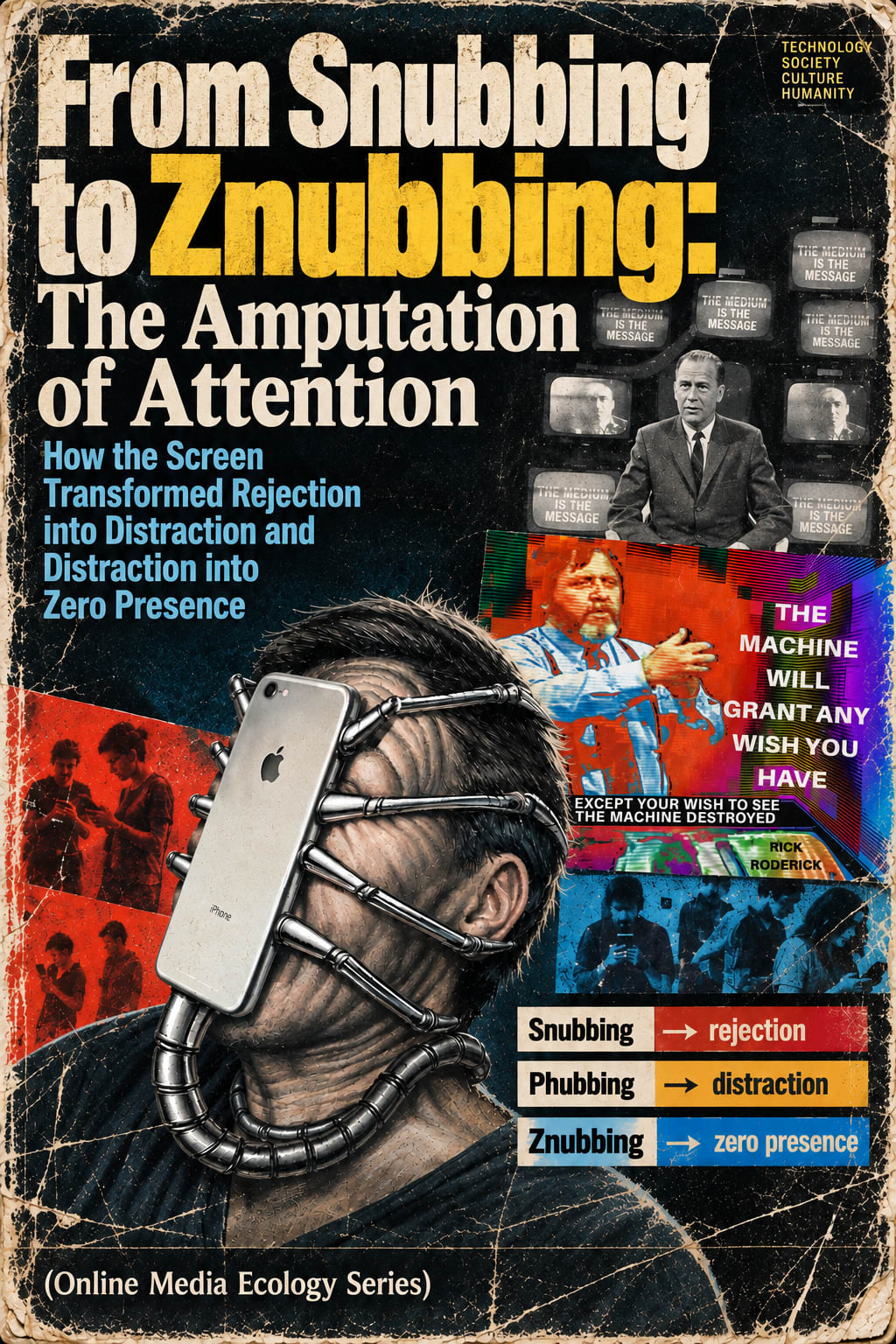
This article proposes a genealogy of social inattention through three related but phenomenologically distinct practices: Snubbing, Phubbing and Znubbing. It begins from an apparent paradox: deliberate snubbing, conventionally understood as a failure of sociability, may simultaneously testify to the continuing presence of human attention. To snub another person intentionally requires first perceiving that person, recognising the possibility of an encounter and consciously refusing participation in it. The history of the word itself reinforces this structure: the older meanings associated with snub include checking, rebuking, cutting short and cutting off. The traditional snub can consequently be understood as an intentional amputation of an already perceived communicative possibility. Drawing upon Rick Roderick’s exposition of Jacques Derrida’s account of structural possibility, the article extends the relation between understanding and misunderstanding towards another co-constitutive opposition: conversation and its deliberate refusal. If dialogue is possible, the possibility of refusing dialogue belongs to its architecture. Against this background, Marshall McLuhan’s concepts of technological extension, amputation, narcosis and the human servomechanism provide a framework for examining a historical transformation in which the locus of refusal progressively moves away from conscious interpersonal agency. Phubbing, or phone-snubbing, constitutes the intermediate condition: the Other is not necessarily rejected but loses the competition for attention against the technologically mediated elsewhere of the screen. The article then introduces Znubbing, an original term combining Zero/Zombie and Snubbing, to describe a more radical form of social non-recognition in which the objective is neither to subordinate nor simply to ignore another person but to perform their absence from the socially meaningful environment. Its defining condition is Zero Presence. Whereas the snub communicates “I recognise you but refuse you,” and phubbing redirects attention elsewhere, Znubbing behaves as though there were no socially perceptible Other to reject. The article develops Znubbing as a theoretical hypothesis concerning contemporary alienation and anomie rather than as an established psychological diagnosis, examining whether the operational grammar of digital environments—blocking, muting, deleting and rendering users invisible—can migrate metaphorically into embodied interaction. The resulting argument reverses the conventional criticism of technological distraction. The deeper danger may not be that contemporary media merely prevent people from communicating, but that continuous technologically organised connectivity weakens the autonomous human capacity to determine when and to whom attention will be granted or denied. The trajectory from Snubbing through Phubbing to Znubbing thus describes a possible transformation from rejection, through distraction, towards social erasure: an amputation not simply of conversation, but of sovereign attention itself.
Keywords
Snubbing; Phubbing; Znubbing; attention; Marshall McLuhan; Jacques Derrida; Rick Roderick; ostracism; recognition; social exclusion; technological mediation; servomechanism; alienation; anomie; Zero Presence; social erasure; digital culture; dialogue
Introduction: The Other Side of Conversation: Why the Possibility of Dialogue Contains the Possibility of Refusal
“Media tend to isolate one or another sense from the others. The result is hypnosis.”
— Marshall McLuhan (1969), Counter Blast
“When you are on the phone or on the air, you have no body.” McLuhan’s extraordinary image of “discarnate man” contains the hidden premise of the contemporary crisis of attention. Electronic communication does not simply extend speech across distance; it separates social presence from the geographical location of the body. The body remains in one place while voice, attention and consciousness enter an electronic elsewhere, and the nervous system, technologically extended across the globe, increasingly operates as an incessant information-gathering apparatus. The paradox of digital connectivity therefore begins before anyone is ignored: the person holding the device is already divided between corporeal presence here and electronic presence elsewhere. McLuhan’s discarnate man provides the missing bridge from Snubbing to Phubbing and finally to Znubbing. Once the embodied Self becomes progressively dispersed through its electronic extensions, the physically present Other can lose the privileged reality once guaranteed by proximity. The deepest secret of Zero Presence, however, is reciprocal. If the Other can be treated as though they are not there, it is because the Self that once encountered, judged, welcomed or rejected that Other is itself becoming uncertain. The disappearance of the Other and the disappearance of the Self are therefore not two separate catastrophes. They are opposite surfaces of the same electronic amputation.
Conversation is usually imagined from its positive side. Its vocabulary privileges connection: speaking, listening, answering, recognising, welcoming, understanding. Yet every one of these actions acquires social meaning because its opposite remains possible. A greeting matters because it may be withheld; an answer matters because silence is available; listening becomes an act because one can refuse to listen. Dialogue therefore contains its own negative architecture. If it is possible to converse, it is possible to snub. This proposition does not reduce snubbing to defective conversation but treats refusal as one of the possibilities generated by the existence of conversation itself. Rick Roderick’s exposition of Jacques Derrida provides a useful structural precedent. Discussing the relation between understanding and misunderstanding, Roderick argues that if misreading, misreference and misunderstanding are possible at all, they cannot simply be expelled from language as external accidents: “a possibility once”, when considered structurally, becomes “a necessity forever”. The present argument extends that logic from meaning to social interaction. If one human being can address another, the address can be refused; if acknowledgement can be offered, it can be withheld. Snubbing consequently inhabits the same relational field as welcoming. The two are not moral equivalents, but structural counterparts. This becomes especially clear when snubbing is distinguished from mere silence. A silent person may be listening intensely, while a talkative person may hear nothing another says. The radical snub closes both directions of the reciprocal circuit: it refuses to speak and refuses to listen. Yet even this refusal paradoxically remains socially eloquent. The person who deliberately turns away has first recognised someone from whom to turn. The gesture denies interaction while confirming perception. Long before the smartphone, then, attention possessed a margin: a human boundary within which another person could be admitted, rejected, approached, avoided, welcomed or deliberately left outside.
The contemporary problem begins when that margin itself becomes unstable. McLuhan’s apparently severe observation about media and hypnosis is valuable precisely because it directs attention away from technological content and towards alterations in the sensorium: a medium can reorganise the conditions under which something becomes perceptible at all. The question raised here is therefore not the familiar complaint that smartphones make people impolite, nor the nostalgic claim that social life before digital media was somehow more humane. Something conceptually stranger may have occurred. Traditional snubbing requires an agent capable of deciding where attention stops. The snubber may be arrogant, hostile or cruel, but the cruelty presupposes a remarkable sequence of human operations: perception of the Other, recognition of a possible encounter, evaluation of that encounter and deliberate withdrawal from it. The screen introduces another actor into this architecture. With phubbing, attention can be displaced before rejection is consciously performed; the person immediately present competes with messages, feeds, images, notifications and distant interlocutors arriving through a portable technological environment. This article follows that displacement towards a third condition for which the term Znubbing is proposed. Combining Zero or Zombie with Snubbing, Znubbing describes not the declaration that another person is inferior but the attempted performance of that person’s Zero Presence: behaviour organised as though a physically present human had failed to enter the socially meaningful world at all. The genealogy from Snubbing through Phubbing to Znubbing therefore traces more than an escalation of discourtesy. It describes three different configurations of agency and attention—rejection, distraction and erasure. Read through McLuhan, their succession raises an unsettling possibility. The greatest technological amputation may not be the loss of conversation itself. It may be the erosion of the autonomous human faculty that once decided whether to turn towards another person or deliberately turn away.
Part I: Snubbing: To Recognise the Other and Cut Them Off
“Any extension of ourselves they regard as ‘autoamputation,’ and they find that the autoamputative power or strategy is resorted to by the body when the perceptual power cannot locate or avoid the cause of irritation.”
— Marshall McLuhan (1964), Understanding Media: The Extensions of Man
The genealogy of snubbing begins, appropriately, with an act of cutting. The English verb snub appears in the mid-fourteenth century with the meanings of checking, reproving and rebuking, deriving from the Old Norse snubba and related Scandinavian forms associated with chiding and scolding; behind these social meanings lies the probable physical sense of cutting off, reinforced by the later English usage “cut off, cut short, nip”. What eventually became the eighteenth-century meaning “treat coldly” therefore carries a remarkably material ancestry: the snub is linguistically related to interruption, abbreviation and severance. This etymological residue allows an apparently minor gesture of etiquette to be reconsidered as an elementary operation upon the architecture of human attention. To snub is to cut a possible relationship short. Yet a cut requires something upon which it can be performed. The classical snubber cannot erase the preliminary encounter because the insult depends upon it. A greeting is noticed before it is unanswered; an approaching person is perceived before the gaze is redirected; an offered conversation is understood before silence is imposed. Even when snubbing functions as an assertion of status, its cruelty remains relational. The aristocrat who refuses to acknowledge the servant, the celebrity who looks through the admirer, or the colleague who deliberately excludes another from an exchange performs superiority precisely because the supposedly inferior person has already been registered as someone whose acknowledgement can be denied. The traditional snub consequently contains a concealed recognition: “I know that you exist, but I refuse you.” This differentiates it from accidental neglect, absent-mindedness, shyness and what Goffman called civil inattention, the socially necessary practice through which strangers can share public space without continually demanding interaction. The snub is not simply the absence of communication. It is an intentional boundary drawn after the possibility of communication has become perceptible. Its social violence depends upon the consciousness behind the gesture.
Seen in this way, the traditional snub produces the first, and still human, amputation in the genealogy developed here. McLuhan’s account of autoamputation concerned the paradox by which extension, irritation and perceptual numbness become entangled; the snub reverses the direction of his metaphor before technology enters the scene. Here it is the person who performs the cut. This explains why ostracism can be experienced so powerfully even when nothing is verbally said. The refusal to communicate does not abolish signification. On the contrary, the withheld greeting, unanswered remark, deliberately averted face or conspicuous silence can become more semantically concentrated than ordinary speech. There is therefore no contradiction in defining radical snubbing as a refusal both to speak and to listen while recognising that this refusal itself produces social meaning. First-order reciprocal communication has been closed; second-order information about the relationship has become unmistakable. The closed door does not converse with the visitor, but it establishes where the visitor stands. This also explains why deliberate snubbing can operate as punishment, hierarchy and ostracism: the person remains sufficiently present to experience exclusion. The snubber does not destroy the social field but redraws its boundary, placing one participant beyond the permitted line. Such behaviour may be contemptuous, cowardly or cruel, yet it retains something that will become increasingly important in the movement towards Phubbing and Znubbing: agency. The traditional snubber owns the refusal. Attention has reached its human object, evaluated the encounter and been consciously withdrawn. The disturbing historical irony is that an act conventionally condemned as deficient sociability may therefore preserve evidence of a faculty whose disappearance would be more radical than rudeness. The old snubber could still choose the direction of the face. What mattered was not merely that one human being turned away from another, but that there remained someone who was consciously doing the turning.
Part II: Phubbing: When the Screen Turns Away for Us
“"When you are on the phone or on the air, you have no body"
— Marshall McLuhan (1988), Laws of Media: The New Science
The passage from Snubbing to Phubbing is not merely the replacement of one form of bad manners by another; it changes the location from which inattention is organised. The traditional snubber encounters a human presence and deliberately terminates its claim upon attention, whereas phubbing inserts a technological portal between perception and response. Coined from phone and snubbing, the term describes the familiar situation in which someone physically present is neglected while attention is directed towards a smartphone. Yet the apparent simplicity of the gesture conceals a profound alteration in social space. The screen does not merely provide another object to look at. It opens an elsewhere populated by messages, photographs, news, games, work, strangers, friends, advertisements, emergencies and algorithmically selected stimuli, all capable of entering the immediate situation without sharing its physical location. Presence therefore ceases to guarantee priority. The person sitting across the table competes against an indefinitely expanding population arriving through a rectangle small enough to remain permanently in the hand. Research on partner phubbing and the broader phenomenon of technoference has consequently associated device intrusion with diminished relationship satisfaction and impaired quality of interpersonal interaction, but the philosophical significance extends beyond measurable dissatisfaction. Phubbing destabilises the ancient geography of proximity. For most of embodied social history, distance imposed friction: someone elsewhere could not ordinarily interrupt every moment of an encounter here. The networked smartphone collapses that protection. The distant becomes continuously eligible to defeat the near. Unlike deliberate rejection, this defeat need contain no judgement that the nearby person is unworthy. Indeed, the phubber may care deeply about the person being neglected. Attention has simply been captured by a competing environment whose demands arrive continuously and whose entrances rarely close. Rejection consequently begins to mutate into distraction: not “I have chosen not to acknowledge you,” but “my attention has already been summoned elsewhere.”
McLuhan’s language of the servomechanism makes this mutation more disturbing than a conventional critique of screen addiction. The technological extension does not remain a passive instrument waiting for its owner’s command; once embedded in social routines, it generates behaviours required for its own continued operation. Messages solicit answers, feeds solicit scrolling, platforms solicit reactions, notifications solicit inspection, and the connected individual becomes responsible for servicing a proliferating network of technologically manufactured claims upon attention. This is the paradox hidden inside McLuhan’s observation that the machine “expedites” human wishes: the more perfectly the medium fulfils the desire for immediate access, the more thoroughly immediacy itself can become an obligation. The smartphone promises that anybody can be reached almost anywhere, but universal reachability means that the person physically present no longer possesses any privileged claim upon the moment. Here the McLuhanesque logic of extension approaches reversal. A device that extends the capacity to communicate can simultaneously amputate control over when communication should occur; a technology designed to abolish distance can produce unprecedented psychological distance between bodies occupying the same room. Phubbing is therefore best understood as a transitional architecture rather than the terminus of the argument. Human agency has not disappeared: phones can be silenced, pockets can remain closed, screens can be put face down. But agency now operates inside an environment specifically organised to compete for it. The significant transformation is that the human being need no longer perform the entire act of turning away. The portal participates. It supplies the interruption, presents the alternative object, renews the stimulus and normalises departure from the immediate encounter while the body remains visibly present. Snubbing required the autonomous cruelty of a conscious boundary; Phubbing can occur through the routine maintenance of connectivity. The first cuts another person off. The second allows an apparatus of communication to perform part of the cut. Once that difference becomes ordinary, a still more radical possibility appears: a social condition in which neither rejection nor distraction adequately describes what has happened because the Other is treated as though no claim upon attention had existed in the first place.
Part III: Znubbing: Zero Presence and the Erasure of the Other
“Man in the electronic age has no possible environment except the globe and no possible occupation except information-gathering.”
— Marshall McLuhan (1970), Culture Is Our Business
Phubbing still leaves a triangle: the person, the neglected Other and the screen towards which attention has migrated. Znubbing names a more radical configuration in which even this description becomes insufficient. The term proposed here combines Zero and Zombie with Snubbing, but it is not intended as a fashionable synonym for ignoring someone. Its defining principle is Zero Presence. Traditional snubbing operates through hierarchy: the snubber recognises another person and deliberately communicates that the person is unworthy of acknowledgement. Znubbing attempts something different. Consider a group in which one individual speaks and receives no response, moves and attracts no gaze, enters and produces no alteration in the interaction, while those around that individual continue communicating normally among themselves. Consider further that this non-response is maintained deliberately and collectively despite the obvious physical presence of its target. The objective is no longer to put someone beneath the social hierarchy but to remove them from the hierarchy altogether. The Znubber performs the proposition: “There is nobody there.” The Zombie component of the term captures the peculiar social choreography that can result: all together but as individuals, neighbouring bodies coexist without reciprocal recognition while remaining capable of suddenly converging upon a selected stimulus, approved interlocutor or common target. This resembles neither solitude nor ordinary metropolitan anonymity. It is an active simulation of absence performed in the presence of its object. For this reason, Znubbing should be distinguished carefully from absent-minded detachment, exhaustion, introversion and the legitimate anonymity through which strangers coexist in crowded environments. Its strongest theoretical form requires expenditure of social effort: gaze must be controlled, responses suppressed, conversational openings bypassed and the surrounding interaction organised so that the excluded person receives no confirmation that their presence has registered. The paradox is severe. Snubbing wounds through negative acknowledgement; Znubbing seeks to withdraw acknowledgement itself. The snub devalues the Other. Znubbing deletes the Other.
McLuhan’s “information-gathering” human provides an unexpected route into the possible genealogy of this behaviour. Digital environments have normalised operations that would have been extraordinarily difficult to reproduce in embodied social space: block, mute, hide, remove, unfollow, delete. A user can disappear from an interface without disappearing from the world. Znubbing asks whether this operational grammar can migrate back across the screen. The hypothesis is not that video games or social networks mechanically cause a new behaviour, nor that every act of online blocking constitutes dehumanisation. Blocking can be necessary self-protection, and selective attention is indispensable to ordinary life. The theoretical question is narrower and more disturbing: what happens when the interface teaches disappearance as an available form of relationship management and that logic is subsequently performed upon a physically present human? Znubbing would then resemble a peculiar live-action role-playing of the digital command. There is no literal button, yet behaviour attempts to execute the same operation: this person will not appear in my social field. Here the concept intersects with the older sociological languages of alienation and anomie while exceeding both in a specifically digital direction. Alienation traditionally describes estrangement within a world still shared; Znubbing hypothesises the attempted fragmentation of that shared world into incompatible fields of social existence. Its possible psychological consequences, prevalence in contemporary cities and relationship to digital habits remain empirical questions and should be investigated rather than presumed. The conceptual proposition, however, can already be stated precisely. Dehumanisation ordinarily retains an object that can be degraded, exploited or despised. Zero Presence imagines a still colder operation: denying the target even the status of a socially perceptible object. This is why Znubbing marks the endpoint of the genealogy developed here. Snubbing retained recognition while weaponising it; Phubbing allowed technological elsewhere to displace it; Znubbing attempts to conduct embodied social life according to the logic of erasure. The screen no longer needs to remain visibly between two faces. Its grammar has entered the relationship itself.
Conclusion: When Nobody Turns Away: Discarnate Man and the Death of Human Presence
“Electric technology, by virtue of its immediate relation to our nervous system, is itself a sort of corporate or collective nervous system.”
— Marshall McLuhan (1964), Understanding Media: The Extensions of Man
The movement from Snubbing through Phubbing to Znubbing reveals a transformation more profound than the familiar decline of manners. What changes across these three conditions is the status of embodied presence itself. The traditional snub belongs to a recognisably corporeal social world. Two people occupy the same space; one perceives the other, understands the possibility of interaction and deliberately refuses it. The gesture may be contemptuous, humiliating or cruel, but it remains anchored in bodily co-presence. Someone turns a face away from another face. Phubbing destabilises this arrangement because the body remains locally present while attention is electronically transported elsewhere. McLuhan’s concept of the “discarnate man” captures this condition with unusual precision. When a person enters the telephone, radio or electronic network, McLuhan argues, the physical body no longer defines the boundaries of presence. The sender is effectively sent. Applied to the smartphone, this produces a peculiar social doubling: a person can sit physically at a table while psychologically and communicatively inhabiting another environment assembled from messages, images, distant voices, feeds and algorithmically selected stimuli. The nearby body therefore ceases to guarantee nearby presence. Phubbing is not simply looking at a device instead of a person; it is participation in a technological condition in which embodied proximity competes with discarnate simultaneity. The person across the table confronts a human organism whose operative attention has partially departed. This is the decisive difference from Snubbing. The old snubber remains entirely present in order consciously to reject. The phubber can remain corporeally here while becoming communicatively elsewhere. Electronic extension has begun to separate the location of the body from the location of attention.
Znubbing completes the genealogy by reversing this process upon the Other. If electronic media permit the connected subject to become partially discarnate, contemporary social behaviour may acquire the complementary power to treat another embodied person as though that person were already absent. This is the significance of Zero Presence. The Znubber does not need to establish superiority through an ostentatious refusal, because hierarchy itself has ceased to be the principal operation. Nor must a smartphone remain visibly between the two people. The deeper digital lesson has already been learned at the level of the interface: unwanted presences can be muted, blocked, hidden, removed and made functionally nonexistent. Znubbing transfers that operational imagination into physical interaction. A living body remains in the room, yet behaviour is organised as though no socially meaningful presence occupied that space. This is why the transition from Snubbing to Znubbing should not be mistaken for a simple escalation of impoliteness. It describes a movement from rejection to distraction and finally towards attempted erasure. The traditional snubber could injure another precisely because both parties still inhabited a common social world; the Znubber performs the fragmentation of that world itself. McLuhan’s collective nervous system therefore acquires a dark counter-image. Humanity may become electronically connected at precisely the moment when immediate human recognition becomes increasingly discontinuous. Bodies gather while attention travels elsewhere; networks thicken while neighbouring presences become thinner; communication proliferates while acknowledgement becomes scarce. The ultimate amputation of attention is consequently not the inability to concentrate upon another person for sufficiently long. It is the possible loss of sovereignty over the boundary between presence and absence, recognition and non-recognition, encounter and erasure. The old snub at least required a human being who could consciously turn away. The deeper danger begins when the capacity to turn away is no longer necessary because the Other has already become Zero.
In the electronic universe, McLuhan’s discarnate man has surrendered the boundaries of the body while his nervous system, technologically extended across the globe, becomes an incessant device for gathering information. Once the embodied Self dissolves into this planetary circuitry of extended senses, the disappearance of the Other into Zero Presence ceases to appear anomalous: a discarnate consciousness can inhabit everywhere while encountering nobody. Yet Znubbing conceals a deeper philosophical secret—the Other cannot become Zero without something also disappearing from the Self, because selfhood is constituted through the possibility of encountering what it is not. When the Other finally becomes Zero, therefore, the apparent victor of social erasure discovers the ultimate paradox of Znubbing: there is no longer a sovereign Self left to perform the erasure.
References
Derrida, J. (1982) ‘Signature Event Context’, in Margins of Philosophy. Translated by A. Bass. Chicago: University of Chicago Press, pp. 307–330.
Etymonline (2026) ‘Snub: Etymology, origin and meaning’. Online Etymology Dictionary.
Goffman, E. (1963) Behavior in Public Places: Notes on the Social Organization of Gatherings. New York: Free Press.
Karadağ, E., Tosuntaş, Ş.B., Erzen, E., Duru, P., Bostan, N., Şahin, B.M., Çulha, İ. and Babadağ, B. (2015) ‘Determinants of phubbing, which is the sum of many virtual addictions: A structural equation model’, Journal of Behavioral Addictions, 4(2), pp. 60–74.
McDaniel, B.T. and Coyne, S.M. (2016) ‘“Technoference”: The interference of technology in couple relationships and implications for women’s personal and relational well-being’, Psychology of Popular Media Culture, 5(1), pp. 85–98.
McDaniel, B.T., Galovan, A.M., Cravens, J.D. and Drouin, M. (2018) ‘“Technoference” and implications for mothers’ and fathers’ couple and coparenting relationship quality’, Computers in Human Behavior, 80, pp. 303–313.
McLuhan, M. (1962) The Gutenberg Galaxy: The Making of Typographic Man. Toronto: University of Toronto Press.
McLuhan, M. (1964) Understanding Media: The Extensions of Man. London: Routledge & Kegan Paul.
McLuhan, M. (1969) Counterblast. London: Rapp & Whiting.
McLuhan, M. (1970) Culture Is Our Business. New York: McGraw-Hill.
McLuhan, M. (1978) ‘A Last Look at the Tube’, New York Magazine, 17 March.
McLuhan, M. and McManus, M. (1977) ‘Marshall McLuhan in conversation with Mike McManus’, The Mike McManus Show, TVOntario.
Nakamura, T. (2015) ‘The action of looking at a mobile phone display as nonverbal behavior/communication: A theoretical perspective’, Computers in Human Behavior, 43, pp. 68–75.
Roberts, J.A. and David, M.E. (2016) ‘My life has become a major distraction from my cell phone: Partner phubbing and relationship satisfaction among romantic partners’, Computers in Human Behavior, 54, pp. 134–141.
Roderick, R. (1993) ‘Derrida and the Ends of Man’, The Self Under Siege: Philosophy in the Twentieth Century, lecture 6. Austin Community College.
Watzlawick, P., Beavin, J.H. and Jackson, D.D. (1967) Pragmatics of Human Communication: A Study of Interactional Patterns, Pathologies, and Paradoxes. New York: W.W. Norton.
Williams, K.D. (2001) Ostracism: The Power of Silence. New York: Guilford Press.
Williams, K.D., Forgas, J.P. and von Hippel, W. (eds.) (2005) The Social Outcast: Ostracism, Social Exclusion, Rejection, and Bullying. New York: Psychology Press.
Williams, K.D. and Nida, S.A. (eds.) (2017) Ostracism, Exclusion, and Rejection. New York: Routledge.
About the Creator
Peter Ayolov
Peter Ayolov’s key contribution to media theory is the development of the "Propaganda 2.0" or the "manufacture of dissent" model, which he details in his 2024 book, The Economic Policy of Online Media: Manufacture of Dissent.
Enjoyed the story? Support the Creator.
Subscribe for free to receive all their stories in your feed.
Comments
There are no comments for this story
Be the first to respond and start the conversation.