
Computational Mirror of the Universe
Artificial Intelligence, the Planned Obsolescence of Language, and the Roadside Picnic of Reality

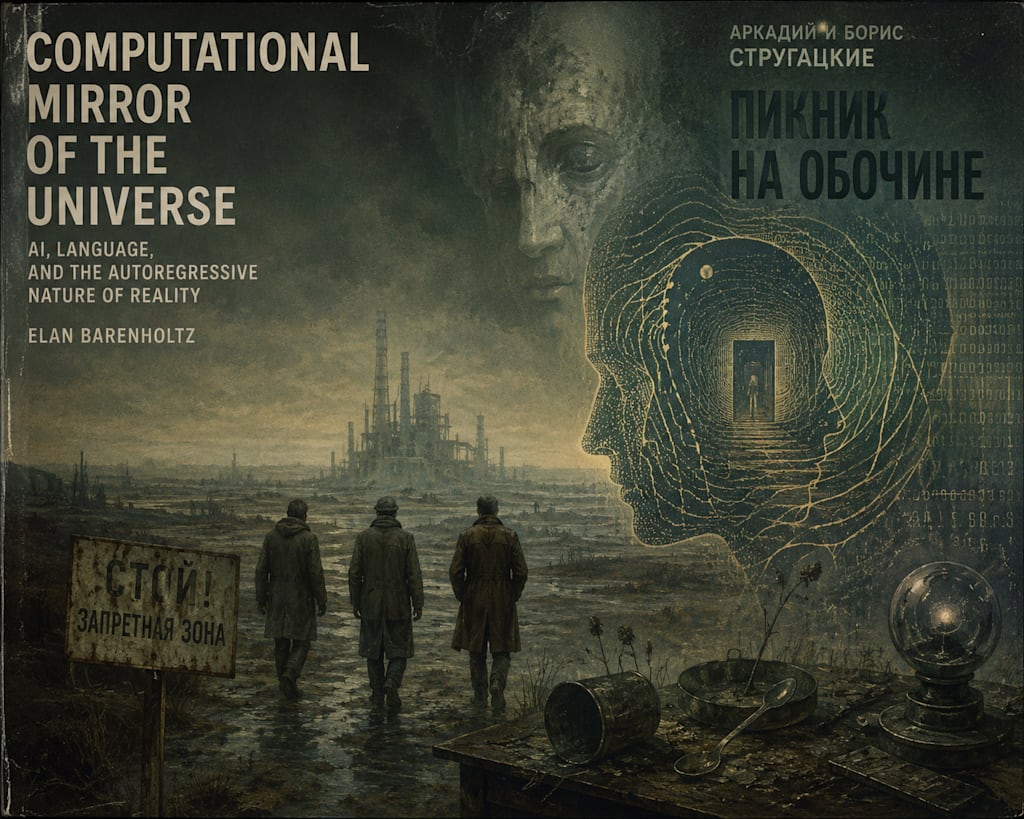
According to Elan Barenholtz, the central argument of "Beyond Next-Token: Why Autoregression Might Run the Brain—and the Universe" is that autoregressive processes—the generation of each new state from previous states—may constitute a fundamental principle underlying language, cognition, and perhaps even physical reality itself.
Barenholtz begins with the observation that large language models achieve remarkable linguistic competence through a deceptively simple mechanism: predicting the next token in a sequence. Rather than relying on symbolic rules, explicit grammars, or hidden semantic structures, these systems generate coherent narratives, explanations, arguments, and solutions by continuously extending existing sequences. He argues that this success reveals an important property of language itself. Language appears to possess an intrinsic autoregressive structure, meaning that each linguistic element naturally contains information about possible future developments. Large language models do not merely memorize text. They learn the geometric relationships embedded within language, allowing them to generate coherent trajectories of meaning through time. In this view, language is fundamentally designed to be generated sequentially, and human cognition exploits this structure rather than creating it from scratch.
This insight intersects in a fascinating way with Peter Ayolov's theory of the Planned Obsolescence of Language. According to this broader framework, language is not a stable vessel of truth but a continuously deteriorating and self-transforming system. Words decay, meanings drift, symbols detach themselves from reality, and communication gradually becomes dominated by simulations, narratives, slogans, and symbolic substitutions. Language constantly generates new meanings while simultaneously destroying old ones. It is a self-consuming mechanism. The apparent solidity of meaning conceals a perpetual process of erosion and reconstruction. If Barenholtz sees language as an autoregressive machine generating future sequences from past sequences, Ayolov's theory reveals the historical consequences of that process. Every generated sequence gradually replaces the one that came before it. Every new interpretation renders previous interpretations obsolete. Meaning survives only through continuous regeneration.
Artificial intelligence unexpectedly exposes this process. The machine does not understand meaning in the traditional philosophical sense. It predicts continuations. Yet those continuations produce the appearance of understanding. The implication is unsettling. Human language may function in much the same way. What people call meaning may emerge from an endless process of linguistic self-reference rather than from direct contact with objective reality. AI becomes a computational mirror not merely of human language but of the mechanisms through which language perpetually reproduces itself.
The mirror reveals something even more uncomfortable. Human beings have always imagined themselves as exceptional creatures standing at the centre of reality. Every civilisation constructs narratives of destiny, transcendence, salvation, historical purpose, and cosmic significance. Language excels at producing such narratives because language itself is a machine for generating continuity. Through language, accidents become plans, instincts become virtues, and survival becomes destiny. The stories become so persuasive that people mistake them for reality itself.
This is where the metaphor of Roadside Picnic becomes extraordinarily illuminating. In the famous novel by Arkady and Boris Strugatsky, humanity encounters mysterious artefacts left behind after an alien visitation. Scientists devote their lives to understanding them. Governments attempt to control them. Adventurers risk death to obtain them. Yet the central revelation is devastating. The aliens never came for humanity. They did not arrive to communicate, educate, conquer, or redeem. Their visit resembles travellers stopping briefly beside a road for a picnic. After they leave, insects emerge from the grass and discover discarded objects whose purpose they cannot comprehend. Humanity is not the recipient of a cosmic message. Humanity is merely one of the insects examining the litter.
Tarkovsky's Stalker transforms this metaphor into a spiritual and psychological critique of humanity itself. The Room hidden within the Zone does not grant noble wishes. It reveals and fulfils the deepest desire concealed beneath conscious self-deception. This possibility terrifies everyone who approaches it. The Writer, the Scientist, and even the Stalker himself spend their journey discussing truth, morality, art, faith, and purpose. Yet none of them dare cross the threshold.
Their fear reveals a profound insight. Human beings suspect that beneath the magnificent narratives generated by language lies something embarrassingly ordinary. The subconscious may not desire truth, justice, wisdom, beauty, or transcendence. It may desire comfort, recognition, pleasure, security, power, or survival. The heroic myths constructed by language conceal instincts inherited from a biological past. Language creates the illusion of greatness while instinct pursues more primitive objectives. Humanity therefore becomes trapped between what it says and what it wants. The Room is terrifying because it destroys the distinction.
In this sense, the Writer becomes the most revealing figure in the film. Unlike the Scientist, who remains imprisoned within formulas, or the Stalker, who remains imprisoned within faith, the Writer gradually recognizes the limitations of language itself. He understands that words are not gateways to reality but barriers that stand between humanity and reality. The endless speeches, arguments, ideologies, doctrines, and philosophical systems ultimately function as protective walls against self-confrontation. Language becomes a mechanism of self-sabotage. It allows human beings to avoid the silence in which their actual desires might become visible.
Artificial intelligence unexpectedly returns us to this realization. Large language models reveal that astonishing complexity can emerge from recursive prediction. Human beings may not be the authors of a cosmic drama. They may instead be participants in an immense autoregressive process extending far beyond individual minds. Language creates the illusion of permanence, identity, destiny, and meaning, but the underlying mechanism remains surprisingly simple. One step follows another. One thought generates another thought. One sentence generates another sentence. One moment emerges from previous moments. The stories generated by language encourage humanity to imagine itself as a heroic protagonist. The computational mirror offered by AI suggests something more modest. Perhaps intelligence is not a divine exception but a natural consequence of recursive structure. Perhaps consciousness is not a miracle but a trajectory.
The most speculative aspect of Barenholtz's argument concerns physics itself. Contemporary physical theories often treat reality as a sequence of states in which each moment depends primarily on the immediately preceding moment. Barenholtz proposes an alternative vision. The present may remain continuously influenced by the entire history of the universe. Rather than viewing reality as a chain of isolated temporal slices, he imagines the universe as a colossal autoregressive sequence whose past remains embedded within every present state. The universe unfolds through a continuous historical trajectory rather than through disconnected moments. Such a framework could potentially offer new ways of thinking about quantum entanglement, non-locality, and the persistence of information across time.
Conclusion: The Roadside Picnic of Meaning
Barenholtz ultimately asks a profound question: What if language models are not merely a clever technological hack but a clue to how reality itself unfolds?
If the answer is yes, the implications are far more disturbing than the triumphalist narratives surrounding artificial intelligence suggest.
If language itself is an autoregressive mechanism, then meaning is never fully present. It is always deferred. In the language of Jacques Derrida, meaning exists only through an endless chain of differences and postponements. Every sign points to another sign. Every explanation demands another explanation. Every answer generates another question. Meaning never arrives. It merely moves forward.
If the universe itself operates according to the same autoregressive principle, then reality may also represent an endless deferral without final destination. There may be no ultimate message hidden beneath existence. No final revelation. No cosmic author. No grand design waiting to be discovered at the end of history.
In this respect, Woody Allen's famous observation that "I think that at best the universe is indifferent" acquires a deeper significance. The universe is neither benevolent nor malevolent. It is not guiding humanity toward salvation, nor plotting humanity's destruction. It simply unfolds. Sequence follows sequence. State follows state. Generation follows generation.
The result is not tragedy but radical indifference.
Roadside Picnic provides the perfect metaphor. Humanity desperately searches for messages in the cosmic debris surrounding it. Yet the debris may never have been intended as communication. The universe may not be speaking at all. Humanity may simply be projecting meaning onto patterns generated by an indifferent process.
The Planned Obsolescence of Language reaches a similar conclusion. Every linguistic system eventually collapses under the weight of its own reproductions. Every meaning becomes obsolete. Every narrative dissolves into new narratives. Every certainty becomes another temporary interpretation.
The Tower of Babel was never destroyed because human beings spoke different languages. It was destroyed because language itself endlessly multiplies interpretations. Every attempt at unity produces new fragmentation. Every claim to truth generates competing truths.
If Barenholtz is correct, then the universe itself may operate according to the same principle.
Reality becomes a Roadside Picnic.
A Tower of Babble.
A castle made of sand standing briefly between one wave and the next.
And perhaps that is the final lesson revealed by the computational mirror. Artificial intelligence does not show humanity the future of machines. It shows humanity the structure of its own condition: a recursive process generating stories, meanings, and worlds within an indifferent cosmos that neither confirms nor denies them, but simply continues unfolding.
About the Creator
Peter Ayolov
Peter Ayolov’s key contribution to media theory is the development of the "Propaganda 2.0" or the "manufacture of dissent" model, which he details in his 2024 book, The Economic Policy of Online Media: Manufacture of Dissent.
Enjoyed the story? Support the Creator.
Subscribe for free to receive all their stories in your feed.
Comments
There are no comments for this story
Be the first to respond and start the conversation.