
Buried Brilliance: How Global Knowledge Was Erased to Elevate the West
From algebra to astronomy, Western progress stands on foundations it refuses to acknowledge

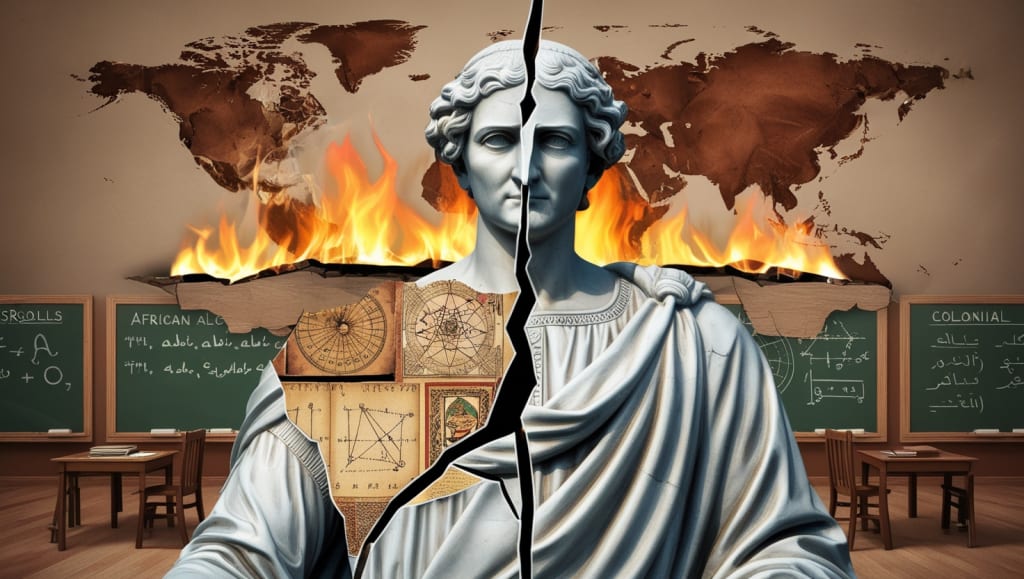
When we’re taught the origins of science, mathematics, and philosophy, the names sound familiar — Aristotle, Newton, Galileo, Descartes. European. Male. Genius. But what if I told you that this “lineage of brilliance” is not just incomplete — it’s a deliberate fiction?
Growing up, I never questioned the curriculum. I assumed Europe had always led the way — that modern knowledge was born in the West and shared, out of generosity, with the rest of the world. I didn’t realize I was learning a story told by the victors — a story built on silence, theft, and erasure.
The Global Foundations of Modern Knowledge
Before Newton, Indian scholars were calculating gravity and planetary motion. Before Descartes, Islamic philosophers were wrestling with the nature of the soul and logic. Before Galileo, African astronomers in Mali had charted the stars and designed observatories. Algebra comes from Arabic. Paper from China. The number zero — without which modern math collapses — was developed in India. And yet, in most classrooms, these facts are treated as side notes. The narrative still flows one way: from Europe, outward.
Why the Erasure?
Colonialism was not just about land. It was about minds. To justify domination, colonizers needed to convince themselves — and their subjects — that they were inherently superior. That meant minimizing or outright denying the achievements of those they colonized.
So, libraries were burned. Indigenous knowledge systems were outlawed. Oral histories were dismissed. And when colonizers stumbled upon advanced technologies or mathematical systems, they either claimed them or renamed them. This is how history gets rewritten. Not always by lies, but by omission.
The Cost of Silence
This erasure isn’t just academic. It affects how people see themselves and their place in the world. A child who grows up never hearing of their ancestors’ contributions to knowledge will internalize the idea that genius doesn’t look like them. That innovation speaks only one language. That history has one center. Meanwhile, Europe continues to benefit — economically, politically, and intellectually — from a knowledge legacy it did not build alone.
Rewriting the Story, Not Just the Syllabus
What can we do?
We start by telling the truth. That science is not Western — it is human. That discovery is not linear — it is collective. That the brilliance of ancient Africa, Asia, and the Americas was not a prelude to Europe, but a chapter that was cut out. We need to:
- Reinsert global thinkers into the curriculum — not as “diversity” tokens, but as essential voices.
- Support research into Indigenous science, African mathematics, and non-Western philosophies.
- Call out Eurocentrism in academia and publishing.
- Demand that museums and universities credit the sources and lineages of the knowledge they profit from.
I’m not writing this as an expert. I’m writing it as someone unlearning. Someone who believed, for too long, that history was objective — and that absence meant insignificance. I now see that absence was engineered. And as I relearn, I feel both anger and awe — anger at what was taken, and awe at how much brilliance has survived despite centuries of erasure.
This is not just about adding names to a textbook. It’s about reclaiming memory. Dismantling myth. And rebuilding a future rooted in truth — one where no culture has to ask permission to be remembered.
About the Creator
David Thusi
✍️ I write about stolen histories, buried brilliance, and the fight to reclaim truth. From colonial legacies to South Africa’s present struggles, I explore power, identity, and the stories they tried to silence.
Enjoyed the story? Support the Creator.
Subscribe for free to receive all their stories in your feed.
Comments
There are no comments for this story
Be the first to respond and start the conversation.