
Beyond the Tupperware Trap
Stop forcing "optimized" eating on people who actually run the world. It's time to trade cold chicken for empathy and flow.

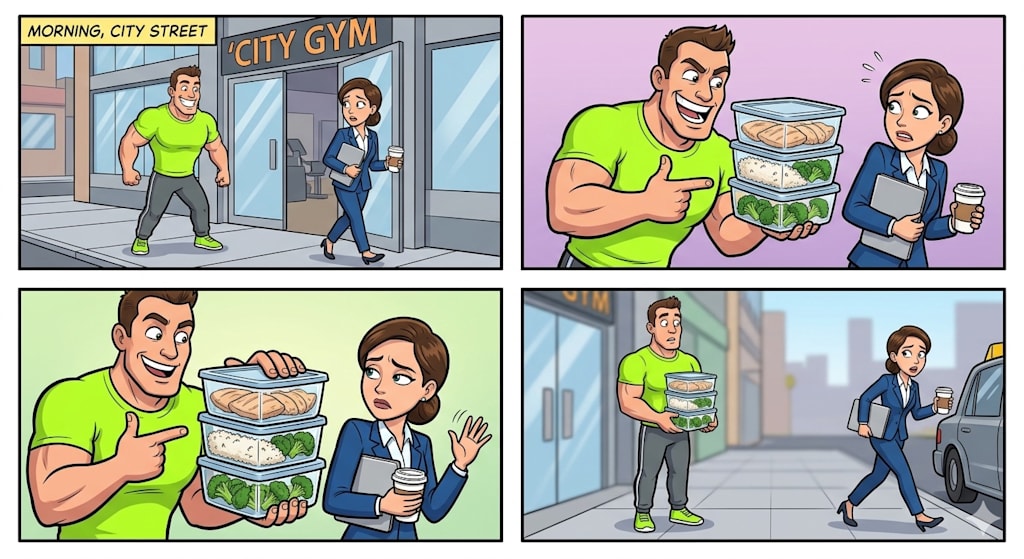
There’s a scent that follows the fitness industry around, and if you’ve been in it long enough, you probably don’t even notice it anymore. It’s not just the smell of iron, rubber mats, or dried sweat. It’s the lingering aroma of cold broccoli and steamed chicken wafting from a plastic Tupperware container in the middle of a gym lobby.
To a trainer, that plastic box is a trophy. It’s a badge of honor, a symbol of 24/7 dedication. But I’ve spent a lifetime looking at the world through a different lens — first as a combat veteran where strategy had to meet the mud and the blood, and now as a coach for people who carry the weight of the world on their shoulders. And let me tell you: to a man who just spent ten hours navigating a corporate merger or stabilizing a bank’s liquidity, that trainer with the plastic box doesn’t look disciplined. He looks like a slave to a routine that the rest of the world simply can’t afford.
The gap between a private trainer and a high-level businessman is a canyon. Most trainers live in a beautiful, controlled bubble where everything — sleep, training, meals — is designed to serve their own body. But the businessman? He’s just a visitor in our world. He’s wandered into the gym looking for a lifeline, not a new set of chores. When a trainer tries to force their “Tupperware lifestyle” onto a CEO, they aren’t helping. They’re just adding one more fire to a life that’s already burning at both ends.
The Man Behind the Title
I remember a specific client of mine. He was the director of a major bank — a textbook “Alpha.” This is a man who holds the strings of a massive institution, someone who makes decisions that affect thousands of lives. He didn’t come to me because he wanted to look like a bodybuilder; he came to me because his life was grinding him down, and he was looking for a way to fight back.
His arrivals at the gym were a sight to see. He’d walk in with that specific kind of “executive vibration” — a mix of high-voltage adrenaline and bone-deep exhaustion. More often than not, he hadn’t eaten a single thing all day. In the world of “perfect nutrition,” that’s a cardinal sin. But in his world, it was just Tuesday.
My first instinct wasn’t to pull out a calorie spreadsheet or lecture him on catabolism. My instinct, shaped by years of leading men in the military and a deep sense of empathy, was to protect him. I’d literally hand him an apple or a protein bar the second he walked through the door, terrified he might actually hit the floor in the middle of a set of squats. I didn’t see a “failing client.” I saw a high-performer who was running on fumes, and he needed a teammate, not a judge.
The Strategy of the Trenches
When we finally sat down to talk about his habits, I didn’t lead with my “rich knowledge” of nutrition. I just asked: “When do you actually eat?”
His answer was raw. He told me that the only time he felt he could truly breathe was late at night, when he finally got home. That was the moment he’d “shove his head in a pot” and eat for three people. It was his decompression. It was his only ritual of peace after a day of war in the boardroom.
A lot of coaches would have jumped in right there: “This has to stop. You’re ruining your metabolism.” But I felt the weight of his words. He looked at me and said, “This is the only thing I have left. If you take this away, I’m not going to make it.”
So, I chose a different path. We call it “the fine bow” — wrapping a solution so elegantly that the client doesn’t even feel the weight of the change. I told him, “Keep your ritual. Keep the peace. But can we swap the junk food for a bowl of blueberries and kiwi?” It was a small shift. It gave him the sweetness he craved to shut his brain off, but without the toxic fallout.
He agreed. Why? Because I didn’t attack him. I didn’t take away his peace; I just polished it. Within a few weeks, he dropped a few pounds. That tiny “win” gave him something more valuable than a flatter stomach — it gave him the feeling of being in control again.
Stealth Nutrition for the Alpha Office
The next battle was the office. This man is a leader. He has an image to maintain, a level of professional ethics that most trainers don’t consider. He couldn’t — and wouldn’t — be the guy opening a smelly container of tuna in the middle of a board meeting. It’s not just about the smell; it’s about the optics of authority.
We came up with what I call “The Mash.” It was a blend of flax, chia, hemp protein, and a touch of honey. To the naked eye, it looked like nothing. It was alkaline, neutral-smelling, and required almost no chewing. He could keep it in the corner of his desk and take a spoonful between calls.
It was invisible nutrition. It kept his blood sugar stable so he wouldn’t crash and look weak in front of his staff. It allowed him to stay sharp without looking like he was on a “diet.” He was grateful because I understood his position as an Alpha. I wasn’t trying to make him a “fitness guy”; I was helping him be a better Bank Director.
Style, Grace, and the Human Connection
It’s hard for me to watch trainers parade their meals and their “perfect” lives in front of people who are struggling just to find thirty minutes of sleep. There’s a lack of style in that. If you need to eat, go to a corner. Do it privately. Don’t make a spectacle of your discipline.
When you shove your lifestyle down a client’s throat, you’re creating a barrier. You’re telling them that to be healthy, they have to become you. And they know they can’t. So they quit.
My philosophy is built on “drip-feeding” change. Sometimes, the most professional thing you can say is, “Just cut out the bread for three months.” That’s a mission they can accept. As a veteran, I know that you don’t give a soldier a hundred-page manual in the middle of a firefight. You give them the next move.
We are in the business of changing lives, not just bodies. That requires stepping out of our world of sets and reps and into their world of deadlines and high stakes. It requires a “fine bow” — wrapping your knowledge in empathy so that it feels like a gift, not a burden.
At the end of the day, my client didn’t just lose weight. He felt understood. He realized that his trainer wasn’t a rigid lecturer, but a strategist who respected the weight of his responsibilities. That is how you build a body, and that is how you build a legacy. We aren’t just counting calories; we are supporting the people who move the world, one quiet, elegant adjustment at a time.
About the Creator
Feliks Karić
50+, still refusing to grow up. I write daily, record music no one listens to, and loiter on film sets. I cook & train like a pro, yet my belly remains a loyal fan. Seen a lot, learned little, just a kid with older knees and no plan.
Enjoyed the story? Support the Creator.
Subscribe for free to receive all their stories in your feed.
Comments
There are no comments for this story
Be the first to respond and start the conversation.