
Apocalypse as Argument
A Critical Review of the SNEAKO–Jiang–Dugin Dialogue

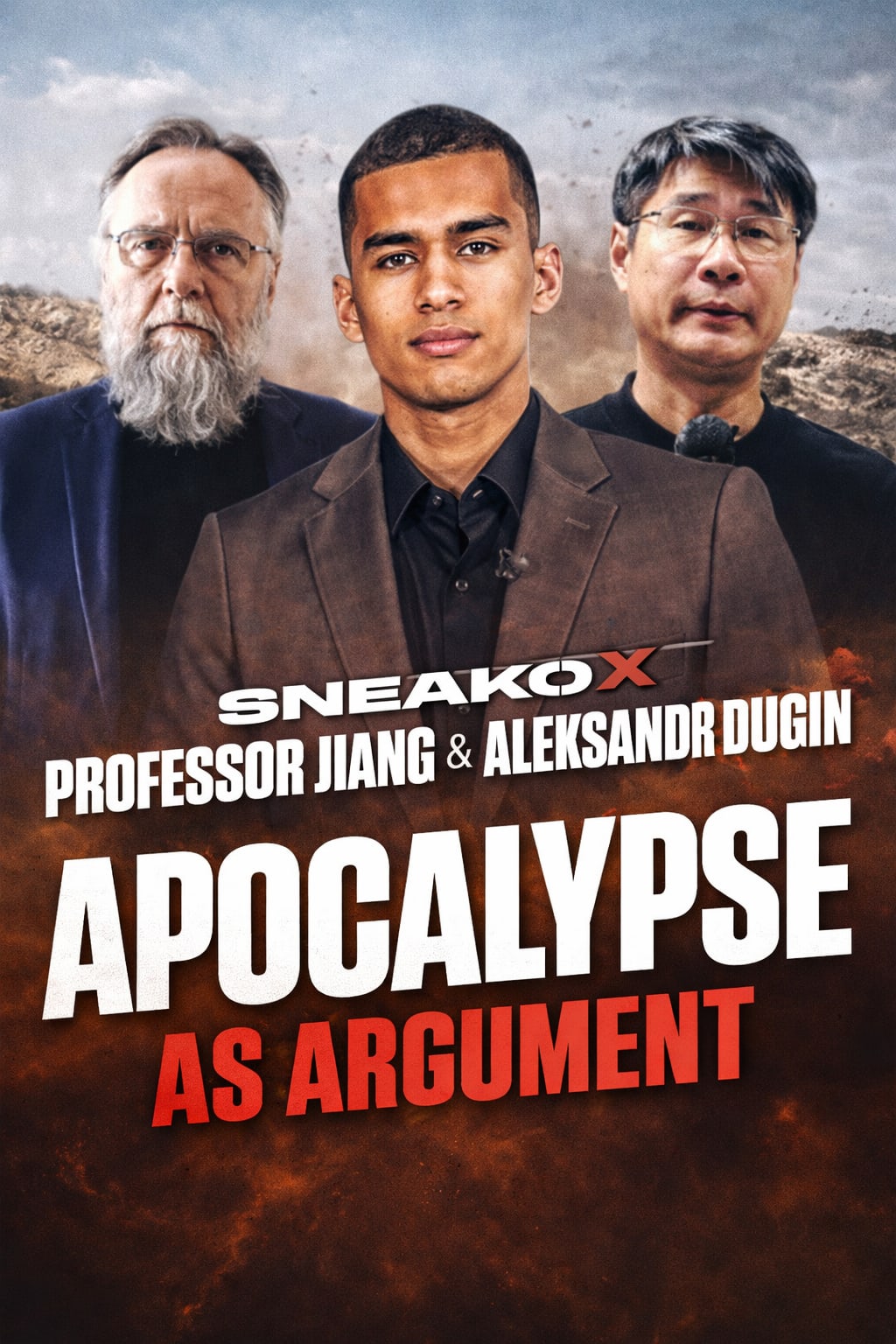
Apocalypse as Argument: A Critical Review of the SNEAKO–Jiang–Dugin Dialogue
The long-form discussion hosted by SNEAKO with Jiang X and Aleksandr Dugin unfolds as an ambitious attempt to synthesize theology, geopolitics, and contemporary cultural anxiety into a single explanatory framework. Framed initially as a structured exploration of eschatology—the study of end-times across religious traditions—the conversation gradually expands into a sweeping diagnosis of modern civilization, touching on everything from Enlightenment philosophy and global finance to media manipulation, war, and metaphysical evil. What emerges is not merely an interview but a layered narrative in which apocalypse becomes not an event, but an argument—a way of interpreting reality itself.
### Introduction: Eschatology as the Master Key
The discussion begins with a surprisingly methodical premise: that eschatology offers a unifying lens through which different civilizations understand history, purpose, and destiny. Jiang introduces eschatology as the study of the “end”—a framework shared across traditions but expressed differently in Protestant, Zionist, Islamic, and Orthodox contexts. Aleksandr Dugin extends this idea by proposing that eschatology is not merely theological but civilizational, reflecting what he calls the “soul” of a people.
This opening is one of the strongest elements of the dialogue. The contrast between Chinese philosophical balance (rooted in harmony and cyclical time) and the linear, conflict-driven eschatologies of Abrahamic traditions provides a compelling starting point. It suggests that geopolitical conflicts are not just material struggles but clashes of temporal imagination—between cultures that anticipate an ultimate end and those that prioritize equilibrium.
Yet even here, the seeds of the conversation’s later excesses are visible. Eschatology is quickly elevated from interpretive tool to explanatory totality, setting the stage for a discourse where every political event becomes a sign, every actor a symbol, and every conflict a prefiguration of the end.
### The Expansion: From Theology to Total Critique
As the discussion progresses, the focus shifts from comparative religion to a broad critique of Western modernity. Jiang traces the origins of contemporary Western society to the financial revolution of the Bank of England, linking it to the philosophical developments of John Locke, David Hume, and Jeremy Bentham. In this account, the Enlightenment becomes less a triumph of reason than a justification for debt-based economies, individualism, and consumerism.
Dugin amplifies this critique through the lens of traditionalist philosophy, invoking René Guénon and arguing that modernity represents not progress but decline—a fall from sacred order into material chaos. The convergence between Jiang’s economic-historical narrative and Dugin’s metaphysical traditionalism is striking. Despite their different intellectual backgrounds, both arrive at a similar conclusion: that the modern West is fundamentally disordered, driven by principles that undermine human flourishing.
This section is rhetorically powerful but analytically uneven. While the critique of consumerism, alienation, and moral relativism resonates with longstanding philosophical traditions, it is presented in absolutist terms. Enlightenment thought is reduced to a monolithic force, its internal tensions and achievements largely ignored. The result is a narrative that is compelling in its clarity but limited in its nuance.
### The Descent into Symbolic Politics
The conversation takes a decisive turn when contemporary political figures and events are introduced. Discussions of Donald Trump, media imagery, and the symbolism of public figures are interpreted through an eschatological lens. References to Jeffrey Epstein and the so-called “Epstein class” become central to the argument, functioning as evidence of a hidden elite whose actions are framed not merely as criminal but as metaphysical signs of corruption.
Here, the dialogue begins to blur the boundary between analysis and speculation. Conspiracy-adjacent claims are integrated into the broader framework without critical examination, creating a closed system in which every piece of information reinforces the overarching narrative. The “deep state” is invoked not as a contested concept but as an assumed reality, and complex geopolitical dynamics are reduced to the actions of hidden networks.
This shift is significant because it transforms the conversation from a philosophical inquiry into a form of myth-making. Political events are no longer analyzed in terms of strategy, economics, or institutional dynamics; they are read as symbols within a cosmic drama. While this approach can be rhetorically powerful, it risks oversimplification and undermines the credibility of the analysis.
### Geopolitics as Eschatological Theater
One of the most distinctive aspects of the dialogue is its fusion of geopolitics with eschatology. Conflicts involving Russia, China, Iran, and the United States are interpreted not only as strategic struggles but as manifestations of deeper metaphysical forces. The concept of multipolarity—advocated by Dugin—is presented as both a রাজনৈতিক and spiritual alternative to Western hegemony.
Jiang’s discussion of a potential Eurasian alliance, including economic systems based on gold and regional cooperation, introduces a more concrete geopolitical dimension. However, even these proposals are framed within a broader narrative of civilizational struggle, where economic systems and military alliances are seen as extensions of underlying spiritual realities.
Dugin’s concept of the “Katechon”—a force that restrains the coming of the Antichrist—adds another layer to this framework. In his interpretation, Russia plays a unique historical role as a restraining power, delaying the onset of global chaos. This idea, drawn from Christian theological tradition, is presented not as metaphor but as a guiding principle of political action.
While intellectually intriguing, this fusion of theology and geopolitics raises important questions. By framing political decisions in eschatological terms, the discussion risks legitimizing conflict as part of a predetermined narrative. It also limits the possibility of alternative interpretations, as dissent can be construed as alignment with opposing metaphysical forces.
### Media, Information, and Psychological Exhaustion
Amid the more speculative elements, the conversation offers a perceptive observation about the nature of contemporary media. The idea that modern information systems overwhelm individuals not through censorship but through excess—flooding them with competing narratives until engagement becomes impossible—is one of the most grounded insights in the discussion.
This notion aligns with broader concerns about digital communication, where the abundance of information can lead to fatigue, apathy, and disengagement. The participants suggest that this condition serves as a form of control, diffusing attention and preventing sustained critical inquiry.
Unlike the more conspiratorial elements of the dialogue, this argument is both plausible and empirically observable. It highlights a genuine challenge of the digital age and connects the discussion back to its initial concern with communication, meaning, and the fragmentation of discourse.
### The Role of the Moderator
SNEAKO plays a crucial role in shaping the conversation. Positioned as an intermediary, he bridges the perspectives of his guests while also steering the discussion toward topics that resonate with online audiences. His questions often reflect contemporary internet discourse, bringing in viral controversies and popular narratives.
While this approach makes the discussion accessible, it also contributes to its instability. The rapid shifts between topics, combined with the introduction of speculative claims, create a sense of fragmentation. The conversation oscillates between philosophical depth and sensationalism, reflecting the hybrid nature of digital media.
### Conclusion: The Limits of Total Explanation
“Apocalypse as Argument” ultimately reveals both the power and the danger of totalizing narratives. By framing contemporary events within an eschatological framework, the participants offer a cohesive and emotionally resonant interpretation of a complex world. The appeal of such a narrative is clear: it provides meaning, structure, and a sense of direction in an otherwise chaotic environment.
However, this coherence comes at a cost. The reduction of diverse phenomena to a single explanatory model limits critical engagement and obscures complexity. The blending of theology, geopolitics, and conspiracy creates a discourse that is difficult to challenge, as it operates on multiple levels simultaneously.
At its best, the dialogue raises important questions about the relationship between belief, culture, and politics. It highlights the enduring influence of religious narratives on modern thought and the ways in which these narratives shape our understanding of history and destiny. At its worst, it exemplifies the risks of uncritical synthesis, where the desire for meaning leads to the acceptance of unsupported claims.
In the end, the conversation stands as a reflection of its own subject. It is both a critique of modern communication and a product of it—fragmented, expansive, and driven by the search for significance. Apocalypse, in this context, is not merely an end-point but a mode of reasoning, a way of organizing experience into a story of ultimate stakes. And like all such stories, it reveals as much about the storyteller as it does about the world it seeks to explain.
About the Creator
Peter Ayolov
Peter Ayolov’s key contribution to media theory is the development of the "Propaganda 2.0" or the "manufacture of dissent" model, which he details in his 2024 book, The Economic Policy of Online Media: Manufacture of Dissent.
Enjoyed the story? Support the Creator.
Subscribe for free to receive all their stories in your feed.
Comments
There are no comments for this story
Be the first to respond and start the conversation.