
Why Trump Failed to Defeat Iran? – The Importance of Geography in Modern Conflicts
Mountains, Distance, Missiles, and Strategy: Why Geography Still Decides the Outcome of Wars

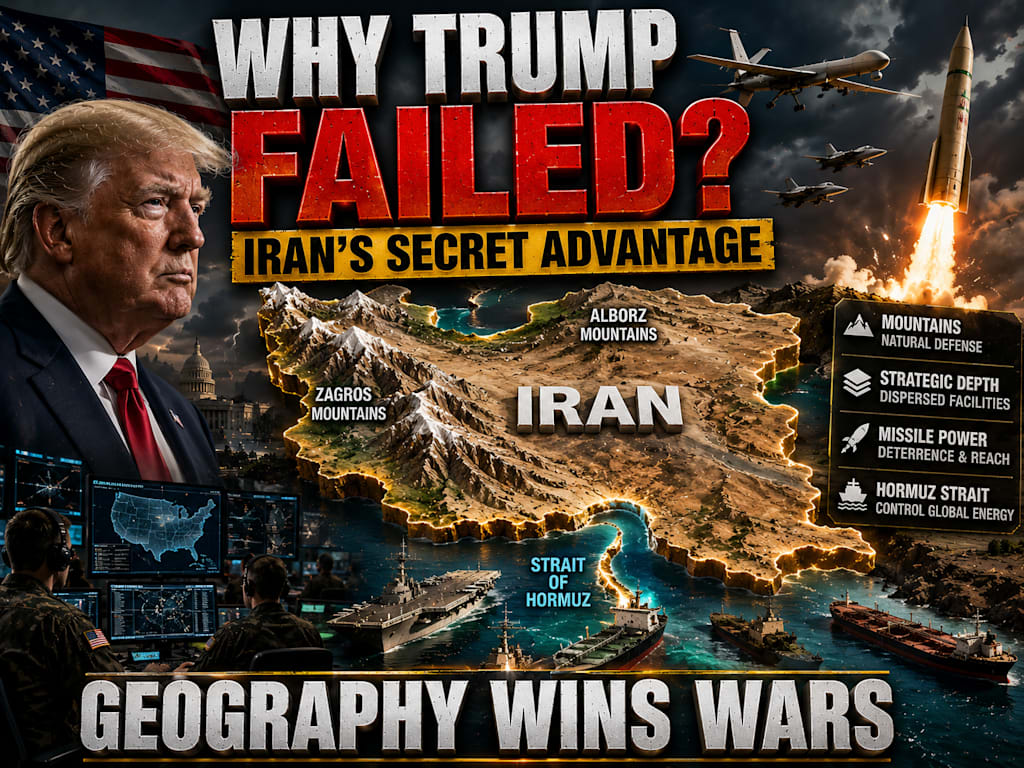
Why Trump Failed to Defeat Iran? – The Importance of Geography in Modern Conflicts
The recent military confrontation between the United States and Iran has renewed one of the oldest questions in military strategy: Can a powerful military always achieve its political objectives? While the United States possesses one of the world's most advanced armed forces, many defense analysts argue that geography remains one of the greatest challenges in any conflict. Understanding the role of terrain, logistics, and strategic depth helps explain why military campaigns can be far more complex than they appear.
Iran's geography is one of its greatest strategic advantages. Covering more than 1.6 million square kilometers, Iran is surrounded by mountain ranges, deserts, and long coastlines. The Zagros Mountains in the west and the Alborz Mountains in the north create natural defensive barriers that make large-scale ground operations difficult. Throughout history, armies have struggled to operate effectively in mountainous terrain because movement, supply lines, and communications become much more complicated.
Another important factor is Iran's strategic depth. Unlike smaller countries, Iran has a vast interior where military infrastructure can be dispersed. Air bases, command centers, missile facilities, and industrial sites can be spread across large distances. This makes it more difficult for any opponent to eliminate military capabilities through a single series of air strikes.
Distance also matters. The United States does not share a border with Iran. Any sustained military campaign would rely heavily on overseas bases, naval forces, and long supply chains. Maintaining logistics over such distances requires enormous resources, coordination, and political support from regional partners. In military planning, logistics are often described as the foundation of successful operations.
The Strait of Hormuz further increases Iran's strategic importance. This narrow waterway is one of the world's busiest energy routes, carrying a significant share of globally traded oil. Any disruption in the area can influence international energy markets and affect economies far beyond the Middle East. Because of its location, Iran has the ability to influence maritime security in one of the world's most strategically important regions.
Modern warfare has also changed. Precision-guided missiles, drones, electronic warfare, cyber capabilities, and advanced air-defense systems have made military operations more complex than in previous decades. Even countries with smaller defense budgets can develop capabilities that increase the cost and difficulty of military action. Geography and technology together can create significant defensive advantages.
History provides many examples showing that military superiority alone does not guarantee strategic success. Campaigns in mountainous or geographically challenging regions have often required far greater time, resources, and political commitment than initially expected. This is one reason why military planners carefully consider terrain alongside troop numbers and equipment.
At the same time, it is important not to oversimplify the situation. Modern conflicts are influenced by many factors beyond geography. Intelligence, diplomacy, economic sanctions, international alliances, domestic politics, public opinion, and technological innovation all affect outcomes. Geography is an important factor—but it is only one part of a much larger strategic picture.
Political objectives also influence military decisions. Governments generally seek to achieve specific strategic goals rather than simply winning battles. Even successful military operations may not produce the desired political results if they increase regional instability, economic disruption, or international diplomatic costs.
Regional dynamics further complicate decision-making. The Middle East includes numerous countries with different security interests and strategic priorities. Actions involving one country can affect neighboring states, global trade routes, and international energy markets. This interconnected environment makes military escalation a matter of worldwide concern.
For these reasons, diplomacy often remains an essential component of international security. Military force may influence negotiations, but lasting stability usually requires political agreements, communication, and confidence-building measures. Many experts argue that sustainable security depends on combining deterrence with diplomacy rather than relying exclusively on military action.
In conclusion, discussions about why the United States did or did not achieve particular objectives in relation to Iran often focus on military capability alone. However, geography remains a critical factor in understanding modern conflict. Iran's mountainous terrain, strategic depth, geographic size, and location near key maritime routes all shape military planning. At the same time, technological, political, and diplomatic factors also play essential roles. Understanding these multiple dimensions provides a more complete picture of why contemporary conflicts are rarely decided by military power alone.
About the Creator
Wings of Time
I'm Wings of Time—a storyteller from Swat, Pakistan. I write immersive, researched tales of war, aviation, and history that bring the past roaring back to life
Enjoyed the story? Support the Creator.
Subscribe for free to receive all their stories in your feed.
Comments
There are no comments for this story
Be the first to respond and start the conversation.