
"When Rich Meets Poor"
"A Story of Two Souls, One Truth"

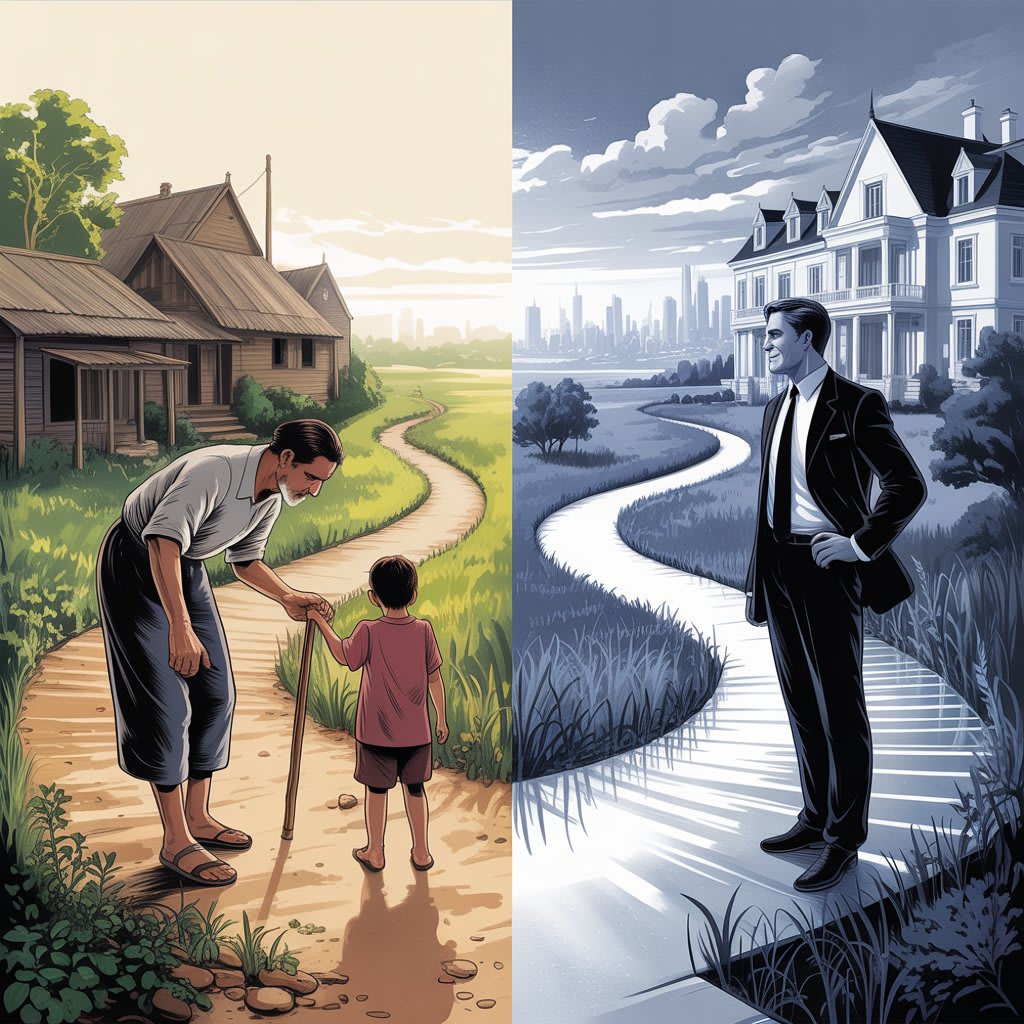
In a land where the sun painted gold across the fields and the winds whispered secrets through the trees, there lived two men at opposite ends of fortune.
Mr. Darius, the richest man in the city of Velora, lived in a marble estate with fountains that danced and gardens that bloomed year-round. His wealth came from trade—spices, silks, and land. People bowed when he passed, not out of love, but fear and respect. He dressed in tailored suits, rode in carriages carved with gold, and dined with kings.
Just outside the city's walls, in a crumbling hut with a thatched roof and wooden floor, lived Elias, a poor farmer. His clothes were patched, his meals were simple, and his hands bore the calluses of hard labor. But his eyes sparkled with kindness, and his heart beat with quiet contentment. Though he had little, he shared much—with beggars, stray animals, and any traveler who knocked on his worn-out door.
Despite their differences, both men had something in common: they were growing older, and both felt something missing from their lives.
The Meeting
One summer, a drought struck Velora. The rivers shrank, crops wilted, and tempers flared. Even Darius, with all his wealth, began to worry. His businesses faltered as water became scarce.
One day, desperate to inspect the lands he rarely visited, Darius traveled by carriage to the outskirts, where he owned a large farm that had been left in the hands of poor tenants.
As he surveyed the dry land, he saw Elias working under the sun. Unlike others who had fled or cursed the sky, Elias was digging trenches, using what little water he had to nourish a small vegetable patch.
Darius, irritated, called out, "You! Why do you waste effort? The land is dead!"
Elias looked up and smiled. "Not dead, sir. Just resting. If I give it love, it might return the favor."
Darius scoffed. “Love? The world does not return love. It returns money and power.”
Elias walked over and offered the rich man a cool drink of water—his last jug. “Even power needs water, sir. You’re welcome to share.”
Darius hesitated but drank. Something about the man’s calm unsettled him. “What’s your name?”
“Elias.”
That night, Darius couldn’t sleep. The poor man’s eyes, his peace, his generosity—they haunted him. How could someone with nothing give so freely?
The Test of Fortune
Over the next few weeks, Darius returned. He claimed it was to inspect the land, but really, he was drawn by Elias. They talked—about weather, the soil, life, even death. Elias never begged, never asked for help. He simply listened, spoke, and shared whatever he had.
One day, moved by curiosity and pride, Darius proposed a challenge.
“You speak of peace and love as if they are more valuable than gold. I propose this: come live in my mansion for a month. Eat as I eat, dress as I dress. If by the end of the month, you still say you are happier in your hut, I will give you this farm—free, and all the land around it.”
Elias thought for a long time. “And if I choose to stay in your world?”
Darius smiled. “Then you will have wealth beyond imagining, and a place at my side.”
Elias agreed.
The Mansion
Life in the mansion was like nothing Elias had known. Silken robes, servants, feasts, music, soft beds. He was treated like a prince, bathed in luxury and surrounded by people who praised him constantly.
At first, he was dazzled. But within days, he noticed things others missed. The servants smiled with fear, not warmth. The laughter at dinner was hollow. Darius's friends spoke of profits and deals, not love or family. No one asked about Elias’s thoughts—only what he wore, what he ate, how he’d slept.
He missed the chirping birds outside his hut, the taste of simple bread, the joy of digging his hands into the earth.
Most of all, he missed peace.
Darius, however, watched Elias with satisfaction. He thought the poor man was enchanted, tempted by wealth.
On the thirtieth day, during a grand banquet, Darius stood and raised a glass.
“Elias,” he declared, “you’ve tasted luxury. What is your choice? Stay and rule beside me? Or return to your patch of dirt?”
The room fell silent.
Elias stood slowly. “I thank you, Darius. This has been a gift. But I choose my patch of dirt.”
Gasps echoed. Darius’s face turned red. “You reject all this? Why?”
Elias looked around. “Because everything here is borrowed. Your joy depends on others serving you. Your comfort depends on things. In my hut, my joy comes from within. I sleep well because my conscience is clean. I eat humbly, but I’m never hungry for more. That is true wealth.”
The Aftermath
True to his word, Darius gave Elias the land. People laughed at the rich man, mocked his failure to lure a poor man with riches.
But Darius said nothing.
He stopped attending parties. He stopped expanding his empire. Weeks later, he visited Elias again—this time alone, without gold or guards.
“Do you still dig those trenches?” he asked.
Elias smiled, handing him a shovel. “Only when I have help.”
And so they worked—together, under the sun.
The Change
Over the years, something remarkable happened. The land bloomed. Elias taught others to farm, to share, to trust the earth and each other. Darius funded wells and schools—not for power, but from the heart.
He never moved into Elias’s hut, but he built a small cottage nearby. Every evening, they would sit under a tree and talk—not about gold or harvests, but about life.
And when Darius died many years later, he left behind a simple will:
"Let my wealth return to the people. I have found what I was searching for—in the heart of a poor man."
Moral of the Story:
True wealth is not measured by gold or possessions, but by peace of mind, kindness of heart, and the joy of simple things. What we give, not what we keep, defines who we are.
About the Creator
Enjoyed the story? Support the Creator.
Subscribe for free to receive all their stories in your feed.
Comments
There are no comments for this story
Be the first to respond and start the conversation.