
What Is DLSS and Why Do Gamers Talk About It So Much?
What Is Deep Learning Super Sampling

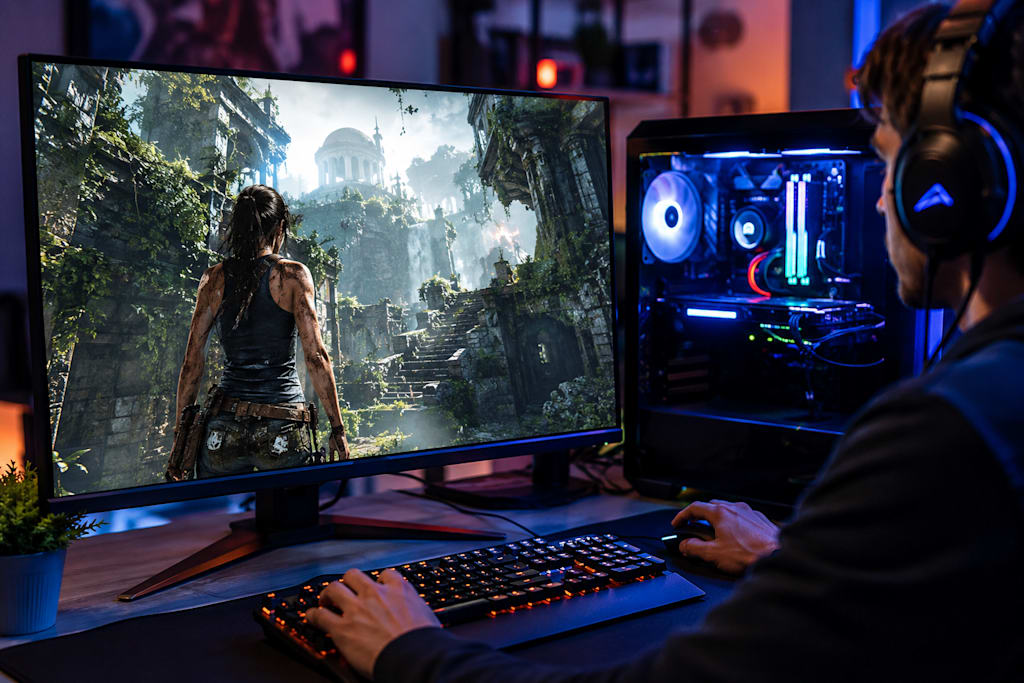
If you’ve spent any time browsing gaming PCs lately, you’ve probably seen the term DLSS pop up. It’s everywhere. You’ll spot it in game settings, graphics card reviews, and plenty of marketing material. At first glance, it can seem like just another tech buzzword. But DLSS is actually a pretty important feature, especially for PC gamers.
DLSS stands for Deep Learning Super Sampling. It’s a technology created by NVIDIA. It uses artificial intelligence to boost gaming performance while keeping visuals looking sharp. Put simply, it helps games run faster. The good part? They usually don’t look noticeably worse.
How DLSS Works
Running a game at a high resolution, such as 4K, takes serious power. Every frame contains millions of pixels. Your graphics card has to process all of them. That’s a lot of work, especially in modern games.
DLSS handles things differently.
Instead of rendering every frame at full resolution, the game renders at a lower resolution internally. After that, AI steps in. It rebuilds the image and adds missing detail. It also sharpens the picture. The end result looks surprisingly close to a native higher-resolution image.
You can think of it as an advanced form of upscaling. Though, honestly, that description doesn’t quite capture how smart it is. The AI model has been trained using huge amounts of image data. Because of that, it can predict what the final image should look like. And oddly enough, it often gets remarkably close.
Why Gamers Like It
The biggest reason is simple. Better performance.
Modern games are packed with demanding visual features. Ray tracing is one example. Realistic lighting is another. Then there are highly detailed environments. These effects can look incredible. They can also hammer your frame rate.
That’s where DLSS comes in. It can provide a substantial performance boost. In many games, frame rates can jump by 50% or even more. The exact result depends on the game, your settings, and your hardware. Newer DLSS versions can push performance even further. At the same time, image quality often stays very close to native rendering.
For players using 1440p or 4K monitors, the difference can be huge. A game that feels sluggish can suddenly feel smooth. And let’s be real, smooth gameplay matters a lot.
The Evolution of DLSS
DLSS has come a long way since its debut in 2018.
The first versions were impressive from a technical perspective. Still, they weren’t perfect. Some images looked a little soft. Others appeared blurry in certain situations. Over time, NVIDIA kept refining the technology. New AI models arrived, and new features followed.
DLSS 2 was a major step forward. Image quality improved dramatically. It also helped DLSS become a mainstream feature. Later, DLSS 3 introduced Frame Generation. This feature creates additional frames using AI. The goal is smoother gameplay, and it often delivers. More recently, DLSS 4 expanded those capabilities. It introduced more advanced AI models and Multi-Frame Generation technology.
The adoption rate has been impressive. In fact, it’s grown faster than many people expected. NVIDIA reported support in more than 125 games and applications for DLSS 4 technologies. The broader RTX ecosystem now includes hundreds of supported titles and apps. That’s a pretty strong sign of how widely the technology has been embraced.
Does DLSS Affect Image Quality?
This is probably one of the questions gamers ask most often.
The answer isn’t completely straightforward. It depends on which DLSS mode you’re using. Performance-focused modes can sacrifice some fine detail. That trade-off is part of the deal. Quality-focused modes, however, are a different story. Many players struggle to spot any meaningful difference during normal gameplay.
In some situations, DLSS can even improve the visual experience. It may reduce shimmering. It can also help smooth out jagged edges. That surprises some people. Yet it’s one reason many gamers switch it on, even when they already have solid frame rates.
Is DLSS the Future of Gaming?
As games become more demanding, AI-assisted rendering is becoming increasingly important. Hardware alone can’t solve every problem forever. Because of that, companies are looking for smarter solutions. Machine learning is becoming one of them.
DLSS is one of the best-known examples of this shift. It lets players enjoy higher resolutions and advanced graphics settings. It also helps deliver smoother gameplay. The best part is that you don’t always need top-tier hardware to get those benefits.
For many PC gamers, DLSS no longer feels like an extra feature. It feels standard. Almost expected, actually. Graphics technology keeps evolving, and the pace isn’t slowing down. Because of that, AI-powered tools like DLSS will likely play an even larger role in the years ahead. They’re changing how games are rendered and how we experience them too.
About the Creator
Kanchan Bains
Kanchan Bains is a journalist with over five years of experience in digital media and news reporting. She holds a Bachelor’s degree in Journalism and Mass Communication and began her career as a trainee reporter.
Enjoyed the story? Support the Creator.
Subscribe for free to receive all their stories in your feed.
Comments
There are no comments for this story
Be the first to respond and start the conversation.