
US-Iran War The Illusion of Victory
A War Without a Battlefield

Umair
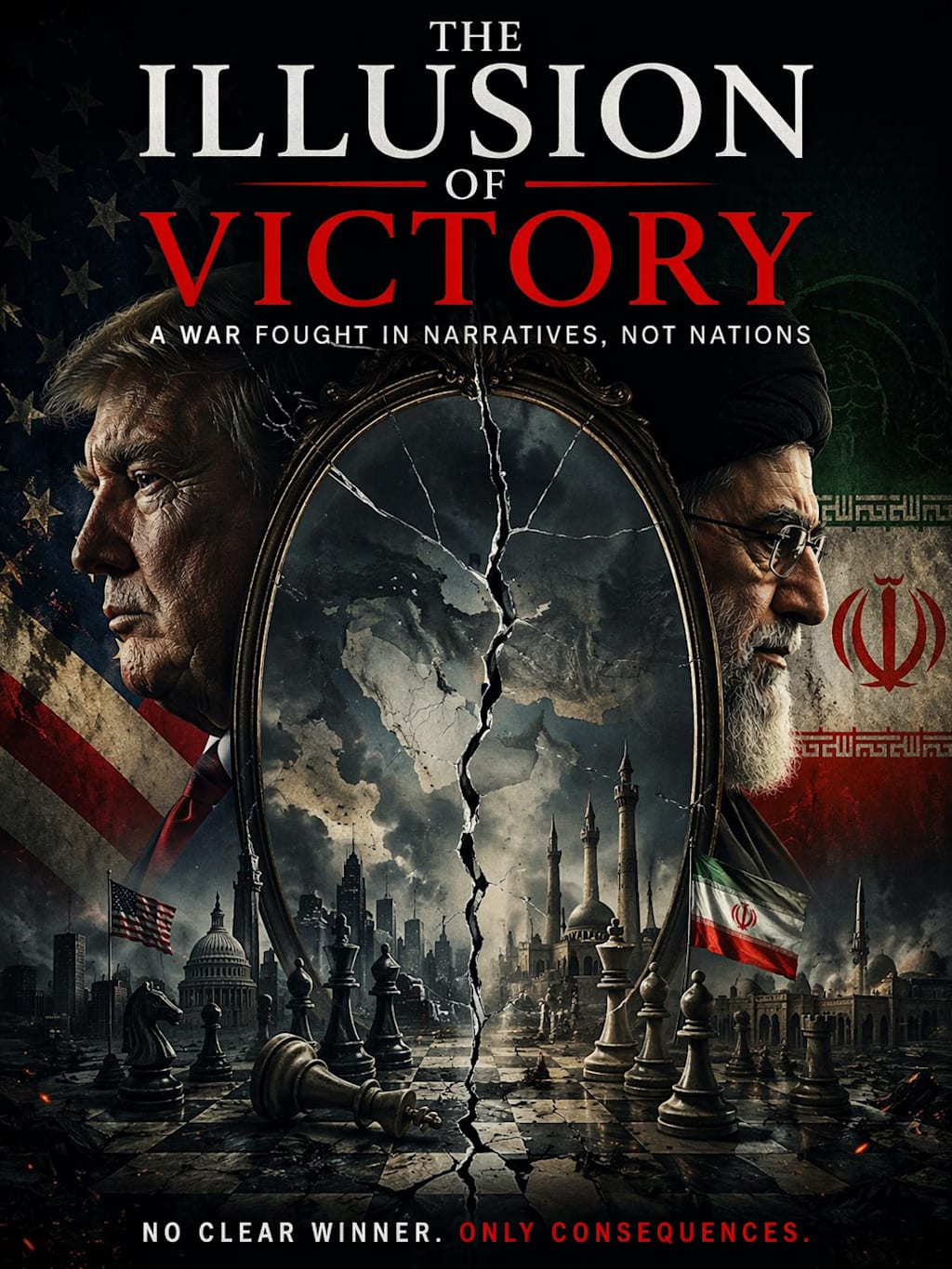
History does not always record wars in the language of explosions and advancing armies. Some wars are quieter, more intricate, and infinitely more deceptive. They are fought in corridors of power, through economic chokeholds, intelligence operations, and carefully crafted narratives. The confrontation between the United States and Iran belongs to this category a prolonged struggle that has reshaped the Middle East and influenced global politics without ever becoming a formally declared war. Yet, across social media platforms and public discourse, this conflict is often reduced to a simplistic binary: America has lost; Iran has won. The United States, once an uncontested superpower, is now portrayed as weakened, even humiliated. Iran, once isolated and sanctioned, is seen as triumphant a symbol of resistance that has forced a global giant to retreat. But reality rarely conforms to such neat conclusions. The truth lies somewhere in between layered, complex, and often uncomfortable. The Rise of a Superpower: America’s Unipolar Moment To understand the present, one must first revisit the era when American power stood unchallenged. The collapse of the Soviet Union in 1991 marked the beginning of what scholars described as the “unipolar moment.” The United States emerged not just as a superpower, but as the superpower. Its military strength was unmatched. Its economy dominated global markets. Its cultural influence penetrated societies across continents. Institutions such as the IMF and World Bank operated within frameworks heavily shaped by American policy preferences. NATO expanded under its leadership, and its alliances stretched from Europe to Asia. In the Middle East, American influence was decisive. Governments aligned themselves with Washington not merely out of strategic interest but often out of necessity. The Gulf War of 1991 reinforced the perception that American military intervention could decisively shape outcomes in the region. This was not merely power it was dominance. The Beginning of Decline: Iraq and Afghanistan However, history has a way of humbling even the most powerful nations. The events of September 11, 2001, triggered a series of decisions that would redefine America’s global role. The invasion of Afghanistan, initially justified as a response to terrorism, gradually transformed into a prolonged and costly conflict. What was expected to be a swift victory became a two-decade struggle, draining resources and testing public patience. The invasion of Iraq in 2003 proved even more consequential. Justified on the basis of weapons of mass destruction claims that later became deeply controversial the war destabilized an entire region. Instead of creating a stable, pro-Western democracy, it opened the door to sectarian violence, insurgencies, and the emergence of new power centers. Ironically, one of the unintended beneficiaries of the Iraq War was Iran. With the fall of Saddam Hussein a key regional rival Iran found an opportunity to expand its influence in Iraq. Political groups with ties to Tehran gained prominence, reshaping the country’s internal dynamics. America had removed an adversary, but in doing so, it had strengthened another. Iran’s Strategy: Power Without Parity Iran’s rise in the regional order did not follow the traditional path of great powers. It lacked the economic might of the United States and the global alliances that underpin Western influence. Instead, it adopted a strategy rooted in asymmetry. Iran understood a fundamental reality: it could not defeat the United States in a conventional war. But it did not need to. Through a network of alliances and proxies ranging from political groups in Iraq to armed organizations in Lebanon and Syria Iran extended its influence across the Middle East. This strategy allowed it to project power indirectly, minimizing the risks associated with direct confrontation. It was a form of strategic patience. Rather than seeking rapid victories, Iran focused on long-term positioning. It embedded itself in regional conflicts, built relationships, and cultivated a narrative of resistance against foreign intervention. Over time, this approach yielded results. The Shadow War: Conflict Without Declaration The relationship between the United States and Iran is best described as a “shadow war.” It is a conflict defined not by formal declarations but by continuous, low-intensity engagement across multiple domains. Economic sanctions have been one of the most significant tools employed by the United States. These sanctions have targeted Iran’s banking sector, oil exports, and access to global markets, aiming to exert pressure without resorting to military force. In response, Iran has relied on its regional networks and strategic alliances to counterbalance this pressure. There have been moments of direct confrontation missile strikes, targeted killings, and naval incidents but these have remained limited. Both sides have consistently avoided crossing the threshold into full-scale war. This restraint is not accidental. It reflects a mutual understanding of the catastrophic consequences that such a war would entail. The Assassination That Redefined Red Lines In January 2020, the targeted killing of a senior Iranian military commander marked a turning point in the conflict. The strike demonstrated the United States’ willingness to take bold and risky actions. Iran’s response missile strikes on bases housing American forces was equally significant. It signaled that Iran was prepared to retaliate, but also that it sought to avoid uncontrolled escalation. This exchange revealed a delicate balance: both nations were willing to engage, but neither was willing to ignite a full-scale war. It was a confrontation governed by calculation rather than impulse. The Myth of American Collapse The narrative that the United States has lost its status as a superpower is both widespread and misleading. There is no denying that American dominance has been challenged. The rise of China, the resurgence of Russia, and the assertiveness of regional powers have created a more complex global landscape. However, complexity does not equate to decline. The United States continues to possess unmatched military capabilities. Its technological innovations drive global progress. Its financial systems influence international markets. Its alliances remain extensive and strategically significant. What has changed is not the existence of American power, but its nature. It is no longer absolute. It is now contested. Iran’s Gains: Influence, Identity, and Leverage From Iran’s perspective, the past two decades have been transformative. Its influence in Iraq has grown substantially. In Syria, it has played a critical role in supporting the government during a prolonged civil war. In Lebanon, its alliance with Hezbollah provides strategic depth. In Yemen, its involvement has added another dimension to regional dynamics. Beyond these tangible gains, Iran has also achieved something less measurable but equally important: narrative power. It has positioned itself as a symbol of resistance an image that resonates with segments of the global population disillusioned with Western interventionism. This narrative has amplified its influence far beyond its material capabilities. The Cost of Resistance: Economic and Social Strain Yet, these gains have not come without cost. Sanctions have taken a severe toll on Iran’s economy. Inflation has eroded purchasing power. Currency devaluation has affected savings and livelihoods. Unemployment remains a persistent challenge. For ordinary Iranians, the geopolitical struggle translates into daily hardship. Periodic protests reflect underlying frustrations economic, social, and political. These internal pressures complicate Iran’s strategic calculations. A nation cannot sustain external influence indefinitely if its internal stability is compromised. Israel and the Expanding Arena of Conflict No analysis of the US-Iran dynamic is complete without considering Israel. Israel views Iran as an existential threat, particularly due to its nuclear ambitions and support for armed groups in the region. This perception has led to a series of covert and overt actions ranging from cyber operations to targeted strikes. These actions have added another layer to the conflict, transforming it into a multi-actor confrontation. In many ways, the US-Iran tension cannot be understood in isolation. It is part of a broader regional struggle involving multiple stakeholders with overlapping and often conflicting interests. The Gulf States: Between Fear and Pragmatism The Gulf countries, particularly Saudi Arabia and the United Arab Emirates, occupy a complex position in this dynamic. On one hand, they view Iran’s regional ambitions with suspicion and concern. On the other, they recognize the risks associated with prolonged instability. In recent years, there have been efforts to reduce tensions and explore diplomatic engagement. These shifts reflect a broader recognition that conflict, if left unchecked, can have devastating consequences for the entire region. Pragmatism, increasingly, is replacing confrontation. Pakistan’s Role: Balancing Between Powers Pakistan’s position in this geopolitical landscape is both sensitive and strategic. As a country with ties to both the United States and Iran, Pakistan has occasionally sought to play a mediating role. Its efforts to reduce tensions and facilitate dialogue are consistent with its broader interest in regional stability. However, claims that Pakistan acted merely as a conduit for American messaging oversimplify a far more nuanced reality. Diplomacy is rarely visible in its entirety. It operates through quiet channels, backdoor communications, and carefully calibrated statements. Pakistan’s role, like that of many middle powers, is defined by balance navigating competing interests without becoming entangled in conflict. The Logic of Ceasefire: Strategy, Not Surrender The notion that only the losing side seeks a ceasefire is a persistent but flawed assumption. In reality, ceasefires are often strategic decisions. They allow nations to: Consolidate gains Prevent escalation Reassess strategies Engage in negotiation History is replete with examples of powerful nations choosing de-escalation not out of weakness, but out of prudence. Strength, in international relations, is not always about استمرار جنگ—it is often about knowing when to stop. The Human Cost: Beyond Numbers While strategic analysis focuses on states and policies, it is essential not to overlook the human dimension. The US-Iran conflict has not resulted in large-scale direct casualties between the two nations. However, in proxy arenas particularly in Iraq and Syria thousands of lives have been lost. These include fighters aligned with various factions, as well as civilians caught in the crossfire. Each number represents a life a family, a story, a future cut short. War, even when indirect, leaves lasting scars. A Multipolar World: The New Reality Perhaps the most significant outcome of this prolonged confrontation is the shift in the global order. The world is no longer unipolar. It is not strictly bipolar either. It is multipolar defined by multiple centers of power, each pursuing its own interests. In such a world: Alliances are fluid Conflicts are complex Outcomes are uncertain The US-Iran dynamic is not an anomaly; it is a reflection of this broader transformation. Conclusion: Beyond Victory and Defeat In the final analysis, the question of who won and who lost misses the essence of the conflict. The United States remains a formidable global power, but its dominance is no longer uncontested. Iran has expanded its regional influence and strengthened its narrative of resistance, but at significant economic and social cost. This is not a story of clear victories or decisive defeats. It is a story of adaptation of nations navigating a changing world, making choices, bearing consequences, and recalibrating strategies. The greatest danger lies not in the conflict itself, but in the narratives that surround it. When complex realities are reduced to simple slogans, understanding becomes a casualty. And in a world already fraught with uncertainty, the loss of understanding is perhaps the most profound loss of all. Because in the end, power is not just about strength… It is about perception. And perception, more often than not, is where the real battle is fought. Media, Narrative, and the Manufacturing of Perception In modern conflicts, reality is no longer defined solely by events on the ground. It is shaped, filtered, and often distorted by media narratives. The US-Iran confrontation is a prime example of how perception can become as powerful as reality itself. Western media, with its vast global reach, has historically framed Iran as a destabilizing force highlighting its nuclear ambitions, its support for armed groups, and its defiance of international norms. This framing is not entirely unfounded, but it is selective. It often omits the broader context of regional dynamics, including decades of foreign intervention and shifting alliances. On the other hand, Iranian state media and its allied platforms present a very different picture. Here, Iran is portrayed as a victim of unjust sanctions and an aggressive global order dominated by Western powers. It is depicted as a nation standing firm against oppression, defending not just its sovereignty but also the dignity of the wider Muslim world. Between these two narratives lies a complex and often obscured truth. For audiences in the Muslim world, including Pakistan, these competing narratives create confusion. Social media further amplifies this confusion by prioritizing emotionally charged content over nuanced analysis. Viral posts, short videos, and selective clips often replace comprehensive understanding. In such an environment, the line between fact and interpretation becomes blurred. The result is a fragmented perception of reality one in which individuals often believe they understand global events while relying on incomplete or biased information. The Psychology of Power: Why Narratives Matter Power is not only about military strength or economic capability; it is also about perception. A nation perceived as strong can exert influence without direct action. Conversely, a nation perceived as weak may struggle to assert itself, regardless of its actual capabilities. For decades, the United States benefited from a perception of invincibility. Its military victories, technological advancements, and global alliances reinforced an image of unmatched power. However, prolonged conflicts in Iraq and Afghanistan, coupled with visible challenges from other global actors, have altered this perception. The image of an all-powerful America has been replaced by a more nuanced understanding one that acknowledges both its strengths and its limitations. Iran, in contrast, has leveraged perception as a strategic tool. By consistently positioning itself as a defiant actor resisting a dominant global power, it has cultivated an image of resilience. This image resonates particularly in regions where historical grievances against Western intervention remain strong. It is important to note that perception does not always align with reality. But in international relations, perception often influences outcomes as much as reality itself. Economic Warfare: The Silent Battlefield While missiles and military maneuvers capture headlines, economic warfare operates in a quieter but equally impactful domain. Sanctions imposed on Iran represent one of the most comprehensive economic pressure campaigns in modern history. These measures have targeted critical sectors, including oil exports, banking systems, and international trade. The objective is clear: to limit Iran’s economic capabilities and force policy changes without direct military confrontation. The impact of these sanctions has been profound. Iran’s oil revenues have fluctuated significantly Access to international financial systems has been restricted Foreign investment has been severely limited For the Iranian government, these challenges require constant adaptation. For the Iranian people, they translate into rising costs of living, limited opportunities, and economic uncertainty. Yet, despite these pressures, Iran has demonstrated a degree of resilience. It has sought alternative trade partnerships, developed domestic industries, and explored unconventional economic channels. This resilience, however, should not be romanticized. Economic hardship is not a strategic advantage. It is a burden one that shapes public sentiment and influences internal stability. The Nuclear Question: A Persistent Tension At the heart of the US-Iran conflict lies the issue of nuclear capability. The international community has long been concerned about the possibility of Iran developing nuclear weapons. Iran, for its part, maintains that its nuclear program is intended for peaceful purposes. This disagreement has led to years of negotiations, agreements, and breakdowns. The Joint Comprehensive Plan of Action (JCPOA), commonly known as the Iran nuclear deal, was a significant attempt to address these concerns. It imposed restrictions on Iran’s nuclear activities in exchange for sanctions relief. However, the withdrawal of the United States from the agreement marked a turning point. It undermined trust, escalated tensions, and complicated diplomatic efforts. Since then, the nuclear issue has remained a central point of contention. It represents not just a technical challenge, but a strategic dilemma one that has implications for regional stability and global security. Proxy Conflicts: The Hidden Frontlines The absence of direct war between the United States and Iran does not imply the absence of conflict. Instead, the confrontation has manifested in multiple proxy arenas. In Iraq, various groups aligned with Iran have played significant roles in shaping political and security dynamics. In Syria, Iran’s involvement has been crucial in supporting the government during years of conflict. In Lebanon, Hezbollah serves as both a political and military force with strong ties to Tehran. In Yemen, the conflict has taken on regional dimensions, with Iran and its adversaries supporting opposing sides. These proxy conflicts are complex. They involve local grievances, historical tensions, and external interventions. For the United States, they represent challenges to its influence and strategic interests. For Iran, they are instruments of leverage. For the people living in these regions, they are sources of instability and suffering. Public Sentiment in the Muslim World The US-Iran dynamic cannot be fully understood without considering public sentiment in the Muslim world. In many countries, including Pakistan, there exists a deep skepticism toward Western foreign policy. Historical events, from colonial experiences to modern interventions, have shaped collective memory. Within this context, Iran’s narrative of resistance finds a receptive audience. However, this support is not uniform or unconditional. Many people admire Iran’s defiance but are also aware of its internal challenges. They recognize the symbolic value of resistance, but they also understand the practical consequences of prolonged confrontation. This duality reflects a broader tension between idealism and realism. People want dignity and independence, but they also seek stability and prosperity. The Risk of Escalation: A Fragile Balance Despite years of tension, a full-scale war between the United States and Iran has been avoided. This is not due to a lack of hostility, but due to the recognition of consequences. A direct conflict would have far-reaching implications: Disruption of global oil supplies Regional instability on an unprecedented scale Potential involvement of multiple international actors Significant human and economic costs Both nations understand these risks. As a result, their interactions are often characterized by calculated restraint. Actions are taken, but within limits. Messages are sent, but with caution. This balance is fragile. A miscalculation, a misunderstanding, or an unintended escalation could disrupt it. Future Scenarios: What Lies Ahead? The future of the US-Iran relationship remains uncertain. Several scenarios are possible: 1. Continued Tension The most likely scenario is the استمرار of the current dynamic ongoing tension without full-scale war. 2. Diplomatic Engagement Renewed negotiations could lead to agreements on nuclear issues and sanctions relief. However, trust deficits make this challenging. 3. Escalation A significant incident could trigger a broader conflict, though both sides are likely to avoid this outcome. 4. Regional Realignments Shifts in alliances, particularly in the Middle East, could alter the balance of power. Each of these scenarios carries its own risks and opportunities. Revisiting the Question: Who Won? After examining the various dimensions of this conflict, we return to the original question: Who won? The answer, perhaps unsatisfying but honest, is that no one has achieved a decisive victory. The United States has maintained its global power but faced challenges to its regional dominance and perception. Iran has expanded its influence and strengthened its narrative but at significant economic and social cost. Both have adapted. Both have endured. Both have compromised. This is not a story of triumph. It is a story of استمرار—of a conflict that continues to evolve without resolution. Final Reflection: The Danger of Simplification In an age of instant information and rapid communication, there is a tendency to simplify complex issues. We prefer clear answers, definitive conclusions, and easily digestible narratives. But reality resists simplification. The US-Iran conflict is not a morality play with clear heroes and villains. It is a multifaceted struggle shaped by history, strategy, perception, and human experience. To understand it requires patience, nuance, and a willingness to question assumptions. Because in the end, the greatest risk is not misunderstanding a single conflict— It is losing the ability to think critically about the world around us. And when that happens, we do not just misinterpret events… We misinterpret reality itself.
#USIranWar #Geopolitics #InternationalRelations #WarAnalysis #GlobalTensions #PowerPolitics #MilitaryStrategy #ConflictZone #IranWar2026 #MiddleEastCrisis #GlobalConflictWorldAtWar #BreakingNews #WarUpdate
About the Creator
Umair Ali Shah
Writer exploring life, truth, and human nature through words. I craft stories, essays, and reflections that aim to inspire, challenge, and connect. Every piece is a step on a shared journey of thought and emotion.
Enjoyed the story? Support the Creator.
Subscribe for free to receive all their stories in your feed.
Comments
There are no comments for this story
Be the first to respond and start the conversation.