
Turning Death Into Life: The Beautiful Philosophy Behind Capsula Mundi
Death doesn't have to be the end of a story. It could be the beginning of a forest.

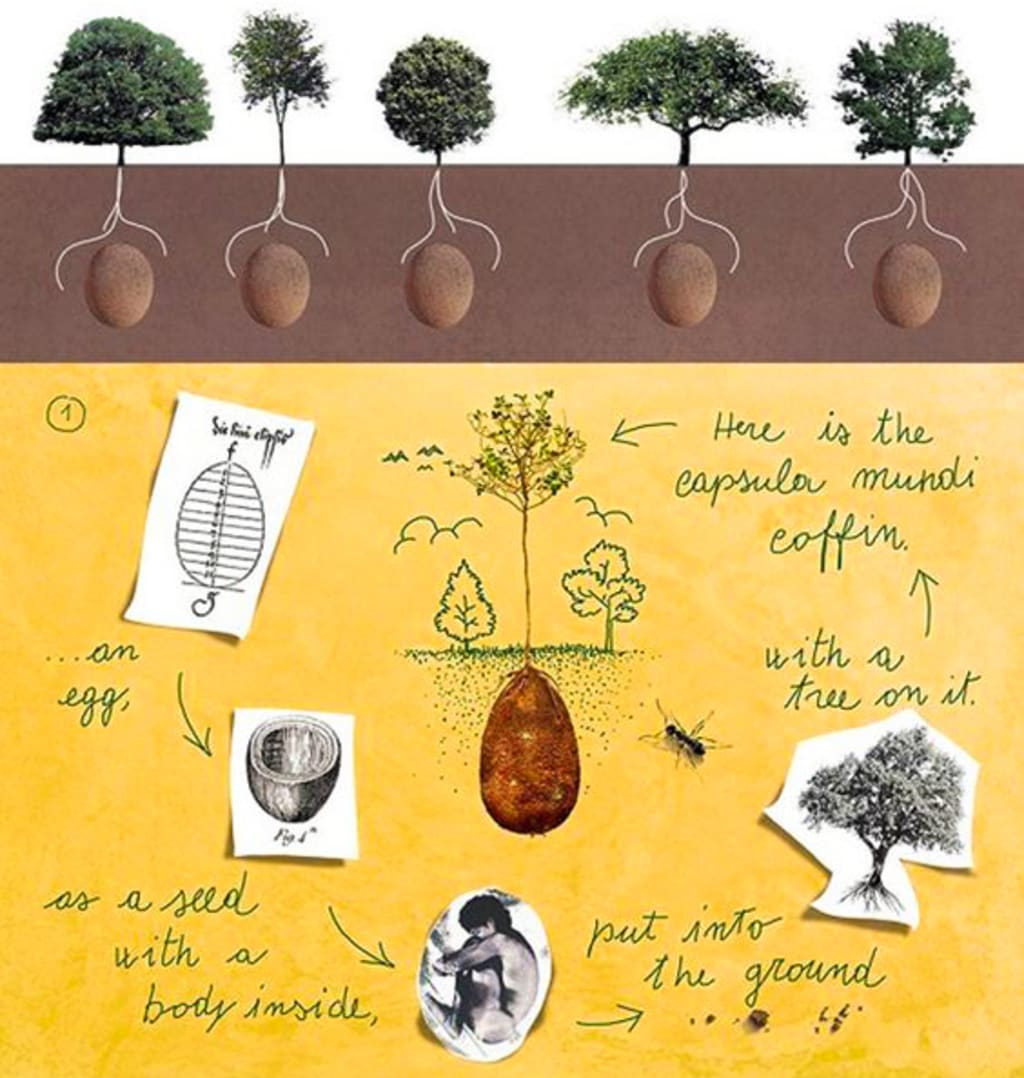
A Seed for the Soul
Imagine this: instead of being buried in a casket or cremated, your body is gently placed inside a biodegradable, egg-shaped capsule in a fetal position. This capsule is then buried underground like a seed, and a tree is planted on top. Over time, as the capsule naturally decomposes, your body returns to the earth, nourishing the soil that feeds the growing tree. Your final resting place becomes a living monument—a testament to your existence that breathes, grows, and provides shade for future generations.
The beauty of Capsula Mundi lies not just in its environmental compassion, but in its profound symbolism. The fetal position speaks to rebirth and renewal. The tree becomes a living legacy. The forest becomes a memorial garden where families can return to care for their loved one's tree, watching it grow season after season, just as they would nurture a cherished memory.
Choosing Your Legacy
What makes this concept even more personal is the choice involved. While still living, individuals can select which species of tree will grow from their capsule—perhaps an oak for strength, a cherry blossom for beauty, or a native species that supports local wildlife. Alternatively, families can make this meaningful decision together after their loved one has passed, making it a shared act of remembrance and hope.
Each tree in this "forest of memories," as the designers envision it, tells a human story. The garden becomes not a place of silence and sorrow, but a sanctuary where life continues in a new form.
Challenging Our Modern Rituals
What's truly provocative about Capsula Mundi is what it asks us: Why do modern funerals work so hard to preserve the body?
We embalm, we encase in elaborate caskets, we build marble monuments and concrete structures—all to resist what nature does automatically and beautifully: return everything to the earth. We spend enormous resources fighting decomposition, even though decomposition is how life regenerates.
Capsula Mundi invites us to question whether we've gotten it backwards. Perhaps the most human memorial isn't something static and cold—a granite headstone with dates etched into stone. Perhaps it's something alive. Something that grows. Something that shelters birds and provides oxygen. Something that connects us to the eternal cycle of life, death, and renewal that has sustained all living things since the beginning of time.
The Reality and the Dream
Currently, Capsula Mundi faces significant legal and regulatory hurdles. Burial laws vary dramatically by country, and burying human remains involves complex health codes and safety regulations. In most places, the full-body capsule burial hasn't yet become mainstream practice. The project exists largely as a concept and a statement—a beautiful provocation rather than a widely accessible option.
Yet that hasn't stopped it from capturing global imagination. Capsula Mundi has become the subject of countless conversations, documentaries, and design discussions precisely because it dares to ask uncomfortable questions about how we've organized our relationship with death and remembrance.
A More Human Monument
The legacy of Capsula Mundi may ultimately be this: it has reframed how people think about mortality and meaning-making. It's shown us that perhaps the most fitting tribute to a human life isn't measured in square feet of marble or the permanence of stone.
Instead, it might be measured in rings of wood. In the birds that nest in branches. In the oxygen released into the air. In the shade provided to strangers. In the way a child points at a tree in a memorial forest and asks, "Who was this tree?"
Because maybe—just maybe—the most human memorial isn't something we carve into stone and leave behind. It's something that continues to breathe, to grow, and to give back to the world long after we're gone.
The future of how we honor our dead may very well be green.
About the Creator
S.Phairat
We bring you concise summaries of fascinating articles and stories across various topics news, science, technology, culture, and everyday life.
Enjoyed the story? Support the Creator.
Subscribe for free to receive all their stories in your feed.
Comments
There are no comments for this story
Be the first to respond and start the conversation.