

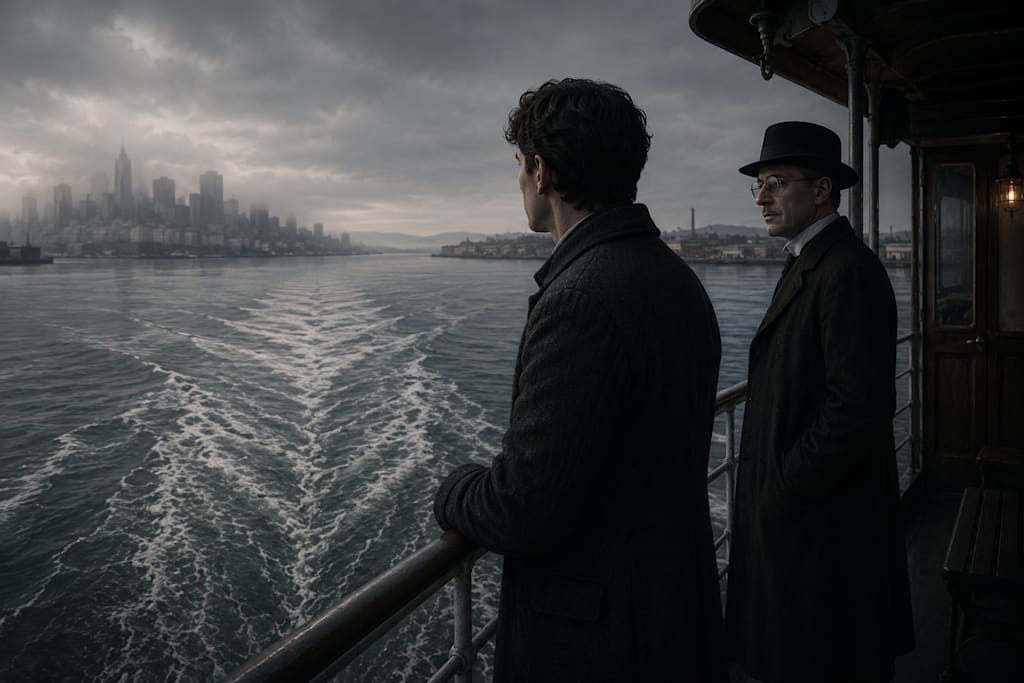
The man in silver spectacles was watching Daniel.
“You understand,” he said, “that I don’t deal in claims.”
Daniel kept his eyes on the horizon. “I’m not selling one.”
“No,” the man said. “You’re asking me to believe one.”
A pause.
“That requires terms.”
Daniel frowned slightly. “Terms?”
“Yes.” The man folded his hands behind his back. “A demonstration that cannot be explained away as instinct, or luck, or clever reading of men.”
“That’s not how this works.”
“Then that,” the man said mildly, “is precisely what I intend to test.”
Daniel turned to him. “You think you can box it in?”
“I think,” the man replied, “that if something is real, it will survive being given stakes.”
His mind shifted, briefly, toward the distant oval of the track.
“Small predictions are cheap,” he went on. “They cost nothing to be wrong about. People forget them. Excuse them.”
He looked back at Daniel.
“But money—” a slight pause “—money is remembered. Accounted for. Questioned.”
Daniel’s jaw tightened. “So this is about profit?”
“No,” the man said. “This is about consequence.”
A beat.
“If you are wrong,” he continued, “I lose money.”
“And if I’m right?”
The man’s expression didn’t change.
“Then I lose the ability to dismiss you.”
Daniel asked, “You want to test a vision?”
The man was quiet for a moment.
Not thinking—
selecting.
“There’s a track across the bay,” he said at last. “Oakland. Afternoon card.”
Daniel didn’t respond.
“Public,” the man went on. “Measured. Watched closely enough that chance has to behave itself.”
A faint pause.
“If your… sight holds,” he added, “it will hold there.”
He reached for his coat.
“Come,” he said
The ferry cut a slow line through the bay, its wake folding the gray water back on itself.
Daniel stood at the rail.
The city behind them—San Francisco—rose through a thin veil of fog, solid and unaware. Ahead, the low stretch of Oakland waited in a flatter light, the racetrack beyond it a dark oval carved into pale ground.
He didn’t like the distance.
It didn’t lessen the pressure.
If anything, it spread it out—thinner, wider, harder to locate.
“You’re very quiet,” the man in silver spectacles said beside him.
“I told you,” Daniel replied. “This isn’t a good idea.”
“And yet,” the man said mildly, “you came.”
Daniel didn’t answer.
Because that part was true.
The track was louder than the city.
Not in volume—San Francisco roared in its own way—but here the noise had a different quality. Sharper. Focused. Contained inside the ring of the oval and thrown back at itself.
Men with folded programs. Women under hats pinned too precisely. Bookmakers calling odds with voices worn thin from repetition.
Order.
Measured risk.
Daniel felt it immediately.
And underneath it—
that same faint pressure.
Waiting.
“You said you could prove it,” the man said as they moved along the rail. “Something small. Harmless.”
“There’s no such thing,” Daniel said.
“Then we’ll pretend there is.”
They stopped near a bookmaker’s stand.
A chalkboard listed the entries for the sixth race.
Numbers. Names. Odds shifting in small, restless increments.
The man glanced at it, then at Daniel.
“Well?” he said.
Daniel didn’t look at the board right away.
He watched the track instead.
A horse was being led past—sleek, dark, restless under the hand of its handler. Muscles moving under skin like coiled wire.
Normal.
Everything was normal.
That was the problem.
He exhaled slowly.
“Don’t do this,” he said.
The man’s mouth curved faintly. “You’ve said that before.”
Daniel closed his eyes.
Just for a second.
And the world tilted—
Not fully.
Not a vision.
A pressure line.
A narrowing.
Like something in the sequence ahead was… tightening.
He opened his eyes and looked at the board.
His gaze didn’t settle on the favorite.
Didn’t settle on the long shot.
It caught—
and held—
on one name.
“Five,” he said quietly. “Stardust.”
The man followed his gaze.
Brows lifted slightly.
“Not to win,” Daniel added. “To place.”
That came out with more resistance than it should have.
Like saying it fixed something in place.
The man studied him a moment longer.
Then nodded once.
“Very well.”
The bookmaker barely looked up.
“One hundred to place on number five,” the man said.
That got attention.
A glance.
A quick recalculation.
Then a ticket slid across the wood.
“Race six,” the bookmaker said. “You’ll collect if she comes in first or second.”
“I’m aware,” the man replied, taking the ticket.
He didn’t look at it.
He looked at Daniel.
By the time the sixth race was called, the stands had thickened.
Noise built in layers.
Daniel stood still, eyes on the track.
Not the horses.
Not yet.
The edges of things.
The way movement lined up.
The way it failed to line up.
“There,” he said suddenly.
The man turned.
The horses were being brought toward the gate.
Stardust—number five—moved cleanly. Controlled. No sign of trouble.
Nothing wrong.
Daniel’s jaw tightened.
“That’s not it,” he murmured.
“What isn’t?”
“I don’t know.”
The words came sharp.
Too sharp.
The man said nothing.
He was watching now.
Really watching.
The gates snapped open.
The field broke.
Clean start.
Too clean.
The favorite surged forward immediately, taking the rail with confidence. Stardust settled mid-pack, running steady, unremarkable.
The crowd leaned into it.
Voices rose.
This was the part they understood.
Daniel didn’t.
Because the pressure hadn’t released.
It had… shifted.
The race stretched down the back straight.
Positions held.
Then—
A stumble.
Not Stardust.
The horse ahead of her clipped stride—just enough to falter, just enough to force a correction behind it.
A ripple through the field.
Stardust adjusted.
Moved up.
Not aggressively.
Just… there.
Where she hadn’t been a moment before.
Daniel’s fingers curled at his sides.
“That’s wrong,” he said under his breath.
“Looks right enough to me,” the man replied, though his tone had cooled.
They rounded the far turn.
The favorite still led.
Another horse pressed for second.
Stardust held third—
then edged forward—
then held—
then—
The finish came in a blur.
The favorite first.
A tight line for second.
Too close to call.
The crowd broke into noise.
Relief. Frustration. Argument.
Daniel didn’t move.
He was watching the aftermath.
Because the pressure hadn’t gone away.
It had… paused.
They waited.
Numbers flickered on the board.
Then:
Official Order: 3 – 7 – 5
Stardust third.
No payout.
The man glanced at Daniel.
One brow raised.
Daniel didn’t react.
Because something inside him had tightened again.
Harder this time.
“No,” he said quietly.
A commotion near the track.
Voices—sharper now.
An official moving quickly.
Another following.
A flag raised.
“Objection,” someone said.
“Interference on the stretch.”
The words moved through the crowd like a current.
People turned.
Programs flipped open.
Eyes scanned, recalculated.
Daniel felt it.
That same grinding pressure—
but now it was moving backward.
Reaching into what had already happened.
The man beside him went still.
Completely still.
Minutes stretched.
Arguments at the rail.
Gestures.
Handlers talking too fast.
Finally—
The board changed.
Slowly.
Reluctantly.
Official Order Revised: 3 – 5 – 7
A disqualification.
The second-place horse dropped.
Stardust moved up.
Second.
Placing.
The bet was now valid.
The crowd didn’t cheer.
Not really.
There were sounds—voices, reactions—but they weren’t clean.
Too many people recalculating what they had just seen.
What they thought they had seen.
“It’s paid,” the man said quietly.
But he didn’t move toward the bookmaker.
He was still watching the board.
As if waiting for it to change again.
At the stand, the bookmaker took the ticket.
Looked at it.
Looked at the board.
Then back at the man.
A pause.
Not long.
But enough.
“Strange race,” he said.
“Seems so,” the man replied.
The money was counted out.
The correct amount to the cent.
No argument.
But the bookmaker’s hand lingered a fraction longer than necessary before letting go.
Not anger.
Not suspicion.
Something closer to… dissatisfaction.
As if the outcome had followed the rules—
but not the spirit of them.
They stepped away.
The noise of the track folded back in behind them.
For a moment, neither of them spoke.
Daniel stared out at the oval.
At the churned dirt.
At the place where the order had changed.
“It didn’t happen the way I saw it,” he said.
The man turned to him slowly.
“No,” he said. “It didn’t.”
Daniel shook his head once.
“I said she would place.”
“And she did.”
“Not like that.”
The man studied him.
Longer this time.
More carefully.
“You’re troubled,” he said.
Daniel let out a breath.
“Because it moved,” he said. “It wasn’t fixed. It—”
He stopped.
Because the thought had finished itself.
The man’s voice came, quiet and precise:
“It corrected.”
Daniel looked at him.
The man held his gaze.
“You didn’t tell me what would happen,” he went on. “You told me where it would end.”
A beat.
“And the world arranged the rest.”
Daniel felt something sink in his chest.
Cold.
Heavy.
“That’s not—” he started.
But he had no word to finish it with.
The man glanced back once at the track.
Then at the money in his hand.
Then back to Daniel.
“It isn’t the winning that concerns me,” he said.
“No?”
“It’s the way the race refused to stay decided.”
Daniel said nothing.
Because he had felt it too.
That moment—
when the outcome had already happened—
and then changed anyway.
They stood there a moment longer.
The noise continued around them.
Normal again.
As if nothing had been disturbed.
The man folded the money carefully.
Slipped it into his coat.
Then:
“How many things,” he asked quietly, “have you already seen… that haven’t finished deciding yet?”
Daniel’s throat tightened.
He didn’t answer.
Because for the first time—
he wasn’t sure the answer would stay true long enough to matter.
The shop was quieter than before.
Not empty—never empty—but the noise of the street seemed to stop at the door now, as if it had learned not to press too hard against the glass.
Daniel stood just inside, hat still in his hand.
The bell had rung.
The man in silver spectacles had looked up.
And this time, there had been no surprise in it at all.
“You’ve made a habit of this,” the man said, setting aside the coin he’d been examining.
Daniel stepped forward.
“I won’t stay long.”
“You never do,” the man replied. “Though you leave more behind each time.”
Daniel didn’t answer that.
He came to the counter and stopped, palms resting lightly on the glass.
For a moment, he just looked at the man.
Alive.
Whole.
Still fixed in place.
“You asked me for proof,” Daniel said.
“And you gave me something that paid,” the man replied. “Though I’m not convinced it behaved properly.”
“It didn’t,” Daniel said.
A flicker of interest.
“No,” the man said. “I don’t think it did.”
Silence settled between them.
Not empty.
Waiting.
Daniel drew a breath.
“This isn’t about the races,” he said. “Not really.”
“I assumed as much.”
“There’s going to be an earthquake.”
The man didn’t react immediately.
Not disbelief.
Not acceptance.
Just attention sharpening into something finer.
“You’ve said as much before,” he said.
Daniel nodded once.
“Morning,” he added.
That word came harder than it should have.
Like it resisted being fixed.
“Morning,” the man repeated.
“Yes.”
A pause.
“How certain?”
Daniel didn’t hesitate.
“Certain.”
That, at least, was allowed.
The man tapped one finger lightly on the counter.
“And where,” he asked, “am I in this certainty of yours?”
Daniel’s jaw tightened.
“In the city.”
“That’s rather broad.”
“In your shop,” Daniel said.
That came out too fast.
Too clean.
And for a moment—
the air shifted.
Not a full vision.
Just that same pressure—deep, grinding, as if something had taken note.
The man saw it.
Saw the way Daniel stilled.
The way his breath caught just slightly.
“Go on,” he said quietly.
Daniel forced himself forward.
“You go back inside,” he said. “After it starts.”
“Why?”
“I don’t know.”
A lie.
Or something like one.
Because he had seen—
smoke, heat, the doorway—
—but the reason wouldn’t hold still long enough to speak.
The man considered that.
Then:
“And then?”
Daniel’s mouth opened.
Closed.
The pressure rose—
sharp now—
like a line drawn too tightly—
He looked at the man—
saw, for an instant, the stillness where there should be movement—
—and the words failed.
He shook his head.
“It doesn’t matter,” he said. “What matters is this—”
He leaned forward, just slightly.
“Be out of town in the morning.”
The words landed.
Clean.
Final.
For a moment, nothing moved.
The man did not answer immediately.
He studied Daniel the way he might study a coin whose authenticity was in question—not for what it showed, but for what it failed to show.
“Out of town,” he said at last.
“Yes.”
“How far?”
“It doesn’t matter.”
“When should I leave?”
“Before it happens.”
A faint smile touched the man’s mouth.
“You see the difficulty.”
Daniel’s hands tightened on the glass.
“I’m telling you what I can.”
“And I’m trying to understand what that is,” the man replied.
He straightened slightly.
“You’re very precise in some places,” he went on. “And curiously vague in others.”
Daniel didn’t respond.
Because there was no answer that wouldn’t make it worse.
“If I am not here,” the man said slowly, “then the man you saw in your… vision…”
He let the word hang, testing it.
“…he isn’t me.”
Daniel’s chest tightened.
“He is you.”
“Then how can that be, if I leave?”
Daniel didn’t answer.
Because the question had already formed in him—
and found no solid ground.
The man leaned forward now, mirroring Daniel’s earlier posture.
“Am I meant to leave?” he asked.
The words were soft.
But there was weight behind them.
Not curiosity.
Inquiry.
Daniel hesitated.
Just long enough.
“I don’t know,” he said.
That, again, was true.
The man watched him.
And something shifted—not in the room, but in his understanding.
“You’re not giving me instructions,” he said.
Daniel frowned.
“What?”
“You’re giving me… boundaries.”
He tapped the counter once.
“Not where to go. Not what to do.”
Another tap.
“Where not to be.”
Daniel felt that land.
Harder than anything else so far.
“Just don’t be here,” Daniel said, the edge creeping into his voice now. “That’s enough.”
The man tilted his head slightly.
“Is it?”
“Yes.”
“And if I leave,” he continued, “what happens to the version of me that does not?”
Daniel’s breath caught.
Because that—
that was the question he had been avoiding.
“I don’t know,” he said again.
Silence.
Longer this time.
Outside, a wagon rattled past. Somewhere, a voice called out. The world went on, indifferent.
Inside, the air felt tighter.
More defined.
“You keep telling me where not to stand,” the man said at last.
Daniel looked up.
The man met his gaze steadily.
“You haven’t told me where I’m supposed to be.”
The words settled between them.
Heavy.
Unanswered.
Daniel straightened slowly.
“I don’t think there is a right place,” he said.
“No?”
“I think there are… fewer wrong ones.”
A faint, thoughtful expression crossed the man’s face.
“That’s a very different sort of map.”
Daniel reached into his coat, fingers brushing the key.
For a moment—
just a flicker—
the shop leaned.
A crack where there was no crack.
A line through the street outside that did not yet exist.
He closed his hand.
The world steadied.
“Morning,” the man said again, almost to himself.
Daniel nodded.
“Yes.”
The man picked up his loupe.
Turned it once between his fingers.
Then set it down again.
“I’ll consider it,” he said.
Not agreement.
Not refusal.
Something in between.
Daniel held his gaze one last moment.
Trying to see—
not the future—
but the shape of what might still move.
There was nothing.
Only the man.
Present.
Fixed.
Thinking.
“Be out of town,” Daniel said again.
Softer this time.
Not command.
Not plea.
Just… a condition.
He turned and walked to the door.
The bell rang as he stepped out.
Clear.
Uncertain.
Behind him, the man in silver spectacles did not return to his work.
He stood very still, one hand resting lightly on the glass.
And for the first time—
he was not deciding whether Daniel was right.
He was deciding what it meant—
if he was.
He closed the shop earlier than usual.
Not abruptly—nothing that would invite questions—but with a quiet efficiency that bordered on ritual. Cases locked. Curtains drawn. The ledger brought out and opened to the last entry.
He paused there.
Ink drying. Line unfinished.
For a moment, his pen hovered.
Then he set it down without completing the thought.
At home, his wife looked up from the table as he came in.
“You’re early.”
“Opportunity,” he said, removing his coat. “A piece I’ve been chasing. It’s surfaced in Sacramento. I gathered up the best of the collection to trade for it.”
She studied him.
“That sounds like you,” she said. “It doesn’t sound like tonight.”
“It won’t wait.”
“And it won’t wait until morning?”
“No.”
That answer came too quickly.
He softened it.
“I’d rather not risk losing it.”
She leaned back slightly, folding her hands.
“And I’m coming with you?”
“Yes.”
A beat.
“Why?”
He met her eyes.
“Because I’d like you to.”
Not a lie.
Not the whole truth.
Something in between.
The station was busier than expected for that hour.
Porters moving quickly. Lamps burning a little too bright. Voices carrying farther than they should.
He purchased the tickets without trouble.
That, more than anything, unsettled him.
No hesitation. No delay. No complication.
Just—
available.
“Two to Sacramento,” the clerk said, tearing the stubs. “Departing shortly.”
He took them.
The paper felt lighter than it should have.
On the platform, steam drifted low along the ground, curling around boots and hems like something undecided.
His wife slipped her arm through his.
“You’re certain about this?” she asked.
He nodded.
“Yes.”
“Because you look like a man who’s forgotten something important.”
He glanced back once.
The direction of the city.
Not the shop—too far to see—but he knew exactly where it stood.
Door closed.
Cases locked.
One light left burning.
A space still shaped around him.
“I haven’t forgotten,” he said.
That was the part that troubled him.
They boarded.
The carriage was half full. Travelers settling in, adjusting bags, folding coats.
Ordinary.
He took a seat by the window.
As the train lurched into motion, he kept his gaze fixed outward.
The platform slid away.
Then the station.
Then the first lines of the city beyond.
For a moment—
just a moment—
something didn’t align.
A street angle wrong by a degree.
A building that seemed to lean before correcting itself.
He blinked.
It was gone.
His wife watched him.
“You’re doing it again,” she said.
“What?”
“Looking at things like they might change if you don’t.”
He almost smiled.
“They might,” he said.
The train gathered speed.
Steel on steel. Rhythm settling in.
Distance forming.
Behind them, San Francisco receded into darkness and fog.
Ahead, the line stretched clean and certain toward Sacramento.
He sat back slowly.
Hand resting against his coat.
Against the small case he had chosen to bring—the heart of it.
Not everything.
Just what mattered.
“You’re not running,” his wife said quietly.
It wasn’t a question.
He looked at her.
“No,” he said.
“Then what are you doing?”
He considered that.
Listened to the steady, measured sound of the rails.
Felt, beneath it, something else—
not pressure now
but alignment.
“I’m being somewhere else,” he said.
She frowned slightly, as if the answer almost made sense.
Almost.
Then she let it go.
Outside, the dark fields passed in long, unbroken stretches.
The city behind them continued as it always had.
Lights.
Motion.
Lives unfolding.
Unaware.
And somewhere in that distance—
though no clock marked it yet—
morning was already on its way.
About the Creator
Mark Stigers
One year after my birth sputnik was launched, making me a space child. I did a hitch in the Navy as a electronics tech. I worked for Hughes Aircraft Company for quite a while. I currently live in the Saguaro forest in Tucson Arizona
Enjoyed the story? Support the Creator.
Subscribe for free to receive all their stories in your feed. You could also become a paid subscriber, letting them know you appreciate their work.
Comments
There are no comments for this story
Be the first to respond and start the conversation.