
The Smuggler’s Bargain
Chapter Thirty-Nine The Gap

The Smuggler’s Bargain
The Gap — The Zodiac Bronzes
The Williams family’s limousine pulled to a stop on a narrow street overlooking the Seine.
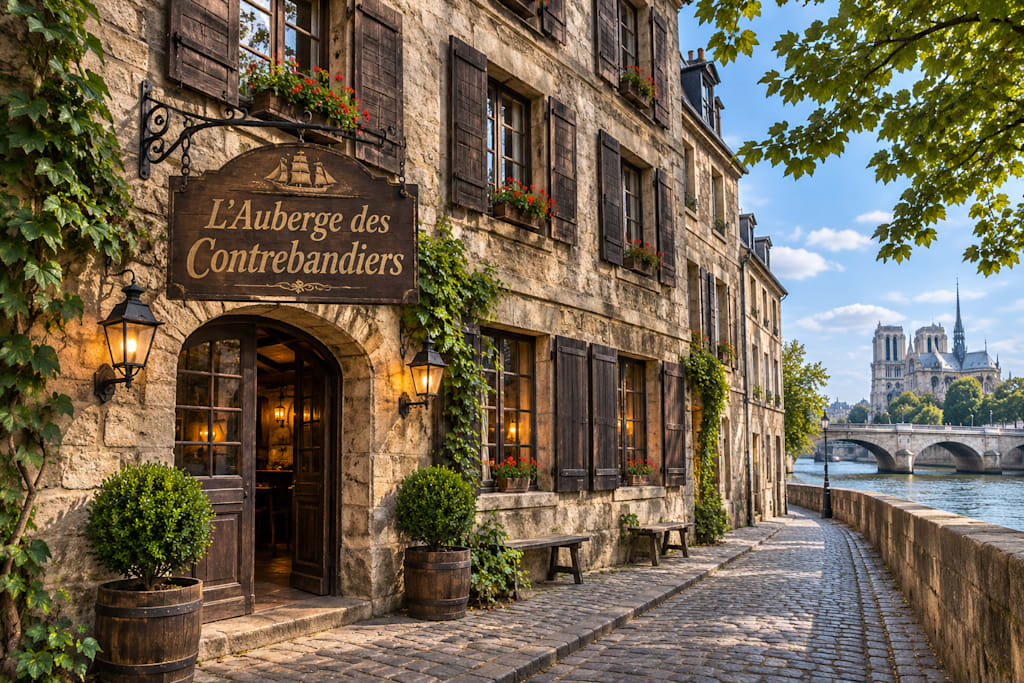
The building before them was four stories tall, constructed of weathered limestone with dark wooden shutters and a faded sign hanging above the entrance.
L’Auberge des Contrebandiers.
The Smugglers’ Inn.
Jack studied the building through the window.
“That’s it.”
Chas looked at the old structure.
“Doesn’t look like much.”
“It’s nearly four hundred years old, Dad.”
“That explains why it looks like it needs painting.”
Vicky laughed.
“Chas, it’s charming.”
“That’s what people call old buildings when they don’t want to say they’re falling apart.”
Jazz looked up from her tablet.
“Are we staying here?”
“No,” Chas replied. “We’re staying at a hotel with elevators that work.”
“Good.”
Duke raised his head from the floor of the limousine.
“THE BUILDING HAS BEEN RENOVATED SEVERAL TIMES, CHAS. STRUCTURALLY, IT IS IN REMARKABLY GOOD CONDITION.”
“Thank you, Link. I’ll try to contain my enthusiasm.”
The family climbed out of the limousine.
Inside, the inn was considerably more attractive than its exterior suggested.
Heavy wooden beams crossed the ceiling, and the stone walls were decorated with antique prints of sailing vessels and old maps of Paris.
A small reception desk stood near a staircase.
Behind it was a gentleman in his late sixties with silver hair, a neatly trimmed mustache, and the unmistakable bearing of a man who considered himself the master of his establishment.
He looked up as they entered.
“Bonjour. May I help you?”
Chas stepped forward.
“Good morning. I’m Charles Williams. I believe we spoke on the telephone.”
The gentleman’s expression changed.
“Ah! Monsieur Williams. The American.”
“That’s me.”
“I am Henri Moreau. Welcome to my inn.”
They shook hands.
Henri looked at the family, then down at Duke.
“And you have brought everyone.”
“Afraid so,” Chas replied. “We travel as a group.”
Henri smiled.
“Even the dog?”
“Especially the dog,” Jazz replied.
Duke sat politely.
“BONJOUR, MONSIEUR MOREAU.”
Henri stared.
The dog stared back.
After a moment, Henri looked at Chas.
“Your dog speaks?”
“Only when he has something to say.”
“Remarkable.”
“He’s also very opinionated.”
“THAT IS AN UNFAIR CHARACTERIZATION, CHAS.”
Henri laughed.
“Well, this promises to be an interesting visit.”
Chas smiled.
“Actually, that’s what we’re hoping.”
Henri led them into a small sitting room overlooking the river.
Coffee was brought, along with a plate of pastries.
After everyone was seated, Henri folded his hands.
“Now, Monsieur Williams. You said on the telephone that your son was interested in the old passage beneath my inn.”
Jack nodded.
“Yes, sir.”
Henri studied him.
“You are the young American who discovered those bronze sculptures in Poland and England.”
“Yes.”
“I read about you in the newspaper.”
“Then you know what we’re looking for.”
“I know what you have found. That is not quite the same thing.”
Jack smiled.
“No, sir. It isn’t.”
Henri leaned back.
“The passage is real. It dates from a time when goods entered Paris without the benefit of customs officials.”
“Smuggling,” Jazz said.
Henri smiled.
“An unpleasant word for a very profitable occupation.”
Chas laughed.
“I like the way you think.”
“The passage connects an old storage cellar beneath the inn to an entrance near the river. It has not been used for its original purpose in more than a century.”
“Can we see it?” Jack asked.
Henri raised one finger.
“Before we discuss that, I have a question.”
Chas nodded.
“Go ahead.”
“Do you believe there are valuable objects hidden in my building?”
Jack glanced at his father.
“Yes, sir. I believe there are three bronze sculptures concealed somewhere in the old passage.”
Henri was silent for a moment.
“And these are like the six sculptures you have already discovered?”
“Exactly.”
“Which the newspapers say may be worth millions?”
“Possibly,” Chas replied. “Nobody has established their value yet.”
Henri nodded thoughtfully.
“Then I believe we should discuss an arrangement.”
Chas smiled.
“I was wondering when we’d get to that.”
Henri reached for his coffee.
“You see, Monsieur Williams, I am a businessman. My inn is not a museum, and my cellar is not an archaeological excavation.”
“I understand.”
“If your son wishes to search my property, there must be conditions.”
“Naturally.”
“First, you will pay for any damage.”
“Agreed.”
“Second, the work must not interfere with my guests.”
“Reasonable.”
“Third, any alterations must be restored to my satisfaction.”
“Agreed.”
Henri paused.
“And fourth, I wish to receive seven percent of the value of whatever you discover.”
Chas raised an eyebrow.
“Seven percent?”
“Precisely.”
“That’s a rather specific number.”
Henri smiled.
“I considered ten.”
“What happened to ten?”
“I decided seven sounded more reasonable.”
Jazz laughed.
Chas leaned back in his chair.
“Seven percent of what?”
“The value of the objects you find.”
“Appraised value or sale price?”
“Appraised value. I understand you do not intend to sell the sculptures.”
Chas studied the Frenchman.
“You’re well informed.”
“I read the newspapers, Monsieur Williams.”
“And suppose Jack finds nothing?”
Henri spread his hands.
“Then seven percent of nothing is nothing.”
Chas chuckled.
“Can’t argue with that.”
Jack leaned forward.
“Mr. Moreau, we’re not interested in damaging your building. The previous hiding places used mechanical releases. I believe this one does too.”
Henri looked interested.
“A mechanical release?”
“Yes. Something built into the structure to open a concealed compartment.”
“And you know where it is?”
“Not exactly. But I have instructions.”
Henri glanced at the old mathematics book lying beside Jack.
“From that book?”
“Yes, sir.”
Henri considered this.
“An extraordinary business, all of it.”
Chas took another sip of coffee.
“Let me ask you something, Henri.”
“Certainly.”
“Suppose those bronzes are worth a million dollars apiece.”
Henri’s eyes widened slightly.
“Three million dollars?”
“Just suppose.”
“Then my seven percent would be two hundred and ten thousand dollars.”
“Exactly.”
Henri smiled.
“I am very good at arithmetic, Monsieur Williams.”
“So I see.”
Chas set down his cup.
“But there’s one more condition.”
Henri’s smile faded slightly.
“Which is?”
“If we find the sculptures, the seven percent buys out your financial interest in them. No additional claims, no negotiations afterward, and no arguments about ownership. Subject, of course, to whatever French law requires.”
Henri considered that.
“And you will pay seven percent of an independent appraisal?”
“Yes. By a qualified art appraiser acceptable to both of us.”
“Even if you never sell them?”
“Even if I never sell them.”
Henri looked at Jack.
“And the sculptures will go to your museum in America?”
“That’s the plan,” Jack replied. “We want to keep the collection together.”
Henri nodded slowly.
“I read what your father said in the newspaper. That someone had hidden these objects because they wanted them to survive.”
“That’s right.”
“And you believe the artist was Jewish?”
“We don’t know yet,” Jack replied. “But it’s possible.”
Henri looked toward the window.
“My grandfather was a boy during the German occupation. He used to tell me stories about those years.”
The room grew quiet.
“Paris was not always the beautiful city you see today,” Henri continued. “There were times when people disappeared, and their possessions disappeared with them.”
He looked back at Jack.
“If these sculptures were hidden to protect them from the Nazis, I would be pleased to see them preserved.”
Chas nodded.
“Then we understand each other.”
Henri smiled again.
“Almost.”
Chas sighed.
“What now?”
“I would like the agreement in writing.”
“Of course.”
“And I would like to be present when the compartment is opened.”
“Certainly.”
“And if there is a secret mechanism in my cellar, I want to know how it works.”
Jack grinned.
“That makes two of us.”
Henri extended his hand.
“Seven percent, Monsieur Williams.”
Chas shook it.
“Seven percent.”
Duke, who had been lying quietly beside Jazz, raised his head.
“CHAS, I SHOULD POINT OUT THAT YOU HAVE JUST AGREED TO PAY A SUBSTANTIAL SUM OF MONEY FOR THREE OBJECTS THAT MAY NOT EXIST.”
Chas looked down at him.
“Thank you, Link.”
“YOU ARE WELCOME.”
Henri laughed.
“Your dog is a very cautious businessman.”
“He’s worse than my accountant.”
“AND CONSIDERABLY MORE ACCURATE.”
Jazz giggled.
Henri stood.
“Very well. My solicitor can prepare the agreement this afternoon. Once it is signed, I will show you the passage.”
Jack looked disappointed.
“Not before?”
Henri smiled.
“Young man, that passage has been waiting for more than a hundred years. I believe it can wait another few hours.”
Chas laughed.
“He’s got you there, Jack.”
Jack closed his mathematics book.
“All right.”
Henri walked toward the door, then stopped.
“There is one thing you should know.”
Jack looked up.
“What?”
“The passage has been inspected many times over the years. I myself have examined every corner of it.”
“And?”
“There is nothing there.”
Jack smiled.
“That’s what they said about the other two hiding places.”
Henri studied him for a moment.
Then he smiled too.
“Then perhaps, Monsieur Williams, we shall both have a very profitable afternoon.”
As Henri left to telephone his solicitor, Chas turned toward his son.
“Well, Jack, you’ve done it again.”
“What?”
“Found another man willing to let you search his building.”
“That’s good, isn’t it?”
“Depends on how much seven percent turns out to be.”
Jazz picked up her purse.
“Speaking of money, Mom and I were thinking of doing some shopping while you wait.”
Chas closed his eyes.
“Of course you were.”
Vicky smiled.
“Paris does have some wonderful jewelry shops.”
Duke looked at Chas.
“SHALL I INCLUDE THE SHOPPING EXPENSES IN THE COST OF THE TREASURE HUNT?”
“No, Link.”
“ANOTHER EXCELLENT DECISION.”
Jack laughed.
He looked down at the old mathematics book.
Three more bronzes.
Cancer, Scorpio, and Pisces.
Somewhere beneath this four-hundred-year-old inn, a secret had survived nearly a century.
And if his calculations were correct, the secret was hidden behind a dripping water pipe.
He only hoped the pipe was still there.
About the Creator
Mark Stigers
One year after my birth sputnik was launched, making me a space child. I did a hitch in the Navy as a electronics tech. I worked for Hughes Aircraft Company for quite a while. I currently live in the Saguaro forest in Tucson Arizona
Enjoyed the story? Support the Creator.
Subscribe for free to receive all their stories in your feed. You could also become a paid subscriber, letting them know you appreciate their work.
Comments
There are no comments for this story
Be the first to respond and start the conversation.