
The Satchel
Chapter Seven of The Harvest

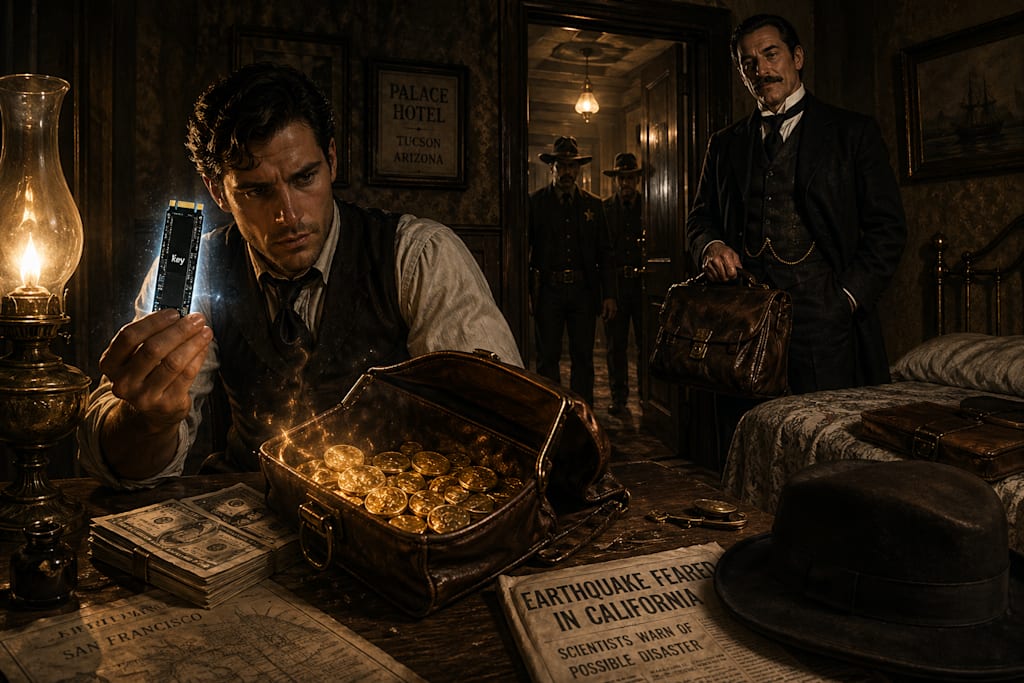
Daniel sat alone in the private room of the bank, the heavy steel door shut behind him. On the table lay the leather satchel Dr. Vey had given him and beside it, wrapped in a handkerchief, the strange electronic key.
The banker had asked no questions. Men with money were allowed privacy.
Daniel unwrapped the key slowly.
It looked like a M.2 memory blade marked key.
He turned it in his fingers.
“A key to what?” he muttered.
He looked at the satchel.
Inside were paper banknotes—useful enough money, but ordinary. Dr. Vey had wanted this object badly enough to lie, cheat, and chase. Men did not behave that way over trinkets.
Daniel remembered Vey’s words, the strange confidence in them, the way he seemed less surprised by anything than any man Daniel had ever met.
He placed one hand on the satchel and the other on the key.
“If you’re magic,” Daniel said, half ashamed of himself, “show me something worth the trouble.”
Nothing happened.
He laughed once.
Then, without knowing why, he spoke more firmly.
“Instead of paper money, let this satchel hold gold coins. Old ones. Rare ones.”
The room went still.
The air tightened like the moment before lightning.
The key grew hot.
Daniel jerked but did not let go.
A sharp metallic rustle came from inside the satchel. Not the soft slide of paper, but the clink and tumble of heavy metal striking metal.
He stepped back, breathing hard.
Slowly, he opened the bag.
Gone were the notes.
Inside lay stacks of bright gold coins, thick and heavy, each stamped with worn kings, strange shields, sailing ships, eagles, and dates from long before Arizona was a territory. Spanish doubloons. Mexican escudos. American eagles from vanished years. Coins no honest cashier could explain.
Daniel picked one up.
Real weight. Real gold.
He stared at the key.
“Well now,” he whispered.
He understood two things at once.
Dr. Vey would never stop hunting for this object.
And Daniel Ryder had no intention of giving it back.
Night settled over Tucson in layers of violet dust and lantern glow. The town had gone quieter, though never silent. Somewhere a piano thumped through an open saloon door. A dog barked twice and gave up.
Daniel Ryder sat alone in the rented room above the livery stable. On the washstand lay the M.2 memory blade key, no larger than a stick of gum, black and gold, with its tiny contacts catching the lamplight.
It looked ridiculous.
A thing from centuries ahead. A sliver of metal and circuitry that had opened doors no one in 1900 could imagine. Men had lied, killed, and crossed time for it.
And right now it sat beside a cracked shaving mug and a bar of lye soap.
Daniel turned it over in his fingers.
“You caused enough trouble,” he muttered.
He had learned something about the key. It answered intention as much as touch. Not magic exactly—some advanced recognition system wrapped around materials science beyond his understanding. If he held it and pictured a thing clearly enough, sometimes the thing bent.
Money had changed.
Locks had opened.
Metal had remembered shapes it never had before.
So Daniel gathered what he could find: a broken pocket watch plate, two brass collar stays, a bit of silver wire, and the thin steel spring from a ruined harmonica reed.
He laid them in a row.
Then he placed the key atop them.
Nothing happened.
He exhaled through his nose. “Fine.”
He closed his hand over the blade and concentrated—not on copying technology, which he could not understand, but on function.
A twin.
A decoy.
Something that would look right, weigh right, answer right—long enough to fool a proud man in a hurry.
The metal pieces trembled.
The lamp flame bent sideways though no wind touched it. A faint tone filled the room, high and distant, like a glass rim being sung.
Daniel did not move.
The brass softened first, running like wax without heat. The silver wire unwound itself and curled around the dark blade. The watch plate flattened thinner than paper. Tiny sparks stitched across the contacts of the real key.
Then pain hit him—sharp behind the eyes.
He nearly let go.
Instead he gritted his teeth and held the image steady.
A copy. Good enough to deceive. Not enough to rule anything.
The tone rose higher.
With a snap, the pieces separated.
Daniel jerked back.
On the washstand lay two blades.
The original looked unchanged—sleek, black, precise.
Beside it rested its brother. Same size. Same contacts. Same weight when he lifted it.
But not the same.
This one felt colder. Hungrier somehow. When he touched it to the lamp base, the flame surged bright blue for an instant, then shrank again. A pulse of power with no depth behind it.
A mimic.
Daniel smiled for the first time that day.
Down in the street, wagon wheels rattled past. Somewhere far laughter rose from the saloon.
He wrapped the true key in oilcloth.
The false one he placed in the satchel.
Then he sat on the edge of the bed and waited for Dr. Vey to come claim his victory.
Morning light slanted through the lace curtains of Daniel Ryder’s room at the Palace Hotel.
He had been awake since dawn.
The real satchel lay hidden above him, tucked through a loosened ceiling panel he had pried back with a butter knife. Inside it were the rare gold coins, heavy as fate, and the true key.
Under the bed, where any fool with authority would look first, rested the second satchel.
That one held newly formed paper money and the copy.
Daniel sat on the edge of the mattress, boots on, coat buttoned, hat ready. He heard footsteps in the corridor long before the knock came.
Not one man.
Three.
The knock was hard enough to rattle the basin.
“Mr. Ryder,” called a stern voice. “Open in the name of the law.”
Daniel opened the door at once.
The sheriff stood there broad-shouldered and dusty, one hand near his revolver. Beside him, neat as a banker at church, stood Dr. Vey in a dark frock coat, gloves folded over one wrist, expression composed and regretful.
“Mr. Ryder,” Vey said sadly, “I had hoped there was some misunderstanding.”
Daniel looked only at the sheriff.
“What misunderstanding is that?”
The sheriff cleared his throat.
“This gentleman reports a satchel of cash stolen from his wagon, along with a personal article of great sentimental value.”
“Sentimental,” Daniel said.
Vey gave a small nod. “A keepsake of my late father.”
Daniel almost smiled.
The sheriff stepped inside. “We’ll search the room.”
“You’ve come all this way,” Daniel said. “Seems a shame not to.”
The deputies began at once—opening drawers, checking the wardrobe, peering beneath the washstand. One dropped to his knees and looked under the bed.
“Well now.”
He dragged out the satchel.
Vey’s eyes flicked to it with a hunger he hid almost perfectly.
The sheriff set it on the table and opened the clasp.
Stacks of bills.
On top of them lay the copied key.
Vey inhaled sharply and then softened it into relief.
“Yes,” he said quietly. “Yes, that is mine.”
The sheriff turned to Daniel with disappointment more than anger.
“Anything to say?”
Daniel shrugged.
“Only that a man ought to keep better watch over his belongings.”
One deputy laughed before catching himself.
Vey snatched up the key and slipped it into his pocket with studied calm. He gathered the satchel close.
“You see?” he said to the sheriff. “An unfortunate lapse of judgment by a young man tempted by opportunity. I shall not press charges if the property is returned.”
The sheriff seemed grateful to avoid paperwork.
“You’re fortunate, Ryder.”
“I often am.”
The sheriff pointed a finger at him. “Best leave town before fortune changes.”
Daniel tipped his hat.
The lawmen filed out. Vey paused at the threshold and glanced back.
There was triumph in his smile, but also something narrower—uncertainty.
He knew he had won too easily.
Then he was gone.
Daniel waited until the footsteps faded down the stairs.
He crossed to the bed, listened once at the door, then climbed onto the chair and pushed aside the loose ceiling panel.
The real satchel dropped into his arms with satisfying weight.
He opened it.
Gold coins winked in the dim room.
Wrapped among them lay the true key, black and silent.
Daniel grinned.
“Sentimental,” he said.
By noon he was seated in a westbound railcar, the Palace Hotel shrinking behind him, Tucson flattening into dust and distance.
San Francisco waited ahead—fog, crowds, ships, money, and a city large enough for a man to disappear.
Somewhere back in town, Dr. Vey was about to discover the difference between possession and victory.
About the Creator
Mark Stigers
One year after my birth sputnik was launched, making me a space child. I did a hitch in the Navy as a electronics tech. I worked for Hughes Aircraft Company for quite a while. I currently live in the Saguaro forest in Tucson Arizona
Enjoyed the story? Support the Creator.
Subscribe for free to receive all their stories in your feed. You could also become a paid subscriber, letting them know you appreciate their work.
Comments
There are no comments for this story
Be the first to respond and start the conversation.