
The History of Mobile Phones
From Brick to Smart Revolution

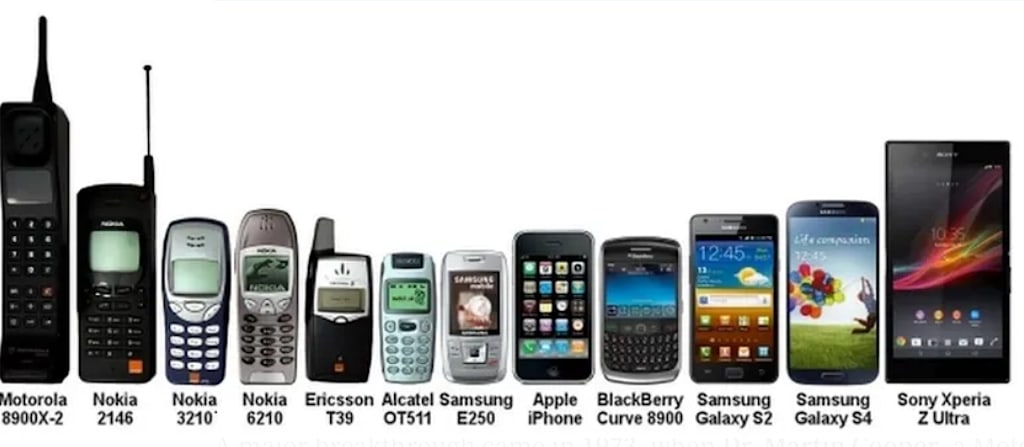
The story of mobile phones is a remarkable journey of innovation, miniaturization, and connectivity. What began as a bulky device used only by a select few has evolved into an indispensable tool that connects billions of people across the world. Here’s a closer look at the key milestones in the history of mobile phones.
1. The Birth of the Mobile Concept (1940s–1970s)
The origins of mobile communication trace back to the 1940s, when engineers began experimenting with radio telephony in vehicles. Early systems were primarily used by military, police, and emergency services. These devices were large, heavy, and dependent on powerful radio towers with very limited range.
A major breakthrough came in 1973, when Dr. Martin Cooper, a Motorola executive, made the first public mobile phone call on a prototype device weighing nearly 2.5 pounds. This call, made on the streets of New York City, marked the beginning of the mobile revolution.
2. The First Generation (1G) — Analog Era (1980s)
The 1980s saw the commercialization of mobile phones with the introduction of 1G networks, which used analog signals. The first commercially available mobile phone was the Motorola DynaTAC 8000X, released in 1983. It offered 30 minutes of talk time, 8 hours of standby, and sold for nearly $4,000.

These phones were large, had poor battery life, and limited network coverage. Yet, they laid the foundation for future development.
3. The Digital Leap: 2G and SMS (1990s)
The 1990s brought the second generation (2G) of mobile technology, transitioning from analog to digital networks like GSM (Global System for Mobile Communications). This shift improved call quality, reduced interference, and allowed for text messaging (SMS), which quickly became a cultural phenomenon.

Phones became smaller, more affordable, and began to include features like monochrome displays, phonebooks, and basic games — including the iconic “Snake” on Nokia handsets.
4. The Mobile Internet and 3G (Early 2000s)
In the early 2000s, the introduction of 3G technology enabled mobile phones to access the internet at usable speeds. Devices such as the BlackBerry and early Palm Treo models catered to business professionals, offering email, web browsing, and early app ecosystems.

Color screens, cameras, and multimedia capabilities began to appear, marking the beginning of the mobile phone’s transformation into a multi-functional tool.
5. The Smartphone Revolution (2007–2010s)
A major turning point came in 2007, when Apple introduced the iPhone. It combined a sleek touchscreen interface with powerful computing capabilities and an intuitive operating system. The iPhone set the standard for the modern smartphone, and soon after, Android devices emerged, leading to intense innovation and competition.

The launch of app stores (Apple’s App Store in 2008 and Google Play shortly after) revolutionized how people used phones. Smartphones became hubs for communication, productivity, entertainment, and social media.
6. The 4G Era and the Age of Connectivity (2010s)
With the rise of 4G LTE networks, mobile internet became fast enough to stream HD video, conduct video calls, and run complex cloud-based apps. Smartphones also saw advances in hardware — HD displays, multi-lens cameras, fingerprint sensors, and voice assistants became standard.
Mobile phones played a pivotal role in shaping social behavior, economies, and even political movements through their role in spreading information and connecting people globally.
7. The 5G Era and Beyond (2020s–Present)
Today, 5G networks are rolling out globally, offering even faster speeds, lower latency, and the ability to connect billions of devices, fueling the rise of the Internet of Things (IoT), augmented reality (AR), and autonomous technologies.
Modern smartphones now function as powerful computers with AI-driven features, biometric security, professional-grade cameras, and more. Foldable phones, wearable integration, and sustainability concerns are shaping the next chapter of innovation.
From a clunky tool for elite professionals to a pocket-sized supercomputer used by nearly everyone, mobile phones have come a long way. Their evolution is not just a story of technological progress but also one of social transformation. As we step into an increasingly connected world, the mobile phone remains at the heart of how we live, work, and communicate.
About the Creator
Enjoyed the story? Support the Creator.
Subscribe for free to receive all their stories in your feed.
Comments