
The Death of the Queen - Act I, Scene I
A Play in Four Acts


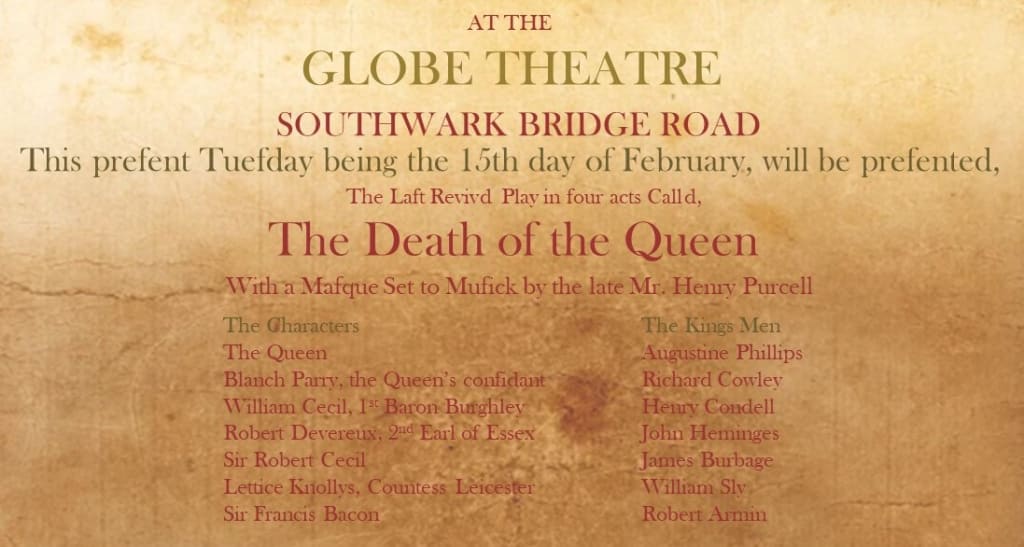
When I taught in the English department at the Naval Academy, my office was across the hall from a professor who specialized in Elizabethan and Jacobean era literature and music. Every summer break she would spend happily ensconced in the Parker Library medieval manuscript collection at the Corpus Christi College in Cambridge.
Although her primary interest was English music from the baroque era, during a sabbatical year at Cambridge she stumbled upon a play manuscript she had never encountered prior. There are several anonymously written plays from that era, but this one somehow was missed or ignored by the prominent specialists in her field. She added a framed copy of the playbill and the play to her office arcana, but to my knowledge did nothing else with her discovery.
At the time, I asked her if I could make a copy of the play for myself and photograph the play bill. Of course, I quickly forgot all about both as one does with such things.
But a couple weeks ago, while looking for something else entirely, I stumbled upon the printed photo of the play bill and the manuscript copy in a box of my teaching materials where they had moldered for almost a quarter century. Naturally, I did not find what I was looking for.
After rereading the play, I thought it might be fun to share this curiosity with my friends on Vocal.
Although it's a little hard to read, please note that the play bill shows that the musical accompaniment for the performance was by Henry Purcell, widely regarded as the greatest of the English Baroque era composers. And for science and philosophy geeks, Sir Francis Bacon is one of the characters!
Included herein please find Prologue and Act I/Scene I. I edited it a little to improve reader comprehension, but left it as close to the original spelling, vocabulary and syntax as I dared. I'll continue posting a Scene at a time till all four Acts are fully posted. Hopefully breaking it up in several iterations will make it easier to digest for those of you interested in reading it in its entirety.
Please drop me a note if you enjoy arcana like this. I always have a bit of this and a bit of that to share from my research files.
...
THE DEATH OF THE QUEEN - A PLAY IN FOUR ACTS
PROLOGUE
Parliament is begun and I trust will be short, for matters of moment to pass are not many, reviving some old laws and methinks the grant of subsidy. Her majesty the Queen is dead. Let the tuckets sound, and beat the drums
With solemn order. The Queen returns to Whitehall from the palace by water, the oars at every stroke tears will let fall, multitudes in the streets and gutters stand to behold the passing of their Queen. Grant me thus the
Turn of an hour to remember her whilst our hearts are heavy with sadness. We are not living in eternity. We have only this moment, sparkling like a star in our hands and melting like a snowflake. Let me speak while breath
Remains, not to tell of a cold and virgin queen, but to render the inner countenance of the woman beneath bejewel'd crown heavy and brow caved by woe. An Author's silence befits art more than love of one's own wit,
For absent heart, a poet's words gain only laurels of self-love. Forget not gentle maidenhood in our pastiche, for history wilt not endear save we paint her with all too human face. Elizabeth was once young and in love.
Crowned Queen, she vowed with the Lordes of England faire counsel to guide and make an accounting to God that comfort and posterity might forever abide. But the enterprise of states as great engines moves slowly,
Subject to the wil of mighty princes and fortune both il and kind. Twas not her Majesty's pleasure to take husband, though suitors many, and advisors did entreat whom she aught to under lie. But the lone heart she dared love
And might have wedd’d, her counselors character marr'd. Sir Robert Dudley, Master of the Horse, drew cruel calumny and lies, 'The queen wil listen to none but unto him,' they sneered, 'sometimes she is faine to
Come to his bedside to entreat.' None but blinde fortune's augury testify'd how rumors of secret love might ensnare when marriage betwixt like minds but unlike states offend the commonweal. She named Sir Robert
Earl of Leicester to gentle his estate and make him fit for her royal bed. But her counselor’s whisper'd murder most foul and warned of traitorous plots when Robert's wife Amy fel to her death, the Queen a virgin stil.
ACT I.
SCENE I.
The Queen's chambers. The Queen sits alone wearing widow's weeds. She mourns for Robert Dudley, the late Earl of Leicester.
Enter Blanch Parry, confidant of the Queen
Q.E. No visitors, Blanch, we pray thee. We’ve not the heart to condole nor suffer the simpering of another well-wisher. We pray they go to the devil if it make our Robert whole.
Bl. The Baron Burghley, Mum, he has news from the continent. He is most insistent.
Q.E. Tiresome old Jephthah. Send him away. Can ye not see we are unwel?
Bl. He has threatened to break down the door.
Q.E. Think'st he a prince? Tell him let us keen!
Bl. Very well, Mum.
Exit.
The Queen opens her treasure chest and withdraws a letter and presses it to her breast.
Q.E. Can thou hearest me from thy perch in heav'n's jewel'd courts, dearest one? The weight of the crown is most oppressive whil thou art so very far away. We might have married and made thee as happy as ever was any, but for our burden, this kingdom, this crown.
We hold thy last letter upon our heart, deare Robert. We might have put thee in possession of a kingdom, to lay in thy naked arms a most faire lady.
Fie, fie, fie upon the cruel fates. And fie upon thee, Robert, for marrying that she-wolf, Lettice Knollys. A traitor and cuckold thou art! Why after rising to high station and shewn extraordinary favour, could you have in such contemptible manner broken the commandment of love?
Oh, that you stil lived, Robert, I might yet wring your heart with this my grief. How could ye forget that we loved thee, and thou once loved us in return? How could thee betray us for that red haired counterfeit, that wigged rump, that plague sore, that sodden-witted loon!
Heaven knows truly that thou wert false. Fie, fie, fie upon thee and thine!
Why Robert? Why didst thou wait to repent till Death's cold arms encircled tightly about thee? If we had but known, we would have flown to thee for our last embrace. Fie, fie, fie!
The Queen weeps. At the sounds of battering upon the door she returns the letter to her treasure box. The door bursts open and Baron Burghley enters.
Q.E. How dare thee invade our private chambers when we are yet unpainted and unwigged? Dost thou forget thyself, William?
B.B. The kingdom is in need of its Queen, Mum. This is most unseemly.
He points at her widow's weeds.
Q.E. The Armada defeated not seven weeks hence, can we not have a few hours to grieve?
B. B. It's been eight days, Mum. And the Armada is defeated, not destroyed. The threat of Spanish invasion yet remains.
Q.E. Dost thou mean to fright us with false fire, William?
B.B. I mean to warn thee, Mum. With malice and rage does Spain conjure hurt upon your majesty and thy people and blow fresh coals of division upon the continent. Thou knowest that foreign attempts against thy crown are seldom plotted without false friends at home. We must look to it.
Q.E. Any word from Marlowe?
B.B. He meets with the privy council on the morrow.
Q.E. Very weal. Report to us after. We know thou love us, William, but leave us anon, I beg. And mind thy station in the future!
He bows.
Exit.
About the Creator
John Cox
Where would you like to travel? Who would you like to meet? No ticket required, a surprise at every destination guaranteed. Strap on your time travel goggles and bring a compass. It's sometimes bumpy in my imagination, so hold on tight!
Enjoyed the story? Support the Creator.
Subscribe for free to receive all their stories in your feed. You could also become a paid subscriber, letting them know you appreciate their work.
Comments
There are no comments for this story
Be the first to respond and start the conversation.