

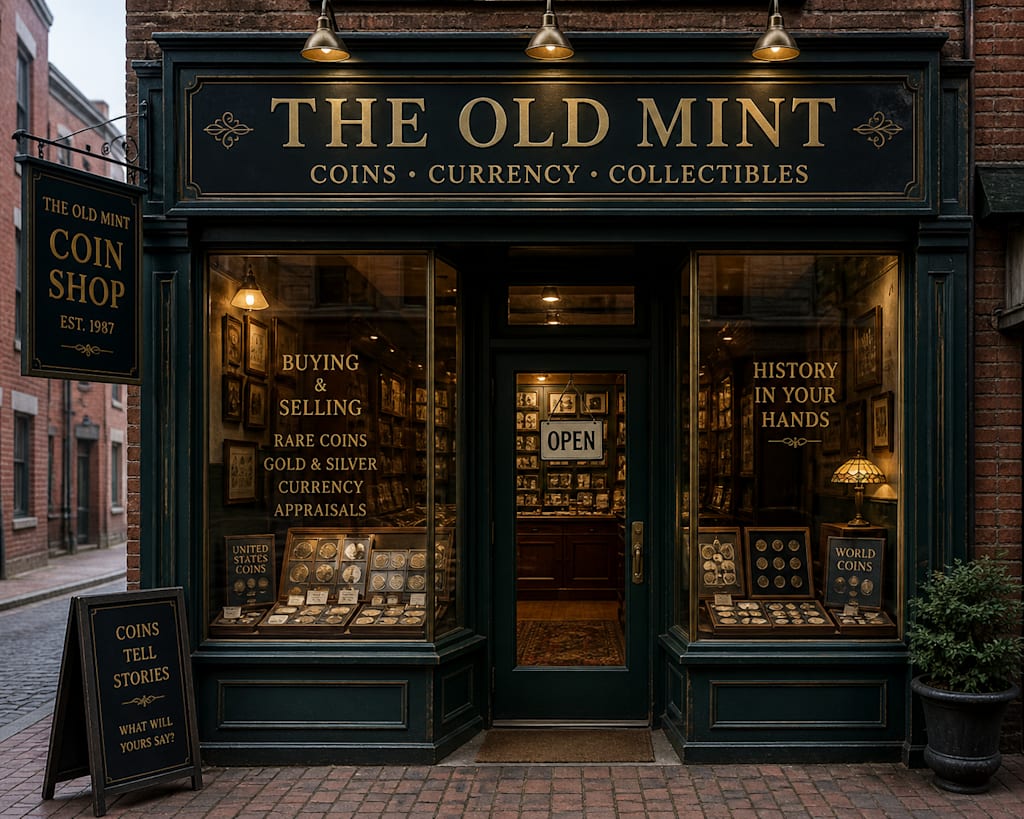
The shop sat narrow and deep, its windows crowded with coins that caught the gaslight like small, captive suns. A bell chimed as Daniel stepped inside.
Behind the counter, a thin man in silver spectacles looked up.
“Buying or selling?”
“Selling.”
Daniel reached reached into the satchel, pulled out one coin, and sat it on the glass.
The man did not touch it at first. He leaned closer, eyes narrowing, then carefully lifted it.
Silence stretched.
“Well,” the man said softly, “that is something.”
He turned it once, twice, then reached for a loupe.
“This is… not a piece one expects to see walk in off the street.”
“Will you buy it?” Daniel asked.
The man ignored the question.
“The wear is wrong. The strike is wrong. And yet…” He glanced up. “Where did you get this?”
Daniel’s voice stayed even. “Will you buy it?”
A pause.
Then the man nodded slowly. “Yes. At a price that assumes I am either very clever… or very foolish.”
He named the figure.
Daniel didn’t react. “Done.”
The money changed hands quickly after that.
Too quickly.
The coin disappeared into velvet. The notes into Daniel’s satchel.
The transaction closed like a book.
But the man behind the counter was still watching him.
“You should be careful, Mr…?”
“Ryder.”
“Yes. Careful, Mr. Ryder. Objects like that have a way of attracting questions.”
Daniel gave a faint smile. “So do answers.”
He stepped back into the street.
The city hit him all at once—noise, motion, heat.
A cable car clanged past. Horses strained in their traces. Someone laughed too loudly just behind him.
Daniel took three steps.
Stopped.
Something shifted.
Not outside.
Inside.
A pressure—deep, grinding, immense—like the earth itself had drawn a breath and was holding it.
The glass in a nearby window gave a thin, trembling hum.
Daniel’s head snapped toward it.
“No…”
The street vanished.
For an instant—
Buildings tore open like paper.
The ground heaved.
A roar, too large to be sound, filled everything.
Dust swallowed the sun.
Daniel staggered.
His hand shot out and caught a lamppost.
Cold iron.
Solid.
Real.
The vision snapped away.
The street came back whole—intact, crowded, alive.
But Daniel was still gripping the post like a drowning man.
“Hey—!”
A laugh broke near him.
“Easy there, friend,” a passerby said. “Started early, didn’t you?”
Another voice: “Man can’t hold his liquor past noon.”
A couple of men slowed, grinning. One mimed a sway, mocking him.
Daniel didn’t answer.
His breath came sharp.
He looked at the buildings.
Whole.
He looked at the street.
Unbroken.
But he had felt it.
Not imagined.
Felt it.
His grip tightened on the lamppost until his knuckles whitened.
“Not yet,” he whispered.
A woman passing gave him a wide berth, pulling her child a little closer.
“Come along,” she murmured. “Don’t stare.”
Daniel forced himself to let go.
The iron left a chill in his palm.
The world moved on around him, indifferent.
Normal.
He reached into his coat and touched the key.
It lay quiet.
But the echo of that moment—the tearing, the weight, the certainty of it—still rang through him.
They thought he was drunk.
Daniel swallowed once.
“If it was just that,” he said under his breath.
Then he turned and walked deeper into the city that, for a heartbeat, he had already seen destroyed.
He made his way to the rail office before sunset.
“I need passage out,” he told the clerk. “First train east.”
The clerk flipped through a ledger.
“Tomorrow morning,” he said. “Plenty of seats.”
“I’ll take one.”
Names were written. Money exchanged.
Simple.
Clean.
Daniel stepped back into the street with the ticket in his hand.
For the first time since arriving, the pressure eased.
He exhaled.
“Good,” he said. “That’s that.”
He got a room, and he dreamed of the quake. He woke with the sensation of the floor still moving, his hand gripping the bedframe hard enough to ache.
That morning the train did not leave.
A coupling failure, they said.
Repairs would take the day.
Daniel watched from the platform, jaw tight.
“Tomorrow, then,” the clerk assured him.
He went back to the hotel. That night he drempt of whole streets burning in rows, flames moving faster than men could run.
The next day, a landslide farther up the line.
Nothing passed.
“Unusual,” the clerk admitted. “Very unusual.”
He went back to the hotel, and when he slept he dreamed of desperation the use of dynamite to try and open fire breaks. Men shouting, fuses hissing, then explosions that did nothing but feed the fire.
On the third day, Daniel did not go to the station.
He stood instead on a rise overlooking the city, fog drifting between the buildings, the bay a dull sheet of pewter beyond.
He had the ticket in his pocket.
He could try again.
He already knew.
Every step away had frayed, slowed, failed.
Not dramatically.
Precisely.
He reached into his coat and drew out the key.
For a moment, the city shifted.
Not enough to be called a vision.
Just a misalignment.
A building leaning where it should stand straight.
A line of street cracked where it should run smooth.
He closed his hand.
The world settled.
Daniel looked out over San Francisco—alive, crowded, unbroken.
He shook his head. Then he saw them dead in the streets.
“No.”
The bodies lay in the rubble, crushed and torn apart. He did not move.
One of them looked almost familiar. A thin man in silver spectacles.
His gaze moved across the carnage, the broken streets, the shattered rooftops, the narrow lines of shadow between.
Understanding came slowly, like something rising through deep water.
“They’re holding me here.”
The key lay silent in his palm.
But the certainty of it pressed through him, heavier than gold.
Not showing him what might come.
Not warning.
Placing him.
Daniel slipped the key back into his pocket.
Behind him, the city moved and breathed and laughed.
Ahead of him, though no clock marked it, something vast was already on its way.
About the Creator
Mark Stigers
One year after my birth sputnik was launched, making me a space child. I did a hitch in the Navy as a electronics tech. I worked for Hughes Aircraft Company for quite a while. I currently live in the Saguaro forest in Tucson Arizona
Enjoyed the story? Support the Creator.
Subscribe for free to receive all their stories in your feed. You could also become a paid subscriber, letting them know you appreciate their work.
Comments
There are no comments for this story
Be the first to respond and start the conversation.