
The Bridge
In 2019, I came back from Mexico carrying more questions than answers.
In 2019, I came back from Mexico carrying more questions than answers.
I spent nearly a month in a hotel near the Port of Los Angeles, trying to decide what came next. Acting had already given me more than most people ever get. Speaking roles on television. Short films. Projects I had helped produce myself. Years of training, auditions, small victories, and the stubborn belief that eventually someone would look at the work and understand what I was capable of.
I went to see an agent in South Los Angeles who was supposed to help me get my career moving again. Another young woman was there for the same kind of meeting. The agent seemed delighted to speak with her.
Then she reached my résumé.
She glanced at it, shrugged, and treated me as though I had done nothing. As if the years of work, the speaking parts, the films, and the effort amounted to barely enough experience to stand quietly in the background of someone else’s scene.
I left angry, but underneath the anger was something worse.
I felt invisible.
Whenever life became too loud, I went looking for wilderness.
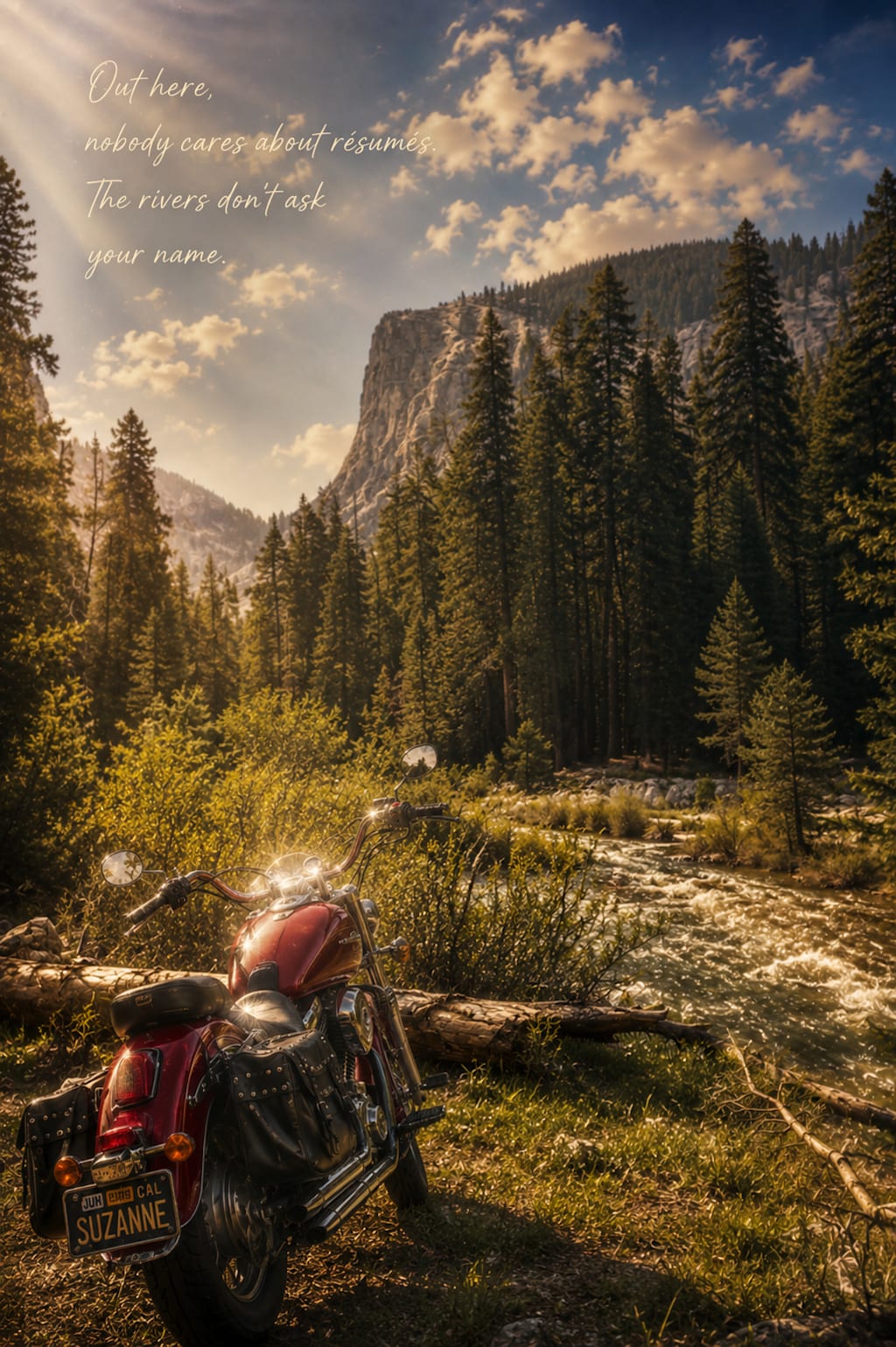
So I rode north on Suzanne, my Honda Shadow 750, and disappeared into Sequoia National Park for five days.
There were giant trees older than nations, crystal-clear water, mountain air, and long stretches of road where the only sound was the motorcycle beneath me. Out there, nobody cared about résumés. The sequoias were unimpressed by Hollywood. The rivers did not ask whether I had booked a television role.
They simply existed.
For a few days, that was enough.
I decided to continue toward Kings Canyon and took a road called Ten Mile Road. I was wearing a plaid hiking shirt because it was too hot for leather.
Halfway along the road, I saw a truck approaching from a dirt turnoff. The driver stopped. He hesitated.
I slowed to around thirty-five miles per hour. I had the right of way, and I was certain he had seen me.
He had not.
The truck pulled directly into my path.
There was no time for fear. Only calculation.
Turn right, and I would hit the back of the truck.
Turn left, and I would go down the embankment toward the river below.
So I dropped the motorcycle.
Suzanne slid across the pavement. The underside of my helmet scraped along the front of the truck. My boot became trapped between the clutch peg and the pedal, twisting my foot at an angle it was never designed to reach.
When I stood up, the pain arrived.
The insurance company later declared Suzanne totaled. The tow truck driver was kind enough to take me to the hospital. I refused the ambulance. At the emergency room, they gave me a tetanus shot, took an X-ray, saw no broken bones, and sent me away.
But something was wrong.
I had torn the Lisfranc complex in my foot, an injury that can hide inside an ordinary X-ray while quietly dismantling the architecture of walking.
The insurance company eventually paid me fifteen thousand dollars.
It sounded like a large amount of money until I spent six months learning how to walk again.
Movement had always been part of my identity. When I was younger, I worked in a strip club and learned how to dance. I loved it. Later came hiking, martial arts, running, motorcycles, and the quiet confidence of knowing that my body would do what I asked of it.
Then suddenly, walking became an assignment.
Near the cabin where I lived, there was a bridge at the top of a hill. I often sat staring at it.
At first, I told myself I watched the bridge because it gave me a clear view of every car entering the neighborhood. That was true.
But it was not the whole truth.
The bridge had become a goalpost.
I would climb three flights of stairs from the cabin, make my way up the hill, and try to run. At first, the pain stopped me before I even reached the bottom.
So I walked.
Then I ran a little farther.
Then farther still.
One day, I reached the bridge.
Another day, I ran past it.
The bridge had not moved. I had.
Years later, the foot still hurts sometimes. My balance on that leg is not what it once was. Standing on one foot is harder now.
But I can still throw spinning kicks.
That counts for something.
In 2025, I injured myself again, this time tearing my biceps tendon.
During that period, I met a brunette in blue scrubs who worked in emergency medicine. She was practical where I was stubborn, cautious where I was willing to experiment, and far too perceptive for my usual defenses.
She warned me about peptides.
She told me I should not get the surgery.
We argued for hours.
One night, she challenged me with a smile.
“I bet you can’t come here and pick me up with both arms now.”
I laughed.
“Bet.”
I had the surgery.
Recovery came again, slower and uglier than confidence ever admits it will be. There was pain, infection, frustration, and the humiliation of asking an injured body to perform movements that had once been automatic.
But I had already learned the language of recovery.
It begins quietly.
One step.
One repetition.
One bridge.
Today, I can lift with both arms again.
I suppose I won the argument.
But the real victory was never proving her wrong.
The real victory was discovering that healing had become one of the central rhythms of my life.
I have been dismissed, injured, lost, and rerouted more times than I care to count. Each time, I thought I was starting over.
I was not.
I was continuing.
Suzanne never came home from Ten Mile Road. The foot never returned entirely to what it had been. The acting career did not unfold according to plan. The brunette in the blue scrubs did not remain in my life.
But the man who learned to walk again remained.
The man who ran to the bridge remained.
The man who could still dance somewhere inside a damaged foot remained.
For years, I thought strength meant becoming harder.
Now I think strength is the ability to rebuild without becoming cruel.
To lose something without deciding that everything is lost.
To feel pain and still move.
The bridge taught me that progress is rarely dramatic. Sometimes it is simply the distance between where the pain forced you to stop yesterday and where you managed to stop today.
And sometimes, after months of trying, you look up and realize the bridge is behind you
About the Creator
Alejandro Arango
A theater major, a poet, and a lover of the written word. I write to the muses that they may inspire me, and to you the reader. Hopefully you can find meaning in my words or something that will lighten your heart on this journey of life
Enjoyed the story? Support the Creator.
Subscribe for free to receive all their stories in your feed.
Comments
There are no comments for this story
Be the first to respond and start the conversation.