

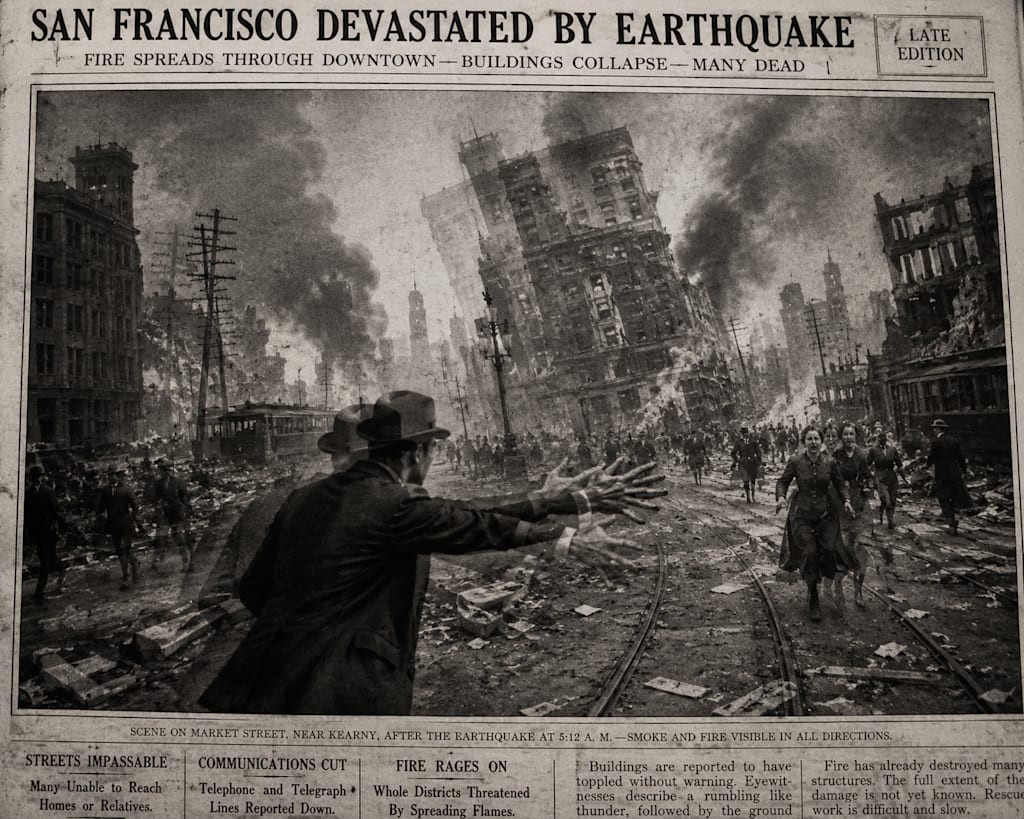
Daniel stood in a field and waited.
San Francisco spread out below him—quiet, intact, unaware.
Then the ground moved.
Not a jolt-a shift.
The kind that didn’t stop when it should.
He was thrown from his feet.
By the time he pushed himself up, the city was… wrong.
Lines broken.
Angles slipped.
Smoke where there shouldn’t be smoke
And then flame—
Not everywhere.
Not yet.
But enough.
Enough to know where it was going.
The light in Sacramento was wrong for the hour—too pale, as if it had traveled farther than it should have to reach them.
She noticed it before she knew why.
The hotel lobby was quieter than the night before. Not empty—never empty—but subdued. Voices kept low. Movements more deliberate.
On the table near the entrance, a stack of newspapers had been set out.
Not neatly.
Dropped.
She took one.
The ink smudged faintly against her fingers.
That, more than anything, made her frown.
She unfolded it.
At first, it didn’t make sense.
Not because of the words—
but because of how many of them were wrong.
Fire… damage… streets impassable… communications cut…
She turned the page.
And then she saw it.
Not a headline.
An image.
Dark columns of smoke where the city should have been.
Buildings broken open.
Light where there should have been structure.
She felt something drop, quietly, into place.
Behind her, a chair shifted.
Her husband.
“Is it bad?” he asked.
She didn’t answer right away.
Her eyes moved over the page again—
not reading now
but confirming.
Matching.
Finding the shape of something she had already been given.
Slowly, she folded the paper.
Turned.
“You knew,” she said.
Not accusation.
Not fear.
Recognition.
He didn’t respond.
That was answer enough.
She held his gaze.
“How,” she asked?
“I did a man a favor,” he said.
She waited.
“Or that’s what I told myself at the time.”
He moved to the window, though there was nothing to see but pale morning and people trying not to look at one another.
“He brought me a coin,” he went on. “One that should have been a fake.”
A small pause.
“It wasn’t.”
He let that settle, then added:
“He seemed… grateful.”
She watched him carefully now. “That’s not enough to leave a city in the night.”
“No,” he said.
Another pause.
“He had a knack,” he said slowly, “for seeing how things might turn out.”
“Might?”
He almost smiled at that. Almost.
“He picked a horse at the track,” he said. “Not to win. To place.”
He shook his head once.
“It didn’t happen the way it should have.”
His voice lowered slightly.
“But it paid.”
Silence stretched.
She didn’t interrupt this time.
“I think…” he began, then stopped.
Tried again.
“I think he saw something about me.”
“What?”
He met her eyes.
“An ending,” he said.
The word sat between them.
“He told me not to be in the city this morning.”
A beat.
“So I wasn’t.”
She held his gaze.
“And the rest?” she asked quietly.
He looked down at his hands, as if expecting to find something there that would make it easier to say.
“I didn’t think…” he said.
He stopped again.
This time he didn’t correct it.
“I didn’t think it would be this,” he finished.
“Not like this.”
She watched him for a long moment.
Not the man she had left the city with—
but the one who had chosen to leave it.
“Did he tell anyone else?” she asked.
The question seemed to catch him off guard.
He frowned slightly.
“No,” he said.
She looked back at the folded newspaper in her hands.
At the ink that still hadn’t fully dried.
At the city that was no longer where it should be.
Then back to him.
“Why you?” she asked.
He didn’t answer.
Because for the first time—
he didn’t think the answer had already been decided.
——
The city did not fall all at once.
It fractured.
San Francisco split into overlapping instants—buildings leaning in one moment, already collapsed in the next, whole streets flickering between standing and ruin as if reality could not decide what version of itself to keep.
Daniel felt it through the key before he saw it.
A pressure—not in space, but in time.
Like something enormous had inhaled.
Then the echoes began.
At first, he thought they were afterimages of shock—the mind struggling to accept catastrophe.
But the figures did not fade.
They returned.
A man on Market Street reached for a child
and reached again.
And again.
Each time the motion completed, it dissolved halfway through and reformed at the start, trapped in the same final breath of intent.
Not memory.
Not illusion.
A loop anchored to a breaking moment.
Daniel staggered as the key burned cold in his hand.
“They’re being taken,” he whispered, though no one stood near him to hear it.
Across the fractured skyline, Vey appeared not as a single presence, but as a sequence—slightly misaligned versions of him standing at impossible intervals through the collapsing geometry of the quake.
Where he moved, the echoes thickened.
People did not simply die.
They detached.
Their final moments peeled away from the falling city like glass lifting from heat, drawn into the invisible lattice Vey had threaded through the fracture to harvest the temporal extract from their cells.
And then Daniel saw it clearly.
The harvest of the rare extract.
Each death did not complete.
It was caught—pinched between seconds—held in suspension just long enough to be extracted sideways out of time.
The streets filled with repeating instants: falling, reaching, breaking, calling out—each one stuttering at the edge of completion before vanishing into Vey’s unseen system.
Not erased.
Collected.
Vey stood at the center of it all as if listening to a symphony only he could hear.
“You see it now,” his voice arrived, not from one place, but threaded through all of them at once. “The moment they were going to lose anyway.”
Daniel’s grip tightened on the key until it hurt.
Around him, the city kept dying—over and over—not as an event, but as a captured state of reality being pulled out of the world itself.
And for the first time, Daniel understood what Vey had built.
Not destruction.
Not chaos.
A mechanism that turned endings into something that could be owned.
The Key burned against Daniel’s palm.
Not heat.
Pressure.
Like something on the other side of the metal contacts of the memory blade was trying to force its way through his bones.
Below him, the city folded into smoke and motion.
Screams carried through the fractured streets of San Francisco, but they no longer sounded separate.
That was the first thing he noticed.
The sounds were merging.
A woman crying beneath falling brick.
Men shouting near the waterfront.
Glass exploding somewhere uphill.
Horse hooves.
Sirens.
Prayer.
None of it stayed distinct.
The fracture hanging above the city pulsed once—
—and suddenly Daniel heard all of it together.
One sound.
Not blended.
Focused.
As if thousands of mouths had become a single throat.
He staggered.
The Key’s contacts flashed silver.
The world lurched sideways.
And Daniel saw the dead.
Not ghosts.
Perspectives.
A child staring upward as windows burst outward into sunlight.
A dockworker turning at the exact moment the street split beneath him.
Smoke filling the lungs of a woman trapped under timber.
A fireman reaching for someone Daniel never saw.
The visions struck all at once.
Not one after another.
Layered.
Thousands of eyes opening inside his skull.
Daniel fell to one knee, clutching the Key so hard the metal the memory blade cut his hand.
“No—”
The city flickered.
For a heartbeat he saw something beneath it.
Lines.
Structures.
Invisible geometry spread through the fracture like veins through glass.
Vey.
Daniel understood immediately.
The fracture was collecting them.
Not bodies.
Endings.
Every death released something into the rupture above the city—something pulled from the final instant between life and nothing.
Temporal Extract.
The realization hit with nauseating clarity.
Vey wasn’t causing destruction for chaos.
He was harvesting resonance.
The dead were being echoed.
Repeated.
Held in the fracture long enough for extraction.
Another pulse rolled through the air.
Daniel screamed.
The sound hit him through thousands of ears.
A bell somewhere downtown rang once—
—and Daniel heard it from every street at the same time.
Different distances.
Different walls.
Different hearts stopping beneath the same sound.
His vision blurred.
Too many impressions.
Too many final moments trying to occupy the same space inside him.
Then the Key changed.
The pressure reversed.
Daniel froze.
The echoes around him bent inward slightly, drawn toward the metal in his hand.
Not destroyed.
Pulled.
Grounded.
The voices dimmed for half a second.
The fracture above the city trembled.
Daniel stared at the Key.
Understanding arrived slowly.
Horribly.
“The Key isn’t opening the fracture,” he whispered.
It was containing it.
The echoes surged again, clawing at the air around him.
And Daniel finally understood what the Key needed from him.
Not control.
Not strength.
A vessel.
Something living strong enough to absorb the resonance of the dead before Vey could harvest it.
His stomach tightened.
Because he could already feel it happening.
The memories brushing against his own.
Fear that did not belong to him.
Grief without names.
A thousand dying impressions pressing against the edges of his mind.
The Key darkened in his hand.
The fracture above the city flickered violently.
And for the first time, Vey looked afraid.
Daniel didn’t realize it had begun until the ground stopped feeling singular.
He was standing in the remains of a quiet street—somewhere between fracture zones, where the city still pretended it remembered how to be itself. The air tasted wrong. Like it had been breathed too many times and never replaced.
The Key was warm.
Not active. Not reacting.
Waiting.
Then the first thought arrived.
Not his.
A clean, precise observation:
If the pattern repeats at this interval, collapse is not accidental.
Daniel blinked.
Another thought followed immediately, overlapping the first instead of replacing it.
You’re assuming linear escalation. That’s the mistake.
Then another:
The harvest is not a consequence. It is a schedule.
He staggered back a step.
“No—” he started, but the word didn’t finish in his own voice.
It fractured halfway through and came back wrong.
The street around him sharpened.
Details he hadn’t noticed before suddenly became loud: cracks in glass, electrical hum beneath pavement, the faint pressure of distant movement in buildings that hadn’t moved yet.
And then the perspectives widened.
It wasn’t voices.
It was positions of understanding.
He wasn’t hearing people talk about the Harvest of 2030.
He was receiving the best conclusions they had ever reached about it.
A researcher:
It only triggers when temporal density crosses threshold saturation.
A field operative:
It always begins in places where death has already been rehearsed.
A mathematician:
The system optimizes for recurrence, not destruction.
A survivor:
It doesn’t happen to cities. It happens through them.
Each thought struck like a polished piece of certainty, not emotion—stripped of doubt, refined down to its most useful form.
Daniel dropped to one knee.
The Key’s contacts pressed harder into his palm.
And the next layer arrived.
Not more thoughts.
A synthesis.
As if all those minds—dead, fractured, overlapping across time—were briefly agreeing on a single inference.
The 2030 Harvest is the stabilization event.
Daniel’s breath caught.
Stabilization.
Not collapse.
Not accident.
Not disaster.
A correction.
His vision blurred, and suddenly he was seeing through too many angles at once.
A conference room he had never been in.
A coastline under different light.
A map of pressure points across continents.
A diagram of temporal fracture spread like a nervous system across the planet.
He saw people he didn’t recognize pointing at it.
He saw them hesitate.
Then proceed anyway.
Because another thought rose beneath it all—heavier than the rest, not spoken but arrived at by convergence:
If it is not harvested, it will rupture everything.
Daniel gasped.
That was the justification.
Not evil.
Not ambition.
Necessity.
And worse—consensus necessity.
The street beneath him flickered.
For a moment he wasn’t in one place anymore. He was in many.
He saw the Harvest of 2030 from multiple futures at once:
A city spared, but time unraveling behind it like thread pulled from fabric.
A city consumed, but reality held stable afterward.
A world where nothing happened—and everything began to misalign slowly, imperceptibly, until language itself failed to agree with memory.
Daniel pressed his hand to his head.
“Stop,” he whispered.
But the thoughts didn’t stop.
They refined.
One final layer formed—not a voice, not a memory, but the sharpest shared conclusion across all perspectives:
You cannot prevent the Harvest by resisting it.
A pause.
Then:
Only by redirecting where it feeds.
Daniel went still.
For the first time, the overload wasn’t just pain.
It was direction.
Not one idea.
Not one plan.
But the highest-confidence convergence of every mind he had just touched.
And buried inside it—small, almost imperceptible, but unmistakably present—
was Vey’s footprint.
Not his name.
His logic.
The same shape of thinking that turned endings into systems.
Daniel slowly rose.
The Key cooled slightly in his hand, as if acknowledging recognition.
He looked at the fractured horizon and saw it differently now—not as damage, but as infrastructure.
As if the world had already been mapped into something that could be fed.
And somewhere in that distributed intelligence, across thousands of borrowed perspectives, one final certainty settled into him like a weight becoming purpose:
The Harvest of 2030 wasn’t coming.
It was already being prepared.
About the Creator
Mark Stigers
One year after my birth sputnik was launched, making me a space child. I did a hitch in the Navy as a electronics tech. I worked for Hughes Aircraft Company for quite a while. I currently live in the Saguaro forest in Tucson Arizona
Enjoyed the story? Support the Creator.
Subscribe for free to receive all their stories in your feed. You could also become a paid subscriber, letting them know you appreciate their work.
Comments
There are no comments for this story
Be the first to respond and start the conversation.