True Crime
📖 Secrets of Silence
The shattered glass from the window still lay scattered across the floor. The wind rushed in, making the curtains sway violently. Alia shivered as she tried to steady herself, but Ayaan’s eyes still carried that same heavy fear. “What is all this?” Alia demanded sharply. “Why do you have Anwar’s file? And who is that man watching us?” Ayaan didn’t reply. He closed the file on the table, picked it up, and said quietly, “It’s not yet time to answer those questions.” Alia snapped angrily, “I’m a reporter. Finding the truth is my job. If you don’t tell me, I’ll uncover it myself!” Ayaan’s gaze remained fixed on her. After a moment, he spoke, “You want the truth? Then be ready. Truth is often like poison.” With that, he opened a copy of the file and placed it in front of her. The moment Alia saw the first page, the color drained from her face. These weren’t Anwar’s business documents— It was a black list. Dozens of names were written there—famous figures of the city, politicians, businessmen, even police officers. Beside each name was a date and a short note: “Incomplete work.” “Threat.” “Must be silenced.”
By dabeer hashmiabout a year ago in Chapters
Why TTP Attacks Are Rising in Khyber Pakhtunkhwa: Taliban’s Return, Political Discord, and Pakistan’s Counterterrorism Struggle
Earlier this month, following the viral footage of a militant attack on a military center in Bannu district of Khyber Pakhtunkhwa—showing Major Adnan Aslam of the Pakistan Army risking his life to save a wounded comrade—tributes poured in for his bravery from both public and official quarters. At the same time, many also voiced concerns over the growing wave of militant activities in the province. Looking at the recent news from different regions of Khyber Pakhtunkhwa, it appears that banned Tehrik-e-Taliban Pakistan (TTP) has been carrying out frequent attacks on Pakistan’s security forces, leaving soldiers, policemen, and law enforcement personnel dead. Field Marshal Asim Munir and Prime Minister Shehbaz Sharif visited Bannu last Saturday, where the Prime Minister urged the Taliban authorities in Afghanistan to “choose between Pakistan or TTP.” Pakistan has repeatedly claimed that the banned TTP receives support from across the border in Afghanistan, though Afghan authorities deny these allegations. Counterterrorism experts note that ever since the Taliban returned to power in Afghanistan in 2021, there has been a dramatic increase in TTP’s operations and influence in Pakistan—a fact reflected in official statistics. According to government data, more than 2,500 people were killed in TTP attacks in Pakistan in 2024. The number of attacks that year was 66% higher compared to 2023. Similarly, according to the Khyber Pakhtunkhwa Counter Terrorism Department, in the first eight months of this year alone (2025), the province has witnessed 766 incidents of militancy, killing 366 security personnel and 92 policemen. The districts worst affected include Bannu, North Waziristan, Khyber, and Bajaur. However, the Inspector General of Police for Khyber Pakhtunkhwa believes that although TTP attacks have increased, the resultant casualties are fewer compared to last year—suggesting that law enforcement agencies are dealing more effectively with the militants. Most of these attacks have been claimed by TTP, which according to a 2024 United Nations report, is the largest terrorist organization operating in Afghanistan, enjoying support from the Taliban government to launch cross-border attacks into Pakistan. The report further states that the number of TTP fighters in Afghanistan ranges between 6,000 and 6,500. Why are TTP’s attacks and influence growing? Experts say the core reason is the Taliban’s return to power in Afghanistan in 2021, which not only emboldened TTP but also provided it access to new resources. They argue that under the leadership of Mufti Noor Wali Mehsud, TTP has become far more cohesive and focused than before. Former KP IG Akhtar Ali Shah explains that whether religious extremist groups or nationalist outfits, they all exploit the governance vacuum created by weak economic, social, and judicial structures. “Because of various factors, these groups even enjoy a degree of societal acceptance. Their recruitment continues, they keep receiving funds, they have propaganda machinery, and they maintain logistics… in a sense, just like other state institutions continue their functions, they too are carrying out their own parallel operations.” After former TTP leader Mullah Fazlullah was killed in a U.S. drone strike in 2018, Mufti Noor Wali Mehsud was appointed as the new head of the organization. Experts say Noor Wali reshaped TTP’s strategy by reintegrating splinter militant groups that had broken away in the past. Security analyst Abdul Sayed notes, “From 2018, Pakistani Taliban began revising their policies to overcome the decline caused by past infighting and policies. After the 2020 Doha peace agreement between the Taliban and the U.S., these reforms became operational.” As a result, nearly 80 small and large militant groups—including major Taliban factions—rejoined TTP, fueling a surge in attacks. The group also adopted an Afghan Taliban-style centralized command system, better organizing its war against the state. For example, at the start of 2025, TTP announced a shadow structure of about 1,200 officials, establishing networks at the district and tehsil level in Khyber Pakhtunkhwa, as well as in parts of Balochistan, Punjab, and Sindh. Over time, TTP’s ideology has also evolved—from a narrow focus on enforcing Sharia through jihad to a broader narrative that now also advocates for Pashtun and Baloch rights, to project a more “popular” image. Counterterrorism expert Khurram Iqbal says, “Had the U.S. and international forces withdrawn from Afghanistan more responsibly, perhaps we wouldn’t have seen this resurgence of terrorism in Pakistan. The withdrawal was extremely irresponsible—large quantities of weapons flooded the black market, and TTP acquired advanced weaponry through this, intensifying their attacks.” He adds that while Pakistan’s military operations since 2014 achieved significant tactical success, the state failed to follow through with serious post-conflict reconstruction. “The federal government promised 100 billion rupees for the ex-FATA region, but not even a fraction of that has been invested in its development.” This lack of seriousness, he argues, has undermined the military gains. Khurram Iqbal also highlights the political discord between the federal government and the Khyber Pakhtunkhwa provincial government in recent years as another factor undermining counterterrorism efforts. He points out that over the past four years, TTP’s capabilities have increased significantly: their weapons are more advanced, their attacks more organized—all evidence of their growing operational strength. So, does this mean Pakistan’s counterterrorism strategy has failed? Khurram Iqbal says: “If you look at the data, there is little doubt. Pakistan is now the world’s second most terrorism-affected country, after Burkina Faso.” Abdul Sayed adds that Pakistan’s internal political turmoil since the 2022 change of government prevented both political and military leadership from making unified, decisive moves against TTP. “In 2022 and 2023, political instability forced the government to prioritize survival over counterterrorism. This gave TTP the space to consolidate both politically and militarily.” Where does TTP get its funding? Experts say TTP’s financial structure is systematic and hierarchical. A central finance committee supervises regional sub-committees. These regional bodies prepare daily financial reports, which are compiled into monthly audits and shared with the central committee—in other words, a complex financial operation. Journalist Iftikhar Firdous, who reports on militant groups, recalls that in 2018, TTP issued a document titled “Laiha Amal” (Plan of Action). “This document laid out a comprehensive financial model for TTP—still in use today. At its core is ‘taxation’: extorting money from areas under their control and from individuals engaged in cross-border trade. They refer to this extortion as tax.” He adds that TTP propaganda channels also share digital currency account numbers, enabling sympathizers to donate. Indeed, TTP has long collected donations via cryptocurrency. Militant groups widely use cryptocurrency for fundraising because it allows them to collect money quickly while remaining hidden from security forces—at least until a specific crypto wallet is flagged. Operation Experts note that TTP’s media wing, Umar Media, has expanded significantly in recent years to glorify militancy and spread anti-state sentiments. In January 2025, TTP revamped Umar Media, announcing a detailed organizational structure, involving nearly three dozen members. Umar Media now operates through a wide portfolio: video and audio series, regular statements, and magazines in Urdu and Pashto. It has five specialized departments for audio, video, magazines, FM radio, and social media, along with a central media commission. The group also uses platforms like Telegram and WhatsApp to disseminate content. Iftikhar Firdous notes that TTP propaganda is no longer limited to traditional platforms like CDs, which were once common among such groups. “Now they’re on almost every social media platform. Their content heavily focuses on discrediting security forces, targeting Pakistani youth. Their website servers are spread across different countries, allowing them to operate even if one server is taken down.” However, he clarifies that TTP’s actual operations are still far smaller than their propaganda presence. Over time, the group has mastered the art of propaganda. to the Past Khyber Pakhtunkhwa’s Inspector General of Police, Zulfiqar Hameed, says that while militant attacks on police and security forces have risen in the first eight months of this year, casualties are 20% lower compared to the same period last year. He credits increased vigilance and proactive countermeasures. He claims that most areas of the province are now safer, though some districts still face challenges. He expressed optimism that conditions will improve soon even in those troubled areas. According to him, the situation has “significantly improved” in the past eight months: “There are no major problems now. Highways are safe. While attacks on police were frequent at the start of the year, our operations have reduced them, and the situation is now much better.” He added that wherever a threat arises, additional forces are deployed, and targeted operations are launched—leading to the killing of key militant commanders in areas like Lakki Marwat. Would you like me to also summarize this translation into a short analytical article in English (around 800–1000 words) for publication, instead of the full-length detailed translation?
By Real contentabout a year ago in Chapters
Doha Strike on Hamas Negotiators Threatens Gaza Ceasefire and Regional Stability
The Israeli strike on Hamas leadership in Qatar has dangerously escalated tensions in the region, and analysts believe it has not only undermined ceasefire efforts in Gaza but also dimmed prospects for any new U.S.-led alliances in the Middle East. Israel has stated that the strike on a complex in central Doha was “accurate.” The residential compound was used by Hamas’s negotiating team. Ceasefire Prospects Fade Hugh Lovatt, a Middle East expert with the European Council on Foreign Relations (ECFR), said the attack on Hamas’s negotiating team has dealt a severe blow to U.S.-backed talks on a ceasefire in Gaza. Qatar, Egypt, and the United States are currently mediating between Hamas and Israel to secure a ceasefire in Gaza and the release of hostages. According to Lovatt, “Killing the very negotiators you are in talks with makes reaching any agreement far less likely.” Six Hamas-linked individuals were killed in the Israeli strike in Doha, including the son and office manager of Hamas leader Khalil Al-Hayya. However, Hamas’s senior leadership survived. Put simply, Israel targeted Hamas’s negotiating team at the very moment they were discussing U.S.-proposed ceasefire terms. Hamas leaders have lived in Qatar for years, but this was the first time Israel targeted them there. Still, Lovatt noted, “This tactic is not new in the region.” He recalled, “Last year, Israel killed Ismail Haniyeh while he was engaged in ceasefire talks.” He argued that the aim is to derail ceasefire efforts. “What the Israeli government says is irrelevant—its actions make it clear it has no interest in any ceasefire agreement.” Lovatt added that such Israeli measures will alter Hamas’s internal structure, making diplomacy even more difficult. “Israel is clearly weakening moderate figures by assassinating them, which only strengthens the hardliners who argue that Israel understands nothing but violence, not diplomacy.” In the past, Israel has also targeted Hamas leaders in Lebanon and Syria. Could the Doha Strike Have Effects Beyond Gaza? Experts warn that the Hamas strike in Doha on Tuesday could have repercussions far beyond Gaza. They note that Qatar is a key U.S. ally and has acted as a mediator between Hamas and Israel for two years. An attack inside the country sets an unprecedented example. Lovatt remarked, “This isn’t the first Arab capital Israel has bombed, but it is the capital of a U.S. ally.” “Qatar is not Tehran, not Beirut. It hosts a major U.S. airbase and has heavy Western investment.” During a press briefing, White House Press Secretary Karoline Leavitt said Israel had informed the Trump administration of the strike. But it remains unclear whether the notification came before or during the attack. She echoed President Trump’s remark that the Israeli strike in Doha “brought no benefit to either Israeli or American objectives.” However, Dr. Sanam Vakil of Chatham House’s Middle East and North Africa Program argued that the strike undermined Qatar’s security and exposed weaknesses in regional alliances. She added, “The possibility that the U.S. may have approved the attack on Hamas leadership will certainly affect bilateral ties with Qatar.” “Qatar will not sever its relations with Washington over this, but it has been thrown into uncertainty.” Vakil stressed that the Israeli strike shattered several long-standing assumptions: “It was assumed that allies don’t attack each other, nor endorse such strikes. The fact that the U.S. may have supported a violation of Qatar’s sovereignty will have implications across the Middle East.” Dr. H.A. Hellyer of the Royal United Services Institute agreed. He said states in Doha and across the region will now question “whether U.S. security guarantees have any real meaning, given Israel’s freedom to act in this way.” Still, Vakil pointed out that Qatar’s security ultimately depends entirely on the U.S., underscoring the limits of Qatar’s influence. She added, “For years it was assumed Israel would not target Hamas leadership in Qatar for the sake of diplomacy—but Israel has now shattered that notion and exploited the political and military moment.” According to Vakil, whether Trump approved the attack or not can be debated, but what is clear is that Washington does not view it as a diplomatic failure. Instead, it sees the strike as part of a broader strategic approach. “Agreements aren’t made solely at the negotiating table—you can force people to change their positions. Clearly, the U.S. president is trying to influence negotiations through other means.” Grave Consequences for the Region Both Dr. Vakil and Hugh Lovatt warned that the Israeli strike in Doha could have far more serious regional consequences. Arab officials worry that Israel is becoming not only increasingly aggressive but destabilizing in a manner largely unchecked by either the U.S. or Europe. Vakil added, “We are entering a new world, a new region, a new era with new rules. Old assumptions are collapsing.” Both analysts argued that these concerns will drive regional powers to further expand their military capabilities. In Lovatt’s view, the biggest casualty of current events may not be Israel or Palestine, but rather the credibility of the West itself.
By Real contentabout a year ago in Chapters
Qatar hosts emergency Arab-Islamic Summit after Israeli strike in Doha
Almost a week after the Israeli strike on Hamas leaders in Doha, Qatar is hosting an emergency Arab-Islamic summit on Monday. As part of preparations for the summit, a foreign ministers’ meeting will be held on Sunday, followed by the gathering of heads of state on Monday. Observers say Qatar has a historic opportunity to move beyond mere condemnations of Israeli actions and shape a joint narrative. Some experts argue that everyone is now looking toward Qatar and other regional countries to see what options they put forward against Israel. Jaber Al-Harami, editor-in-chief of the Qatari newspaper Al-Sharq, says many expectations are attached to this summit, and if no practical steps are taken against Israel, the meeting will prove meaningless. He added that the conference should not remain limited to condemnations, but rather show the world that a new regional mindset is emerging to confront Israel’s challenge. He noted that after the Israeli attack, Arab nationalism has re-emerged and is being perceived not only as an assault on Qatar but on all Arab nations. Al-Harami further said that even Israel’s allies within the Organization of Islamic Cooperation did not refrain from condemning it, which is why this Arab summit could help strengthen the anti-Israel narrative at the international level. Arab States Must Seize the Historic Opportunity Al-Harami emphasized that Arab and Islamic countries must seize this “historic opportunity,” otherwise they may never get it again. During the summit, discussions will be held on a draft resolution concerning last Tuesday’s Israeli attack, which will be finalized at the Arab and Islamic foreign ministers’ meeting on Sunday. Qatari Foreign Ministry spokesperson Majed Al-Ansari stressed in a statement that convening this Arab-Islamic summit carries multiple meanings and implications, as it reflects Arab and Islamic solidarity with Qatar. He said the summit would serve as a unified voice against “Israel’s cowardly and aggressive actions.” Lebanese author and political researcher Mahmoud Alloush believes that since the October 7, 2023 attack, Israel has become a major threat to regional peace and security. This fact is also clear to Arab states. Therefore, he said, they need to formulate a collective policy that enables them to exert pressure on Israel. He expressed hope that the summit would produce a strong political stance, showing solidarity with Qatar and condemning Israel. However, he stressed that a collective narrative alone would not be enough to face the challenges posed by Israel. According to him, there are many measures Arab and Islamic states can take to send Israel a “strong message.” He suggested that countries maintaining diplomatic and economic ties with Israel could signal a review of those relations. Alloush argued that the region stands at an important historical turning point, requiring decisive action to confront the challenges posed by Israel. Arabs Have Options Al-Harami emphasized that Arabs do have options, but they require genuine determination. He said Arab states could assert their importance by reassessing their political and economic relations with Israel and by exerting pressure on its Western allies and partners. He highlighted that Gulf states supply 40 percent of the world’s oil needs, which gives them special leverage. Al-Harami also suggested that a strategy to “tighten the noose” on Israel through international courts and organizations could be effective. On the question of whether Qatar might abandon its mediation role between Hamas and Israel, Al-Harami said this was a permanent element of Qatar’s policy and constitution. He noted that rather than ending mediation, Doha would continue its diplomatic efforts to bring an end to the war in Gaza and facilitate humanitarian aid delivery. The Doha summit will take place following a meeting in Washington between Qatari Prime Minister Sheikh Mohammed bin Abdulrahman bin Jassim Al-Thani, U.S. President Donald Trump, and several senior administration officials. That meeting was described as “positive,” with discussions covering Doha’s future role as a mediator in the region as well as defense cooperation between Qatar and the United States.
By Real contentabout a year ago in Chapters
It is surprising that the Israeli Prime Minister mentioned Pakistan twice while justifying the attack on Qatar.
It is surprising that the Israeli Prime Minister mentioned Pakistan twice while justifying the attack on Qatar. A video message from Israeli Prime Minister Benjamin Netanyahu — posted on social media over the past few hours — is being widely discussed. He released the message on the occasion of the 24th anniversary of the 9/11 attacks in the U.S., and used that context to justify Israel’s strike in Qatar. In the roughly two-minute statement, Netanyahu also referred to Pakistan and Osama bin Laden. Justifying the strike on Qatar, Netanyahu said that the United States had pursued Al Qaeda and killed Osama bin Laden in Pakistan. He warned Qatar and other countries not to shelter extremists, or Israel would continue to carry out such strikes abroad. It should be recalled that Osama bin Laden was killed on 2 May 2011 in an operation carried out by U.S. Navy SEALs in Abbottabad, Pakistan. Israel carried out an attack on Hamas senior leaders in Doha, Qatar, on Tuesday. What did Netanyahu say in his message? In the video message released by the Israeli Prime Minister’s Office on 10 September, Netanyahu began by referring to 11 September: “Tomorrow is 11 September. We remember 11 September. On that day Islamist terrorists carried out the worst brutal attack on American soil since the founding of the United States.” He went on: “We (Israel) also had our 11 September. We remember 7 October. On that day Islamist terrorists carried out the worst brutal act against Jews since the Holocaust.” Continuing, the Israeli prime minister said: “What did the United States do after 11 September? It vowed to capture those terrorists responsible for this heinous crime, wherever they may be. Two weeks later the UN Security Council passed a resolution saying governments cannot shelter terrorists.” Justifying Tuesday’s strike in Qatar, Netanyahu said: “Yesterday we acted on that principle. We did in Qatar what shelters terrorists, finances Hamas, and gives terrorist leaders magnificent palaces. Qatar gives them everything.” Netanyahu further said: “So we did what the United States did — it pursued Al Qaeda terrorists in Afghanistan and then killed Osama bin Laden in Pakistan.” Addressing the strong international reaction to the Qatar strike, the Israeli prime minister said: “Now many countries are condemning Israel. They should be ashamed. After the killing of Osama bin Laden by the United States, what did they do? Did they say ‘oh dear, Afghanistan or Pakistan has been wronged’? No — they applauded. These countries should stick to the same principles and praise Israel for upholding them.” Netanyahu warned Qatar and other countries that harbor terrorists, saying: “I tell Qatar and all countries that shelter terrorists: either expel them or bring them to justice, because if you do not, we will.” “A deplorable attempt to justify its crime”: Qatar Qatar’s Ministry of Foreign Affairs condemned Netanyahu’s comparison of the Doha strike to the U.S. pursuit of Al Qaeda, saying the Israeli prime minister’s statement was not only an attempt to justify Israel’s cowardly attack but also a shameful effort to justify future violations of state sovereignty. The statement said Netanyahu is fully aware that Hamas’s office in Qatar is hosted as part of Qatar’s mediation efforts at the request of both the U.S. and Israel. Qatar’s foreign ministry said that Netanyahu’s allegation that Qatar secretly sheltered a Hamas delegation is a deplorable attempt to justify a crime that the whole world has condemned. The ministry added that Netanyahu tried to justify the Doha attack by comparing it to the U.S. pursuit of Al Qaeda after 9/11. It also noted that Al Qaeda never had a negotiating delegation with whom the U.S. was seeking regional peace with international backing. Qatar said that despite attempts to tarnish its reputation, it continues to act as a neutral international partner for regional and global security and stability. The statement added that Qatar will take all necessary steps to defend its sovereignty and territory. Pakistan is not Qatar, and Israel is not the U.S. Netanyahu mentioned Pakistan twice in his message, prompting many social media users to comment. User Mansoor Ahmed Qureshi wrote that Netanyahu is warning Qatar to “hand over the terrorists to us or we will act.” He added that it is surprising Netanyahu mentioned Pakistan twice while justifying the Doha strike. Another user wrote, Pakistan is not Qatar and Israel is not the U.S. One user commented that “it is not right to appropriate 9/11 and use it to justify a terroristic attack on another country. The Taliban are terrorists, but the U.S. negotiated with the Taliban in Qatar; the U.S. did not attack Taliban delegations in Qatar.
By Real contentabout a year ago in Chapters
Amnesty International: Millions of Pakistanis Monitored Through Chinese Firewall and Phone-Tapping Syste
Amnesty International: Millions of Pakistanis Monitored Through Chinese Firewall and Phone-Tapping Syste Human rights organization Amnesty International has said in a report that “millions of citizens in Pakistan are being monitored through a Chinese-made firewall and phone-tapping system.” Amnesty’s latest report also claims that “Pakistan is running this surveillance and censorship system with the help of Chinese, European, and North American companies. Through it, critical content and dissenting voices on social media can be censored, which is a major example of state surveillance.” So far, the Government of Pakistan has not issued a response to this report, while Amnesty International says that the government has not replied to any of its letters on the matter. However, after a court hearing last year, on 21 August, at a Senate Standing Committee on Information Technology session, the Chairman of the Pakistan Telecommunication Authority (PTA), Major General (R) Hafeez ur Rehman, admitted that “the federal government has ordered the installation of the firewall, and the PTA is implementing it. What Amnesty International’s report claims Amnesty’s recent report states: Through the Lawful Intercept Management System (LIMS), at least 4 million mobile phones can be tapped simultaneously. Meanwhile, the Web Management System 2.0 firewall used to filter and censor internet content can block 2 million internet sessions at one time. It should be recalled that news of China’s firewall being used in Pakistan had circulated last year as well, when there were widespread complaints about severe internet slowdowns. During a court hearing on this issue, it was also revealed that telecom companies in Pakistan provide user data to intelligence agencies under a specific system called the Lawful Intercept Management System. According to the European Telecommunications Standards Institute, “lawful interception” means allowing the government access to private communications such as telephone calls or email messages. Surveillance Technology & International Supply Chain Amnesty’s report says that investigations reveal how Pakistani authorities obtained advanced surveillance and censorship tools through a secret global supply chain of foreign companies—particularly the new firewall known as the Web Monitoring System (WMS 2.0). According to the report: The WMS firewall was initially based on technology provided by the Canadian company Sandvine. After Sandvine was dissolved in 2023, new technology from Gauge Networks (China), Niagara Networks (USA), and hardware/software from Thales (France) were used to build a new version of the firewall. The report says: “Pakistan’s WMS operates like mass surveillance watchtowers and constantly spies on ordinary citizens.” Amnesty International’s Secretary General, Agnes Callamard, said: “Pakistan’s Web Monitoring System and Lawful Intercept Management System continuously track the lives of ordinary citizens. In Pakistan, your texts, emails, calls, and internet access are all being monitored. But people have no idea they are under constant surveillance. This grim reality is extremely dangerous because it operates in the shadows, severely restricting freedom of expression and access to information.” She added: “It has been proven that the system lacks transparency, oversight, and accountability.” Expert Opinions The report also mentions that fictional names were used for the surveillance technologies, making it hard to get accurate information about them. IT experts explained that: The term Lawful Interception Management System (LIMS) was given, but once Chinese technology replaced Canadian systems, the new version was simply called Web Management System 2.0, though its function as a firewall remained unchanged. Nighat Dad, Executive Director of the Digital Rights Foundation, said Amnesty’s report confirms long-standing fears. She said: “It has become clear that our system lacks transparency, oversight, and accountability, as this technology was used for political purposes—such as arresting activists who participated in protests.” She added that: “The LIMS technology is even more concerning. Although it is labeled as ‘lawful,’ in reality, it is entirely unlawful. There should be restrictions on the purchase and sale of such surveillance technologies.” Farieha Aziz, co-founder of the digital rights group Bolo Bhi, said Amnesty’s report verifies last year’s suspicions that a firewall has indeed been installed to restrict internet access in the country. According to her: The Lawful Intercept Management System was already exposed. This system is an example of what is also called “surveillance capitalism.” She added: “It has now been confirmed that this technology was purchased from foreign countries and installed here. There is ongoing debate that the sale of such technologies should be banned, as they pose serious threats to human rights. The way they are sold to governments and then used directly harms privacy and freedom of expression, because it means you are being listened to and your sources are no longer protected.” She also pointed out: “Concerns remain because not only is there targeted surveillance, but there is also mass surveillance in Pakistan. Through the firewall, authorities decide what content people can and cannot access. We saw how internet loading slowed down, then people turned to VPNs for access, but eventually VPNs were also blocked.” According to her, the report also reveals which companies sold their hardware and software to Pakistan for this surveillance system.
By Real contentabout a year ago in Chapters
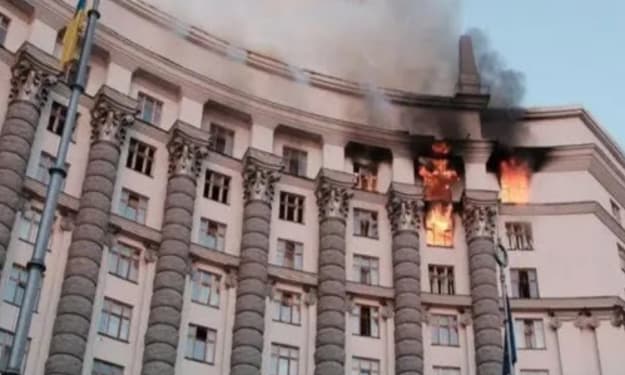
Kyiv Government Building Hit for First Time as Russia Launches Record 800 Missile and Drone Strikes Across Ukraine
vernment Building Hit for First Time as Russia Launches Record 800 Missile and Drone Strikes Across Ukraine Ukrainian Prime Minister Yulia Svyrydenko has said that for the first time during the war with Russia, Kyiv’s central government building has been targeted. Yulia Svyrydenko stated that the roof and upper floors of the building were badly damaged, and a fire broke out as a result of the strike. Nationwide attacks killed at least four people, including a child and a young woman who died when a nine-story residential building in Kyiv’s Sviatoshynskyi district was hit. Ukraine’s Air Force claimed that in the latest overnight assault, Russia launched a record number of drones and missiles, with the total exceeding 800. According to the Air Force, nine missiles and 56 drones hit 37 sites, with debris damage reported at eight of them. President Volodymyr Zelenskyy said that the strikes also caused destruction in the cities of Zaporizhzhia, Kryvyi Rih, and Odesa, as well as in the regions of Sumy and Chernihiv. On social media, Zelenskyy wrote: “Such killings now, when genuine diplomacy could have started long ago, are a deliberate crime and an attempt to prolong the war.” He urged world leaders to show a clear political will to stop these attacks. The Russian Ministry of Defense claimed it had struck Ukraine’s military and industrial facilities and transport infrastructure, damaging arms and equipment depots. The government building in Kyiv that was hit is also known as the Cabinet of Ministers building, as it houses the offices of key Ukrainian ministers. Although details on Sunday were unclear, Kyiv Mayor Vitali Klitschko suggested that during the interception of a drone, it may have accidentally crashed into the Cabinet building. He wrote on Telegram: “A fire broke out in a government building in the Pechersk district, possibly as a result of downing a UAV.” This marks a new and significant turn in Russia’s war on Ukraine. Until now, no government building had been struck in central Kyiv, which has been heavily fortified since the beginning of the war. The incident is likely to cause fear and concern among the population. It is also a symbolic strike, showing that Russian President Vladimir Putin’s statements about being ready for peace are merely a façade. He is not stopping; instead, Russia is intensifying its attacks. On Sunday morning, people saw smoke rising into the sky from just behind Independence Square. Later, a video posted on social media showed two Russian cruise missiles moving at high speed, followed by another powerful explosion. In Kyiv, a residential building strike shattered the windows of Valentyna’s home, and glass rained down on her. At the time of the attack, Valentyna and her husband were sleeping. “At least we’re alive,” she said. One of her young neighbors and the neighbor’s child were killed. Neighbors said the family had only recently moved into the apartment, and the woman’s husband was severely injured and hospitalized. Ukrainian footballer Heorhiy Sudakov’s Kyiv apartment was also damaged in a Russian drone strike. The 23-year-old player wrote on Instagram that his wife and child were inside during the attack. Sudakov is currently away on an international tour but posted photos and videos after the strike. It remains unclear whether his family was injured. Kyiv officials reported that in the Sviatoshynskyi and Darnytskyi districts, several multi-story residential buildings were directly hit and partially destroyed. In other parts of Ukraine, such as the city of Zaporizhzhia, 17 people were injured in a strike. According to regional head Ivan Fedorov, multiple homes, buildings, and a nursery were damaged. Fedorov added that in the village of Novopavlivka outside the city, a Russian glide bomb killed one woman and left another person missing. According to President Zelenskyy, one person was killed in Safonivka in the Sumy region, and another was killed in the Chernihiv region. Russia also struck a central Ukrainian city, which is Zelenskyy’s hometown. Three infrastructure sites were damaged there. Air raid sirens sounded throughout the night across the country. Ukraine also launched retaliatory strikes. Russia’s Ministry of Defense said its air defenses intercepted or destroyed 69 Ukrainian drones over several Russian regions. Vyacheslav Gladkov, governor of the Belgorod region, reported on Sunday that at least three civilians were killed and buildings destroyed. Robert Brovdi, commander of Ukraine’s unmanned aerial forces, said Ukrainian drones targeted a major Russian oil pipeline, striking a pumping station in the Bryansk region. Earlier this week, Putin rejected proposals for the deployment of Western forces in Ukraine immediately after any ceasefire. British Prime Minister Keir Starmer condemned Sunday’s strikes, saying they showed that “Putin believes he can act with impunity” and that he is “not serious about peace.” French President Emmanuel Macron said that 26 of Ukraine’s allies have formally pledged to deploy forces by land, sea, or air once the war ends, in order to provide security. He gave no further details. Putin warned that any troops deployed in Ukraine would be considered “legitimate targets.”
By Real contentabout a year ago in Chapters
Title: Will India–US Relations Recover? Trump, Modi and the Oil-Tariff
Will India–US Relations Recover? Trump, Modi and the Oil-Tariff US President Donald Trump has described relations between the United States and India as “very special” and said that he and Indian Prime Minister Narendra Modi “will always remain friends” and that “there is nothing to worry about.” Prime Minister Narendra Modi has praised Trump’s statement. He said that he sincerely values President Trump’s sentiments and fully supports him. In a post on social media platform X, he wrote: “I appreciate President Trump’s feelings and his positive thoughts about our relationship. India and the United States have a highly positive, comprehensive, and globally strategic partnership based on understanding.” On social media, users are sharing interesting comments on this U-turn, but many Indian users are also criticizing both Trump and Modi. Earlier, Trump had said that it seems “we have lost India and Russia to China.” When asked to respond to Trump’s remarks, Indian Ministry of External Affairs spokesperson Randhir Jaiswal said: “I have nothing to say on this.” Apart from Trump, his trade adviser Peter Navarro has also once again targeted India. Navarro said that India does not accept the truth and twists the matter. India’s Ministry of External Affairs has called Navarro’s statements misleading. Will India–US relations be the same as before? Trump was asked: “Are you ready to restart relations with India at this time?” In response, Trump said: “I will always remain Modi’s friend. He is a great prime minister. I will always remain a friend, but I don’t like what he is doing right now. However, India and the United States have very special relations, there is nothing to worry about. Sometimes such situations happen.” When asked who he held responsible for India falling into China’s hands, Trump said: “I don’t think we’ve lost them. I am disappointed that India is buying Russian oil, and I have imposed a 50% tariff to make that clear to them. But I get along well with Modi.” Asked about ongoing trade agreements with India and other countries, Trump said: “Negotiations are going very well. Other countries are also doing well. We are doing well with everyone.” Analysts say that President Trump is an “unpredictable” personality. He can change his stance at any time. Navtej Sarna, who served as India’s ambassador to the US, said that Donald Trump was an unpredictable leader in his first term, and this approach has only intensified in his second. Sarna said that President Trump is running the presidency in a completely different way. All of his advisers have become loyal to him. No one is ready to advise him. Washington-based journalist and author Seema Sirohi says that policies in the United States are being made by only one person—Donald Trump. Policies are not being made bottom-up but top-down. Sarna said that the trust both countries built over 20–25 years has now weakened significantly. President Trump attacked the Indian economy and bilateral ties without any solid reason. Sarna said: “President Trump has attacked this relationship, the Indian economy, and our ties.” Seema Sirohi said: Those who worked to improve this relationship over the past 25 years say that President Trump is destroying it entirely. There is also resentment in India over America’s behavior. In many places, demands have been raised that if the US imposes a 50% tariff, India should also retaliate. But Sarna considers this an emotional reaction. Sarna said: “In my view, retaliatory action would be somewhat emotional. Our long-term interest is to preserve as much as possible of the progress, benefits, and cooperation we have had with the United States.” He also said that India should not be so dependent on any one country that when a problem arises, it turns into a crisis for us. Seema Sirohi said that if Prime Minister Modi and President Trump talk on the phone, things could either get worse or improve. According to her: if you want to change President Trump’s thinking, you will have to work in unconventional ways. Navarro and Howard Lutnick’s criticism of India Late Friday night, Peter Navarro posted about India on his X account. He wrote: “India’s high tariff rates hurt American jobs. India buys oil from Russia only to make profits, and this money goes into Russia’s war machine. Ukrainians and Russians are being killed in this. American taxpayers have to spend more money. India does not accept the truth and only spins stories.” Peter Navarro, one of President Donald Trump’s most trusted advisers, has recently been taking an aggressive stance in his remarks about India and Modi. Earlier, Navarro had called the Russia–Ukraine conflict “Modi’s war.” On August 29, he wrote on X that the revenue from Russian oil goes to India’s politically connected energy traders and directly into Putin’s war fund. US Treasury Secretary Howard Lutnick has said that India will have to choose between the United States and Russia. In an interview, Lutnick said that before the Russia–Ukraine war, India bought only 2% of its oil from Russia, but after the war this figure rose to 40%. According to him, India must decide where it stands. If it does not stop importing Russian oil, leave BRICS, and support the US and the dollar, it will face a 50% tariff. Lutnick also said that India will soon apologize and come to the negotiating table with President Trump. America’s stance on BRICS has been aggressive. In July 2025, after the BRICS summit in Brazil, Trump declared BRICS to be anti-American and threatened to impose an additional 10% tariff on its member countries. What did the Finance Minister and the Ministry of External Affairs say? Finance Minister Nirmala Sitharaman reacted strongly to Peter Navarro’s statement about “Brahmins making profits.” In an interview with a news channel, Sitharaman said that the statement about “Brahmins making profits” is exactly like the British policy of “divide and rule.” Sitharaman said that India will continue to buy oil from Russia because India’s oil purchases are based on economic and commercial reasons. On Navarro’s remarks, MEA spokesperson Randhir Jaiswal said: “We have seen Peter Navarro’s false and misleading statements, and we categorically reject them.” The Ministry of External Affairs said that India will continue talks with the United States on trade matters. Social media reactions A user named Surbhi called the situation shameful, writing: “Modi is quick to respond to praise, but stays silent on the nation’s humiliation. “Modi has not said a word about the 42 times Trump has humiliated our nation’s integrity... but upon hearing his own praise, he immediately responded to Trump.” She further wrote: “What exactly is Modi thanking Trump for? For the 50% tariffs on India, or for the insults and putting India on par with Pakistan?” A user named Ankit Mainak wrote: “In the morning, he says we’ve lost India to China. At night, he says we haven’t lost India but will still impose 50% tariffs. Donald Trump is the American version of Modi.” A user named Advait Kala wrote: “Trump extended a hand to India late. While Prime Minister Modi accepted it graciously, the trust is broken. Now the next step is rebuilding relations, in which India seems more neutral than before. There was a time when these relations looked very promising.” Many users wrote that Modi did not respond directly but simply shared the ANI bullet points praising him.
By Real contentabout a year ago in Chapters
Into The Black Maw: Confessions Of A Death Custodian – “The Blood-Spattered Bride”. Content Warning.
Follow along with our YouTube Audio Book Playlist! Sleep had me by the throat — deep, wet sleep. The kind where time isn’t real and your bones don’t belong to you. Where the body becomes a misplaced rumor.
By A.R. Marquezabout a year ago in Chapters
Every Ally Holds a Knife Behind Their Back
The rain had stopped, but the air still carried the damp smell of asphalt and rust. Inside the abandoned warehouse on the edge of East London, the gang sat in a half-circle, the dim light of a single hanging bulb swaying gently above them. The bulb's flicker sent long shadows crawling across the cracked concrete floor — shadows that seemed alive, whispering secrets no one wanted to hear.
By WAQAS AHMADabout a year ago in Chapters