Self-help
The Age of War Must End — The Age of Humanity Must Begin
In a world boasting technological marvels, soaring skyscrapers, and instant communication, it remains a cruel irony that humanity continues to drown in the blood of senseless wars. Across continents and cultures, the cries of the innocent — children, women, and the elderly — echo louder than ever, shattering the very illusion of progress. The Ukraine-Russia war, the burning hostility between Pakistan and India, and the relentless agony of the Palestinians under Israeli occupation stand as damning evidence of international failure to protect human dignity. In Ukraine, a proud nation found itself crushed under the boots of an invading force. Missiles tore through tranquil skies; tanks ground the hopes of millions into dust. Cities that once thrived now lie in ruins, haunted by the memories of civilians who sought nothing more than a peaceful life. Families have been torn apart. Children grow up under the deafening sounds of artillery, their innocence stolen by forces far beyond their control. The so-called protectors of human rights — powerful nations like the United States and alliances like the European Union — responded swiftly. They sent aid, condemned the invasion, and issued endless statements. Yet beneath their actions lies a cold calculation: the need to weaken adversaries, expand influence, protect strategic interests. For every dollar sent for humanitarian assistance, ten were spent fortifying political dominance. The suffering of Ukrainian civilians became a grim stage where global superpowers rehearsed rivalries, compassion reduced to a tool of influence. Meanwhile, the Indian subcontinent remains trapped in a cycle of hostility that has outlived generations. Pakistan and India, birthed through bloodshed in 1947, continue to see each other not as neighbors but as enemies. Their borders, particularly in Kashmir, are lined with barbed wire, watchtowers, and graves. Every clash along the Line of Control tears open old wounds. Every shell fired snatches away another innocent life. On the ground, it is ordinary families who pay the price. Children lose parents. Mothers weep over flag-draped coffins. Dreams wither before they ever have a chance to bloom. Yet the global powers, otherwise quick to voice outrage, largely look away. India’s economic rise makes it an attractive partner for the West. Pakistan’s strategic geography keeps it critical to shifting alliances. The suffering of Kashmiris, caught in the crossfire, remains too complex — and too inconvenient — for the world to care. Nowhere, however, is global moral bankruptcy more stark than in Palestine. A century-old struggle continues to turn the land into a graveyard of peace. Palestinian families live under constant threat: homes demolished without warning, ancient olive trees uprooted, entire neighborhoods reduced to rubble in a single night. Israeli military operations, framed as self-defense, often cross into the territory of collective punishment. Western leaders issue carefully crafted statements, expressing "concern" yet refusing to hold Israel accountable. Billions in military aid continue to flow, while humanitarian assistance to Gaza trickles in — if it comes at all. The message is clear: not all lives are weighed equally in the scales of global empathy. Across all these conflicts, where are the institutions built to uphold human dignity? The United Nations, the International Criminal Court, the myriad NGOs dedicated to peace and justice — all appear shackled. Created from the ashes of global wars, they now struggle for relevance in a world where power speaks louder than principles. Humanitarian workers risk their lives daily, feeding the hungry, healing the wounded, educating the forgotten. Their heroism shines, but it is too often drowned out by the thundering boots of soldiers and the self-serving policies of states. The United States, cloaked in the image of global leadership, reveals itself again and again as a selective defender of rights. Interventions are less about humanitarian need and more about strategic gain. The European Union, proud of its ideals, oscillates between grand declarations and cowardly retreats. In Ukraine, they moved quickly. In Palestine, they hesitate. In Kashmir, they stay silent. It is not just hypocrisy; it is abandonment. Entire peoples are left to suffer because they are not deemed strategically important enough to save. As wars rage, their consequences metastasize far beyond battlefields. Refugee crises surge, bringing social tensions. Economies collapse, breeding desperation. Extremism flourishes in the vacuum left by justice. International law, once a noble shield, crumbles with each unmourned war crime, each unpunished atrocity. We now stand on the edge of a world where war may no longer be an aberration — but the norm. Unless humanity chooses another path. Even now, amid the ruins, there is hope. Amid the tears of grieving mothers and the silence of destroyed schools, there is still a chance for change — if we have the courage to grasp it. To the leaders of all nations, to every citizen, the message must be clear: Enough. Enough of bloodshed, enough of hatred, enough of treating human lives as expendable. No grievance, no ideology, no ambition justifies the death of even one innocent child. Each bomb that falls extinguishes not just life but infinite potential — the doctors, poets, teachers, and dreamers the world will now never know. True strength is not in armies or arsenals. It is in the prosperity of your people. It is in laughter in playgrounds, in books read by eager students, in families living without fear. The real race among nations must not be in stockpiling weapons but in curing diseases, eradicating poverty, saving our planet. India and Pakistan must lay down the sword and compete instead to uplift their people. Israel and Palestine must find the humanity to see each other not as enemies, but as fellow sufferers deserving dignity. Russia and Ukraine must rebuild not just cities but trust. The future must be one of trade, of technology, of education, of culture. Let embassies replace trenches, songs replace sirens, dreams replace nightmares. Leadership that values life over land, justice over dominance, and hope over fear — that is the leadership the 21st century demands. Citizens, too, must rise: rejecting propaganda, refusing to hate, demanding from their governments not war but wisdom. International institutions must be rearmed not with weapons but with willpower: the will to enforce human rights universally, without favor, without fear. Victory must be redefined. Not the conquest of others, but the elevation of all. Not the building of walls, but the opening of doors. Not the pursuit of revenge, but the pursuit of reconciliation. To the children who tonight sleep under crumbling roofs in Gaza, shiver in basements in Ukraine, or live under the shadow of soldiers in Kashmir: You deserve better. To the mothers who bury their sons, the fathers who cradle the broken bodies of their daughters: Your pain must not be ignored. This world can be different. It must be different. It will be — if we have the courage to make it so. Let the history of tomorrow not be another grim chapter written in blood. Let it be a testament — that in the hour of our greatest failures, humanity found the strength to choose light over darkness. We owe it to ourselves. We owe it to each other. We owe it to the future. ---
By Umair Ali Shah about a year ago in Chapters
Say Hello to The Upgraded ASUS TUF Gaming A14 Laptop . Content Warning. AI-Generated.
ASUS has once again level up the battlefield with the latest iteration of its renowned TUF series — introducing the upgraded ASUS TUF Gaming A14 laptop. The A14 strikes a delicate balance between raw power and everyday usability for gamers who demand performance, durability, and style without breaking the bank. Whether you're a competitive gamer, a budding content creator, or just someone who wants serious power in a sleek machine, the A14 is ready to step up.
By Md Shakhawatabout a year ago in Chapters
Election Day in Canada: Where to Vote and Why It Matters
The Canadian federal election is approaching, and whether you're a seasoned voter or a first-timer, one thing is for sure—knowing where to vote is crucial. 🇨🇦 With a large and diverse electorate, finding your voting location in Canada might seem like a daunting task. But don’t worry, I’ve got you covered!
By Lokesh Kumarabout a year ago in Chapters
Top 5 Reasons Behind Muscle Fatigue
Muscle fatigue is a common issue that many people experience, especially after physical activities like exercise, sports, or even long days of work. When muscles feel tired and weak, it can make it difficult to perform everyday tasks or enjoy physical activities. Understanding why muscle fatigue happens can help you manage it better. Here are the top 5 reasons behind muscle fatigue:
By Urooj Khanabout a year ago in Chapters
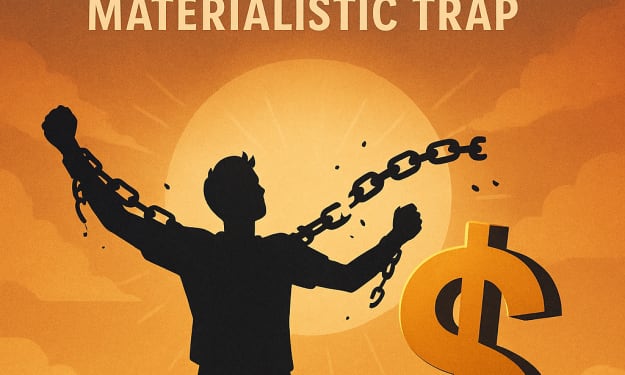
Breaking the Chains — Overcoming the Materialistic Trap
Introduction: A World in Pursuit, A Soul in Drought In today's fast-paced, hyper-connected world, the pursuit of material wealth and modern comforts has become synonymous with success. With every new gadget, luxury item, or trend, we’re sold the idea that happiness lies just around the corner—if only we had a little more. But in this endless chase for more, we often lose sight of the simplest truth: peace doesn't come from possessions—it comes from within.
By Sayed Saad Gillaniabout a year ago in Chapters
Life Lessons From A PlayBoy
The Beginning: The narrative may appear unusual, correct? What could a young boy's journey possibly teach us? Still, let's get into the story because his actions had me more than his name. His transformational adolescence marked the beginning of everything. He gradually began to feel drawn toward someone of a different gender as his physical and emotional state changed. As a result, his youthful desires began to grow. After his sixth-grade final exams, he went to visit his grandparents' house, and everything looked good until then. He met a girl there. Their casual conversations quickly developed into an attraction. The boy made his feelings known to the girl during one of their conversations, and she accepted his proposal. They would talk frequently because she lived next door to his grandparents, and their young romance flourished. She was the first girl he ever got close to, but he didn't necessarily love her first; his affection was more age-based. When he got back to his house just fifteen days later, their communication abruptly stopped due to the distance and lack of proper means of keeping in touch. They were both quite young when the year 2016 arrived. His first loss of love came at this time. Why bring it up? because, in his heart, despite the passing of time, he still considered her to be his first love. He returned to his grandparents' house six months later, hopeful and emotional. However, the actual story began at that point. He learned that the girl's family was already looking for a man to marry her and that she appeared to be ready for marriage. His heart broke for the first time. Although he didn't say anything to her, the pain was real. He carried that sadness with him when he returned home. His friends, school, studies, and sports took over his life over time. He decided one day that he wanted to learn how to ride a bike. In just a week, he mastered riding his grandfather's motorcycle through practice. He was a student in class 7 at the time. There was a school in his neighborhood where a lot of girls went to school. He tried to show off a little by riding the bike to that school after classes ended one day. A girl noticed him, so it worked. Another chapter in his life thus began. He had never lived in a city before and had only recently relocated to a village because of family problems. As a result, he was unfamiliar with this setting and emotionally sensitive. He was happy when the girl started talking to him. This was the beginning of a classic love story between two students at school. They would talk every day after school. They eventually started dating, but the boy was still unsure of what true love was because it was more about emotion and excitement. From morning conversations to afternoon meetings, their relationship developed. They would talk when the girl would come out onto the street in front of her house. Part 2 Coming Soon.....Stay Tuned With Me And Leave A Comment. Your Comments Will Boost Me To Write Another Parts Of This Guy Life story.
By Riazul Islamabout a year ago in Chapters
"Whispers of the Wind: A Journey Through the Hills" Part- 01
Whispers of the Hills (Part- 01) The road to the hills was winding, narrow, and flanked by tall pine trees that reached for the sky like ancient sentinels. I had been planning this solo trip for months, craving an escape from the noise of city life. The moment my car began its slow climb into the hills of Himachal Pradesh, I could feel the tension leave my shoulders, replaced by a growing sense of calm and curiosity.
By abu kwsher sikderabout a year ago in Chapters
Jeffrey Dahmer: The Milwaukee Cannibal – A Full History of a Serial Killer
Jeffrey Dahmer is one of the most infamous serial killers in American history—his name synonymous with horror, depravity, and the darkest corners of the human psyche. Nicknamed "The Milwaukee Cannibal," his crimes shocked the world not only for their brutality but also for their disturbing psychological undertones. Between 1978 and 1991, Dahmer murdered 17 young men and boys, committing acts of necrophilia, dismemberment, and cannibalism.
By Shahadat Hossainabout a year ago in Chapters
Loving Someone Who’s Still Healing. AI-Generated.
Introduction: No one walks into love unscathed. We all carry pieces of our past — heartbreaks, betrayals, childhood wounds we rarely talk about. But loving someone who’s still healing is a different kind of love. It’s soft, patient, and often… heartbreaking.
By Adeyemi sholapeabout a year ago in Chapters
Simplify to Amplify: A Guide to Clear Spaces and Clear Minds
In today’s fast-paced, distraction-heavy world, it’s easy to feel overwhelmed by the sheer volume of stuff both physical and mental we carry around. The truth is, clutter isn’t just an aesthetic issue. It can weigh heavily on your productivity, mental clarity, and even emotional well-being.
By Fahad Khanabout a year ago in Chapters