Politics
The Story of Us All
In the beginning, there was nothing—only silence and space. Then, from the chaos of the early universe, stars were born. One exploded, scattering its heavy elements through the galaxy. From this stellar ash, our Sun emerged, and around it, the planets spun into being.
By Zeeshan Muhammadabout a year ago in Chapters
Empire in the Cloud . AI-Generated.
Synopsis From 2025 to 1995, the flame of the Internet had just been ignited, mobile phones were still bricks, and Hollywood movies had yet to enter the era of special effects. But with the arrival of James, everything was about to change.
By IgnisTheSunabout a year ago in Chapters
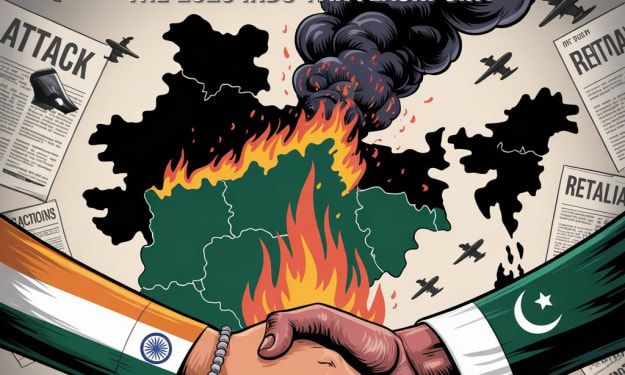
India-Pakistan Crisis 2025: A Comprehensive Political, Economic, and Global Analysis
The April 2025 terrorist attack in Pahalgam, Kashmir, which killed 26 people—mostly Indian tourists—has triggered the most significant escalation in India-Pakistan tensions in recent years. Both nations, equipped with nuclear capabilities and a long history of conflict, have responded strongly, leading to an increasingly volatile situation. This column analyzes the crisis in political, economic, and international contexts, with an emphasis on fresh developments, stakeholder positions, and global perspectives. Recent Developments On April 22, 2025, a terrorist attack struck Pahalgam in Indian-administered Kashmir. India quickly blamed Pakistan, citing recovered IDs of two attackers allegedly linked to Pakistani soil. Pakistan denied involvement and called for an impartial international investigation. Key developments since then include: India suspended the Indus Waters Treaty, a long-standing water-sharing agreement between the two countries. Pakistan shut its airspace to Indian carriers. Both countries downgraded diplomatic ties, expelling each other’s diplomats and halting visa services. These moves mark one of the lowest points in bilateral relations since the 2019 Pulwama-Balakot standoff. Political Perspective India’s Stance Indian Prime Minister Narendra Modi has taken a hardline stance, calling the attack “an act of war” and vowing retaliation. The Indian government has: Deployed more troops to Kashmir. Launched a crackdown on suspected militant hideouts. Temporarily shut down 48 tourist destinations in Kashmir for security. New Delhi’s narrative emphasizes Pakistan’s continued support for cross-border terrorism and calls for global action. Pakistan’s Stance Islamabad has categorically denied the allegations and demanded an independent UN-led investigation. Pakistani Defense Minister Khawaja Muhammad Asif warned that any Indian military incursion would be met with “full-spectrum retaliation.” Pakistan, in turn, accuses India of using the incident to escalate repression in Kashmir and distract from domestic issues. Economic Implications The current crisis has begun to take a toll on both nations’ economies: Trade Halted: Pakistan has suspended all trade with India. Informal cross-border commerce has also ceased. Tourism Collapse: Tourist bookings in Kashmir have dropped sharply. Local businesses are reporting major losses. Water Conflict: India’s suspension of the Indus Waters Treaty raises concerns about Pakistan’s agricultural vulnerability. Analysts warn this could become a new front of hybrid warfare. Foreign investors are also showing signs of nervousness, with regional stock markets experiencing volatility. Global Reactions United Nations The UN has called for both nations to exercise restraint and resume diplomatic dialogue. However, no resolution has been passed due to geopolitical divisions within the Security Council. United States Washington has reaffirmed its support for India’s counterterrorism efforts but has also urged both sides to de-escalate. Diplomatic channels remain open, with quiet back-channel negotiations reportedly underway. China Beijing, a close ally of Pakistan and a major economic player in South Asia, has urged both countries to avoid escalation. China has also offered to mediate, though India has traditionally rejected third-party involvement. Iran and Russia Iran has offered to mediate, while Russia has called for a return to the Simla Agreement framework. Both countries fear regional destabilization that could impact energy routes and trade. Military and Border Status Since April 24, minor skirmishes have been reported along the Line of Control (LoC). Both nations have put forward commands on high alert. Indian media reports indicate targeted strikes across the LoC, although these claims are unverified. Pakistan has conducted nationwide defense drills and relocated air assets to strategic locations. The risk of miscalculation or accidental escalation remains high. Possible Future Scenarios Limited Military Conflict: Continued provocations could lead to a short but intense border conflict similar to the Kargil War. Diplomatic Mediation: International actors might succeed in brokering talks to restore normalcy. Escalation to Broader War: A worst-case scenario involves full-scale war, including missile exchanges and economic embargoes. Internal Political Shifts: Rising domestic pressure in either country could lead to policy changes or leadership shifts. Conclusion The 2025 India-Pakistan crisis reflects deeply entrenched historical hostilities, complicated by terrorism, geopolitics, and strategic rivalry. The involvement of major powers adds layers of complexity, making resolution difficult but urgent. Both nations stand to lose from war, and the only rational path forward is sustained, good-faith diplomacy. The world watches with concern, hoping that wisdom will prevail over nationalism and that peace will return to South Asia.
By Umair Ali Shah about a year ago in Chapters
The Age of War Must End — The Age of Humanity Must Begin
In a world boasting technological marvels, soaring skyscrapers, and instant communication, it remains a cruel irony that humanity continues to drown in the blood of senseless wars. Across continents and cultures, the cries of the innocent — children, women, and the elderly — echo louder than ever, shattering the very illusion of progress. The Ukraine-Russia war, the burning hostility between Pakistan and India, and the relentless agony of the Palestinians under Israeli occupation stand as damning evidence of international failure to protect human dignity. In Ukraine, a proud nation found itself crushed under the boots of an invading force. Missiles tore through tranquil skies; tanks ground the hopes of millions into dust. Cities that once thrived now lie in ruins, haunted by the memories of civilians who sought nothing more than a peaceful life. Families have been torn apart. Children grow up under the deafening sounds of artillery, their innocence stolen by forces far beyond their control. The so-called protectors of human rights — powerful nations like the United States and alliances like the European Union — responded swiftly. They sent aid, condemned the invasion, and issued endless statements. Yet beneath their actions lies a cold calculation: the need to weaken adversaries, expand influence, protect strategic interests. For every dollar sent for humanitarian assistance, ten were spent fortifying political dominance. The suffering of Ukrainian civilians became a grim stage where global superpowers rehearsed rivalries, compassion reduced to a tool of influence. Meanwhile, the Indian subcontinent remains trapped in a cycle of hostility that has outlived generations. Pakistan and India, birthed through bloodshed in 1947, continue to see each other not as neighbors but as enemies. Their borders, particularly in Kashmir, are lined with barbed wire, watchtowers, and graves. Every clash along the Line of Control tears open old wounds. Every shell fired snatches away another innocent life. On the ground, it is ordinary families who pay the price. Children lose parents. Mothers weep over flag-draped coffins. Dreams wither before they ever have a chance to bloom. Yet the global powers, otherwise quick to voice outrage, largely look away. India’s economic rise makes it an attractive partner for the West. Pakistan’s strategic geography keeps it critical to shifting alliances. The suffering of Kashmiris, caught in the crossfire, remains too complex — and too inconvenient — for the world to care. Nowhere, however, is global moral bankruptcy more stark than in Palestine. A century-old struggle continues to turn the land into a graveyard of peace. Palestinian families live under constant threat: homes demolished without warning, ancient olive trees uprooted, entire neighborhoods reduced to rubble in a single night. Israeli military operations, framed as self-defense, often cross into the territory of collective punishment. Western leaders issue carefully crafted statements, expressing "concern" yet refusing to hold Israel accountable. Billions in military aid continue to flow, while humanitarian assistance to Gaza trickles in — if it comes at all. The message is clear: not all lives are weighed equally in the scales of global empathy. Across all these conflicts, where are the institutions built to uphold human dignity? The United Nations, the International Criminal Court, the myriad NGOs dedicated to peace and justice — all appear shackled. Created from the ashes of global wars, they now struggle for relevance in a world where power speaks louder than principles. Humanitarian workers risk their lives daily, feeding the hungry, healing the wounded, educating the forgotten. Their heroism shines, but it is too often drowned out by the thundering boots of soldiers and the self-serving policies of states. The United States, cloaked in the image of global leadership, reveals itself again and again as a selective defender of rights. Interventions are less about humanitarian need and more about strategic gain. The European Union, proud of its ideals, oscillates between grand declarations and cowardly retreats. In Ukraine, they moved quickly. In Palestine, they hesitate. In Kashmir, they stay silent. It is not just hypocrisy; it is abandonment. Entire peoples are left to suffer because they are not deemed strategically important enough to save. As wars rage, their consequences metastasize far beyond battlefields. Refugee crises surge, bringing social tensions. Economies collapse, breeding desperation. Extremism flourishes in the vacuum left by justice. International law, once a noble shield, crumbles with each unmourned war crime, each unpunished atrocity. We now stand on the edge of a world where war may no longer be an aberration — but the norm. Unless humanity chooses another path. Even now, amid the ruins, there is hope. Amid the tears of grieving mothers and the silence of destroyed schools, there is still a chance for change — if we have the courage to grasp it. To the leaders of all nations, to every citizen, the message must be clear: Enough. Enough of bloodshed, enough of hatred, enough of treating human lives as expendable. No grievance, no ideology, no ambition justifies the death of even one innocent child. Each bomb that falls extinguishes not just life but infinite potential — the doctors, poets, teachers, and dreamers the world will now never know. True strength is not in armies or arsenals. It is in the prosperity of your people. It is in laughter in playgrounds, in books read by eager students, in families living without fear. The real race among nations must not be in stockpiling weapons but in curing diseases, eradicating poverty, saving our planet. India and Pakistan must lay down the sword and compete instead to uplift their people. Israel and Palestine must find the humanity to see each other not as enemies, but as fellow sufferers deserving dignity. Russia and Ukraine must rebuild not just cities but trust. The future must be one of trade, of technology, of education, of culture. Let embassies replace trenches, songs replace sirens, dreams replace nightmares. Leadership that values life over land, justice over dominance, and hope over fear — that is the leadership the 21st century demands. Citizens, too, must rise: rejecting propaganda, refusing to hate, demanding from their governments not war but wisdom. International institutions must be rearmed not with weapons but with willpower: the will to enforce human rights universally, without favor, without fear. Victory must be redefined. Not the conquest of others, but the elevation of all. Not the building of walls, but the opening of doors. Not the pursuit of revenge, but the pursuit of reconciliation. To the children who tonight sleep under crumbling roofs in Gaza, shiver in basements in Ukraine, or live under the shadow of soldiers in Kashmir: You deserve better. To the mothers who bury their sons, the fathers who cradle the broken bodies of their daughters: Your pain must not be ignored. This world can be different. It must be different. It will be — if we have the courage to make it so. Let the history of tomorrow not be another grim chapter written in blood. Let it be a testament — that in the hour of our greatest failures, humanity found the strength to choose light over darkness. We owe it to ourselves. We owe it to each other. We owe it to the future. ---
By Umair Ali Shah 2 years ago in Chapters
Election Day in Canada: Where to Vote and Why It Matters
The Canadian federal election is approaching, and whether you're a seasoned voter or a first-timer, one thing is for sure—knowing where to vote is crucial. 🇨🇦 With a large and diverse electorate, finding your voting location in Canada might seem like a daunting task. But don’t worry, I’ve got you covered!
By Lokesh Kumar2 years ago in Chapters
The India-Pakistan War of 2025: A Dangerous Escalation and its Global Implications
Introduction The conflict between India and Pakistan has been one of the most persistent and perilous geopolitical struggles of the modern era. Despite multiple ceasefires and attempts at diplomacy, the relationship between these two nuclear-armed neighbors has been fraught with tension and conflict. The year 2025 marks a significant chapter in this long history, as both nations find themselves on the brink of war once again. The catalyst for this dramatic escalation was a deadly terrorist attack on April 22, 2025, in the Indian-administered region of Jammu and Kashmir, which has sparked a series of retaliatory military and diplomatic measures. This article delves deep into the complex history and events leading to the 2025 India-Pakistan war, analyzing the political, military, and global dimensions of the conflict. By examining the historical context, key flashpoints, and the responses from both nations, this piece aims to provide a comprehensive understanding of the ongoing crisis and its potential global consequences. Section 1: Historical Background of Indo-Pakistani Conflicts To fully understand the gravity of the 2025 conflict, it is essential to grasp the historical backdrop of India-Pakistan relations. Since their partition in 1947, the two nations have fought three major wars—1947, 1965, and 1971—with Kashmir emerging as the central issue in every conflict. The Kashmir dispute has remained unresolved despite numerous attempts at negotiations and peace agreements, including the famous Shimla Agreement of 1972 and the Lahore Declaration of 1999. The Kargil War of 1999 marked the last major military confrontation between India and Pakistan, although tensions have never fully dissipated since. The presence of nuclear weapons in both countries has acted as a deterrent against large-scale war, but it has also increased the potential for catastrophic escalation. For the past two decades, both nations have focused on counter-insurgency operations, military build-up, and proxy wars, particularly in the Kashmir region. The global community has frequently intervened diplomatically, urging both sides to refrain from military action and pursue peace. Yet, as of April 2025, it became clear that neither side was willing to back down, leading to the dangerous situation at the precipice of full-scale war. Section 2: The Trigger Event – The Pahalgam Attack On April 22, 2025, the peaceful town of Pahalgam in Jammu and Kashmir became the scene of one of the deadliest terrorist attacks in recent years. A group of gunmen ambushed a caravan of Hindu tourists traveling to the scenic Baisaran Valley, killing 26 individuals, including women and children. The Resistance Front (TRF), a Pakistan-based insurgent group, claimed responsibility for the attack, further exacerbating the already fragile situation between India and Pakistan. India immediately accused Pakistan of orchestrating the attack through its proxies. The TRF is widely believed to operate with the support of the Pakistani military’s Inter-Services Intelligence (ISI), making this attack not just a random act of terrorism, but a direct assault on Indian sovereignty. The Indian government, led by Prime Minister Narendra Modi, vowed to take swift and decisive action against those responsible. Pakistan, on the other hand, vehemently denied any involvement in the attack. The Pakistani government condemned the violence but insisted that it was the result of internal insurgency rather than state-sponsored terrorism. This denial only fueled India’s accusations, escalating diplomatic tensions between the two nuclear-armed nations. Section 3: Diplomatic Breakdown and Economic Measures In the days following the attack, India took several immediate steps to punish Pakistan and send a clear message. The Indian government expelled several Pakistani diplomats and recalled its own diplomats from Islamabad. Additionally, India announced the suspension of the 1960 Indus Waters Treaty, a bilateral agreement that governs water-sharing between the two countries, citing national security concerns and Pakistan’s failure to curb cross-border terrorism. India also imposed severe travel and visa restrictions on Pakistani nationals, closing the border between the two countries for all non-essential movements. Economic ties, which had already been strained in recent years, were further strained as trade routes were suspended, and Pakistan’s airspace was closed to Indian aircraft. Pakistan retaliated by expelling Indian diplomats, and the government declared that it would suspend the Simla Agreement, a historic 1972 accord that established the framework for peaceful bilateral relations. Pakistan also imposed its own travel and trade restrictions on India, further deepening the divide between the two nations. Despite international calls for restraint, both countries hardened their positions. The diplomatic standoff seemed increasingly intractable, with little prospect for dialogue in the near future. Section 4: Military Escalation – A Dangerous Path The diplomatic breakdown quickly gave way to military confrontations along the Line of Control (LoC) in Kashmir, the de facto border between India and Pakistan in the disputed region. Border skirmishes, artillery exchanges, and cross-border infiltrations escalated, with both sides accusing each other of violating ceasefire agreements. The LoC, which has long been a hotspot for military tensions, became a flashpoint once again, and the possibility of full-scale war seemed imminent. India began mobilizing its forces along the LoC, calling up additional troops and deploying advanced weaponry in preparation for potential escalation. Pakistan, too, moved its military forces to key positions, ready to respond to any provocation. Both nations conducted military drills in the region, showcasing their respective military capabilities. The risk of escalation was high. Both India and Pakistan are nuclear-armed states, and the thought of a nuclear confrontation became a real possibility. While both nations had refrained from using nuclear weapons in previous conflicts, the situation in 2025 was far more volatile. With military tensions escalating rapidly, there were growing fears that a miscalculation or a reckless move by either side could lead to devastating consequences. Section 5: The Role of International Powers The international community closely monitored the situation, and major world powers such as the United States, China, and Russia weighed in on the unfolding crisis. The United Nations called for an immediate ceasefire and urged both countries to engage in diplomatic dialogue. However, the international response was largely reactive, and there was little in the way of tangible pressure on either nation to de-escalate. China, which shares a border with both India and Pakistan, expressed concern about the rising tensions, particularly given its ongoing territorial disputes with India. However, Beijing’s approach was more neutral, as it sought to maintain good relations with both countries. Russia, a longtime ally of India, expressed support for India’s right to defend its sovereignty but also urged both sides to exercise restraint. The United States, historically a key ally of Pakistan, found itself in a delicate position. The Trump administration, which had cultivated close ties with India in recent years, was caught between its strategic partnerships with both nations. Despite calls from some factions within the U.S. to intervene diplomatically, the U.S. chose not to take direct action, preferring to issue statements urging both sides to refrain from further escalation. Section 6: Cyber Warfare and Intelligence Operations In addition to conventional military strategies, both India and Pakistan engaged in cyber warfare and intelligence operations during the 2025 conflict. Both nations have developed advanced cyber capabilities, and the conflict saw a rise in cyberattacks targeting critical infrastructure, government institutions, and defense systems. India accused Pakistan of launching sophisticated cyberattacks on Indian government websites and military networks, while Pakistan claimed that India had attempted to disrupt its communications and military operations. Both countries also increased their intelligence gathering efforts, with reports of espionage, surveillance, and covert operations aimed at destabilizing each other’s political and military establishments. While cyber warfare remains an underreported aspect of modern conflicts, it played a significant role in the 2025 India-Pakistan war, highlighting the growing importance of digital battlegrounds in contemporary warfare. Section 7: Nuclear Deterrence and Strategic Posturing One of the most critical aspects of the 2025 conflict was the nuclear dimension. Both India and Pakistan possess nuclear weapons, and the specter of nuclear war loomed large over the crisis. In the past, nuclear deterrence had kept both sides from engaging in full-scale conventional warfare, but the 2025 conflict brought this delicate balance into question. In response to India’s military build-up, Pakistan’s military leadership emphasized its readiness to use nuclear weapons if its territorial integrity was threatened. Pakistan’s strategic doctrine, which includes the use of tactical nuclear weapons, was put on full display, signaling that any large-scale attack by India could provoke a nuclear response. India, for its part, maintained its traditional stance of “No First Use” (NFU) of nuclear weapons. However, as the situation grew more tense, there were growing concerns that India might abandon this policy and retaliate with nuclear strikes in the event of a Pakistani first strike. The potential use of nuclear weapons in the 2025 war raised alarms worldwide, and the prospect of a regional nuclear conflict was a major point of concern for global security. Section 8: Media Narratives and Public Sentiment Both India and Pakistan’s domestic media played a crucial role in shaping public sentiment during the 2025 conflict. In India, the media largely supported the government’s stance on military retaliation, framing the conflict as a fight against terrorism and Pakistan’s support for militant groups. Nationalistic rhetoric and calls for revenge against Pakistan for the Pahalgam attack were widespread, and there was little tolerance for any suggestions of dialogue or compromise. In Pakistan, the narrative was focused on defending the country against Indian aggression. Pakistani media outlets portrayed India as the aggressor, accusing it of using the Kashmir issue as a pretext to launch military operations against Pakistan. The portrayal of Indian forces as occupying aggressors resonated with many Pakistanis, further solidifying anti-Indian sentiments. Public opinion in both countries became increasingly polarized, with little room for dialogue or peace-building. The role of media in inflaming tensions and fueling nationalism cannot be overstated, as both nations continued to move further away from any peaceful resolution. Section 9: Economic Fallout and Trade Impacts The economic repercussions of the 2025 war were immediate and severe. Both India and Pakistan suffered significant losses due to the conflict, with trade routes being closed and economic sanctions imposed. India, as one of the world’s fastest-growing economies, faced disruptions to its supply chains, particularly in the defense, manufacturing, and technology sectors. Pakistan’s economy, already fragile due to years of political instability and economic mismanagement, took a direct hit from the conflict. The suspension of trade, coupled with the closure of the border and airspace, led to widespread economic uncertainty. The country’s reliance on exports, particularly to India, meant that the conflict had a devastating impact on its financial system. The war also led to a decline in foreign investments in both countries, as global markets became wary of the geopolitical risks in South Asia. The economic fallout of the war will likely have long-term consequences for both nations, further deepening their reliance on military spending at the expense of domestic development. Section 10: Future Scenarios – Diplomacy, Deterrence, or Disaster? Looking ahead, the question remains: What is the future of India-Pakistan relations after the events of 2025? Several scenarios could unfold, depending on the actions of both governments and the role of international powers in facilitating peace. 1. Diplomacy and De-escalation: Both sides may recognize the catastrophic consequences of further conflict and opt for diplomacy, leading to a return to peace talks. However, given the deep mistrust and animosity, such a scenario remains unlikely without significant international mediation. 2. Continued Deterrence: Both India and Pakistan may continue their respective strategies of deterrence, maintaining a fragile peace. The nuclear threat, while a deterrent to large-scale conflict, could remain a permanent feature of their relationship. 3. All-Out War: The most catastrophic scenario is an all-out war, with conventional battles escalating into nuclear exchanges. While unlikely, this remains a real risk, especially if either side perceives existential threats to their national security. Conclusion The 2025 India-Pakistan war represents a critical moment in the history of South Asia. The complex web of historical grievances, nuclear deterrence, and the ever-present specter of terrorism has brought these two nations to the brink of disaster. While the conflict may yet subside, the lessons learned from the events of 2025 will undoubtedly shape the geopolitical landscape for years to come. The world watches with bated breath as India and Pakistan decide whether to return to diplomacy or spiral further into the abyss of war. ---
By Umair Ali Shah 2 years ago in Chapters
Read Justice Alito's disapproval of the Supreme Court's late-night order preventing some deportations.
In a sharp dissCourt of Appeal of the United States ent that slammed the seven-member majority, Justice Samuel Alito wrote that the Supreme Court acted "literally in the middle of the night" and "without sufficient explanation" in preventing the Trump administration from deporting any Venezuelans held in northern Texas under an 18th-century wartime law.
By MD ANAMUL HAQUE2 years ago in Chapters
“Trump Delivers Fiery Easter Message, Blends Faith with Politics in Holiday Statement”
In a message that was part traditional Easter greeting and part political manifesto, former President Donald J. Trump delivered a fiery statement on Easter Sunday, blending themes of Christian faith with his signature populist rhetoric. The statement, shared via his social media platform Truth Social and quickly picked up by media outlets, was both a call for spiritual renewal and a rallying cry for his political base.
By muhammad khalil2 years ago in Chapters