Politics
Negotiations between Pakistan and Afghanistan and Russia's threat to Pakistan
between Pakstan and Afghanistan and Russia's threat to Pakistan The Russian embassy in Pakistan has declared a video attributed to Russian President Vladimir Putin—purportedly threatening Pakistan—to be fake, stating that the clip is actually part of the president’s remarks to the media in which Pakistan was not mentioned. A video showing the Russian president allegedly threatening Pakistan in the context of Pakistan–Afghanistan tensions had been circulating on social media for several days. The deepfake clip purportedly shows the Russian president saying, “Pakistan should refrain from any aggression against Afghanistan.” In the fake video, the Russian president is shown warning that if Afghanistan is attacked, the response will not come only from Kabul. The video also falsely portrays the Russian president offering full support to the Afghan Taliban and promising assistance to help them counter any external threat. After the video went viral and was shared by several prominent accounts—causing concern—the Russian embassy in Islamabad has now declared it fake. Russian Embassy’s Clarification In a statement issued on Thursday, the Russian embassy said, “A video is currently circulating on social media claiming that Russia’s President Vladimir Putin threatened Pakistan in the context of tensions between Pakistan and Afghanistan. This video is entirely fake.” The explanatory statement said that the clip is from President Vladimir Putin’s media remarks on October 23, 2025, following a meeting of the Board of Trustees of the Russian Geographical Society, where he answered various general questions. In the original remarks, he mentioned neither Pakistan nor Afghanistan. The Russian embassy’s statement further clarified: “We want to make it clear that Russia supports a political and diplomatic resolution of differences between Pakistan and Afghanistan. Russia supports the continuation of constructive dialogue between the two countries and the strengthening of meaningful cooperation on counterterrorism and regional security issues. Social Media Reaction Social media users in Pakistan also expressed surprise over the fake video of the Russian president. Recently, Pakistan–Russia relations have improved, and the leaders of the two countries have met warmly at various international forums. But the fake video of President Putin generated diverse comments on social media. Reacting to the Russian embassy’s statement, a user named Naveed Babar wrote that he had suspected the video was fake because Russia could never support a group like the Afghan Taliban. A user named Hadiya posted that the fake video appeared to be circulated from accounts based in Afghanistan. Faisal Ansari commented that the video was an attempt to widen distances between two states, which the Russian embassy has thwarted. Akmal Bhatti wrote that given the region’s politics and geography, the Russian president could never have made such a statement. What Has Russia’s Position Been in the Pakistan–Afghanistan Dispute? Earlier this month, Russia expressed concern about the tensions and border clashes between Pakistan and Afghanistan and urged the parties to exercise restraint. Russia welcomed the temporary ceasefire agreement reached between the parties after talks in Doha. The Russian Foreign Ministry said it welcomed the ceasefire agreement mediated by Qatari and Turkish authorities. Historically, Pakistan–Russia relations were cool because of Russia’s closeness to India, but in recent years the two countries have grown closer. Pakistan has appreciated Russia’s balanced regional foreign policy, a view expressed by Pakistan’s Prime Minister Shehbaz Sharif during his meeting with President Putin at the Shanghai Cooperation Organization (SCO) summit last month. At that meeting, Putin called Pakistan a traditional partner, spoke of increasing trade and cooperation at the United Nations Security Council, and invited Prime Minister Sharif to visit Moscow. Prime Minister Sharif noted that last year bilateral trade increased due to oil imports from Russia. He also pointed out that numerous delegation exchanges have taken place and that new agreements were made in sectors such as agriculture, steel, and transport—particularly on the Belarus–Pakistan corridor. What Is a Deepfake? In simple terms, deepfake technology allows one person’s face and voice to be superimposed onto another person’s face and voice. Many people wonder whether this is the same as using Photoshop or other editing software. The answer is no. With tools like Photoshop, we typically edit a single image ourselves. Deepfake technology, however, uses artificial intelligence. When someone makes a deepfake of Michael Jackson, for example, the software trains on a large set of images and videos of Jackson. The deepfake program examines the facial movements and expressions from those materials. The software does not only replace someone’s face with Jackson’s; it also makes the subject’s facial movements and expressions resemble those of Jackson.
By Real content12 months ago in Chapters
Pakistan-Afghanistan Ceasefire: Torkham Border Reopening Likely as Trade Losses Mount
Pakistan-Afghanistan Ceasefire: Torkham Border Reopening Likely as Trade Losses MountThe positive effects of the ceasefire following tensions between Pakistan and Afghanistan have begun to emerge. There is a strong possibility that the Torkham border, closed for ten days, will reopen soon. According to sources, Islamabad and Kabul have reached a principled agreement on reopening the border crossing, after which customs staff have been instructed to immediately return to the Torkham terminal. Sources also report that scanners for clearing cargo vehicles have been delivered to the Torkham terminal to avoid further delays in resuming trade activities. It should be noted that in Balochistan, the Chaman border, and in Khyber Pakhtunkhwa, the Ghulam Khan and Angoor Adda borders, remained closed for nine days due to Pakistan-Afghanistan tensions, completely halting trade and pedestrian movement. Hundreds of transit trade vehicles were stranded on both sides of the border due to the closure. The perishable goods fruits and vegetable inside many vehicles spoiled, causing heavy financial losses to traders. According to security sources, thousands of import, export, and transit trade vehicles have been halted due to the closure, forming long queues stretching far back. Customs officials state that trade worth approximately 850 million rupees takes place daily through the Torkham crossing—580 million rupees in exports and 250 million rupees in imports. Pakistan exports cement, medicines, textiles, fruits, and vegetables to Afghanistan, while Afghanistan exports coal, soapstone, and both dried and fresh fruits to Pakistan. The suspension of trade activities has not only affected traders but also thousands of workers associated with the transport sector. However, government sources have stated that both countries have agreed to ensure that border trade continues in an organized manner and in line with international norms. Federal Defense Minister Khawaja Asif said that Afghanistan will once again be able to use Pakistani ports. According to the defense minister, Afghan citizens holding valid visas and identification documents will be allowed to stay in Pakistan, while the repatriation process of illegal migrants will continue. Khawaja Asif further stated that the use of the Pakistan-Afghanistan border must now adhere to complete transparency and international standards to prevent any future misunderstandings or tensions. Afghanistan’s fresh fruit exporters are enduring severe losses as a major land route to Pakistan remains closed, leaving around 200 trucks loaded with tomatoes, onions, grapes, and apples stranded at the Torkham crossing, effectively suspending trade with South Asian markets. The Dried Fruit Exporters Union reports that the shipment of fresh produce has almost completely stopped, though a small volume of dried fruits continues to be exported. “It’s apple season now, and the only nearby and accessible route to sell our produce has been shut down,” a spokesperson stated. Traders estimate that Afghanistan’s fresh fruit exports have dropped by 60 to 70 percent since shipments were first disrupted nearly six months ago. With ground routes blocked, exporters say air freight is now the only means of delivery. However, the high cost of air transport and weak demand caused by inflated shipping prices have made this option financially unviable for most exporters. 5000 Pakistanis stranded in Afghanistan await return 5,000 Pakistanis stranded in Afghanistan await return Bab Dosti remained closed for trade activities for the 11th day. Vehicles returning after transferring Afghan nationals at Bab Dosti in Chaman were allowed to pass. According to customs officials in Chaman, a large number of visa passport travelers are stranded on both sides of Bab Dosti. More than 5,000 Pakistanis stranded in Afghanistan due to the border closure are waiting to return. The Pak-Afghan border Bab Dosti remained closed for all types of trade activities for the 11th day. Long queues of cargo vehicles are lined up at the Torkham trade crossing due to the closure of bilateral trade. According to officials, thousands of cargo vehicles of transit trade are parked, in which goods worth millions of rupees including cement, medicines, cloth, fresh fruits and vegetables are stuck. Similarly, Angoor Adda in South Waziristan, Ghulam Khan in North Waziristan, and Kharlachi border in Kurram district are also closed. The border closure has increased the prices of food items, while hundreds of daily laborers who commute to Afghanistan to work are also severely affected.
By Real contentabout a year ago in Chapters
I Love Muhammad” Banner Sparks FIR, Protests and Arrests in Kanpur in India
In India’s largest state, Uttar Pradesh, a dispute that began in Kanpur over putting up a banner during Eid Milad-un-Nabi (the birthday of Prophet Muhammad) is escalating. The banner carried the words “I Love Muhammad.” The filing of an FIR (First Information Report) over the incident has led to protests by Muslims not only in Uttar Pradesh but also in several other Indian cities. During protests in multiple cities, several demonstrators were accused of clashing with police and creating disturbances. Cases have been filed against many of them, and several arrests have been made. In Uttarakhand’s Kashipur, protests against the initial FIR turned into clashes with police, leading to the arrest of eight people. In Uttar Pradesh’s Unnao district, five people were arrested after protesting against the same issue. Some Muslim organizations have alleged that the police are targeting Muslims for expressing their religious freedom. However, Kanpur police now claim that the initial FIR was not lodged for putting up the “I Love Muhammad” banner but rather for setting up a tent for the Eid procession outside the designated spot allocated by the administration. Similarly, Uttar Pradesh government spokesperson Rakesh Tripathi rejected the accusations from Muslim groups, saying, “No one is being targeted on the basis of faith.” What Happened in Kanpur? Kanpur police officer Dinesh Tripathi said in a statement: “The Eid Milad-un-Nabi procession was supposed to begin from its traditional spot in Rawatpur police station limits. But local Muslims erected a tent and displayed an ‘I Love Muhammad’ banner outside the designated spot. This sparked objections from another community (non-Muslims). Eventually, by mutual agreement, the banner was removed and placed at the official location. He claimed the FIR was not about writing “I Love Muhammad” but about erecting a tent outside the permitted area and tearing each other’s posters during the procession. The FIR alleges that the Muslim community attempted to “start a new tradition” by putting up the banner, which read “I Love Muhammad,” and that another community opposed it. The FIR, filed on behalf of police officers present during the procession, also alleged that posters belonging to the non-Muslim community were torn down. The case was filed under sections 196 and 299 of the Indian Penal Code, relating to promoting enmity and spreading hatred between communities. The organizers of the Eid Milad-un-Nabi procession were among those named in the FIR. Kanpur police said that no arrests were made immediately after this initial FIR. According to local journalist Abhishek Sharma, the banner dispute occurred on September 4, the procession was held peacefully the next day, but the FIR was filed six days later, on September 10. Following this, AIMIM president and MP Asaduddin Owaisi tagged Kanpur Police on September 15, writing: “‘I Love Muhammad’ — Kanpur Police, this is not a crime. If it is, then I accept any punishment for it.” He added, “I would sacrifice a million lives for Prophet Muhammad.” Protests and Arrests in Other Cities After the Kanpur FIR, several women staged a protest in Lucknow outside the state assembly carrying “I Love Muhammad” banners. The protest was led by Samajwadi Party leader and poet Munawwar Rana’s daughter, Samia Rana. Samia said that many young people who wanted to join were stopped by police on the way. “We women reached the assembly in one vehicle and registered our protest. Police then removed us from there too.” She alleged that many young people who joined the protest were kept in illegal detention for hours. Lucknow police have not yet responded to this claim. Samia said: “When inflammatory speeches are made against Muslims, no FIR is filed. But when Muslims express their constitutional right to show their religious beliefs, FIRs are registered. These are attempts to suppress Muslim religious expression and emotions, which will not be tolerated.” In Unnao, a protest march against the FIR was taken out, after which police filed a case and arrested five people. During this, clashes also broke out between protesters and police. Videos circulating on social media showed women and children carrying banners and chanting slogans in Unnao’s Ganga Ghat area. Unnao Additional SP (North) Akhilesh Singh said: “Section 163 has been imposed in Unnao; no procession or protest can be held without permission. An unauthorized procession was taken out in Ganga Ghat. When police intervened, some women and children obstructed official work. Five people were detained and arrested after a case was registered. Further investigation is ongoing.” He added that the situation is now under control and police patrols are in place. Meanwhile, UP minister Dharm Pal Singh stated: “No one will be allowed to break the law. Action has been taken swiftly. Several people have been arrested, and further investigations will lead to more action.” Violence and FIR in Kashipur In Kashipur, Uttarakhand, Muslims held a procession last Sunday evening carrying “I Love Muhammad” banners. Clashes broke out with police during the protest. Local journalist Abu Bakar reported that police registered cases afterward and arrested several people. He said one police officer was injured in the clashes. Police used baton charges to disperse the protesters. According to SSP Manikant Mishra: “Nearly 400 people held an unauthorized protest in Kashipur, even attacking a police vehicle. Seven people were arrested and 10 detained. Similarly, a case was registered in Uttar Pradesh’s Kaisarganj area as well. At Aligarh Muslim University, former student union president Faizul Hasan said: “We organized a peaceful march against the initial FIR. No slogans were raised, no laws were broken. Later, we learned that cases were filed against us. He has now petitioned the Allahabad High Court to quash the FIR. Faizul Hasan said: “Muslims love Prophet Muhammad. We are being targeted for expressing our love for the Messenger.” Allegations of Discrimination Against Muslims Human rights activists argue that Muslims are being deliberately targeted by inflating minor incidents and provoking religious sentiments. Nadeem Khan of United Against Hate said: “We’ve received reports of police action against Muslims in several places. We don’t yet have confirmed numbers of FIRs and arrests.” He added: “Muslims are angry and upset over what happened in Kanpur. But this is not the first such incident. During Ramadan, cases were filed in Moradabad for offering prayers at home, and some were stopped from praying on rooftops. Now an FIR has been filed over a Prophet’s poster. It seems Muslims are being singled out, and their emotions deliberately provoked.” On the Kanpur incident, Nadeem Khan said: The ‘I Love Muhammad’ banners were torn down. Muslims filed complaints, but no action was taken against the culprits. Instead, cases were filed against the Muslims themselves. He said they would challenge this in court as part of their constitutional rights. Kanpur police have not responded to his allegations. Congress MP Imran Pratapgarhi asked: “If expressing love for Prophet Muhammad is grounds for FIRs, then will cases be filed against India’s 300 million Muslims? Every Muslim loves the Prophet more than their own life.” He advised Muslim youth not to hold rallies or processions without permission, as this could put them in legal trouble. On multiple FIRs, he said it appeared the administration intends to target Muslims, so people should express their feelings carefully. “We Won’t Allow the Atmosphere to Be Disturbed” Rejecting allegations of discrimination, UP BJP spokesperson Rakesh Tripathi said: “The government does not act on the basis of religion. Whoever breaks the law will face action.” He added that some groups were trying to politicize the issue and disturb peace. Tripathi said: “No one should be targeted for their faith. No one has any objection to religious slogans. But if a slogan crosses legal boundaries, action will be taken. Posters, banners, or slogans must be placed only in designated spots. Violations will face legal action. This is being turned into an issue to provoke public emotions, which is not right.” Wider Protests The Kanpur incident on Eid Milad-un-Nabi has triggered protests not only in Uttar Pradesh but also in other states like Uttarakhand, Madhya Pradesh, and Gujarat. On social media, Muslims are posting pictures under the hashtag #ILoveMuhammad, with many changing their profile pictures to the banner image. Jawaharlal Nehru University professor Vivek Kumar said: While it cannot be said that Muslims are being targeted as part of any central policy or campaign, small incidents and their responses do indicate that minorities are feeling a sense of marginalization.
By Real contentabout a year ago in Chapters
UK, Canada and France Recognize Palestinian State
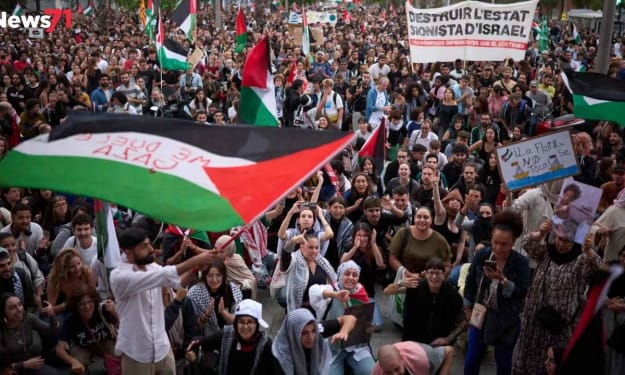
.Destruction in Gaza and the severe humanitarian crisis are bringing notable changes to the diplomatic landscape. On Sunday, the United Kingdom, Canada, Australia, and Portugal recognized the existence of the Palestinian state, while more countries are preparing to do so during the 80th session of the United Nations General Assembly. The governments of Finland and New Zealand have also given similar signals. Among the countries that have recently recognized the Palestinian state, the decisions by the UK and Canada are particularly significant. The UK is one of the five permanent members of the UN Security Council and holds veto power over its decisions, while Canada is the first G7 country to recognize the Palestinian state. After France’s recognition of Palestine, the United States will remain the only permanent Security Council member that does not recognize the Palestinian state. The other two permanent members, China and Russia (then part of the Soviet Union), recognized Palestine just days after the Palestine Liberation Organization (PLO) declared independence in Algeria in November 1988. France has announced it will recognize Palestine unconditionally. The UK decided to act because Israel is unwilling to end the “horrific situation” in Gaza and refuses to agree to a ceasefire with the Palestinian armed group Hamas. In addition, the British Labour government has demanded that Israeli Prime Minister Benjamin Netanyahu stop further annexations in the West Bank and commit to a long-term peace process leading to a two-state solution. London has also called on Hamas to release all hostages, sign a ceasefire agreement with Israel, lay down its weapons, and have no role in the future governance of Gaza. Although these demands have not been met, Sir Keir Starmer has rejected claims by Israeli officials and some relatives of hostages that this move is tantamount to a “reward” for Hamas. The British Prime Minister said their demand for a two-state solution is the exact opposite of Hamas’s hateful vision. Similar conditions were laid down for Hamas at the end of July in a declaration signed in New York by the Arab League’s 22 member states, the European Union, and 17 other countries. In response, Hamas said it would not disarm until an independent Palestinian state is established. the Gaza War and the Two-State Solution Since the start of the Gaza war, 13 countries have formally recognized the Palestinian state: Spain, the UK, Canada, Australia, Portugal, Ireland, Norway, Slovenia, the Bahamas, Jamaica, Barbados, Armenia, and Trinidad. French President Emmanuel Macron announced on X his readiness to join this list of countries, writing: “The most urgent need today is to end the war in Gaza and protect the civilian population.” He added: “Peace is possible. We need an immediate ceasefire, the release of all hostages, and large-scale humanitarian aid for the people of Gaza. We must disarm Hamas and work on Gaza’s security and reconstruction.” The Israeli president, however, emphasized that these steps could fuel “terrorism” and create “another Iranian proxy” in the Middle East. Last August, Israeli Prime Minister Netanyahu said: “Under these conditions, a Palestinian state would not live in peace but would serve as a launching pad for Israel’s destruction.” Israel claims these moves amount to a “reward” for Hamas. What Does Recognition of a State Actually Mean? Recognition by other countries is one of the four main factors of statehood. But it is not the sole decisive factor for the existence of a state. From the perspective of international relations, the three essential elements of a state are: defined borders, a permanent population, and sovereignty. There are several places that fulfill these three elements but function as active states only with recognition by a handful of governments. The most prominent example is Taiwan, which China considers a breakaway province. Taiwan also lacks full UN membership. On the other hand, there are failed states that are recognized by the UN and its members yet lack full control over their territory and borders or the ability to ensure the welfare of their citizens. More countries recognizing Palestine means an increasing number of governments view the Palestinian Authority as a legitimate entity — capable of establishing normal diplomatic relations, opening embassies, and cooperating in various forms. However, this is not enough to grant Palestinians full representation at the UN. Admission of new members requires approval by the Security Council, which means either gaining votes in favor or at least the US abstaining from voting. In April 2024, the US vetoed a resolution to admit Palestine as a member state. If Palestine were admitted, it would gain rights and responsibilities equal to other UN member states. But this alone would not improve realities on the ground or create a fully functioning state. For that, it would be necessary not only to end the Gaza war but also to resolve the decades-long Israeli–Palestinian conflict. Israel not only controls Palestinian borders but is also regarded by many international bodies as an occupying power. For decades, hopes for peace between Israel and Palestine have largely revolved around the two-state solution. Yet progress has repeatedly stalled due to multiple complex issues. One of the most significant is the future of Israeli settlements built on land captured during the 1967 Six-Day War in the West Bank and East Jerusalem, where about 700,000 people now live. : A Core Issue Palestinians want East Jerusalem as the capital of their state, but Israel has established its capital there — a move not recognized by the majority of the international community, which maintains that Jerusalem cannot be divided. Israel’s position is rooted in the fact that many Jewish holy sites are located in East Jerusalem. Moreover, after the 1948 war, the city was divided for nearly 20 years, during which time Israeli Jews were denied access to worship at the Western Wall, then under Jordanian control. Another key issue is the right of return for Palestinians displaced during wars with Israel. It is estimated that around 700,000 Palestinians were forced to flee or were expelled from their homes after the first Arab–Israeli war, and today their descendants number nearly six million. Palestinian leadership demands that these people be allowed to resettle not only in a future Palestinian state but also within Israel’s current borders. Israel, however, categorically rejects this.
By Real contentabout a year ago in Chapters
Taliban Rejects US Plan to Reclaim Bagram Air Base | China Warns of Regional Tensions
Taliban Reject US Plans to Retake Bagram Air Base The Taliban government in Afghanistan has rejected the US announcement about taking back control of Bagram Air Base, saying that “those harboring such ambitions should look at the history of Afghanistan.” On Friday, Suhail Shaheen, the Taliban government’s ambassador in Qatar, referring to US President Donald Trump’s statement, said: “If they want good relations with us, investment in Afghanistan, trade, and diplomatic ties, then we welcome them.” He added: “But if they have greed-driven motives, they should read Afghanistan’s history — from the British invasions to the recent US occupation. They will learn a lot from it.” Earlier, Zakir Jalali, an Afghan foreign ministry official, had said in a post on ‘X’ that during the Doha negotiations and the subsequent agreement, any possibility of such an arrangement had been categorically rejected. Jalali further said that without any US military presence in Afghanistan, both countries could establish political and economic relations based on mutual respect and shared interests. This statement from Afghanistan’s interim government came in response to recent remarks by US President Donald Trump, who said that the US wanted to retake control of Bagram Air Base because of its strategic importance, being close to China. China reacted strongly to the US plan to regain Bagram, saying that “escalating tensions and creating conflict” goes against the aspirations of the people. A spokesperson for China’s foreign ministry said that the Afghan people should decide their country’s future. He added that China respects Afghanistan’s independence, sovereignty, and territorial integrity, and hopes all parties will play a constructive role in promoting regional peace and stability. On Thursday, at the end of his two-day visit to the UK, US President Donald Trump held a joint press conference with the British Prime Minister. When asked by a journalist from The Economist about negotiations on the Russia–Ukraine issue, Trump indirectly criticized the former Biden administration, saying: “If American leadership had mattered in Russia’s eyes, this would never have happened.” Criticizing the previous administration further, Trump said: “The withdrawal of US forces from Afghanistan, without any reason, was very shameful. We could have left Afghanistan in a powerful and honorable way.” He added: “We are going to take back Bagram Air Base, which is one of the largest military bases in the world.” Trump continued: “We are trying to take it back. This may be a little breaking news for you. We are trying to reclaim it.” According to him, one reason for retaking the base is that Bagram is only an hour away from China’s nuclear weapons facilities. It should be remembered that Bagram was one of the US’s largest overseas military bases. The US vacated it in 2021 during the withdrawal from Afghanistan. This is not the first time Trump has spoken about Bagram’s importance and the need to reclaim it. During his first press conference with his cabinet after assuming office, he regretted the decision to vacate Bagram. He had said the US should not have abandoned Bagram. Almost every time Trump mentioned the base in Parwan province, north of Kabul, he immediately linked it to China, claiming that “China has taken over Bagram.” Most recently, in July 2025, Trump said during a cabinet meeting: “If it had been up to me, I would have kept the major Bagram base. Now it’s under China’s control. (Bagram) has one of the most powerful runways in the world, made of concrete and steel. It was a massive base — surrounded by hundreds of kilometers of fortified walls, highly secure, and impenetrable.” What Do Recent Satellite Images of Bagram Show? Satellite images before the US withdrawal and after the Taliban takeover show clear differences. We reviewed many satellite images taken at different times. For example, a Planet Labs satellite image dated 24 September 2020 showed at least 35 aircraft parked at the base. However, about a year after the Taliban took power, not a single aircraft could be seen across the entire base. In addition, hundreds of containers were removed from several parts of the base. These might have been used for logistics storage. It appears that containers were either moved out of Bagram or relocated within different areas of the base. In at least two locations, around 40 containers were moved. At another spot on the base, over 100 vehicles were parked together, suggesting they were collected there after the Taliban takeover. In satellite images taken over the past three years, vehicles are rarely seen moving along the internal roads of the base. From these images, it can be said that no major structural changes have occurred at Bagram Air Base. Except for a February 2025 image showing a helicopter on the runway, no other images between mid-2021 and April 2025 show any aircraft. According to Jennifer Jun, this does not necessarily mean no aircraft ever came to the base during the past four years. “It’s possible aircraft movements did not coincide with the times when satellites captured images, or that aircraft were moved to secure shelters.” Jun added that some early 2025 images showed dark marks on the ground in parts of the base, possibly oil storage. She emphasized that the most important aspect of the base is the condition of its runway. For safety, every operational runway is kept clear of debris. The April 2025 images show both runways in good condition. However, no aircraft are visible. She concluded that Bagram Air Base appears to remain in the same condition as when US forces withdrew. Why is Bagram Important? The importance of Bagram Air Base, located in Parwan province north of Kabul, can be judged by the fact that three US presidents — George W. Bush, Barack Obama, and Donald Trump — have visited it over the past two decades. Joe Biden also visited in 2011, though at the time he was vice president. The Soviet Union originally built the base in the 1950s in Parwan province. During the 1980s, it was considered one of the most important Soviet bases during their occupation of Afghanistan. Following the 9/11 attacks and the US declaration of the “War on Terror,” American forces entered and occupied the base in December 2001. For nearly two decades, Bagram was the central hub for operations against al-Qaeda and the Taliban. Spanning 77 square kilometers, it housed barracks and living quarters capable of accommodating more than 10,000 troops at once. One of Bagram’s two runways is more than 2.5 km long. According to Trump: It has the strongest and largest concrete runway the runway’s thickness is about two meters.
By Real contentabout a year ago in Chapters
Human Resources Director at work on Monday
My assistant opens the doors at 9:00 a.m. exactly on Monday morning. I've had my cup of coffee and I'm wearing my best pressed suit. There's already five people waiting at the door as she unlocks it and greets them with a smile. They waltz in and take a seat in one of the available chairs set before my office. They look at her and they look at me with a sense of bewildered hope on their eager faces. I look at my appointment book and read the first name outloud.
By Shanon Angermeyer Normanabout a year ago in Chapters
Why TTP Attacks Are Rising in Khyber Pakhtunkhwa: Taliban’s Return, Political Discord, and Pakistan’s Counterterrorism Struggle
Earlier this month, following the viral footage of a militant attack on a military center in Bannu district of Khyber Pakhtunkhwa—showing Major Adnan Aslam of the Pakistan Army risking his life to save a wounded comrade—tributes poured in for his bravery from both public and official quarters. At the same time, many also voiced concerns over the growing wave of militant activities in the province. Looking at the recent news from different regions of Khyber Pakhtunkhwa, it appears that banned Tehrik-e-Taliban Pakistan (TTP) has been carrying out frequent attacks on Pakistan’s security forces, leaving soldiers, policemen, and law enforcement personnel dead. Field Marshal Asim Munir and Prime Minister Shehbaz Sharif visited Bannu last Saturday, where the Prime Minister urged the Taliban authorities in Afghanistan to “choose between Pakistan or TTP.” Pakistan has repeatedly claimed that the banned TTP receives support from across the border in Afghanistan, though Afghan authorities deny these allegations. Counterterrorism experts note that ever since the Taliban returned to power in Afghanistan in 2021, there has been a dramatic increase in TTP’s operations and influence in Pakistan—a fact reflected in official statistics. According to government data, more than 2,500 people were killed in TTP attacks in Pakistan in 2024. The number of attacks that year was 66% higher compared to 2023. Similarly, according to the Khyber Pakhtunkhwa Counter Terrorism Department, in the first eight months of this year alone (2025), the province has witnessed 766 incidents of militancy, killing 366 security personnel and 92 policemen. The districts worst affected include Bannu, North Waziristan, Khyber, and Bajaur. However, the Inspector General of Police for Khyber Pakhtunkhwa believes that although TTP attacks have increased, the resultant casualties are fewer compared to last year—suggesting that law enforcement agencies are dealing more effectively with the militants. Most of these attacks have been claimed by TTP, which according to a 2024 United Nations report, is the largest terrorist organization operating in Afghanistan, enjoying support from the Taliban government to launch cross-border attacks into Pakistan. The report further states that the number of TTP fighters in Afghanistan ranges between 6,000 and 6,500. Why are TTP’s attacks and influence growing? Experts say the core reason is the Taliban’s return to power in Afghanistan in 2021, which not only emboldened TTP but also provided it access to new resources. They argue that under the leadership of Mufti Noor Wali Mehsud, TTP has become far more cohesive and focused than before. Former KP IG Akhtar Ali Shah explains that whether religious extremist groups or nationalist outfits, they all exploit the governance vacuum created by weak economic, social, and judicial structures. “Because of various factors, these groups even enjoy a degree of societal acceptance. Their recruitment continues, they keep receiving funds, they have propaganda machinery, and they maintain logistics… in a sense, just like other state institutions continue their functions, they too are carrying out their own parallel operations.” After former TTP leader Mullah Fazlullah was killed in a U.S. drone strike in 2018, Mufti Noor Wali Mehsud was appointed as the new head of the organization. Experts say Noor Wali reshaped TTP’s strategy by reintegrating splinter militant groups that had broken away in the past. Security analyst Abdul Sayed notes, “From 2018, Pakistani Taliban began revising their policies to overcome the decline caused by past infighting and policies. After the 2020 Doha peace agreement between the Taliban and the U.S., these reforms became operational.” As a result, nearly 80 small and large militant groups—including major Taliban factions—rejoined TTP, fueling a surge in attacks. The group also adopted an Afghan Taliban-style centralized command system, better organizing its war against the state. For example, at the start of 2025, TTP announced a shadow structure of about 1,200 officials, establishing networks at the district and tehsil level in Khyber Pakhtunkhwa, as well as in parts of Balochistan, Punjab, and Sindh. Over time, TTP’s ideology has also evolved—from a narrow focus on enforcing Sharia through jihad to a broader narrative that now also advocates for Pashtun and Baloch rights, to project a more “popular” image. Counterterrorism expert Khurram Iqbal says, “Had the U.S. and international forces withdrawn from Afghanistan more responsibly, perhaps we wouldn’t have seen this resurgence of terrorism in Pakistan. The withdrawal was extremely irresponsible—large quantities of weapons flooded the black market, and TTP acquired advanced weaponry through this, intensifying their attacks.” He adds that while Pakistan’s military operations since 2014 achieved significant tactical success, the state failed to follow through with serious post-conflict reconstruction. “The federal government promised 100 billion rupees for the ex-FATA region, but not even a fraction of that has been invested in its development.” This lack of seriousness, he argues, has undermined the military gains. Khurram Iqbal also highlights the political discord between the federal government and the Khyber Pakhtunkhwa provincial government in recent years as another factor undermining counterterrorism efforts. He points out that over the past four years, TTP’s capabilities have increased significantly: their weapons are more advanced, their attacks more organized—all evidence of their growing operational strength. So, does this mean Pakistan’s counterterrorism strategy has failed? Khurram Iqbal says: “If you look at the data, there is little doubt. Pakistan is now the world’s second most terrorism-affected country, after Burkina Faso.” Abdul Sayed adds that Pakistan’s internal political turmoil since the 2022 change of government prevented both political and military leadership from making unified, decisive moves against TTP. “In 2022 and 2023, political instability forced the government to prioritize survival over counterterrorism. This gave TTP the space to consolidate both politically and militarily.” Where does TTP get its funding? Experts say TTP’s financial structure is systematic and hierarchical. A central finance committee supervises regional sub-committees. These regional bodies prepare daily financial reports, which are compiled into monthly audits and shared with the central committee—in other words, a complex financial operation. Journalist Iftikhar Firdous, who reports on militant groups, recalls that in 2018, TTP issued a document titled “Laiha Amal” (Plan of Action). “This document laid out a comprehensive financial model for TTP—still in use today. At its core is ‘taxation’: extorting money from areas under their control and from individuals engaged in cross-border trade. They refer to this extortion as tax.” He adds that TTP propaganda channels also share digital currency account numbers, enabling sympathizers to donate. Indeed, TTP has long collected donations via cryptocurrency. Militant groups widely use cryptocurrency for fundraising because it allows them to collect money quickly while remaining hidden from security forces—at least until a specific crypto wallet is flagged. Operation Experts note that TTP’s media wing, Umar Media, has expanded significantly in recent years to glorify militancy and spread anti-state sentiments. In January 2025, TTP revamped Umar Media, announcing a detailed organizational structure, involving nearly three dozen members. Umar Media now operates through a wide portfolio: video and audio series, regular statements, and magazines in Urdu and Pashto. It has five specialized departments for audio, video, magazines, FM radio, and social media, along with a central media commission. The group also uses platforms like Telegram and WhatsApp to disseminate content. Iftikhar Firdous notes that TTP propaganda is no longer limited to traditional platforms like CDs, which were once common among such groups. “Now they’re on almost every social media platform. Their content heavily focuses on discrediting security forces, targeting Pakistani youth. Their website servers are spread across different countries, allowing them to operate even if one server is taken down.” However, he clarifies that TTP’s actual operations are still far smaller than their propaganda presence. Over time, the group has mastered the art of propaganda. to the Past Khyber Pakhtunkhwa’s Inspector General of Police, Zulfiqar Hameed, says that while militant attacks on police and security forces have risen in the first eight months of this year, casualties are 20% lower compared to the same period last year. He credits increased vigilance and proactive countermeasures. He claims that most areas of the province are now safer, though some districts still face challenges. He expressed optimism that conditions will improve soon even in those troubled areas. According to him, the situation has “significantly improved” in the past eight months: “There are no major problems now. Highways are safe. While attacks on police were frequent at the start of the year, our operations have reduced them, and the situation is now much better.” He added that wherever a threat arises, additional forces are deployed, and targeted operations are launched—leading to the killing of key militant commanders in areas like Lakki Marwat. Would you like me to also summarize this translation into a short analytical article in English (around 800–1000 words) for publication, instead of the full-length detailed translation?
By Real contentabout a year ago in Chapters
Doha Summit: Arab and Islamic Nations Meet After Israeli Strike on Qatar Amid Abraham Accords Anniversary
Less than a week has passed since the Israeli attack on Qatar, and already a joint summit of the Arab League and other Islamic countries is being held in the capital, Doha. Call it coincidence or something else, but this summit comes on the fifth anniversary of the signing of the “Abraham Accords.” It should be remembered that in 2021, as a result of the Abraham Accords, Israel and several Arab countries announced the establishment of normal relations. This meeting is taking place at a time when political tensions between Middle Eastern countries and Israel are intensifying. Israel’s war in Gaza has entered its third year, while other countries in the region are also suffering from its devastation. Last week, Israel attacked Qatar, which had been mediating efforts to end the Gaza war. Prior to this, Israel had already launched strikes on Lebanon, Iran, Yemen, and Syria. Despite the Israeli attack, Doha has expressed its determination to continue its mediation efforts with Cairo and Washington to stop the Gaza war. On Sunday, during a closed-door session of Arab and Islamic foreign ministers in Doha, Qatar’s Prime Minister Sheikh Mohammed bin Abdulrahman Al Thani urged the international community to abandon its “double standards.” He said, “What encourages Israel to continue its behavior is the silence of the international community and its failure to hold Israel accountable.” While some hope that serious measures will be taken in this regard, many others are doubtful that Arab countries will present a united response. The Doha summit is being jointly organized by the 22-member Arab League and the Organization of Islamic Cooperation. Arab Force On Sunday, the foreign ministers of member states discussed a draft resolution concerning last Tuesday’s Israeli attack on Qatar, which will be presented for approval at an emergency Arab-Islamic summit. Egyptian President Abdel Fattah el-Sisi is reportedly once again trying to gain Arab countries’ support for the formation of a NATO-style “Joint Arab Force.” Analysts are calling it the “Arab NATO,” intended to defend any Arab country against potential aggression. According to Pakistan’s state news agency, Ishaq Dar stated that in order to monitor Israeli planning in the region and effectively curb its expansionist agenda, an Arab-Islamic task force must be established and coordinated, aggressive measures must be adopted. Qatar’s former Prime Minister Hamad bin Jassim Al Thani, in a message on X, stressed the importance of Arab and other Islamic countries adopting clear and practical decisions at the summit. He said that at the Doha summit, decisions must be made to end Israel’s reckless attacks against different countries under the pretext of fighting terrorism, as well as its hatred towards the Arab and Islamic world. Hamas Calls for Boycott of Israel Meanwhile, Hamas has called on Arab and Islamic foreign ministers, as well as influential powers worldwide, to boycott Israel and work to isolate it politically and economically. It has also demanded an end to Israel’s open violations of international law. In a memorandum issued on Sunday, Hamas demanded that international pressure be applied to stop Israeli “aggression and genocide of Palestinians” in Gaza, the West Bank, and Jerusalem, and that Israeli leaders be prosecuted in international courts. Hamas leader Izzat al-Risheq urged participants at the Doha summit to express historic consensus to halt “genocide in Gaza” and crimes of Zionist occupation in the West Bank, Jerusalem, Lebanon, Syria, Yemen, Tunisia, and Qatar. He said the Israeli prime minister is pushing the entire region to the brink of destruction in order to achieve the “Greater Israel” project, reshape the Middle East, and establish dominance. Arab Governments Do Not Understand the Language Israel and the U.S. Understand However, some believe that the Doha summit will prove useless, and criticism has also been directed at the Qatari prime minister’s visit to Washington following the Israeli attack. Yemeni politician and academic Sheikh Hussein Hazib expressed similar views. Criticizing the Doha summit, he said this alliance would be “stillborn.” He pointed towards the use of force, saying that Arab governments “do not understand the language that Israel and the U.S. understand.” A social media user named Hamad Nasser Muneef also said he expects nothing more than condemnation from the summit. Yahya Sinwar’s Major Achievement This summit coincides with the fifth anniversary of the Abraham Accords. Although the agreement has survived despite the Gaza war, the Washington Institute for Near East Policy has said the deal is facing new complications. These include the indefinite suspension of talks to normalize relations between Israel and Saudi Arabia. In a recent report published in September, the institute stated that the late Hamas leader Yahya Sinwar succeeded in linking efforts to normalize relations between Israel and Saudi Arabia with the Palestinian issue, by capitalizing on Arab anger over the Gaza war. The report added that as long as Israel’s campaign continues in Gaza without any possibility of Palestinian governance, there is little chance of expanding the Abraham Accords—particularly in terms of achieving normalization between Israel and Saudi Arabia.
By Real contentabout a year ago in Chapters
Doha Strike on Hamas Negotiators Threatens Gaza Ceasefire and Regional Stability
The Israeli strike on Hamas leadership in Qatar has dangerously escalated tensions in the region, and analysts believe it has not only undermined ceasefire efforts in Gaza but also dimmed prospects for any new U.S.-led alliances in the Middle East. Israel has stated that the strike on a complex in central Doha was “accurate.” The residential compound was used by Hamas’s negotiating team. Ceasefire Prospects Fade Hugh Lovatt, a Middle East expert with the European Council on Foreign Relations (ECFR), said the attack on Hamas’s negotiating team has dealt a severe blow to U.S.-backed talks on a ceasefire in Gaza. Qatar, Egypt, and the United States are currently mediating between Hamas and Israel to secure a ceasefire in Gaza and the release of hostages. According to Lovatt, “Killing the very negotiators you are in talks with makes reaching any agreement far less likely.” Six Hamas-linked individuals were killed in the Israeli strike in Doha, including the son and office manager of Hamas leader Khalil Al-Hayya. However, Hamas’s senior leadership survived. Put simply, Israel targeted Hamas’s negotiating team at the very moment they were discussing U.S.-proposed ceasefire terms. Hamas leaders have lived in Qatar for years, but this was the first time Israel targeted them there. Still, Lovatt noted, “This tactic is not new in the region.” He recalled, “Last year, Israel killed Ismail Haniyeh while he was engaged in ceasefire talks.” He argued that the aim is to derail ceasefire efforts. “What the Israeli government says is irrelevant—its actions make it clear it has no interest in any ceasefire agreement.” Lovatt added that such Israeli measures will alter Hamas’s internal structure, making diplomacy even more difficult. “Israel is clearly weakening moderate figures by assassinating them, which only strengthens the hardliners who argue that Israel understands nothing but violence, not diplomacy.” In the past, Israel has also targeted Hamas leaders in Lebanon and Syria. Could the Doha Strike Have Effects Beyond Gaza? Experts warn that the Hamas strike in Doha on Tuesday could have repercussions far beyond Gaza. They note that Qatar is a key U.S. ally and has acted as a mediator between Hamas and Israel for two years. An attack inside the country sets an unprecedented example. Lovatt remarked, “This isn’t the first Arab capital Israel has bombed, but it is the capital of a U.S. ally.” “Qatar is not Tehran, not Beirut. It hosts a major U.S. airbase and has heavy Western investment.” During a press briefing, White House Press Secretary Karoline Leavitt said Israel had informed the Trump administration of the strike. But it remains unclear whether the notification came before or during the attack. She echoed President Trump’s remark that the Israeli strike in Doha “brought no benefit to either Israeli or American objectives.” However, Dr. Sanam Vakil of Chatham House’s Middle East and North Africa Program argued that the strike undermined Qatar’s security and exposed weaknesses in regional alliances. She added, “The possibility that the U.S. may have approved the attack on Hamas leadership will certainly affect bilateral ties with Qatar.” “Qatar will not sever its relations with Washington over this, but it has been thrown into uncertainty.” Vakil stressed that the Israeli strike shattered several long-standing assumptions: “It was assumed that allies don’t attack each other, nor endorse such strikes. The fact that the U.S. may have supported a violation of Qatar’s sovereignty will have implications across the Middle East.” Dr. H.A. Hellyer of the Royal United Services Institute agreed. He said states in Doha and across the region will now question “whether U.S. security guarantees have any real meaning, given Israel’s freedom to act in this way.” Still, Vakil pointed out that Qatar’s security ultimately depends entirely on the U.S., underscoring the limits of Qatar’s influence. She added, “For years it was assumed Israel would not target Hamas leadership in Qatar for the sake of diplomacy—but Israel has now shattered that notion and exploited the political and military moment.” According to Vakil, whether Trump approved the attack or not can be debated, but what is clear is that Washington does not view it as a diplomatic failure. Instead, it sees the strike as part of a broader strategic approach. “Agreements aren’t made solely at the negotiating table—you can force people to change their positions. Clearly, the U.S. president is trying to influence negotiations through other means.” Grave Consequences for the Region Both Dr. Vakil and Hugh Lovatt warned that the Israeli strike in Doha could have far more serious regional consequences. Arab officials worry that Israel is becoming not only increasingly aggressive but destabilizing in a manner largely unchecked by either the U.S. or Europe. Vakil added, “We are entering a new world, a new region, a new era with new rules. Old assumptions are collapsing.” Both analysts argued that these concerns will drive regional powers to further expand their military capabilities. In Lovatt’s view, the biggest casualty of current events may not be Israel or Palestine, but rather the credibility of the West itself.
By Real contentabout a year ago in Chapters