Historical Fiction
The Deep Black Box
It was to be a routine salvage dive. The Eurydice, a charter exploration vessel, was sweeping the South Atlantic for wreckage sunk beneath the waves—old war debris, shipping containers, anything that was worth salvaging. The trench they were searching was outside most shipping lanes, in an area of sea so deep it swallowed sonar.
By Amzad Rahidabout a year ago in Chapters
H.H. Holmes: The Murderer Who Built a House of Horror
H.H. Holmes, born Herman Webster Mudgett, is considered one of the first modern serial killers. Operating during the late 19th century, Holmes used his charm, intelligence, and cunning to lure victims into his deadly trap. Holmes, who is famous for building the infamous "Murder Castle" in Chicago, is thought to have killed at least twenty people, though some estimates say it could have been much higher. This is the complete story of H.H. Holmes, from his childhood through his crimes, the infamous "Murder Castle," his capture, and one of America's most chilling killers' lasting legacy. Early Life: A Troubled Beginning
By Shahadat Hossainabout a year ago in Chapters
"The Digital Mask"
In the virtual world of New Eden, everyone wore a digital mask. It was a place where people could be anyone, where identities were fluid, and reality was malleable. For Ava, the digital mask was more than just a tool – it was a shield, a disguise, and a passport to a world where she could escape the confines of her mundane life. *Chapter 1: The Allure of New Eden* Ava's life in the real world was predictable and gray. She lived in a small apartment, worked a 9-to-5 job, and spent her free time scrolling through social media. But in New Eden, she was free to be anyone and do anything. With a few clicks, she could change her avatar, her voice, and even her personality. She could be a superhero, a rockstar, or a queen – the possibilities were endless. Ava's digital persona, "Echo," was a reflection of her ideal self. Echo was confident, charismatic, and fearless. She had a large following in New Eden, and her posts were always filled with witty remarks and sarcastic humor. Ava loved the attention and admiration she received as Echo, and she spent hours crafting her digital persona. *Chapter 2: The Dark Side of the Screen* But as Ava's online presence grew, she began to notice strange occurrences. People she didn't know would message her, asking for personal information or trying to sell her things. Some were friendly and harmless, while others were creepy and threatening. Ava started to feel uneasy, wondering if her digital mask was enough to protect her. One night, Ava received a message from a user named "TruthSeeker." The message was cryptic, but it sent a chill down her spine. "You can't hide forever," it read. "Eventually, your true self will be revealed." Ava tried to brush it off as a prank, but the message lingered in her mind. *Chapter 3: The Unmasking* As the days passed, Ava started to notice more and more strange messages. Some were from people who seemed to know her in real life, while others were from users who claimed to have uncovered her true identity. Ava's anxiety grew, and she began to question whether her digital mask was worth the risk. One night, Ava decided to confront TruthSeeker. She messaged him, asking what he wanted and how he knew her. The response was immediate. "I know you're not who you say you are," TruthSeeker wrote. "I know your secrets, Ava." Ava's heart racing, she asked how he knew her name. "I've been watching you," TruthSeeker replied. "I've been watching you for a long time." *Chapter 4: The Truth Revealed* Ava's world began to unravel. She realized that her digital mask wasn't as secure as she thought. TruthSeeker had been tracking her IP address, and he knew everything about her – her real name, her address, her job. Ava felt vulnerable and exposed. In a desperate attempt to protect herself, Ava tried to delete her account and shut down her digital persona. But it was too late. TruthSeeker had already shared her information with others, and Ava's personal life was about to be exposed to the world. *Chapter 5: The Aftermath* The consequences of Ava's digital life spilling into her real life were severe. She lost her job, her friends distanced themselves from her, and she became a target for online harassment. Ava's mental health began to deteriorate, and she struggled to cope with the aftermath. As she navigated the ruins of her online life, Ava realized that her digital mask had been a double-edged sword. It had given her freedom and confidence, but it had also made her vulnerable to exploitation and harm. Ava began to question the true cost of her online presence and the value of her anonymity. *Chapter 6: The New Beginning* In the end, Ava emerged from the wreckage of her digital life with a newfound appreciation for authenticity. She realized that her digital mask had been a shield, but it had also been a prison. Ava started to rebuild her life, focusing on real-world connections and meaningful relationships. As she looked back on her experience, Ava understood that the digital mask was just a tool – a tool that could be used for good or ill. She vowed to use her online presence more mindfully, aware of the risks and benefits of her digital persona. The story of Ava and her digital mask serves as a cautionary tale about the importance of online safety and digital literacy. In a world where identities are fluid and reality is malleable, it's essential to be aware of the risks and consequences of our online actions. By being mindful of our digital presence, we can protect ourselves and others from the potential harm of the digital world. *Conclusion* The digital mask is a powerful tool that can be
By Hazrat bilal about a year ago in Chapters
The Deal
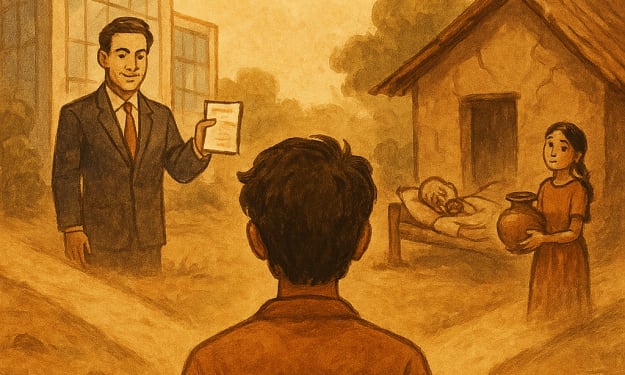
Ravi sat on the old wooden bench near the village tea shop. The sun was high in the sky, and sweat ran down his face. His shirt stuck to his back. It was summer, and the heat was worse than usual. But it was not just the weather that made Ravi uncomfortable — he had a big decision to make, and it was troubling his heart.
By Tahir khanabout a year ago in Chapters
Imran Ahmed Khan Niazi’s Government: A Distinct Chapter in Pakistan’s 74-Year Political History
Introduction Since gaining independence in 1947, Pakistan has witnessed a variety of leadership styles, political ideologies, and governance structures. Among the many political leaders who held the office of Prime Minister, Imran Ahmed Khan Niazi stands out not only for his cricketing fame but also for his ambitious and reformist approach to governance. Leading the Pakistan Tehreek-e-Insaf (PTI), Imran Khan assumed office on August 18, 2018, and served until April 10, 2022 — a period of approximately 3 years and 8 months. His tenure, though short of the full five-year term, left a significant impact on Pakistan’s political, economic, and social landscape. This article explores the beginning of his government, the challenges he faced, the initiatives he introduced for the welfare of the common man, and how his overall performance compares to the governance of Pakistan over the past 74 years and 9 months. --- The Beginning of Imran Khan’s Government Imran Khan’s political journey began in 1996 with the formation of PTI. For over a decade, the party remained on the fringes of Pakistani politics. However, Khan’s charismatic leadership, persistent campaigning against corruption, and the promise of a "Naya Pakistan" gradually gained public attention. By the 2018 general elections, PTI had become a formidable political force, securing enough seats to form a government at the federal level. His election victory was seen as a reflection of public frustration with traditional political parties like the Pakistan Muslim League-Nawaz (PML-N) and Pakistan Peoples Party (PPP), both of which had been marred by allegations of corruption, nepotism, and inefficiency. Imran Khan promised to bring accountability, transparency, and a new era of justice and welfare-oriented governance. --- Challenges Faced by His Government Imran Khan inherited a country riddled with deep-rooted economic, political, and administrative issues. From day one, his government had to deal with: 1. Economic Crisis: Pakistan was facing a severe balance-of-payments crisis with depleting foreign reserves. The government had to seek a bailout from the International Monetary Fund (IMF) to stabilize the economy, which brought its own set of conditions and austerity measures. 2. High Debt and Deficit: Khan’s government had to deal with a massive debt burden and a persistent fiscal deficit. Managing public finances without curtailing development or social programs was a major hurdle. 3. Opposition Pressure: Unlike some past governments, Imran Khan faced strong opposition from day one. Multiple parties joined forces against him, accusing him of being brought into power by the military establishment. 4. COVID-19 Pandemic: The global pandemic hit during his tenure, forcing a delicate balancing act between saving lives and saving livelihoods. Pakistan’s healthcare infrastructure was under immense pressure. 5. Civil-Military Relations: Though initially considered close to the military, cracks began to appear towards the end of his tenure, ultimately contributing to his removal through a vote of no-confidence. --- Welfare and Thoughtfulness for the Poor Despite economic and political challenges, Imran Khan’s government undertook several significant initiatives for the welfare of the underprivileged: 1. Ehsaas Program: Launched in 2019, it became Pakistan’s largest-ever social safety net. It included cash transfers, nutrition programs, interest-free loans, scholarships, and shelter homes for the homeless. During COVID-19, the Ehsaas Emergency Cash Program was internationally praised for delivering aid to over 15 million families. 2. Panagahs (Shelter Homes): To provide dignity and shelter to the homeless and daily wage laborers, panagahs were established in major cities where people could sleep safely and get free meals. 3. Sehat Sahulat Card: A landmark health insurance initiative that allowed citizens to avail free medical treatment at both public and private hospitals. It was initially introduced in KP and later expanded to Punjab and other regions. 4. Low-Cost Housing: Under the Naya Pakistan Housing Program, the government aimed to provide affordable housing to low and middle-income families. 5. Kamyab Jawan Program: Aimed at empowering youth through skills development and small business loans. 6. Digital Pakistan Initiative: To modernize Pakistan’s digital infrastructure and promote innovation among youth and entrepreneurs. --- Comparative Analysis: Imran Khan vs. 74 Years of Governance To fairly compare Imran Khan’s government to the rest of Pakistan’s 74 years and 9 months of governance, we can analyze across a few key dimensions: 1. Anti-Corruption Narrative Unlike many past leaders, Imran Khan consistently maintained a hardline stance against corruption. He established the Asset Recovery Unit, supported NAB’s actions (though critics claimed it was politically motivated), and highlighted money laundering and offshore accounts. In contrast, past governments often protected corrupt elements within their parties and failed to institute strong accountability mechanisms. 2. Focus on Welfare State While welfare programs have existed before (like Benazir Income Support Program), Imran Khan’s Ehsaas was more extensive in scope and implementation. He emphasized the Islamic concept of Riyasat-e-Madina, drawing inspiration from the early welfare state model of Prophet Muhammad (PBUH). 3. Economic Management This is a mixed bag. Under Khan, inflation remained high, especially in food prices, and the Pakistani Rupee depreciated significantly. Critics argue this hurt the middle and lower classes. However, structural reforms, current account improvements, and the rise in exports and remittances were notable achievements. Earlier governments often relied heavily on unsustainable debt and subsidies to mask economic problems. 4. Foreign Policy Khan adopted an independent foreign policy posture. He spoke against Islamophobia at the UN, maintained neutrality in Middle East tensions, and prioritized relations with China, Turkey, and Malaysia. His stance on India, especially after the revocation of Article 370 in Kashmir, was firm and vocal. In contrast, previous governments often adopted a more cautious, traditional diplomatic approach. 5. Media and Free Speech Imran Khan's government was criticized for curbing media freedom and using state machinery to suppress dissent. Journalists faced pressure, and digital censorship increased — a trend that unfortunately has existed under previous governments too. --- Legacy and Public Perception Imran Khan's removal from office through a no-confidence vote was a dramatic end to a polarizing tenure. However, his popularity among the masses, especially the youth, remains high. His messaging of sovereignty, anti-elitism, and public empowerment continues to resonate. His supporters see him as an honest leader who tried to change a corrupt system but was obstructed by the "status quo" forces. His critics argue he lacked experience and team strength to deliver on his promises. --- Conclusion Imran Ahmed Khan Niazi’s time in office may have been short compared to Pakistan’s long and complex political history, but it was certainly impactful. His focus on public welfare, digital transformation, and international standing marked a shift in governance. Despite economic challenges and political instability, his tenure introduced initiatives and debates that continue to shape the national discourse. In a country where leadership is often measured in missed opportunities, Imran Khan’s government represents both the promise of reform and the reality of entrenched resistance. When viewed against the backdrop of Pakistan’s 74 years and 9 months of governance, his chapter stands as a bold — albeit incomplete — attempt at redefining the country's future. The end……….
By Umair Ali Shah about a year ago in Chapters