Children's Fiction
She handwrote a letter in 2042. The city wouldn't be the same again.
On the surface, everything was ideal in the glittering metropolis of Liora. In addition to writing books, music, and even poetry, artificial intelligence also handled traffic. With glowing visors on their faces, people were walking with their eyes deep in machine-tailored, personalized realities rather than on the outside world.
By Md Rakib Islamabout a year ago in Chapters
Mr. Village Boy
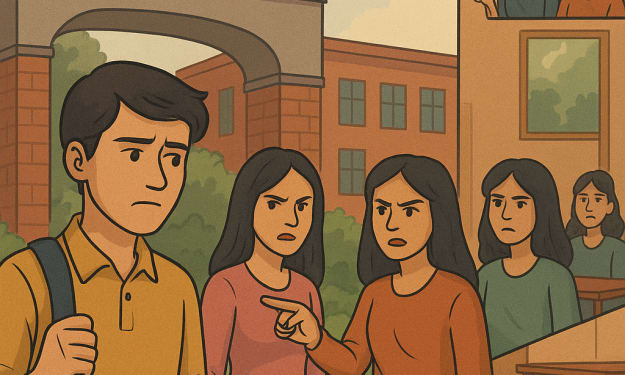
Mr. Village Boy Episode 1 Written by Iqbal Hossain It was my first day at university. As soon as I walked through the gate— Smack!! — “Hey, you rude boy! Do you feel like bumping into girls on purpose?” I said nothing, just listened. — “And why are you staring like that? Does looking at girls make you freeze or what?” — (Nipa) — “No, I mean… actually, sister…” — (Me) — “Oh! So now I’m your sister, huh?” — (Nipa) — “Come on, Nipa, let it go.” — (Her friend) — “Look at him! Looks like he came straight out of the jungle.” — (Another friend) — “Yeah, you’re right. Boys like this are always like that.” — “Let’s go, we’re already late.” — (Nipa) — “Yeah, let’s not waste time talking to these ‘village boys.’” — (Friend) As soon as Nipa said “let’s go,” they all left, and I just stood there. Honestly, I wasn’t even staring at her. I was walking on my side, and she suddenly bumped into me. And yet, I got slapped and scolded for it. I was left wondering—what exactly did I do wrong? Nothing felt good after that. First day at university, and this is my welcome! Anyway, I needed to find my classroom first. Then I’d figure everything else out. After a lot of effort, I found the classroom and walked in— — “Hey look, look! The village boy is our classmate!” — (Friend, laughing) — “No one sit next to this guy.” — (Nipa) I couldn’t figure out why this girl had it out for me so suddenly. Maybe she just didn’t want me to sit anywhere, or maybe there were no seats, so she was trying to push me out. Still, I decided to walk up to the front and sit. — “Hey ‘village boy,’ didn’t I tell you not to sit near us?” — (A guy) — “Well, I mean… there’s no empty seat, so I thought I’d sit here.” — (Me) — “So what if there’s no empty seat? Go sit on the floor at the very back.” — (Nipa, laughing) — “But there’s a seat here.” — (Me) — “Why do you talk so much?” — (Guy next to me) — “Nipa’s the richest girl in this university. If she wants, she can have you kicked out. So just do as she says.” — (Guy) — “Okay, okay… I’ll go sit on the floor in the back. But please ask her not to make a scene.” — (Me) — “Good boy! Now you get it!” — (Nipa) — “Yeah, yeah…” — (Me) — “Go sit on the floor. Who knows what Nipa will do otherwise.” — (Guy) I quietly went and sat on the floor. As soon as I sat, everyone started laughing— — “Nipa, you totally made him your puppet!” And they kept laughing… I felt my head bowing lower, burning with embarrassment. Just then, a girl said— — “If you want, you can sit next to me.” — (Girl next to me) As soon as she said that, I hurried over and sat beside her. The others kept joking— — “Look, one ‘village girl’ called the ‘village boy’ to sit beside her!” — “What a match! The village girl and village boy sitting together!” And right at that moment, Nipa said— To be continued... If you like it, let me know — I’ll post the next episode! ---
By Story writesabout a year ago in Chapters
How to Choose the Best Tours at WatchMuseum. Content Warning. AI-Generated.
In an time overwhelmed by computerized timekeeping, the offer of collectible take observes remains undiminished. These complicated timepieces, once images of status and craftsmanship, proceed to fascinate collectors and aficionados. At the bleeding edge of protecting this horological legacy is [WatchMuseum.org](https://watchmuseum.org/), a stage committed to displaying a curated collection of collectible and vintage take watches.
By ARIF HASANabout a year ago in Chapters
The Story of Us All
In the beginning, there was nothing—only silence and space. Then, from the chaos of the early universe, stars were born. One exploded, scattering its heavy elements through the galaxy. From this stellar ash, our Sun emerged, and around it, the planets spun into being.
By Zeeshan Muhammadabout a year ago in Chapters
Rooftop Renegades: A Dystopian Rebel's Tale of Freedom
Kael spotted the smoke before she heard the sirens. On the edge of a derelict rooftop, the light from the setting sun bathed the city in molten gold. But on the eastern sector, near the Wastelands, a column of black smoke rose like a fist in the sky.
By Ahsan Jamilabout a year ago in Chapters
Rooftop Renegades: A Dystopian Rebel's Tale of Freedom
Rooftop Renegades In the year 2147, the city of Neoterra gleams with neon lights and suffocates beneath its own shadows. Towering skyscrapers split the clouds while drones hum overhead like digital vultures. The government, a faceless machine called the Authority, controls everything: movement, thought, even dreams. Beneath the polished surface, rebellion simmers like a heartbeat waiting to explode.
By Ahsan Jamilabout a year ago in Chapters
"Where Silence Lives"
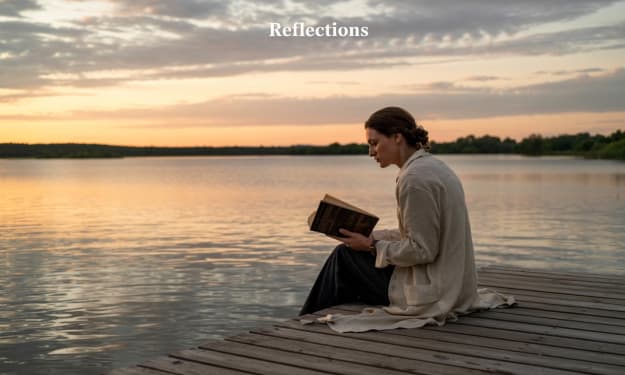
The lake didn’t speak, but it listened. Every morning, as the mist skimmed across its surface, Ava found herself returning to the same wooden dock that creaked beneath her steps. It had become her ritual—not a habit, but a sacred pause—between the noise of everything else.
By Hamdan Khanabout a year ago in Chapters
The Age of War Must End — The Age of Humanity Must Begin
In a world boasting technological marvels, soaring skyscrapers, and instant communication, it remains a cruel irony that humanity continues to drown in the blood of senseless wars. Across continents and cultures, the cries of the innocent — children, women, and the elderly — echo louder than ever, shattering the very illusion of progress. The Ukraine-Russia war, the burning hostility between Pakistan and India, and the relentless agony of the Palestinians under Israeli occupation stand as damning evidence of international failure to protect human dignity. In Ukraine, a proud nation found itself crushed under the boots of an invading force. Missiles tore through tranquil skies; tanks ground the hopes of millions into dust. Cities that once thrived now lie in ruins, haunted by the memories of civilians who sought nothing more than a peaceful life. Families have been torn apart. Children grow up under the deafening sounds of artillery, their innocence stolen by forces far beyond their control. The so-called protectors of human rights — powerful nations like the United States and alliances like the European Union — responded swiftly. They sent aid, condemned the invasion, and issued endless statements. Yet beneath their actions lies a cold calculation: the need to weaken adversaries, expand influence, protect strategic interests. For every dollar sent for humanitarian assistance, ten were spent fortifying political dominance. The suffering of Ukrainian civilians became a grim stage where global superpowers rehearsed rivalries, compassion reduced to a tool of influence. Meanwhile, the Indian subcontinent remains trapped in a cycle of hostility that has outlived generations. Pakistan and India, birthed through bloodshed in 1947, continue to see each other not as neighbors but as enemies. Their borders, particularly in Kashmir, are lined with barbed wire, watchtowers, and graves. Every clash along the Line of Control tears open old wounds. Every shell fired snatches away another innocent life. On the ground, it is ordinary families who pay the price. Children lose parents. Mothers weep over flag-draped coffins. Dreams wither before they ever have a chance to bloom. Yet the global powers, otherwise quick to voice outrage, largely look away. India’s economic rise makes it an attractive partner for the West. Pakistan’s strategic geography keeps it critical to shifting alliances. The suffering of Kashmiris, caught in the crossfire, remains too complex — and too inconvenient — for the world to care. Nowhere, however, is global moral bankruptcy more stark than in Palestine. A century-old struggle continues to turn the land into a graveyard of peace. Palestinian families live under constant threat: homes demolished without warning, ancient olive trees uprooted, entire neighborhoods reduced to rubble in a single night. Israeli military operations, framed as self-defense, often cross into the territory of collective punishment. Western leaders issue carefully crafted statements, expressing "concern" yet refusing to hold Israel accountable. Billions in military aid continue to flow, while humanitarian assistance to Gaza trickles in — if it comes at all. The message is clear: not all lives are weighed equally in the scales of global empathy. Across all these conflicts, where are the institutions built to uphold human dignity? The United Nations, the International Criminal Court, the myriad NGOs dedicated to peace and justice — all appear shackled. Created from the ashes of global wars, they now struggle for relevance in a world where power speaks louder than principles. Humanitarian workers risk their lives daily, feeding the hungry, healing the wounded, educating the forgotten. Their heroism shines, but it is too often drowned out by the thundering boots of soldiers and the self-serving policies of states. The United States, cloaked in the image of global leadership, reveals itself again and again as a selective defender of rights. Interventions are less about humanitarian need and more about strategic gain. The European Union, proud of its ideals, oscillates between grand declarations and cowardly retreats. In Ukraine, they moved quickly. In Palestine, they hesitate. In Kashmir, they stay silent. It is not just hypocrisy; it is abandonment. Entire peoples are left to suffer because they are not deemed strategically important enough to save. As wars rage, their consequences metastasize far beyond battlefields. Refugee crises surge, bringing social tensions. Economies collapse, breeding desperation. Extremism flourishes in the vacuum left by justice. International law, once a noble shield, crumbles with each unmourned war crime, each unpunished atrocity. We now stand on the edge of a world where war may no longer be an aberration — but the norm. Unless humanity chooses another path. Even now, amid the ruins, there is hope. Amid the tears of grieving mothers and the silence of destroyed schools, there is still a chance for change — if we have the courage to grasp it. To the leaders of all nations, to every citizen, the message must be clear: Enough. Enough of bloodshed, enough of hatred, enough of treating human lives as expendable. No grievance, no ideology, no ambition justifies the death of even one innocent child. Each bomb that falls extinguishes not just life but infinite potential — the doctors, poets, teachers, and dreamers the world will now never know. True strength is not in armies or arsenals. It is in the prosperity of your people. It is in laughter in playgrounds, in books read by eager students, in families living without fear. The real race among nations must not be in stockpiling weapons but in curing diseases, eradicating poverty, saving our planet. India and Pakistan must lay down the sword and compete instead to uplift their people. Israel and Palestine must find the humanity to see each other not as enemies, but as fellow sufferers deserving dignity. Russia and Ukraine must rebuild not just cities but trust. The future must be one of trade, of technology, of education, of culture. Let embassies replace trenches, songs replace sirens, dreams replace nightmares. Leadership that values life over land, justice over dominance, and hope over fear — that is the leadership the 21st century demands. Citizens, too, must rise: rejecting propaganda, refusing to hate, demanding from their governments not war but wisdom. International institutions must be rearmed not with weapons but with willpower: the will to enforce human rights universally, without favor, without fear. Victory must be redefined. Not the conquest of others, but the elevation of all. Not the building of walls, but the opening of doors. Not the pursuit of revenge, but the pursuit of reconciliation. To the children who tonight sleep under crumbling roofs in Gaza, shiver in basements in Ukraine, or live under the shadow of soldiers in Kashmir: You deserve better. To the mothers who bury their sons, the fathers who cradle the broken bodies of their daughters: Your pain must not be ignored. This world can be different. It must be different. It will be — if we have the courage to make it so. Let the history of tomorrow not be another grim chapter written in blood. Let it be a testament — that in the hour of our greatest failures, humanity found the strength to choose light over darkness. We owe it to ourselves. We owe it to each other. We owe it to the future. ---
By Umair Ali Shah about a year ago in Chapters
What Left This Long, Winding Trail Across Mars? NASA’s Orbiter Has the Answer. AI-Generated.
From ancient river valleys to towering dust devils, Mars is a mysterious planet. However, one of its most puzzling characteristics has been the numerous miles-long, winding trails that traverse its surface. What could have created these strange marks? Thanks to NASA’s Mars Reconnaissance Orbiter (MRO), we now have an answer.
By IFTYKHER AHMEDabout a year ago in Chapters