Business
The Life Train — CHAPTER 1: THE ENIGMATIC AWAKENING. Content Warning.
The entire novel is available in both hard copy and kdp at https://www.amazon.com/gp/aw/d/B0DBC9J146/ My head hurts. My head is spinning. WAIT! STOP! Who am I? Where am I? I am a… ugh, I don’t even know how to define myself — chunks of personalities in a mental civil war, each wishing to kill the other and gain, most probably, nothing. But wait, who am I again ?
By LAMAANKACHE Oussama8 months ago in Chapters
The Story of Mary Van Brittan Brown
Mary Van Brittan Brown (1922 – 1999) – Home Camera Security System In the quiet hours of night, when most of New York City had finally lulled itself to sleep, the row houses of Queens told a different story. Streetlights flickered against cracked sidewalks, shadows moved where no footsteps sounded, and the uneasiness of the era seemed to settle into the very bones of the neighborhood. It was the mid‑1960s, a time when the city pulsed with ambition and creativity—but also with rising crime. For many residents, safety was something you hoped for rather than something you could rely on.
By TREYTON SCOTT8 months ago in Chapters
If the Strait of Hormuz is closed for a long time, it will benefit Russia.
A war involving the United States and Israel with Iran carries the risk that the Strait of Hormuz could remain closed for a prolonged period. This is a crucial route in the global economy through which 20% of the world’s oil and liquefied natural gas is supplied from the countries of the Persian Gulf. Any disruption in this route would create problems for Europe, the United States, and even Donald Trump himself. However, it would also benefit Russia, because it would give the Kremlin an opportunity to increase oil exports and earn billions of dollars to finance the war against Ukraine. Iran controls the northern coast of the narrow Strait of Hormuz. It has repeatedly threatened to close the strait in response to what it calls American and Israeli “aggression,” but even after the deaths of senior leaders and days of bombardment, it has not acted on this threat. However, shipping has almost stopped because shipping companies are unwilling to take the risk and insurance costs have skyrocketed. “The Strait of Hormuz is technically open, but in practice it has been closed to shipping,” say analysts at Kpler, which monitors tanker traffic. “This is not just an abstract geopolitical risk; it is a real disruption to supply.” How the war helps the Kremlin According to Kpler analysts, “This conflict will significantly strengthen Russia’s position in the global oil market.” Disruptions in Middle Eastern oil supply would increase India and China’s dependence on Russian oil. In recent months, these two major buyers of Russian oil have reduced their imports under Western pressure, forcing Russia to cut prices further and reduce exports. But even these steps have not fully sold the sanctioned oil, and millions of barrels remain at sea in shadow-fleet tankers waiting for buyers. If the Strait of Hormuz is closed, the world will not only lose official Middle Eastern oil from Saudi Arabia, the United Arab Emirates, Kuwait, and Iraq, but also be cut off from the supply chain of smuggled and sanctioned Iranian oil. With Venezuela under U.S. blockade, Russia would effectively become the only country able to sell cheap oil through the shadow fleet. With global prices inevitably rising, it will become easier for Moscow to sell cargo that is currently stranded at sea. Bloomberg energy expert Javier Blas says: “This war will benefit Vladimir Putin because oil prices will rise and demand for sanctioned Russian crude will increase. If the White House ignores it, India could become a buyer of that oil.” Mr. Trump has demanded that India stop importing Russian oil. However, with congressional elections approaching in November, keeping gasoline prices low in the United States may become a higher priority for him. Blas writes that although this option may not be easy for those trying to counter Putin’s aggressive policy, it could partially offset the oil shortage caused by disruptions in the Strait of Hormuz. Analysts say that even if Trump remains dissatisfied, India is likely to resume buying Russian oil. S&P Global Ratings has also stated that India’s strategic oil reserves are currently below the level set by the International Energy Agency. In contrast, China has actively increased its reserves in recent months, but Kpler analysts say that if the Strait of Hormuz is blocked, Beijing will also be prepared to increase maritime oil imports from Russia. “In the short term, disruptions will most likely put pressure on India, which will probably immediately turn to Russian oil due to its availability and well-established logistics mechanisms,” analysts say. China, which has recently reduced imports of Russian oil, may also abandon this caution if the conflict continues for weeks. But Russia’s interests are not limited to this Shipping disruptions have given the Kremlin hope that it can maintain pipeline exports to Europe. However, there are two obstacles. First, the European Union is preparing a full-scale oil embargo against Russia, and its details were expected to be announced in mid-April. An oil crisis would not be the right time to announce such a decision. Second, key European buyers of Russian oil and Kremlin allies Hungary and Slovakia have not received oil via the “Druzhba” pipeline for more than a month because it was damaged in Ukraine due to Russian bombing. As a result, both countries have vetoed new sanctions against the Kremlin and European loans to Ukraine. The European Union proposed that the two countries obtain oil through a pipeline connected to Croatia’s maritime terminal instead of Russian oil. But if maritime oil supplies decrease due to problems in the Strait of Hormuz, this option will become practically ineffective, and the EU may be forced to pressure Ukraine to repair the pipeline more quickly. How the West is affected
By Real content8 months ago in Chapters
Ray Kroc: The Relentless Visionary Who Built a Global Empire One Hamburger at a Time
Today we look back at a man who proved that ambition has no age limit—someone who didn’t discover his life’s defining purpose until he was well into his fifties. His name was Ray Kroc, and his journey from a restless teenager to the architect of the world’s most successful fast‑food corporation is one of the most remarkable business stories of the 20th century. Raymond Albert Kroc was born on October 5, 1902, in Oak Park, Illinois, to Czech‑American parents Rose Mary and Alois “Louis” Kroc. His family lived modestly, and his parents instilled in him the values of discipline, thrift, and relentless effort. Even as a child, Ray showed signs of impatience with ordinary life. At just fifteen, he lied about his age to join the Red Cross during World War I, training as an ambulance driver alongside Walt Disney. The war ended before he could be deployed, but the urgency he felt—the sense that life could change in an instant—never left him. After the war, Kroc drifted through a series of jobs that seemed disconnected on the surface but quietly shaped his future. He played piano in jazz bands, worked as a radio DJ, and sold paper cups door‑to‑door. These roles sharpened his instincts: how to read people, how to persuade, how to adapt. He wasn’t building a traditional career; he was building resilience, versatility, and a salesman’s intuition. His turning point arrived through a machine—the Multimixer, a device capable of making five milkshakes at once. As a salesman, Kroc noticed something unusual: a small restaurant in San Bernardino, California, kept ordering more machines than any other customer. Curiosity drove him across the country to see what made this place different. What he found was revolutionary. Richard and Maurice McDonald were running a compact, efficient hamburger stand that operated with the precision of an assembly line. Their “Speedee Service System” delivered food faster and more consistently than anything Kroc had seen. The brothers saw a successful local business. Kroc saw a scalable model that could reshape American dining. In 1954, at age 52, he persuaded the McDonald brothers to let him franchise their concept. It was a bold move for a man battling financial strain, health issues, and a failing marriage. But Kroc was driven by a belief that this system could become a national—and eventually global—phenomenon. He traveled relentlessly, teaching franchise owners how to replicate the exact standards that made the original restaurant successful: cleanliness, consistency, and speed. He wasn’t selling burgers; he was selling reliability. He insisted that every McDonald’s—from California to Illinois—serve the same fries, the same burgers, the same experience. The work was grueling. Kroc clashed repeatedly with the McDonald brothers over control and vision. He faced financial pressure and the constant challenge of maintaining quality across a growing network. But he pushed forward with a stubbornness that bordered on obsession. He believed that success demanded sacrifice, and he lived by that belief with unwavering conviction. In 1961, Kroc bought the company outright for $2.7 million, gaining full control of the brand. Under his leadership, McDonald’s expanded at a pace that mirrored America’s growing appetite for convenience. The golden arches became a symbol recognized across continents, a visual shorthand for affordability and familiarity. Kroc introduced strict operational standards, training systems, and franchising strategies that turned McDonald’s into the most successful global fast‑food corporation by revenue. Yet behind the corporate triumph was a man with deeply human passions. Kroc loved music, philanthropy, and baseball. Later in life, he purchased the San Diego Padres and, alongside his wife Joan, supported numerous charitable causes. Despite his wealth, he never abandoned the work ethic that defined his early years. He remained, at heart, a salesman—always pitching, always persuading, always chasing the next opportunity. By the time Ray Kroc died on January 14, 1984, in San Diego, McDonald’s annual sales had surpassed $8 billion. His legacy extended far beyond fast food. He had reshaped franchising, branding, and the very idea of what a business could become. His story remains a testament to persistence: a reminder that ambition does not expire with age, and that a single idea—pursued with relentless focus—can alter the world’s habits, culture, and economy. Ray Kroc’s journey is not simply the story of a businessman. It is the story of a man who refused to stop searching, who believed that the next great opportunity might be waiting just around the corner, even if the world thought he was too old to chase it. And in the end, that belief built an empire.
By Haroon Pasha8 months ago in Chapters
How Small Businesses Can Master Financial Management
Mastering financial management is one of the most important responsibilities for small business owners, yet it is also one of the most challenging. Many entrepreneurs start with strong ideas and high motivation, but long-term success depends on building financial systems that support stability, growth, and confident decision-making.
By Michael Kazma8 months ago in Chapters
How has the Israel-US war with Iran affected air travel?
On February 28, Israel and the United States launched a coordinated military operation against Iran, killing Supreme Leader Ali Khamenei. Since then, the conflict has rapidly expanded and affected multiple countries. Dubai Airport, the world’s busiest airport for international travel, was struck by drone debris during a retaliatory attack and was closed for three days, leaving millions of passengers stranded. A projectile also hit Dubai’s luxury Fairmont The Palm hotel, causing a fire that was widely shared on social media. John Rose, Senior Risk Advisor at corporate travel management firm Altour, said: “Retaliation specifically against regions like the UAE was surprising to me and many others.” He added that although some countries such as Israel were expected to face retaliatory attacks, the United Arab Emirates has so far been one of the safest travel destinations in the region, with Dubai alone attracting nearly 20 million travelers in 2025. U.S. President Donald Trump said he expects the attacks to continue for several weeks. As the situation continues to change rapidly, many travelers are wondering whether and when it will be safe to travel to the region again. Countries around the world have quickly tightened their travel advisories. The U.S. State Department, in a social media post, ordered American citizens to leave at least 14 countries in the Middle East immediately, including Egypt, which has not been directly affected by the attacks. Each country’s situation is complex and changing rapidly, sometimes within hours. Because of this, travelers should consider their risk tolerance and the reasons for their travel. At the time of writing, the status of the affected countries is as follows: Iran All civilian travel to and from Iran has been suspended. The country’s airspace was closed immediately after the attacks began and remains closed. The United States, United Kingdom, Canada, and Australia have issued their highest-level travel advisories for Iran. Canada stated that its ability to assist citizens in the country is “severely limited.” Land routes to Armenia remain open for those trying to leave Iran, while reports indicate movement restrictions at the Iran–Turkey border. United Arab Emirates Despite Iranian attacks on Dubai International Airport and Zayed International Airport in Abu Dhabi, both airports are gradually resuming operations. Etihad Airways has resumed its first flights from Abu Dhabi. Emirates has restarted its first flights from Dubai. Airlines are offering free ticket changes, and the UAE government has announced it will cover food and accommodation expenses for 20,200 stranded passengers in the country. Currently, the U.S., U.K., Canada, and Australia advise their citizens to avoid non-essential travel to the UAE. However, John Rose believes the situation could change quickly since the UAE is one of the world’s most important economic and trade hubs, and conditions may stabilize by the weekend. Qatar Qatar’s Ministry of Foreign Affairs said it intercepted several Iranian attacks targeting civilians, including an attempt targeting Hamad International Airport in Doha. The airport remains closed due to the closure of Qatar’s airspace. The U.S. and U.K. have advised citizens to stay indoors since March 2. Australia and Canada have issued “Do Not Travel” warnings. Oman According to John Rose, many travelers from the UAE have gone to Oman, where flights are still operating and the risk of attacks is considered lower than in other regional countries. However, the commercial port of Duqm in Oman was targeted by a drone strike, which surprised many because Oman had been mediating peace talks between the U.S. and Iran. Travel advisories for Oman are somewhat softer compared to other regional countries: The U.K. urged its citizens in Duqm or within a 100 km radius to leave the country via commercial routes. Canada advised against all non-essential travel. Australia urged travelers to reconsider travel. The U.S. State Department urged citizens to leave Oman immediately. Israel Israel continues to exchange fire with Iran and Hezbollah in Lebanon. Air-raid sirens have sounded repeatedly across Israel, including Tel Aviv. Ben Gurion Airport, Israel’s main international airport near Tel Aviv, was closed due to the closure of Israeli airspace, but it is expected to reopen soon with limited flights from Israeli airlines. The U.S., U.K., Canada, and Australia have issued their highest-level travel warnings for Israel. Lebanon Lebanon was already under the highest level U.S. travel warning before the recent escalation. Days before the attacks began, the U.S. ordered non-essential embassy staff to leave due to threats from Hezbollah. Hezbollah leaders had previously said they would not remain neutral if the U.S. attacked Iran. The U.S. Embassy has now urged all American citizens to leave the country while commercial flights are available. Australia and Canada issued “Do Not Travel” warnings. The U.K. advises avoiding all travel to some areas and all but essential travel to others. John Rose said he does not expect travel warnings to be lifted anytime soon. The U.S. State Department has also urged its citizens to leave Lebanon immediately. Kuwait and Bahrain Both countries have closed their airspace after being targeted by Iranian attacks. The U.K. urged citizens in both countries to stay safe and avoid unnecessary travel. Canada and Australia advised against all travel. The U.S. State Department urged citizens to leave Kuwait and Bahrain immediately. Saudi Arabia Saudi Arabia has also been targeted by attacks, including two drone strikes on the U.S. Embassy in Riyadh. The U.S. has urged all citizens to stay indoors and incoming travelers to leave the country immediately. King Khalid International Airport in Riyadh is one of the few airports in the region still operating, and some travelers stranded in other Gulf countries have recently traveled there. Australia warned travelers to reconsider their travel plans. Canada advised against non-essential travel. The U.K. urged citizens to stay indoors due to the risk of missile and drone attacks. Jordan Jordan temporarily closed its airspace for several hours. Australia issued a “reconsider travel” warning. Canada and the U.K. advised against all non-essential travel. The U.S. State Department urged citizens and other travelers to leave Jordan immediately. Iraq Iraq’s airspace is closed. The U.S. has issued a Level 4 “Do Not Travel” warning and had already ordered the evacuation of non-essential embassy staff before the recent attacks. The U.K., Canada, and Australia advise against all travel to Iraq. The U.S. has urged its citizens to leave the country immediately. Cyprus On the morning of March 2, a drone targeted the British Royal Air Force base at Akrotiri in Cyprus. The attack caused minor damage but no casualties, marking the first sign that the conflict was spreading into Europe. Paphos International Airport, used for both civilian and military purposes, was evacuated after a suspicious object appeared on radar, and about 60 flights were canceled. EasyJet has also suspended flights between the U.K. and Cyprus until March 5. However, the U.K. has not yet issued an official travel warning for Cyprus, though British citizens near the military base have been advised to follow local guidance. Egypt Egypt has not been directly targeted by retaliatory attacks, but the U.S. State Department included it in a list on social media urging its citizens to leave the country immediately via commercial routes. Australia and Canada advise travelers to exercise extreme caution. The U.K. has issued regional travel advisories.
By Real content8 months ago in Chapters
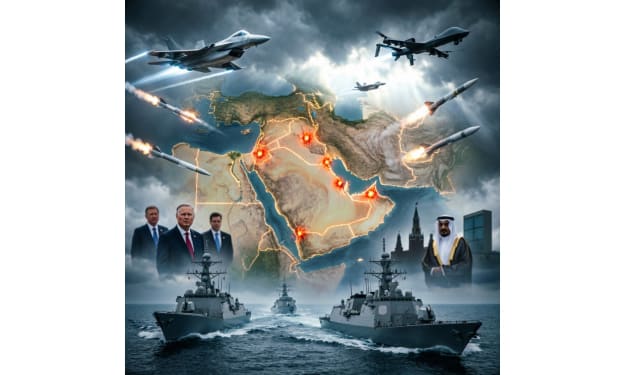
Is the Middle East War Turning Into World War III?
Is the Middle East War Turning Into World War III? The current situation in the Middle East has once again raised a serious question around the world: could this conflict grow into World War III? Tensions in the region have increased due to military strikes, political warnings, and the involvement of several global powers. While no country has officially declared a world war, the combination of regional conflicts and international alliances has made many experts worry about the possibility of a much larger confrontation.
By Wings of Time 8 months ago in Chapters