Biography
Has World War III Started?
Has World War III Started? The question “Has World War III started?” is no longer limited to academic debate or fictional movies. It is now openly discussed in newsrooms, policy circles, and online platforms around the world. While the simple answer remains no, the conditions shaping today’s global environment are deeply alarming. The world is experiencing an unprecedented convergence of regional wars, technological disruption, and power competition that closely resembles the early stages of past global conflicts.
By Wings of Time 8 months ago in Chapters
How did Israel kill Iranian Supreme Leader Ayatollah Ali Khamenei?
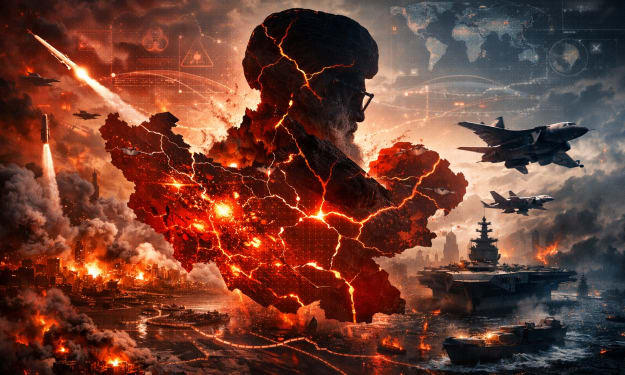
The attack intended to kill Iran’s Supreme Leader, Ayatollah Ali Khamenei, did not take place in the middle of the night under cover of darkness. Contrary to expectations, it was carried out in broad daylight. The reason for striking in daylight was crucial intelligence that U.S. and Israeli intelligence agencies had received just hours earlier. Rather than waiting for nightfall, they decided to immediately act on this sensitive information. For months, the United States and Israel had been waiting for an opportunity when senior Iranian officials would gather in one place for a meeting. The intelligence indicated that Seyyed Ali Khamenei would be present on Saturday morning at a compound in central Tehran. Along with information about Khamenei’s presence at the compound, Israeli and U.S. intelligence also learned the location where other senior Iranian military and intelligence officials were scheduled to gather at the same time for a meeting. For months, the United States and Israel had been monitoring Supreme Leader Seyyed Ali Khamenei’s movements. Although the method of surveillance was kept secret, U.S. President Donald Trump hinted at it in a social media post. Trump wrote that “he (Khamenei) failed to evade our intelligence and highly advanced tracking systems.” It is possible that a human source inside Iran was providing information about his movements; however, it is more likely that key Iranian officials were being monitored through technical means. During last June’s 12-day Iran-Israel war, Israel successfully targeted scientists and senior officials linked to Iran’s nuclear program. It was later reported that access had been gained to telecom and mobile phone systems to track these individuals’ movements. During this process, the movements of bodyguards assigned to protect key Iranian officials were also tracked. Through prolonged surveillance and analysis, such methods help in understanding the lifestyle and routine of important figures. This approach makes it possible not only to stay informed about a target’s activities but also to identify moments of vulnerability when security may be less tight. Iran was aware that Supreme Leader Seyyed Ali Khamenei was a target for his adversaries. Therefore, failure to identify and address moments of vulnerability during efforts to ensure his protection represents a major lapse by Iranian security and intelligence agencies. It also demonstrates that the United States and Israel continually adapt their methods for identifying targets and find new ways to track individuals. Iranians may also have assumed that such a significant attack would not take place during daylight hours. According to a report by The New York Times, the intelligence about the Supreme Leader’s presence at the compound originated from the U.S. intelligence agency, the CIA, and was shared with Israel because Israel was to carry out the strike. There appears to be a division of roles between the United States and Israel: Israel focuses on targeting top leadership, while the United States generally concentrates on military targets. It is also significant that intelligence about the Supreme Leader and other officials was obtained before their movements, enabling the planning of attacks using fighter jets capable of firing missiles from a distance to hit their targets. The attack was not designed solely to target one major leader (Khamenei); rather, it was intended to initiate a broader campaign, which is now being advanced over time and as opportunities arise. Israeli fighter jets may take approximately two hours to reach Tehran, though it remains unclear from how far away they launched missiles toward the city. After the decision to strike was made based on intelligence about Khamenei’s presence, Israeli aircraft dropped 30 bombs on his compound at around 9:40 a.m. The purpose of dropping 30 bombs simultaneously was to ensure that, since the Supreme Leader was reportedly using an underground bunker within the compound for protection, the strike could penetrate deep enough to reach the target. To achieve that depth, different types of bombs were likely used to ensure the target was successfully hit. In addition to the Supreme Leader’s compound in Tehran, other locations were also targeted, including the office of President Masoud Pezeshkian. The Iranian president later issued a statement saying he was unharmed in the attacks. Iran has so far confirmed the deaths of three senior defense officials: Secretary of the Defense Council Ali Shamkhani, Defense Minister Brigadier General Aziz Nasirzadeh, and Commander-in-Chief of the Islamic Revolutionary Guard Corps, General Mohammad Pakpour. When the attack took place in Tehran, it was nighttime in Florida at Mar-a-Lago, and President Trump was closely monitoring the situation with his senior officials. Israeli and U.S. officials knew that confirmation of the Supreme Leader’s death could take several hours after the strike. Iran had prepared for this possibility in advance and had reportedly made contingency plans not only for Khamenei but also for the succession of other senior Iranian officials. This means it remains unclear what impact this assassination will have on the broader conflict.
By Real content8 months ago in Chapters
After Khamenei: How the Middle East Crisis Could Redraw Global Politics
After Khamenei: How the Middle East Crisis Could Redraw Global Politics The confirmed death of Ayatollah Ali Khamenei after joint strikes by the United States and Israel has sharply intensified the ongoing conflict in the Middle East—turning what was a dangerous regional crisis into a moment with global implications. Khamenei, who led Iran for nearly four decades and wielded extraordinary political and military influence, was killed when missiles and airstrikes hit Tehran in the opening phase of a major military operation targeting Iranian leadership and strategic infrastructure. The impact of his death is already reverberating across the region and the world in ways that may last for years.
By Wings of Time 8 months ago in Chapters
Lionel Messi: The Quiet Boy Who Grew Up to Rule the World
Lionel Andrés Messi’s story doesn’t begin with stadium lights or roaring crowds. It begins quietly, on June 24, 1987, in a modest hospital in Rosario, Argentina. He was a small, soft‑eyed baby born into a hardworking family. His father worked in a steel factory, and his mother cleaned houses to support their children. Nothing about his birth hinted that the world had just welcomed a future legend. No headlines. No predictions. Just a tiny boy who would one day make millions believe in magic.
By Haroon Pasha8 months ago in Chapters
The First Hours of World War III
The First Hours of World War III World War III will not begin with a formal declaration, a single invasion, or a dramatic announcement on television. If it comes, it will begin quietly—through alerts, miscalculations, automated systems, and decisions made under extreme pressure. The early hours of a global war will feel confusing, fragmented, and unreal, long before the world understands what has happened.
By Wings of Time 8 months ago in Chapters
How World War III Could Begin in Our Time
The First Sparks: How World War III Could Begin in Our Time World War III may not start with a single declaration or one massive attack. Instead, it could begin quietly, through a series of connected crises, misunderstandings, and power struggles already happening today. The world is more connected than ever, but that connection also makes global conflict easier to spread.
By Wings of Time 8 months ago in Chapters
Is This War Turning Into World War III?
Is This War Turning Into World War III? The question many people around the world are quietly asking today is unsettling but unavoidable: Is the current war climate pushing humanity toward World War III? What once appeared to be localized conflicts in the Middle East are now entangled with global rivalries, advanced technologies, and fragile alliances. History shows that world wars rarely begin with a single dramatic declaration. Instead, they grow out of overlapping crises, miscalculations, and escalating power struggles—many of which are visible today.
By Wings of Time 8 months ago in Chapters
Who Will Be Iran’s Next Supreme Leader?
On Friday, Iran’s Supreme Leader Ayatollah Seyyed Ali Khamenei, who was killed in a U.S. and Israeli attack on Tehran, was the most powerful figure in the country. Under Iran’s Constitution, the position of Supreme Leader was created after the 1979 Islamic Revolution under the leadership of Ayatollah Khomeini. He became the country’s first Supreme Leader on December 3, 1979. Ayatollah Khomeini held the position for nine and a half years. After his death in 1989, Ayatollah Ali Khamenei was chosen as the country’s second Supreme Leader, serving for 36 and a half years until his death on February 28, 2026. Who holds control until a new Supreme Leader is selected? According to Article 111 of Iran’s Constitution, from the death of the Supreme Leader until a new leader is introduced by the Assembly of Leadership (Assembly of Experts), a three-member council temporarily assumes leadership duties. This council consists of the country’s president, the head of the judiciary, and one jurist from the Guardian Council selected by the Expediency Discernment Council. However, this three-member council does not have full authority. In the following matters, its decisions can only be implemented with the approval of three-quarters of the members of the Expediency Discernment Council: Determining the general policies of the system Issuing a referendum decree Declaring war or peace Impeaching the president Dismissing or appointing the Chief of the Joint Staff, the Commander-in-Chief of the Islamic Revolutionary Guard Corps, or senior military and law enforcement commanders If the Supreme Leader is temporarily unable to perform his duties due to illness or an accident, the same council assumes responsibilities in the same capacity. The Assembly of Experts and the selection of the Supreme Leader Iran is currently the most powerful country in the world with a majority Shia population, and under the Constitution, the Supreme Leader can only be an Ayatollah, a religious authority within Shia Islam. However, when Ali Khamenei was selected, he was not an Ayatollah. The law was amended to enable him to assume the position. In Iran, an 88-member body of clerics known as the Assembly of Experts elects the Supreme Leader. Every eight years, millions of Iranians vote to elect members of this body. The last time this occurred was in 2016. However, any candidate for the Assembly of Experts must first be approved by the Guardian Council, whose members are directly or indirectly selected by the current Supreme Leader. It is evident that the Supreme Leader exerts influence over both the Guardian Council and the Assembly of Experts. Over the past three decades, Ayatollah Ali Khamenei ensured a conservative majority within these bodies. Currently, the chairman of the Assembly is Mohammad Ali Movahedi Kermani, while Hashem Hosseini Bushehri and Alireza Arafi serve as deputy chairmen. According to regulations, a meeting of the Assembly of Experts is valid if at least two-thirds of its members (59 individuals) are present. The selection of a new leader requires a two-thirds majority vote of those present. This means that if only 59 members attend, 40 votes would be sufficient to elect a new leader. The commission reviewing potential candidates A commission within the Assembly of Experts is tasked with assessing the qualifications of individuals who may be considered eligible for the position of Supreme Leader. Key members of this commission include Ahmad Hosseini Khorasani, a jurist member of the Guardian Council; Guardian Council members Alireza Arafi and Mohammad Reza Modarresi Yazdi; First Vice Chairman of the Assembly of Experts Hashem Hosseini Bushehri; former representative of Ayatollah Khamenei in Europe Mohsen Mohammadi Araki; Friday prayer leader in Isfahan Abolhassan Mahdavi; and Hassan Amoli, three-time member of the Assembly of Experts and Friday prayer leader in Ardabil. How long does the selection take? There is no fixed timeframe for selecting a new Supreme Leader. Since the three-member interim council has already been formed, at least on paper there will be no power vacuum. However, experience following the death of Islamic Republic founder Ayatollah Ruhollah Khomeini shows that members of the Assembly of Experts acted swiftly in choosing a successor under similar circumstances. Ayatollah Khomeini passed away after 10 p.m. on June 4, 1989, and the Assembly of Experts convened the following morning, making a decision on succession within a few hours. The importance of the position of Supreme Leader According to Article 57 of Iran’s Constitution, “The government of the Islamic Republic of Iran consists of three branches: the legislature, the judiciary, and the executive. These three branches function under the supervision of the absolute guardianship of the jurist and the leadership of the Ummah, in accordance with the provisions of the Constitution.” Although there is political diversity in Iran, from the first day the position of Supreme Leader has been the focal point of public and political movements due to perceived threats to national security and the Islamic Revolution. While the Constitution allows for oversight of the Leader and even disagreement, the Leader is regarded as a symbol of the Islamic Revolution, and opposition to him is often seen as opposition to the revolution itself. Under Article 91 of the Constitution, the Supreme Leader appoints six of the twelve members of the Guardian Council, and under Article 157, he appoints the Chief Justice. Article 110 grants him authority to determine Iran’s general policies in consultation with the Expediency Discernment Council and to oversee the entire system of government. He also has the authority to call referendums, appoint the heads of all armed forces including the Islamic Revolutionary Guard Corps, and is the sole authority empowered to declare war. After presidential elections, the decree appointing the winning candidate is issued by the Supreme Leader. He also has the authority to dismiss the president, but only if the Chief Justice finds the president guilty of a crime or if parliament declares the president incompetent under Article 89. If disputes arise between different branches of government, they are referred to the Leader. However, interpretation of the Constitution is referred to the Guardian Council. The Leader also appoints the head of Iran’s state broadcasting organization and has the power to pardon those convicted by the judiciary. Additionally, the Leader may delegate his powers to others. According to Article 60 of the Constitution, the president exercises executive authority with the assistance of ministers, except for those powers specifically reserved for the Leader. In practice, however, the Leader has delegated certain supreme command authorities over the armed forces to the president. The Supreme Leader and Iran’s armed forces Iran’s armed forces include the Islamic Revolutionary Guard Corps, along with its ground, naval, and air forces, as well as the Quds Force, a strategic unit. In addition, Iran’s conventional armed forces, known as the Artesh (Islamic Republic of Iran Army), are also part of the country’s military power. The Supreme Leader serves as the commander-in-chief of all these forces and appoints their leaders. It is said that Iran has more than ten million volunteers known as the Basij. Its formation was announced by Ayatollah Khomeini with the aim of “safeguarding the Islamic Revolution.” It is also known as the Resistance Basij Force, but its official name is the Organization for the Mobilization of the Oppressed. Initially, it was an independent body, but later it was incorporated into the Revolutionary Guards. Its head is also appointed by the Leader. The Basij has an administrative staff paid as state employees, while its ordinary volunteers serve without pay. Who could succeed Ayatollah Ali Khamenei? Following Ali Khamenei’s death, the most important question is who will be appointed as his successor. Like his predecessor Imam Khomeini, Ali Khamenei was unable to build a broad coalition beyond his supporters, but he maintained the backing of key commanders of the Revolutionary Guards. Therefore, it is likely that the leadership of the Revolutionary Guards could influence the selection of the country’s next Supreme Leader. During Khamenei’s lifetime, some believed that two individuals were particularly favored: his son Mojtaba Khamenei and the head of the judiciary, Ebrahim Raisi. However, Ebrahim Raisi was killed in a helicopter crash in 2024.
By Real content8 months ago in Chapters
Who was Ayatollah Seyyed Ali Khamenei and how powerful is his family?
Iran’s official news agency Tasnim has confirmed that the country’s Supreme Leader, Ayatollah Seyyed Ali Khamenei, has been killed in US and Israeli attacks. Earlier, Donald Trump had claimed that Ali Khamenei had been killed on the very first day of the joint US-Israeli strikes. Ali Khamenei was the second person to become Iran’s Supreme Leader after the 1979 Islamic Revolution. He assumed the position in 1989 following the death of Ayatollah Khomeini, and many young Iranians have only ever known him in that role. He was known for holding a central position in Iran’s power structure. As Supreme Leader, Khamenei had veto power over any government matter. He also had the authority to approve or disqualify candidates for public office. As head of state and commander-in-chief of the armed forces, he was regarded as the most powerful person in Iran. While Iranian presidents often made headlines abroad, in reality the reins of power within Iran remained in Khamenei’s hands. Khamenei: Iran’s “Most Powerful Man” Ayatollah Khamenei was born in 1939 in Mashhad, Iran’s second-largest city, into a religious family. He was the second of his siblings, and his father was a Shiite cleric. He received religious education in childhood and was qualified as a cleric by the age of 11. Like many clerics of his time, his work was both religious and political in nature. As an influential preacher, he became a critic of the Shah of Iran. Ultimately, the Shah was overthrown in the 1979 Islamic Revolution. Khamenei spent several years in hiding and also served time in prison. The Shah’s secret police arrested him six times, and he was subjected to torture. A year after the 1979 revolution, Ayatollah Ruhollah Khomeini appointed him as Tehran’s Friday prayer leader. In 1981, Khamenei was elected President of Iran, and in 1989, following Khomeini’s death, religious leaders appointed him as his successor. Khamenei rarely traveled outside Iran and lived a simple life with his wife in a compound in central Tehran. It is said that he enjoyed gardening and poetry. He was also known to have smoked cigarettes in his youth, which was unusual for a religious leader in Iran. Since an assassination attempt against him in the 1980s, Khamenei had been unable to use his right arm. Khamenei and his wife, Mansoureh Khojasteh Bagherzadeh, have six children four sons and two daughters. In the US attack, one of his daughters and his son-in-law were also killed. The Khamenei family rarely appeared in public or the media. Official and verified information about his children’s private lives is very limited. Among his children, his second son Mojtaba is the most well-known due to his influence and role within Khamenei’s inner circle. How powerful is Khamenei’s son Mojtaba? Mojtaba studied at Alavi High School in Tehran, a school traditionally attended by the children of Iran’s senior officials. He married the daughter of conservative figure Gholam Ali Haddad-Adel before becoming a cleric and while he was considering beginning religious studies. Mojtaba formally began religious education at a seminary in Qom at the age of 30. By the mid-2000s, Mojtaba’s influence within Iran’s political circles had grown considerably, though it was rarely discussed in the media. In 2004, Mojtaba first made headlines when presidential candidate Mehdi Karroubi accused him, in an open letter to Ayatollah Khamenei, of working behind the scenes to support Ahmadinejad. One of the most influential figures Since the 2010s, he has been regarded as one of Iran’s most influential personalities. It is believed that Khamenei saw him as a suitable candidate for succession, although some official sources deny this. An Ayatollah is not a king who can pass his throne to his son; however, Mojtaba wields significant influence within Khamenei’s inner circles, including the Supreme Leader’s office. It should be noted that the Supreme Leader’s office is in many respects more powerful than constitutional institutions. Khamenei’s eldest son is Mostafa Khamenei. His wife is the daughter of conservative religious leader Azizollah Khoshvaght. Mostafa and Mojtaba served on the front lines during the Iran-Iraq War in the 1980s. Ali Khamenei’s third son, Masoud, was born in 1972. He is married to the daughter of Seyyed Mohsen Kharazi, a cleric associated with the Qom Seminary Teachers Association. Masoud keeps away from political circles, and information about him is very limited. He previously headed the office that serves as an important propaganda center for Ayatollah Khamenei. This office is also responsible for preserving his father’s works. Masoud oversees the compilation of Khamenei’s biography and memoirs. Khamenei’s youngest son, Meysam, was born in 1977 and, like his three brothers, is also a cleric. His wife is the daughter of influential businessman Mahmoud Loulachian, who is said to have financially supported revolutionary religious leaders before the 1979 revolution. Meysam has worked alongside his older brother Masoud in the office responsible for preserving their father’s works. Who are Khamenei’s daughters? Very limited information is available about Khamenei’s daughters, Boshra and Hoda. They are the youngest among the siblings and were born after the 1979 Islamic Revolution. Boshra, born in 1980, is married to Mohammad Javad Golpayegani, the son of Gholam Hossein Mohammadi Golpayegani, who is the chief of staff in Khamenei’s office. Khamenei’s youngest child, Hoda, was born in 1981. She is married to Mesbaholhoda Bagheri Kani, who teaches at Imam Sadiq University.
By Real content8 months ago in Chapters