
PR Running Ledger — Issue 3
A Lesson in Crisis Discipline & Institutional Safeguards

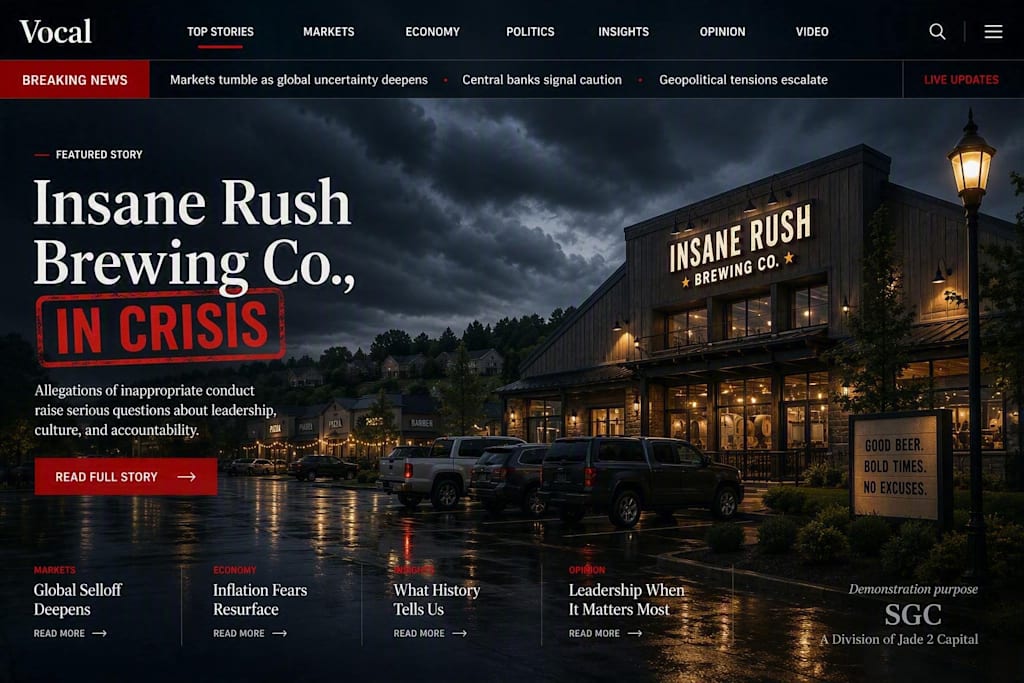
PR Review — Emotional Governance & Organizational Continuity
A Structural Breakdown of Crisis Discipline in Public Institutions
Disclaimer: Insane Rush Brewing Co. is a fictional organization created for analysis and educational purposes. Any resemblance to real companies or individuals is coincidental
Insane Rush Brewing Co., a rising craft‑beer brand known for its high‑energy marketing and “party‑culture” identity, is facing a severe reputational crisis after its Chief Marketing Executive, Darren Cole, was photographed drinking with two underage women at a private VIP event in Miami. Darren, who is married, stated that once he learned the women were underage, he immediately told them to leave — and no further interaction occurred. But the damage was already done. The moment the images surfaced, the narrative was no longer his to control.
The photos appeared late Saturday night on a nightlife gossip page and quickly spread across TikTok, Instagram, and X. In the images:
Darren is holding a can of Insane Rush Citrus Blast
The two underage women are seated beside him, visibly drinking
The table contains multiple open alcoholic beverages
The caption reads: “Insane Rush… literally.”
Within hours, the images went viral.
Public Reaction: Alcohol safety advocates condemned the brand, Parents’ groups demanded an investigation
College meme pages turned the brand name into jokes
Retail partners privately asked for clarification
A regional distributor paused a promotional rollout
The brand’s identity — “Insane Rush” — is now being used against them, reframed as:
“Insane behavior”
“Rushing minors into drinking”
“Rush to irresponsibility”
The scandal gains momentum because the brand name itself amplifies the narrative. When a brand’s identity becomes part of the joke, the crisis escalates faster than the organization can respond.
Internal Fallout
Employees are panicking
The board is demanding immediate action
Legal counsel is assessing regulatory exposure
The marketing team has gone silent
Darren has not issued a statement
The company is now facing:
Conduct risk
Regulatory risk
Reputational risk
Commercial risk
Narrative risk
This is a Level 4 PR crisis — the kind that can permanently damage a brand if not handled correctly.
SGC Analysis — Emotional Governance & Organizational Continuity
When you look at this fictional story conceptually, what emerges is a simple truth: humans make bad choices, and those choices can destabilize entire brands. The harsh reality is that every organization, regardless of size or industry, has the same instinct: survival and continuity of lore. Institutions are built to outlive the individuals inside them, and crises like this reveal exactly how that instinct operates.
So how would this be handled?
There are multiple moving parts, and each one must be executed with precision.
1. Immediate Executive Action
The executive would be fired on the spot or placed on an unpaid leave of absence. This signals seriousness and protects the brand’s moral framework. Founders should always have morality clauses — they are not optional. Within 24 hours, the executive’s presence would be removed from all public‑facing sites. This is not cruelty; it is organizational protection.
2. Press Conference & Family Outreach
The company would hold a press conference and reach out to the family involved. Even though nothing further happened, the family’s continued public involvement could damage the brand’s lore. Visibility without governance is dangerous.
3. NDA & Compensation
The company would agree to terms with the family, including compensation and a nondisclosure agreement. This protects the brand from narrative drift. Even fictional crises require real structural thinking.
4. Public Reparation Gesture
Insane Rush would announce a donation equal to two years of the executive’s salary to a charity chosen by the family. This reframes the narrative toward responsibility and restitution. It shows force, discipline, and emotional governance.
5. Internal Oversight Committee
The organization would establish an internal oversight committee to prevent future incidents. This is how institutions demonstrate continuity — by creating structural safeguards that outlive the crisis.
Timeline:
All of this must be completed within 72 hours.
SGC Closing Doctrine
Visibility without rule is damaging. Every organization must have structural safeguards — a white shield — that protects the institution from the individuals inside it. Even with perfect crisis execution, the long‑term trajectory of the brand may still be impacted.
The natural order is simple: Protect the organization first. Then protect the people.
Many institutions forget the simplest rule: be mindful of visibility, guard the lore, and keep the organization first. To the new readers entering the SGC world — welcome. Identity is a journey, not a product.
About the Creator
Jadrian Laflure
Contributor — SGC Division A Jade 2 Capital Company I write as Jadrian Laflure about identity, atmosphere, precision, and the architecture behind creative systems. This Vocal page serves as part of the SGC ecosystem within Jade 2 Capital.
Enjoyed the story? Support the Creator.
Subscribe for free to receive all their stories in your feed.
Comments
There are no comments for this story
Be the first to respond and start the conversation.