


A Silent Poster That Speaks Volumes: The Power of a Demand for Justice
In moments when institutions feel distant and legal language becomes inaccessible to ordinary people, protest often takes on a visual form. A single sign, held aloft or affixed to a wall, can carry more urgency than volumes of legal briefs. The image at hand presents such a moment: a weathered poster bearing bold lettering and tightly spaced text, anchored by the unmistakable call to action—“CALL. DEMAND JUSTICE 4 KENDRICK JOHNSON.” It is not merely informational. It is confrontational. It does not ask politely; it insists.
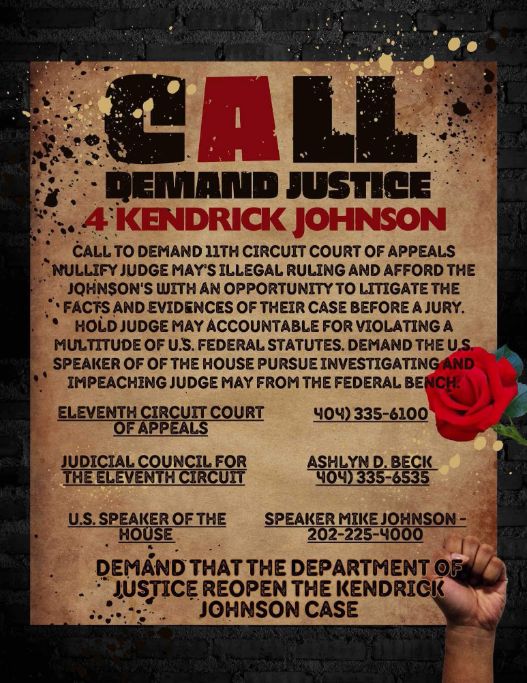
The poster’s appearance immediately conveys seriousness and gravity. The background resembles aged parchment or distressed paper, with dark splatters and rough edges that evoke struggle, endurance, and a long fight against resistance. This is not a polished advertisement or a decorative flyer. It looks deliberately worn, as though reflecting years of unanswered questions and unresolved claims. The visual tone sets the stage before a single word is read: this is about something that has persisted, something that refuses to fade quietly.
At the center of the message is the demand for justice concerning Kendrick Johnson. The name is presented prominently, ensuring that the viewer cannot miss who stands at the heart of the poster. The layout reinforces that this is not an abstract principle or a philosophical argument. It is about a real case involving a real individual, and the urgency of that reality is underscored by repeated calls for immediate action.

The poster does something significant: it bridges the gap between the public and the judiciary. Rather than summarizing the case in vague terms, it names specific institutions, courts, and government offices. It references the Eleventh Circuit Court of Appeals, the Judicial Council for the Eleventh Circuit, the U.S. Speaker of the House, and the Department of Justice. By doing so, it removes any ambiguity about where responsibility is perceived to lie. This is a direct appeal to power, not a general complaint shouted into the void.
The language on the poster is strikingly legal in nature. Phrases such as “illegal ruling,” “opportunity to litigate,” “facts and evidence,” “before a jury,” and “violating a multitude of U.S. federal statutes” suggest that the creator is not merely expressing emotional outrage but is asserting procedural injustice. The argument is not simply that something tragic occurred, but that the judicial process itself failed to operate as it should have. This distinction matters. It reframes the issue from a past event to an ongoing institutional problem.

Another notable aspect of the poster is its insistence on accountability. One passage calls for the investigation and impeachment of a federal judge, specifically naming the alleged misconduct as a basis for removal from the bench. This is among the strongest forms of civic demand available in a constitutional system. Impeachment is not casual rhetoric; it is an assertion that the checks and balances meant to safeguard justice must be activated.
The inclusion of phone numbers is particularly powerful. This transforms the poster from a statement into a tool. It does not simply inform the viewer; it enlists the viewer. Each number is an invitation to participate, to apply pressure, to make the issue impossible to ignore. The act of calling becomes an extension of protest, a means of turning individual concern into collective action.
Visually, the poster also incorporates symbolic elements beyond text. In the lower portion, a clenched hand grips the sign, frozen in a gesture commonly associated with resistance, solidarity, and resolve. The hand is not relaxed; it is firm, purposeful. It suggests that the demand for justice is not passive. It is being physically held up, sustained through effort and determination.
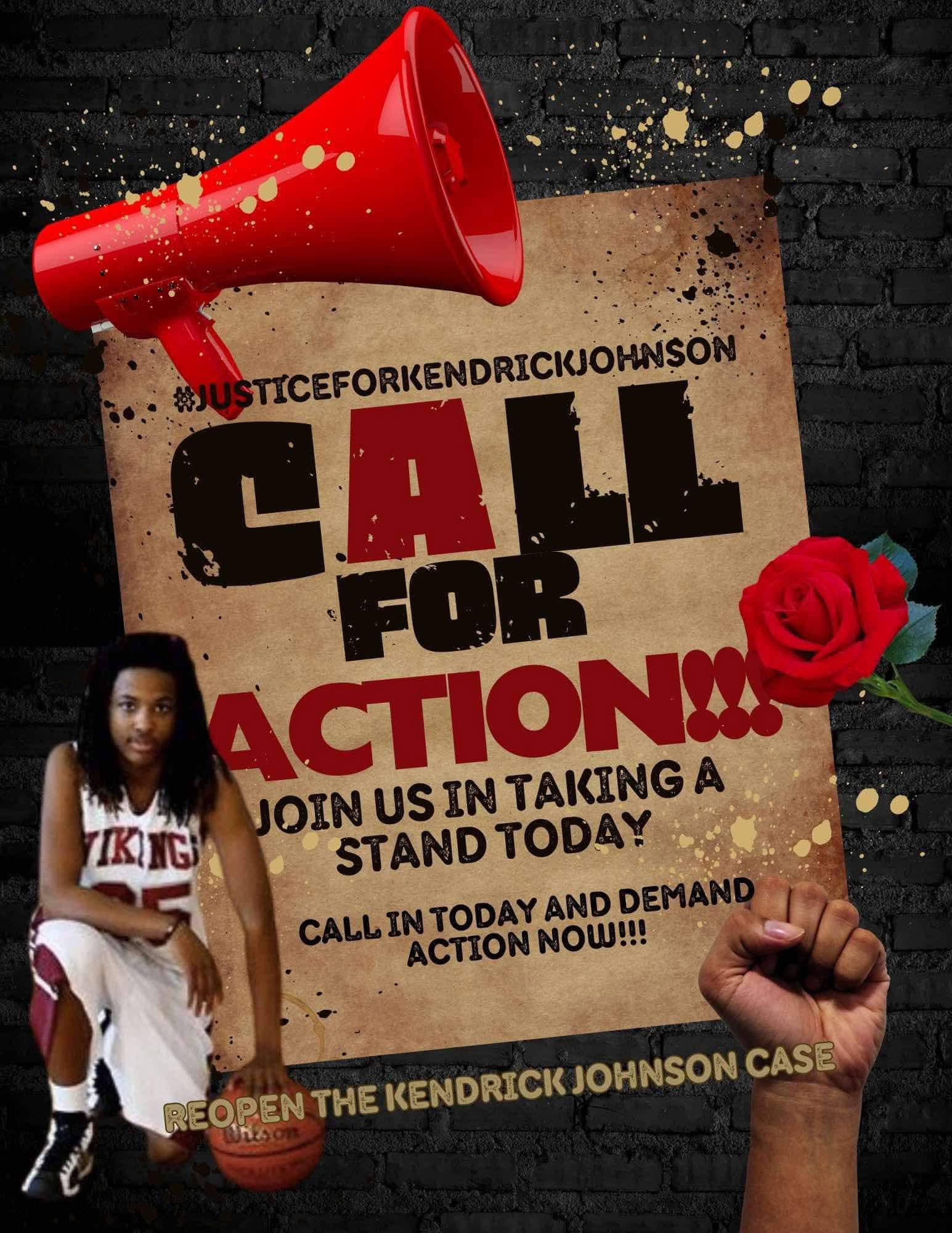
Beside the text appears a red rose, vivid against the muted background. The rose introduces a layer of meaning that contrasts with the harshness of the demands. Traditionally associated with remembrance, mourning, and respect, the rose suggests loss as well as honor. It humanizes the message, reminding viewers that behind legal arguments and institutional critiques lies a life whose value is being defended.
Typography also plays a critical role in the poster’s impact. The word “CALL” is presented in large, dark letters at the top, dominating the visual field. It functions almost like a command. Smaller text follows, densely packed, requiring the viewer to pause and read carefully. This structure mirrors the nature of justice movements themselves: an urgent call that demands attention, followed by complex details that must be understood to grasp the full weight of the issue.
What the poster does not include is equally important. There is no attempt to soften the message, no alternative interpretation offered, no language of compromise. The tone is assertive and absolute. Justice is not framed as a possibility or a hope but as a requirement that has been wrongfully denied. This uncompromising stance reflects the frustration that often emerges when legal avenues appear to have been exhausted or blocked.
From a broader perspective, the poster exemplifies how activism operates in modern civic life. It demonstrates that protest no longer resides solely in marches or slogans but also in publicly shared information. It assumes that an informed citizen can act, that awareness can translate into pressure, and that pressure can still influence institutions of power.

The deliberate naming of offices and officials also suggests an understanding of governmental structure. The poster acknowledges that justice is multi-layered, involving courts, councils, legislative figures, and federal agencies. It does not rely on a single authority to correct the alleged wrong. Instead, it calls on multiple branches and mechanisms, reflecting a belief in systemic accountability even while pointing out systemic failure.
The emotional force of the poster arises not from graphic imagery or sensational language, but from its clarity of purpose. It states what has been wrong, who is believed to be responsible, and what actions must be taken to address it. There is little room for misinterpretation. Even a brief glance communicates that this is about reopening a case, reassessing evidence, and allowing judicial scrutiny to occur openly and lawfully.
In a society saturated with fleeting digital content, the poster’s physical, almost tactile appearance is notable. It looks like something meant to endure exposure—to weather, to time, to repeated handling. This reinforces the idea that the fight it represents is ongoing. The justice being demanded has not yet been delivered, and until it is, the call will remain visible.
Ultimately, the image represents more than a single case. It reflects a broader struggle over trust in legal institutions, the accessibility of justice, and the rights of individuals to challenge authority when they believe those rights have been violated. It stands as a reminder that the pursuit of justice is not always quiet, polite, or comfortable. Sometimes it must be demanded—clearly, persistently, and publicly.
The poster does not offer closure. It offers a challenge. It asks the viewer to decide whether they will look away or pick up the phone. And in that sense, its power lies not just in what it says, but in what it asks others to do.
About the Creator
Press Release
I was born and raised in Chicago but lived all over the Midwest. I am health, safety, and Environmental personnel at the shipyard. PLEASE SUBSCRIBE to my vocal and check out my store
Enjoyed the story? Support the Creator.
Subscribe for free to receive all their stories in your feed.
Comments
There are no comments for this story
Be the first to respond and start the conversation.