
Forty-Seven Years of Doing It Wrong
Chapter One: A Perfectly Ordinary Tuesday

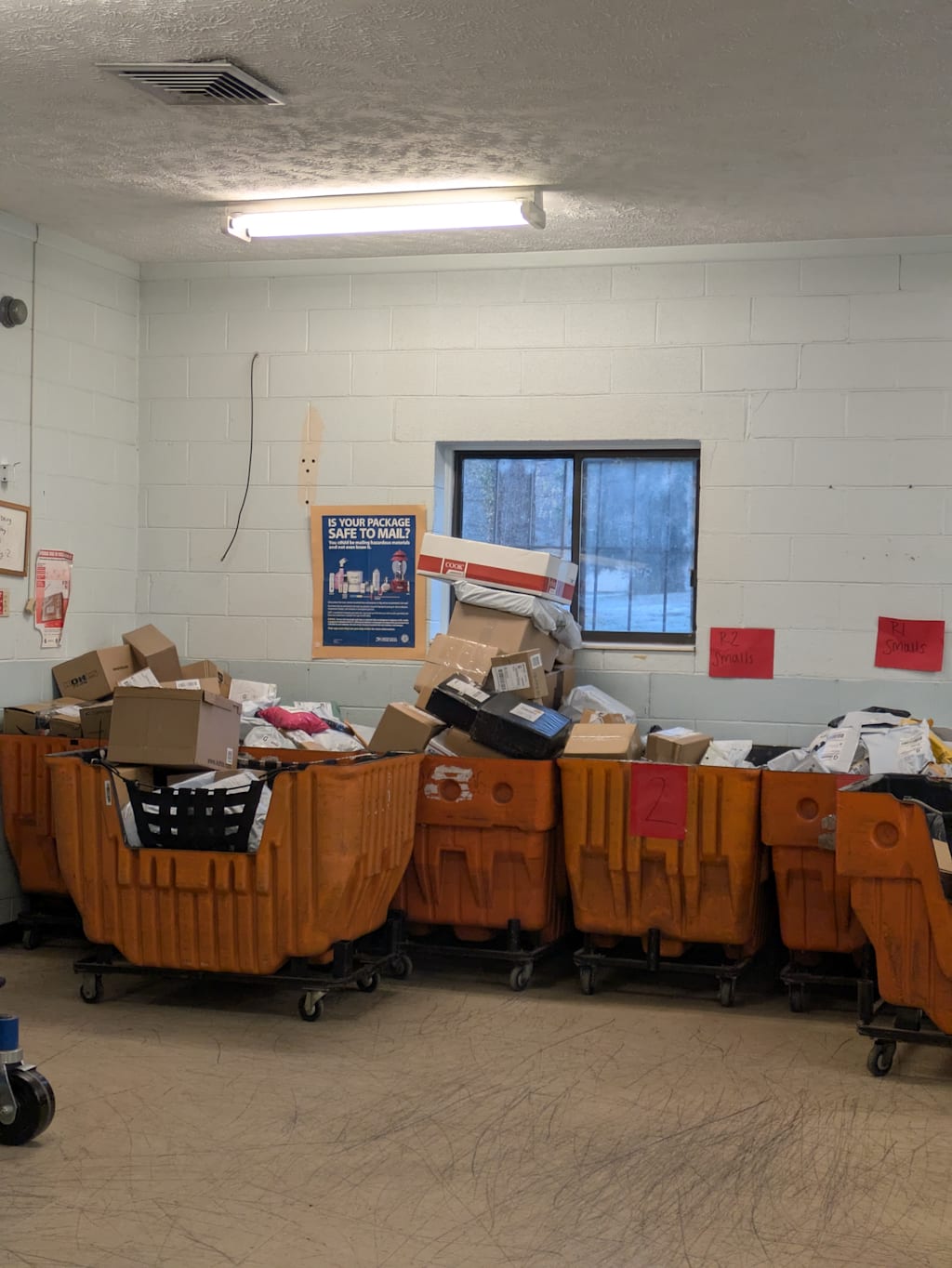
The truck rattled.
It always rattled.
Somewhere behind the driver's seat, a plastic panel vibrated against another plastic panel with a thin, persistent buzzing sound. There was a second rattle near the passenger-side window, something loose in the dashboard, and a metallic clanking noise that appeared whenever she turned left.
Dee knew all of them.
She also knew that if she wedged a folded piece of cardboard between the dashboard and the windshield, she could eliminate one of the noises entirely.
Unfortunately, she'd forgotten the cardboard that morning.
Again.
"Fucking fantastic."
She turned up the radio.
The radio didn't drown out the rattling so much as provide another layer of noise for her brain to sort through. But at least she could sing along, and singing gave her something to do with the part of her mind that otherwise spent the day cataloging every sound the truck made.
She was forty-seven years old, driving a mail truck through the same rural Tennessee neighborhoods she'd delivered to for years, and she was reasonably certain that if someone blindfolded her, she could identify where she was on her route by the potholes alone.
Not that she intended to test the theory.
Her insurance premiums were high enough.
"Four twenty-six," she said aloud.
She pulled a small package from the tray beside her.
"Four twenty-six. Four thirty-two. Four thirty-eight."
The packages were arranged in delivery order, because of course they were. She'd numbered them before leaving the office, written the larger ones on a manifest clipped to her visor, and checked the scanner's package list against what she'd loaded.
Everything had a place.
Everything had a system.
The system worked beautifully, right up until somebody interrupted it.
She stopped at a mailbox, slid the letters inside, closed the lid, and moved forward.
The truck rattled.
Her left sock had developed a wrinkle under her heel.
She'd noticed it approximately forty minutes earlier.
She had been thinking about it ever since.
It wasn't painful. Not really. It was just there, pressing against her skin every time she moved her foot. She could fix it, obviously, but that would mean finding somewhere safe to stop, putting the truck in park, taking off her shoe, adjusting the sock, putting the shoe back on, and getting settled again.
So she left it.
The sock stayed wrong.
"Four forty-one."
Mailbox.
Letters.
Close.
Drive.
There were days she genuinely liked this job.
That was the irritating part.
She liked being outside. She liked the independence. She liked knowing exactly what needed to be done and being left alone to do it. She liked her customers, especially the ones who came out to talk to her, and she had an extensive collection of dogs who considered her the most important person in the federal government.
She carried biscuits for them.
Naturally.
There were worse ways to spend a day than driving through the mountains, singing Queen at the top of her lungs, and being adored by golden retrievers.
She just wished the mountains came with public restrooms.
And climate control.
And perhaps a truck manufactured sometime after the invention of comfort.
The heater was running, which meant her feet were hot while the right side of her face remained cold. Every time she opened the window to reach a mailbox, another blast of November air struck her cheek.
Cold air hurt.
Not metaphorically. It physically hurt, particularly when it hit her ears.
She had a hat somewhere.
Probably.
She couldn't wear it comfortably with her glasses, though, and the glasses were nonnegotiable unless she wanted the mailboxes to become an abstract art installation.
The sun had moved just far enough across the sky to shine directly into her eyes whenever the road curved east.
She adjusted her visor.
She adjusted her sunglasses.
She squinted.
Her right eye had started doing its little wandering act, the one it performed when she got tired.
"Everybody's got to have a hobby," she told it.
At the next box, she reached for a magazine and discovered that it had slipped underneath the flats for the following address.
This was unacceptable.
Not because the magazine was particularly important. It was probably a catalog advertising things nobody needed at prices nobody should pay.
But it was out of order.
Her brain had already moved on to the next address, and now she had to stop, go backward, retrieve the magazine, put it in the correct place, and reconstruct where she'd been.
It was like laying railroad tracks as the train moved, then having somebody pick up a section and ask her to start over.
She delivered the magazine.
Checked the next address.
Checked it again.
"Four forty-six."
She started moving.
She was fine.
That was the thing.
She was always fine.
---
By eleven-thirty, she'd eaten half a protein bar and a handful of pretzels.
Breakfast had been a casualty of the morning.
She'd woken up early, but somehow that hadn't translated into having enough time. It rarely did. She'd spent fifteen minutes sitting on the edge of the bed trying to persuade herself to get dressed, then another ten looking for her work shoes, which had been exactly where they belonged.
She just hadn't seen them.
She'd remembered her medications because her phone had reminded her.
She'd remembered to feed the dogs because the dogs had reminded her.
She'd forgotten breakfast because breakfast had no spokesperson.
Now her stomach was beginning to make its displeasure known.
Hunger didn't always arrive as hunger for Dee. Sometimes it arrived as irritability. Sometimes confusion. Sometimes the sudden conviction that everyone in the world was an asshole and she was the only reasonable person left.
A fairly reliable indicator that she needed a sandwich.
She pulled into a wide gravel turnout and reached for the remaining half of her protein bar.
Her phone buzzed.
A message from her husband.
How's your day?
She considered the question.
The truck was noisy. Her sock was wrong. Her neck hurt. She had to pee. The sun was trying to burn through her retinas. She could feel every seam in her shirt, and somebody nearby was burning leaves, which meant she was going to spend the next several minutes trying not to breathe through her nose.
She still had more than a hundred addresses to deliver.
She typed:
Good. Should be home around 1:30.
Then she added a heart.
It wasn't a lie.
Not exactly.
This was a good day.
The mail wasn't especially heavy. There weren't too many packages. Nobody had blocked a mailbox with a truck. The weather was tolerable for November, and she hadn't made any significant mistakes.
In fact, by every measurement her employer cared about, things were going splendidly.
She took another bite of her protein bar.
A dog barked somewhere behind her.
Another answered.
She heard a leaf blower start up in the distance.
"Jesus Christ, it's a fucking orchestra."
She laughed.
There was nobody there to hear it, which was one of the best things about working alone.
---
Dee hadn't always known that other people experienced the world differently.
As a child, she'd assumed everyone noticed the buzzing lights in classrooms.
Everyone hated the way certain fabrics felt against their skin.
Everyone rehearsed conversations before having them.
Everyone found it difficult to think when several people were talking at once.
She'd assumed everyone was doing the same things she was doing, only somehow managing not to complain about them.
Which meant, naturally, that the problem was her.
She was too sensitive.
Too dramatic.
Too easily distracted.
Too much.
She'd heard those descriptions often enough that eventually they stopped sounding like opinions and started sounding like facts.
She didn't remember deciding to become a different person.
She supposed it had happened gradually.
One correction at a time.
One embarrassing moment.
One occasion when somebody looked at her as though she'd said something deeply strange, even though she couldn't understand what was strange about it.
She learned to laugh when other people laughed.
To watch faces.
To adjust.
By adulthood, she was so good at being the person a situation required that she rarely considered whether she actually wanted to be that person.
She'd mistaken adaptability for identity.
And she'd been doing it for nearly half a century.
---
At twelve-fifteen, she was ahead of schedule.
The truck's scanner confirmed it.
She liked the scanner. It told her what she'd done, what remained, and where the packages were supposed to go.
Objective information.
Beautiful stuff.
People could keep their inspirational speeches about believing in themselves. Dee preferred a numbered list.
She pulled up to a familiar mailbox and saw an older man standing in his driveway.
He waved.
She smiled automatically.
And genuinely.
That was another thing people seemed to misunderstand about her.
She liked people. She liked talking to them. She could talk to practically anybody about practically anything, provided they started the conversation.
Starting was the problem.
Once someone else opened the door, she could walk right through.
"Hey, sweetheart!" the man called.
"Hey, trouble! How're you doing?"
He laughed, shuffled toward the truck, and began telling her about his granddaughter's new puppy.
Dee listened.
She asked questions.
She remembered the granddaughter's name and that the family had recently lost an older dog. She told him the new puppy sounded like an absolute menace and that she expected photographic evidence.
Five minutes later, she drove away smiling.
It had been a lovely conversation.
She was also suddenly aware of the truck rattling again, the pressure of her glasses behind her ears, and the fact that she'd been holding herself at an awkward angle throughout the entire exchange.
She rolled her shoulders.
Cracked her neck.
Looked at the next address.
"Five twelve."
For a moment, she couldn't remember whether she'd already delivered the previous package.
She checked the scanner.
She had.
Of course she had.
She always did.
---
She'd been reading about autism lately.
And ADHD.
Specifically, how both could appear in women who had spent their entire lives learning to compensate for difficulties nobody else recognized.
She'd initially gone looking for an explanation for one particular thing.
She couldn't even remember which thing anymore.
That was funny in a way that wasn't particularly funny.
One article had led to another. Then a video. Then a screening questionnaire. Then several more articles because she didn't trust herself to draw conclusions from the first ones.
There was an awful lot she recognized.
The sensory issues.
The routines.
The way interruptions derailed her.
The need to recover after social activities she genuinely enjoyed.
The difficulty starting tasks that mattered to her, sometimes more than tasks she didn't care about at all.
Some explanations fit so well they made her laugh.
Others made her cry.
And some made her angry.
Because if this was what had been happening all along, if there were explanations for things she'd spent decades blaming herself for, then she'd wasted a truly spectacular amount of energy trying to fix problems that might have needed accommodations instead.
She still didn't know exactly what to call herself.
She was exploring that.
But one thing had already become impossible to ignore.
She wasn't sure she'd ever actually been comfortable.
Not for an entire day.
She knew how to ignore discomfort.
She knew how to work through it.
She knew how to keep smiling, keep talking, keep delivering the mail while her body and brain registered a hundred separate complaints.
What she didn't know was what life would feel like if she stopped doing that.
The thought followed her for the next several miles.
---
At one-oh-seven, she finished her route.
An ordinary day.
A good day, even.
She'd delivered everything. Spoken to a few customers. Given treats to six dogs. Sung along with the radio. Made no significant mistakes.
She was already mentally calculating what she might accomplish when she got home.
Maybe she'd write for a while.
She had three article ideas she was genuinely excited about, and the opening paragraph of one had been assembling itself in her head all morning.
She could work on her book.
Or make something for the little business she was trying to build.
Maybe she'd take the dogs outside, sit in the sunshine, do something that belonged to her instead of someone else.
She really wanted to.
That was the part that kept getting to her.
She wanted to do things.
She had ideas. Plans. Interests. Ambitions.
She wasn't lacking motivation.
But she knew what would probably happen.
She'd get home, change her clothes, sit down for a minute, and feel the accumulated weight of the day settle over her.
The minute would become an hour.
She might scroll through her phone, looking at other people doing interesting things while trying to summon enough energy to do something interesting herself.
Then she'd feel guilty.
Then annoyed with herself for feeling guilty.
Then annoyed that she'd spent another perfectly good afternoon recovering from a perfectly ordinary workday.
And tomorrow she'd do it again.
And the next day.
And the next.
She parked the truck at the post office and switched off the engine.
The rattling stopped.
The sudden silence felt so good she closed her eyes.
Just for a moment.
There it was.
The relief.
Not happiness, exactly.
Relief.
Relief that the noise had stopped. Relief that nobody needed anything from her right now. Relief that she could get out of the truck and eventually go home.
She sat there, noticing how much better she felt simply because one irritating sound was gone.
And then a thought arrived.
Quietly.
Without ceremony.
What if I didn't have to do this anymore?
She opened her eyes.
The post office looked exactly as it always had.
The parking lot. The loading dock. The familiar vehicles lined up in their familiar spaces.
Nothing had changed.
She'd been thinking about leaving for months, of course. The move. The coast. The possibility of finding different work. Of finally having the time and energy to write.
But those thoughts usually arrived as plans or fantasies.
This one felt different.
What if I actually stopped?
Not someday.
Not when everything was perfectly arranged.
Not when she had enough money to guarantee nothing could possibly go wrong.
What if she simply decided that forty-seven years was long enough to spend being uncomfortable?
She looked down at the mail scanner resting beside her.
Tomorrow morning, she'd pick it up again.
She'd organize her packages, number them, make her lists, drive the same roads, smile at the same customers, and come home exhausted.
She could keep doing that.
She was good at it.
She could probably keep doing it for another fifteen years.
The thought made her stomach sink.
"Well," she said to the empty truck.
She reached for her bag.
"Fuck."
About the Creator
Danielle Katsouros
Rural mail carrier, writer, and professional noticer. I write about neurodivergence, burnout, power, shame, joy, and the strange business of being human. Find Curious Katsouros: https://linktr.ee/Curiouskatsouros
Enjoyed the story? Support the Creator.
Subscribe for free to receive all their stories in your feed. You could also become a paid subscriber, letting them know you appreciate their work.
Comments
There are no comments for this story
Be the first to respond and start the conversation.