
Britain by Press Release
When Government Messaging Collides with Everyday Experience
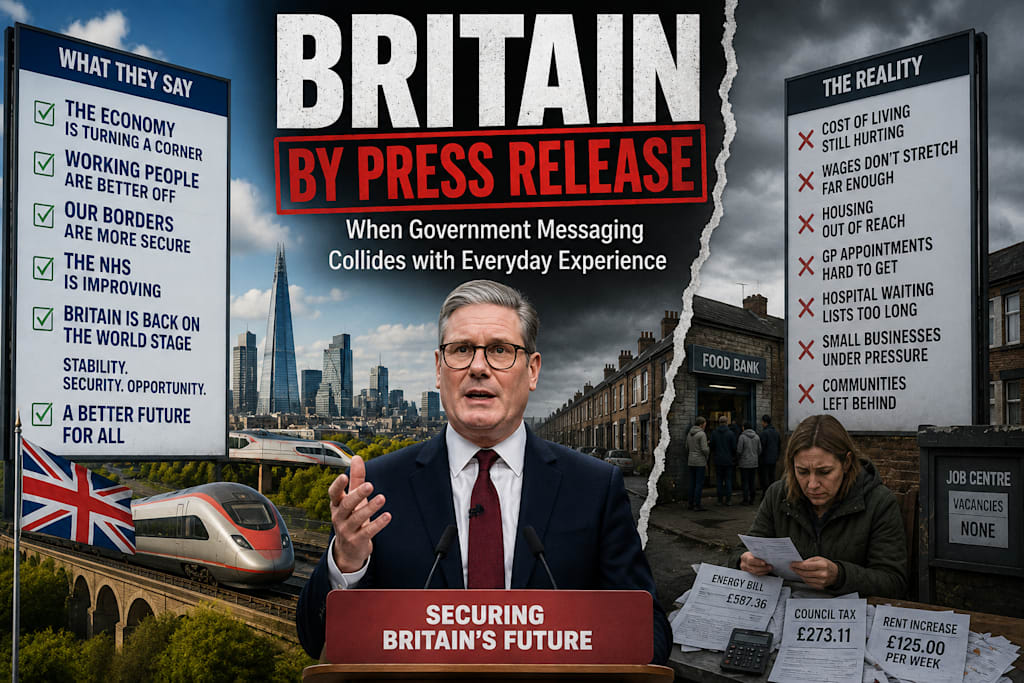
Politics has always involved optimism, with governments naturally emphasising achievements, highlighting positive statistics and presenting a vision of a country moving in the right direction – many people call this gaslighting! Oppositions, by contrast, tend to focus on failures, missed opportunities and the challenges that remain. Since becoming Prime Minister, Sir Keir Starmer has repeatedly argued that Britain is beginning to recover after years of political and economic instability. He has spoken of restoring stability, rebuilding the economy, improving public services and creating a better future for working people. The question is whether these messages accurately reflect the everyday experience of millions of people across the United Kingdom – unfortunately, they do not.
One of the Government's central messages has been that the economy is turning a corner. Ministers have pointed to falling inflation, periods of economic growth, increasing foreign investment and rising average wages as evidence that Britain is moving in the right direction. These indicators are genuine economic measures and provide grounds for cautious optimism. However, many people judge the economy rather differently. They do not measure prosperity by quarterly GDP figures or economic forecasts. They judge it by what remains in their bank account at the end of the month.
For many households, mortgage payments remain significantly higher than they were only a few years ago. Rent continues to consume an increasing proportion of disposable income. Council tax bills continue to rise. Food prices remain well above their pre-inflationary level, even though inflation itself has slowed. Energy costs have fallen from their highest levels but remain expensive for many families. Both observations can be true at the same time. An economy can improve according to official statistics while many individuals continue to feel financially worse off than before.
A similar debate surrounds immigration. The Government has argued that it is taking stronger action to control illegal migration and secure Britain's borders. Ministers point to new agreements with international partners and changes to visa rules. Critics argue that migration remains high by historical standards and that the pressure on housing, schools, GP surgeries and local infrastructure continues to increase in many areas. Whether the Government has succeeded depends largely upon the benchmark being used and the timescale over which success is measured.
The National Health Service provides another example of the gap between official messaging and public perception. The Government has highlighted reductions in certain waiting lists, increased funding and additional appointments. Yet many patients still report difficulty obtaining GP appointments, long waits for specialist treatment and increasing pressure on hospitals. Improvements in some areas do not necessarily remove the frustrations experienced elsewhere.
Housing presents perhaps the greatest challenge. The Government has promised to accelerate housebuilding and improve affordability. New housing developments have been announced across the country, and planning reforms have been proposed. Nevertheless, many younger people continue to find home ownership increasingly difficult. Rising property prices, higher mortgage costs and limited housing supply remain significant obstacles despite the Government's ambitions.
The Prime Minister has also argued that Britain now enjoys greater political stability than in recent years. Compared with the rapid leadership changes seen under previous governments, there is certainly less political turmoil. However, critics argue that stability alone is not enough. They contend that people judge governments primarily by improvements in their daily lives rather than by the absence of political drama.
Perhaps the greatest difference between politicians and the public lies in how success is measured. Governments naturally focus on national statistics because these provide measurable indicators of economic performance. Citizens focus on personal experience because that is the reality they live every day.
If wages rise by three per cent but household bills rise by a similar amount, many people will not feel wealthier regardless of what national statistics indicate. If waiting lists fall but obtaining a GP appointment remains difficult, patients are unlikely to feel that healthcare has fundamentally improved.
This does not necessarily mean that politicians are being dishonest as political language is often selective rather than false. Governments highlight the data that supports their case while opponents highlight the figures that support theirs. The result is that two very different narratives can emerge from the same set of facts.
The challenge for any government is that public confidence cannot be created simply through speeches or press releases. People ultimately judge success through their own lived experience. If they feel financially secure, receive timely healthcare, can afford decent housing and believe their communities are improving, they are likely to conclude that the country is moving in the right direction. If those conditions are absent, optimistic political messaging is unlikely to persuade them otherwise.
History shows that governments are rarely judged by what they promise. They are judged by what people believe they have delivered. Statistics matter, but so do everyday experiences. The economy may indeed be improving according to many accepted measures, yet millions of people will continue to ask a simpler question. "Am I actually better off than I was before?" Until a growing majority answers that question with confidence, the debate over whether Britain has truly turned the corner is likely to continue.
About the Creator
Alan Spencer
Have been an author and writer for over 20 years. Have been a journalist, editor, proofreader, and a designer and presenter of training courses. Have written over 100 articles, two books, and around 20 training courses.
Enjoyed the story? Support the Creator.
Subscribe for free to receive all their stories in your feed. You could also become a paid subscriber, letting them know you appreciate their work.
Comments
There are no comments for this story
Be the first to respond and start the conversation.