
Balanced Triads - Chapter 1
The Illusion of Free Will

Greetings to the slepless and hopeless 🌙
Welcome to Balanced Triads.
Genre: Dark Academia / Dystopian Sci-fi
Schedule: A new chapter every Thursday, follow Matteo Andersson a behavioral scientist whose obsession turned human nature into a weapon. Now history books call him a villain, and he tries to defend himself in his memoir.
Friday, October 1, 2100
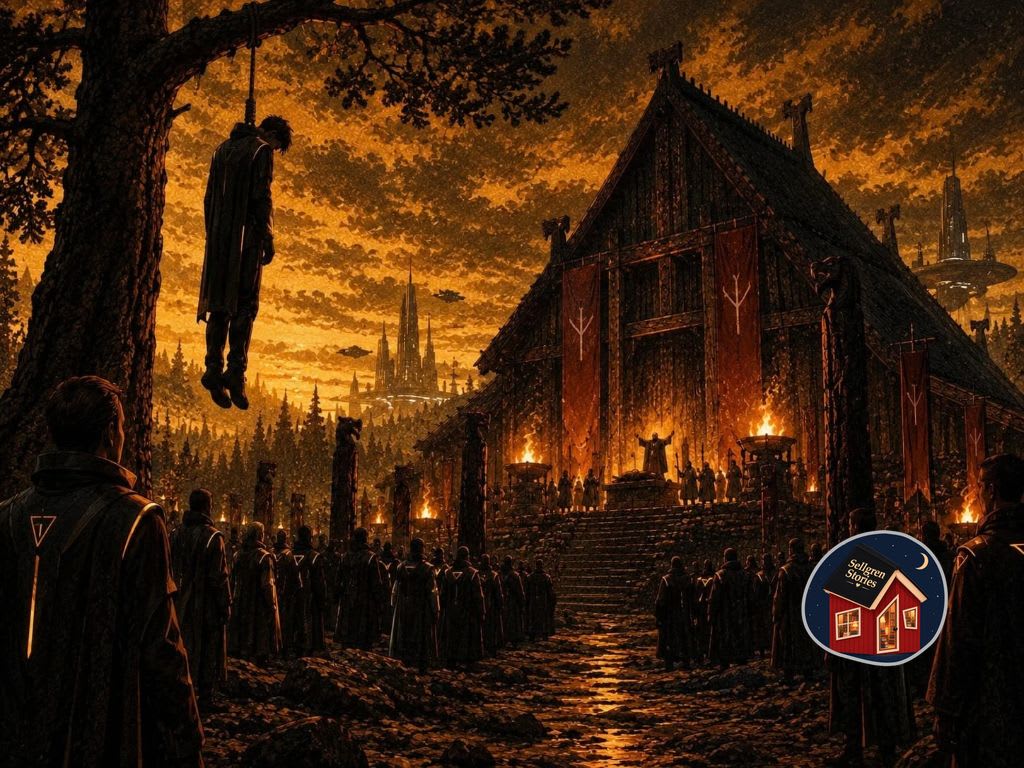
Every time I close my eyes, I hear them screaming. A raw, guttural yell, tears streaming, until the rope pulls tight and the voice collapses into a choked gasp for air. Before consciousness slips away, the blade cuts deep into their throat. The smell of blood in that cold air will haunt me to my grave.
My algorithms predicted this outcome with high precision, I knew what was coming, yet nothing in the data prepared me for the gut-level horror of watching it unfold. While I unsuccessfully try to process this everlasting pain, the media blames me for the tribalistic rituals.
Society has already tried and convicted me from a distance. I was never given the chance to explain who I am or why I did what I did. I will try to the best of my abilities to explain who I am, but sadly, the eye can’t see itself. So it is very plausible that neither perspective presented to you may be accurate. But maybe, by seeing both you can be closer to a so called objective truth.
I decided to write this memoir hoping that someone will read my words and understand who I am before the light of my consciousness finally fades away. Maybe then one might be able to see life through my eyes and understand that I am not the anti-hero of your story. Most likely, you are your own villain. And by ‘you’, I don’t mean you alone, but the collective ‘you’.
I leave my words here for you.
The Classic Illusion of The Self
The self: the you…the me…the us…the them. Separate units, consciously and freely choosing their own individual paths. For many years, I delighted in believing so. The feeling of believing that I am my own person, and that all my decisions belong entirely to me felt so mighty. I could almost feel I was my own God.
However, my standpoint changed after I spent years obsessively studying human behavior. The more you learn, the harder it gets to believe in free will. When data keeps telling you the same story over and over again, it is difficult to ignore it. And evidence has shown, innumerable times, that our actions are foreseeable given that you have the right variables in the equation.
Our behavior is shaped by our DNA, our messy diverse experiences, our unfair environment, the unique subgroups that surround us, and endless other variables which we are not conscious of. So much can be predicted based on the pre-existing conditions we are born into.
I see billions of humans moving around, performing their duties, dropping children off at school, going to work, sitting stuck in traffic, walking in and out in of buildings to attend so-called important group meetings. Back and forth, every single day of their deterministic lives.
When an ant carries food back to its colony, how much free will was actually present in that action? When parents bring children into the most unfortunate situations in this world, how much free will was present in those choices? It is difficult for me to avoid thinking about this biological program running in all of us.
We are social beings. Forming groups is a core imprint for survival. Natural selection rewarded those who could work in groups, trying to minimize conflicts, and compromising to keep harmony. It seems to me that survival will most likely always try to overrule every other variable in the equation of life.
These were the cards that were handed to us, we didn’t have a say in it, we simply learned to play the hand we had been dealt. But I couldn’t help but wonder… What if we had a different set of cards? What if we were born under a different planetary condition? A place that nurtured a completely different set of evolutionary traits. A place where survival didn’t bring brutality along with it.
What would have been? … Well, I don’t know. The limitations of my abstract mind can’t give an answer. I can only work with the variables I know.
Known Variables
So let me give you the variables I know. My name is Matteo Andersson. I was born in 2025 in Stockholm. Average family. Happy parents. Good public welfare. Good family support. A happy childhood, I dare to say. I had the whole complete stable package. I was very fortunate by conventional measurements.
Yet I was never fully satisfied. Maybe I was born with a natural predisposition to find deep boredom in peace. Peace makes me extremely uncomfortable. It is predictable. When all the variables are known and stable, the range of possible outcomes becomes much narrower.
I presume that most people find comfort in predictability. For me it is unsettling. For as long as I can remember, I have found it far more interesting to explore what the extremes can bring. I would try to picture different scenario outcomes of situations that wouldn’t be expected. Like a car going in the opposite direction on a one-way street. Then I would escalate thinking… what would happen if there were several cars then?
Visualizing abnormal situations consumed me, and soon made me wonder: what happens to systems when they are pushed beyond the conditions they were designed to function in? Extremes… It would be the first thing I thought about in the morning and the last one before I went to sleep. It just fascinated me deeply.
Unlike my predisposition to dive into instability, my studies have found that humans are remarkably good at maintaining local stability. Families compromise to remain in the same group. Friends overlook hypocritical behavior. Communities develop shared rules. Political groups are created to protect their own interests.
Our primal brains see it as a matter of life and death to agree and overlook flaws within the group. Because that is what made us survive in the past: a disagreement could easily lead to isolation and then death. Our unconscious rules here: our brains can’t simply understand that we have enough safety and that this desperate need to survive within the group is no longer crucial for an individual to stay alive.
Despite all the programming we inherited to keep us compliant and in harmony, this harmony, ironically, is the mother of chaos. I will attempt to explain to you why.
Chaos Born From Harmony
As a student in 2050, I came across an old study on social interactions leading to more polarization. It immediately caught my attention, I think my inner drive to understand extremes pulled me in. One of the aspects of the study that fascinated me was what happens when small groups of three people who reached a balanced state interacted with one another on a larger, growing scale. Their model suggested that local stability didn’t produce global stability.
Balanced triads could become increasingly unified internally while becoming progressively hostile externally. The stronger the bonds inside each group became, the more the animosity between groups grew. Instead of harmony among groups, an explosion in polarization could be observed.
Isn’t it fascinating? Chaos born from harmony. Homo sapiens, supposedly ‘wise men’, creating the most disorderly situations simply by trying their best to maintain balance within inner circles. A chain of seemingly reasonable decisions leading straight into a tumultuous end.
You could make a decision believing you have your family’s best interests in mind. Your family could be easily convinced that they know what is best for their community. And a community could make political decisions to keep its members safe. Millions and millions of what seem to be reasonable decisions producing a vast amount of unreasonable situations.
The idea consumed me, I kept thinking of all the possible unreasonable extreme scenarios that could occur. I began building social system simulations. I added the variables I knew and created many different radical scenarios by introducing conflicting incentives, adding misinformation into the communication chains, rewarding segregation, removing crucial information, strengthening group identities, and changing many, many other variables.
My simulations didn’t predict the future with 100% accuracy, obviously, but they showed very consistent results. Polarization grew and became increasingly difficult to reverse. I suppose that humanity was never meant to inhabit the middle ground, perhaps peace was never meant for us.
The Machine
The simulations created in me an uncontrollable need to test the models in the real world, which led me to create the Hyper-Polarization Machine. A childish name, but it was the naive me who created it. The machine itself was not impressive. It was a system designed to identify existing problems in society and amplify them as much as possible. I could put it as “adding more fuel to the fire”.
The Hyper-Polarization Machine was designed to map out groups, pinpoint potentially rival groups, introduce different narratives, measure their emotional responses, and then evaluate what narratives could possibly increase distrust and conflict among different circles.
Just to make it clear, I didn’t create hostility. I simply just turned the volume up. The music was already playing way before I arrived. I was curious about how quickly polarization could spread. How long would it take for democratic stability to fade away?
It didn’t take long for physical barriers to start appearing. Information became more and more restricted. Militias were formed. And you know the recipe: all the ingredients baked a civil war. Things didn’t collapse all at once. Like a cake in the oven, it took its time, but we could see it was coming.
“Protect against the enemy!”. Protect, protect, protect… this word was used so many times by those who were attacking. Millions of decisions that have fallen victim to our cognitive fallacies. Reality was becoming so distant from their inner worlds. Unlike in my simulations, the trust in modern democratic institutions decayed much faster than I anticipated.
When democracy fell people tried to find order in the oddest places. Old traditions became a source of comfort to people. More specifically, Old Norse traditions. They revived them in a desperate attempt to bring order back. I knew eventually old rituals would be brought back, the simulations have shown me. I saw human sacrifices being part of the data, but numbers don’t bleed and beg for their lives, I didn’t fully understand what society had become until I saw with my own eyes.
The Dawn
Another human sacrifice will take place today at dawn. I can’t imagine the horror that will be her last hour, seeing thousands of eyes, waiting for her to die, she will hope that at least one single soul will pity her and ask to spare her, but that won’t happen.
I feel more miserable as the minutes pass by because I know her. Ingrid Nilsson. I did simulations several times on Ingrid Nilsson’s situation, and 96% of the time it ended this way. I honestly don’t think I could have done anything differently.
Still hurts, because I care for her, and no one deserves such a gruesome death. What if I try to steer the wheel towards the other 4%? I know what might happen, someone else will end up there. That would mean I have to intervene again on someone’s path, I promised myself I wouldn’t do that again. But I don’t know if I could live with myself seeing Ingrid being hanged…
To our fellow sleepless and hopeless souls 🌙 Thank you for dropping by our little corner of the internet. It’s cozy, warm and intriguing and you are always welcome here. Consider subscribing so you don’t miss the next piece
SubscribeAbout the Creator
Sellgren Stories
Stories for the sleepless and hopeless. 🌙
Enjoyed the story? Support the Creator.
Subscribe for free to receive all their stories in your feed.
Comments
There are no comments for this story
Be the first to respond and start the conversation.