
Awakening in the Soil
Part 2 - Sacred Rituals and Living Microbes Abhishekam and the Hidden Wisdom of Living Substances

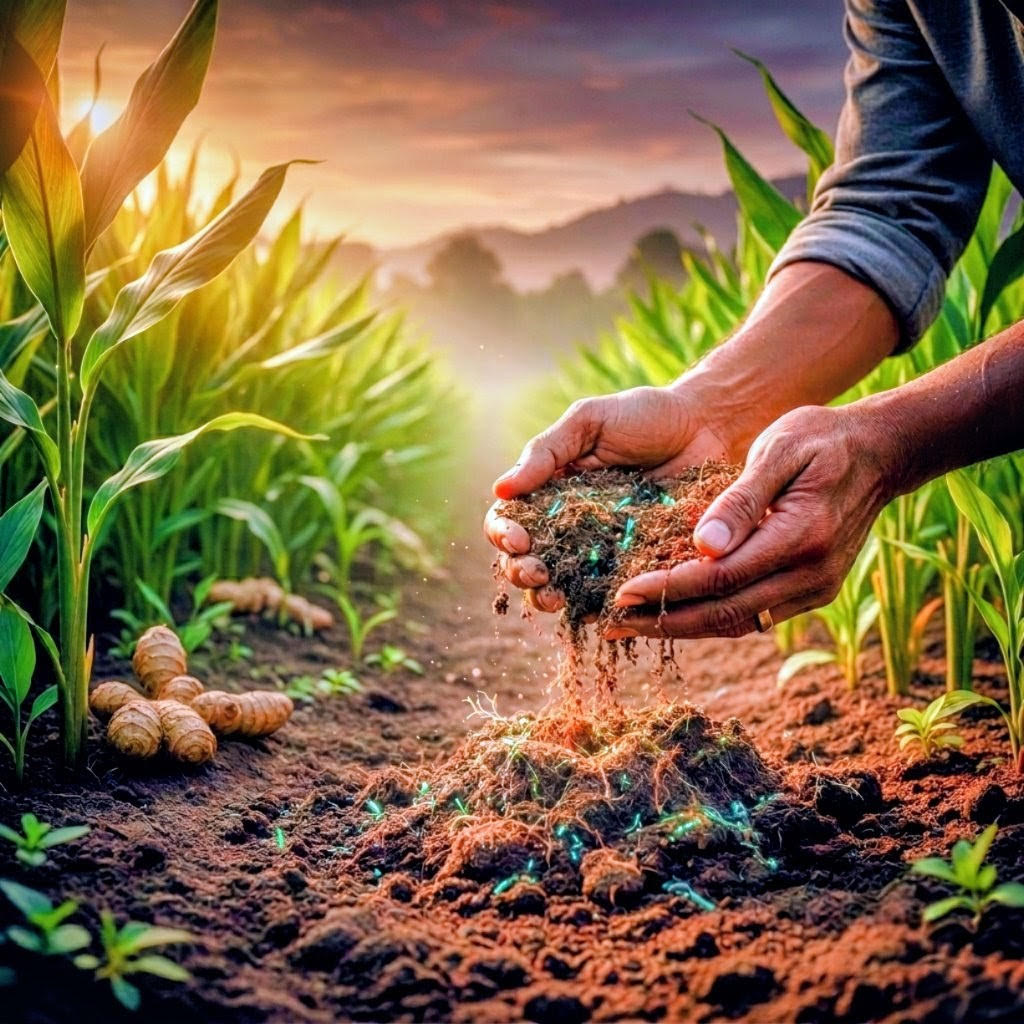
When I began studying microbial farming and the hidden life within healthy soil, something unexpected happened.
The deeper I explored the science of microorganisms, the more I found myself reflecting on the traditions I had witnessed growing up in Hindu temples. Rituals that once seemed purely spiritual began revealing another dimension one that resonated with biology, ecology, and the interconnectedness of life.
One ritual, in particular, kept returning to my mind: Abhishekam.
In temples across India and around the world, sacred substances such as water, milk, curd, honey, sugarcane juice, young coconut water, Panchamirtham, and Vibuthi (holy ash) are reverently poured over the deity. For devotees, this ritual is an expression of devotion, gratitude, humility, and surrender to the Divine.
As I immersed myself in microbial farming and natural agriculture, I began to see these offerings from a different perspective.
- They were not merely symbolic.
- They were substances deeply connected to the living world And life has always sustained life.
The Sacred Substances
Every ingredient used in Abhishekam possesses unique natural characteristics. Viewed through the lens of modern biology, these offerings reveal an intriguing relationship with living systems.
Water is the foundation of all known life. It awakens dormant microorganisms, transports nutrients, and enables countless biological processes within soil and plants.
Milk contains proteins, minerals, and naturally occurring microorganisms that can support microbial activity and biological processes.
Curd (Yogurt) is a living fermented food rich in lactic acid bacteria, microorganisms that play important roles in fermentation and contribute to balanced microbial ecosystems.
Honey contains enzymes and naturally occurring compounds with antimicrobial properties while also interacting with beneficial microbes under appropriate natural conditions.
Sugarcane Juice provides readily available carbohydrates that many microorganisms can use as an energy source for growth and metabolism.
Young Coconut Water is rich in minerals, sugars, amino acids, and bioactive compounds that make it a naturally nourishing liquid.
Panchamirtham, traditionally prepared using fruits, jaggery, honey, and ghee, combines several nutrient-rich ingredients that have long been valued in both spiritual practice and traditional diets.
Vibuthi (Holy Ash) represents purification and impermanence in Hindu philosophy. Although its spiritual significance far exceeds its physical composition, ash has historically also been returned to the earth as part of natural nutrient cycles.
When many of these natural ingredients are combined, they create nutrient rich mixtures that can support fermentation and microbial activity under suitable conditions.
Interestingly, modern natural farming practices often rely on remarkably similar ingredients milk, jaggery, fruit extracts, fermented plant juices, and other biological inputs to cultivate beneficial microbial communities in the soil.
Whether by careful observation or accumulated traditional knowledge, our ancestors may have recognized the importance of substances that support living systems.
Ritual as Ecological Wisdom
Ancient civilizations often preserved knowledge through stories, customs, and rituals.
Long before microscopes or laboratories existed, people closely observed forests, rivers, animals, fermentation, and soil fertility. They learned by watching nature over generations.
Rather than documenting their discoveries in scientific journals, they embedded practical wisdom into daily life and sacred traditions.
Rituals became living libraries.
The repeated use of natural substances such as milk, curd, honey, fruits, and water reminded communities of their dependence on nature and encouraged respect for resources that originated from living ecosystems.
Nothing existed in isolation. Everything participated in the continuous cycle of life and eventually returned to the earth.
The Invisible World Beneath Our Feet
Modern science has confirmed something that many traditional societies intuitively appreciated:
Our planet depends on microorganisms.
Healthy soil contains astonishingly complex communities of bacteria, fungi, archaea, protozoa, and countless other microscopic organisms. Together, they recycle nutrients, decompose organic matter, improve soil structure, protect plants from disease, and support the productivity of entire ecosystems.
Without these invisible workers, forests would struggle to regenerate.
Agricultural systems would lose fertility.
Life on land as we know it would not be sustainable.
Yet because these organisms cannot be seen with the naked eye, they are often overlooked.
Decades of intensive chemical agriculture have disrupted many of these delicate microbial communities by replacing living biological systems with synthetic fertilizers and pesticides.
In many places, humanity has unintentionally weakened one of nature's oldest partnerships the relationship between plants and soil microbes.
When Devotion Meets Biology
The more I practice microbial farming, the more I feel that caring for the soil can itself become a sacred act.
Preparing microbial cultures, fermenting plant extracts, and restoring degraded land require patience, humility, observation, and respect for natural processes.
These qualities closely resemble the mindset cultivated through ritual.
- Both involve intention.
- Both require trust.
Both acknowledge that transformation often happens through forces beyond direct human control.
- In temples, sacred liquids are lovingly offered to the Divine.
- In natural farming, living biological solutions are returned to the soil.
In both cases, life is being nurtured.
The Sacred Is Not Separate from Nature
One of the greatest misconceptions of modern society is the belief that spirituality exists only within places of worship.
But perhaps the sacred exists wherever life is honoured.
- It exists in forests that breathe for the planet.
- It exists in rivers that nourish civilizations.
- It exists in fertile soil filled with billions of unseen organisms working silently every moment.
And it exists whenever human beings choose stewardship over exploitation.
Ancient traditions may not have spoken in the language of microbiology, but many of their practices reflected profound respect for natural cycles and living systems.
Today, science allows us to appreciate those same systems with greater clarity.
Nature reminds us that survival is built not on isolation, but on cooperation.
Remembering Our Place in the Living World
The ritual of Abhishekam invites us to reflect on simple yet life-giving substances:
- Water
- Milk
- Curd
- Panchamirtham
- Sugarcane Juice
- Young Coconut Water
- Vibuthi (Holy Ash)
- Honey
These are more than ritual offerings. They remind us that life is interconnected, biological, cyclical, and deeply dependent on relationships that often remain invisible.
When we begin to understand this, our perspective changes. The soil becomes sacred and farming becomes stewardship.
And every living organism even the smallest microbe becomes part of the vast web of life that sustains humanity and the planet.
Coming in Part 3
The Microbial Revolution
In the next chapter, we will explore how restoring microbial life to the soil could become one of the most powerful pathways toward healing our planet.
Agriculture, human health, biodiversity, and ecological resilience are all linked through the invisible world of microorganisms.
The future of sustainable farming may depend on rediscovering how to work with them rather than against them.
About the Creator
Sivakumar Micheal
Go Green Save the Earth
Let's make a different together
I'm a person concerned about the preservation and protection of the natural environment and works to promote sustainable practices and policies.
Enjoyed the story? Support the Creator.
Subscribe for free to receive all their stories in your feed.
Comments
There are no comments for this story
Be the first to respond and start the conversation.