
5 Fatal Small Business Financial Mistakes That Cost Entrepreneurs Thousands
5 Common Small Business Financial Mistakes That Drain Revenue


Starting a business is one of the most exciting undertakings an individual can embark upon. But the route from a good concept to a cash-flowing, sustained firm is typically limited. The data continues to affirm a dismal reality: around 20% of new enterprises succumb in their first year and 50% fail by year five.
While many believe these failures stem from bad product ideas, the underlying culprit is far more pedestrian. It isn't a lack of passion; it's a lack of basic financial literacy and operational discipline. Startups routinely mismanage their resources, leading to severe cash crunches. In fact, a comprehensive analysis of over 390 startup failures revealed that 29% ran out of cash, and 18% failed due to pricing and unit economic errors.
If you want to protect your hard-earned capital and scale effectively, you must sidestep the heavy small business financial mistakes that routinely cost entrepreneurs thousands of dollars.
1. Mixing Personal and Business Finances
When you are operating a lean, early-stage business or managing a side hustle, it feels easier to run everything out of your personal checking account. However, avoiding separating personal and business finance is one of the most structurally damaging mistakes an entrepreneur can make.
- The Trap: Co-mingling funds blurs your audit trails, cripples your ability to track actual business performance, and severely complicates tax filings. When business revenue is lumped in with your personal grocery money, you cannot easily calculate your true burn rate or margins.
- The Financial Toll: It costs thousands in forensic accounting fees when a professional has to untangle your books at tax time. Furthermore, if your business is structured as an LLC or corporation, mixing funds can trigger a legal vulnerability known as "piercing the corporate veil." This destroys your personal liability protection, exposing your personal assets to business debts and lawsuits.
2. Mistaking Revenue for Cash Flow
A classic trap for new founders is celebrating top-line revenue while ignoring actual cash availability. This is one of the most common startup financial pitfalls in B2B markets.
- The Reality Check: Bookings and cash are entirely different financial metrics. A company can technically generate $100,000 in sales in a month but only collect $30,000 of it in actual cash by month-end.
- The Trap: If you run a business-to-business (B2B) model or rely on invoicing, you might offer net-30, net-60, or even net-90 payment terms. If you recognize revenue the moment a contract is signed and immediately increase your operational spending based on that "paper wealth," you will run out of real money before those invoices hit your account.
- The Financial Toll: This "liquidity illusion" leaves profitable companies completely unstable, preventing them from meeting payroll, fulfilling supplier payments, or buying inventory when liquidity fluctuates unexpectedly. Implementing proactive cash flow management tips is critical to keeping the business alive.
3. Guesswork Pricing and Broken Unit Economics
Determining how much to charge for your product or service shouldn't be based on a "gut feeling" or blindly copying your nearest competitor.
- The Trap: Many entrepreneurs price their products too low in an attempt to win market share, completely failing to calculate their true cost of goods sold (COGS) or accounting for overhead expenses like rent, software subscriptions, and payment processing fees. Others fall victim to "perfect world" financial modeling, completely underestimating their Customer Acquisition Cost (CAC) by omitting sales commissions, marketing software, or content production costs.
- The Financial Toll: If your unit economics are broken—meaning it costs you more to acquire a customer and deliver the service than the customer actually pays you over time—scaling your business will only accelerate your losses. You end up trapped in a cycle where more sales equal more lost capital. Deploying a realistic customer acquisition cost strategy ensures you grow profitably.
4. Building a Complex Corporate Structure Too Early
Early stage startups tend to fall in love with traditional corporate infrastructure before they’ve even found their feet in the market.
- The Trap: Entrepreneurs squander precious cash on recruiting full-time staff to do things that can simply be outsourced, automated or done part-time. They rent pricey office space, buy expensive business software and create a sophisticated corporate structure for a staff of five people.
- The Financial Toll: This inflates fixed overhead costs before the business has achieved stable product-market fit. When cash runs lean, massive fixed payroll and rent obligations become an unmanageable anchor that forces premature closure.
5. Reacting to Taxes as a Last-Minute Emergency
Taxes should never be a surprise. They arrive at the exact same time every single year, yet an alarming number of small business owners treat them like an unforeseen disaster, cementing this as one of the hardest-hitting small business financial mistakes.
- The Trap: Founders fail to set aside a fixed percentage of every dollar earned to cover state, federal, or sales tax liabilities. Instead, they treat 100% of the business's net cash as spendable capital for growth or personal draws.
- The Financial Cost: Entrepreneurs rush by tax season, taking out high-interest short-term loans or facing large penalties and interest from revenue officials. Not making tax payments throughout your initial years of fiscal operation generates a cumulative financial hole that’s nearly impossible to dig yourself.
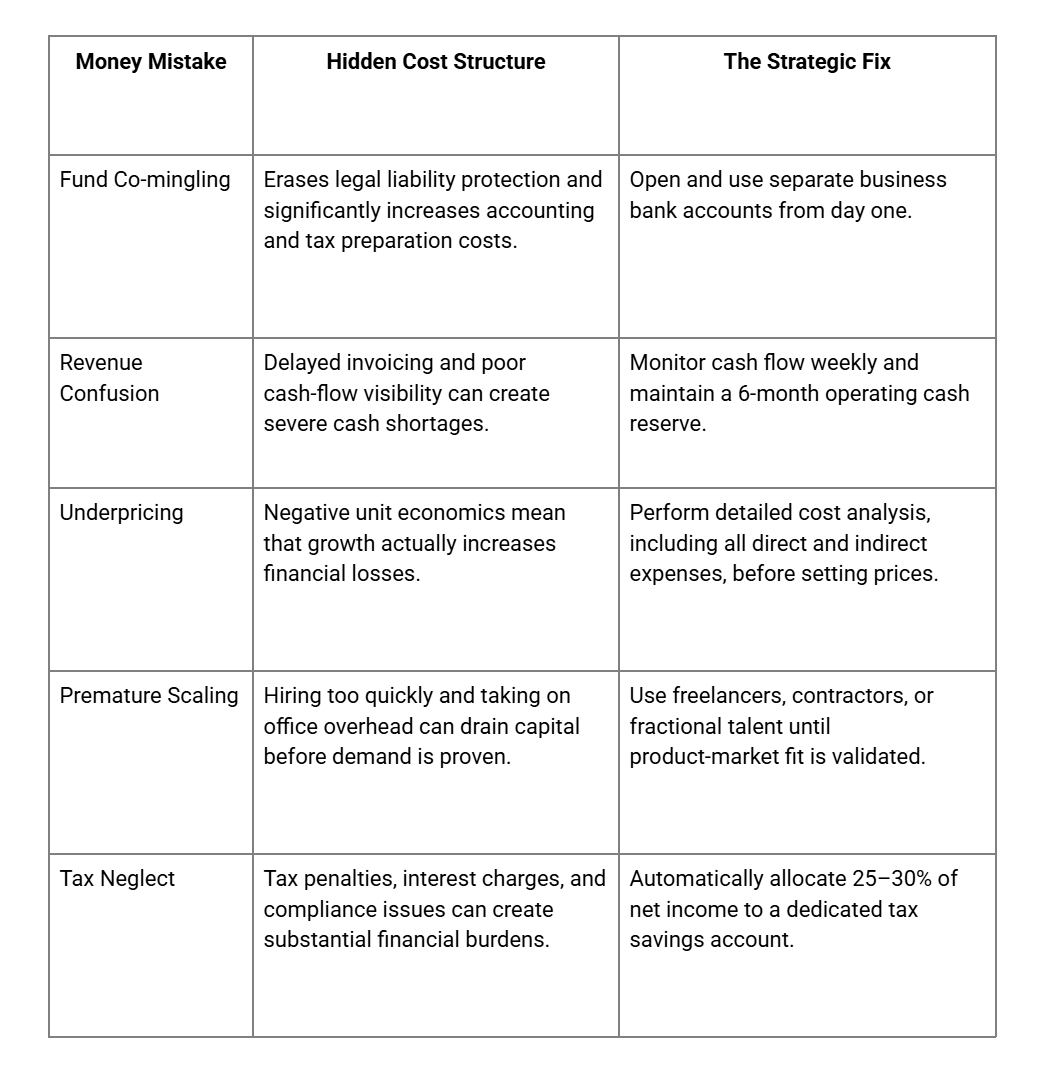
Action Plan: How to Fix Common Small Business Financial Mistakes
Frequently Asked Questions (FAQs)
1. How much cash runway should a new business maintain?
For early stage enterprises, a best practice is to try and have a liquidity safety net for six months of key operational expenditures. If sales slow down, market circumstances change or there’s an unforeseen billing delay, this contingency reserve allows the firm to continue funding its main activities without taking on predatory, high-interest debt.
2. When should I hire an accountant vs. using DIY software?
Cloud-based accounting tools (QuickBooks, Xero, etc.) are great for tracking your daily, automatic costs, but before you launch you should preferably sit down with a professional accountant to build up your corporate framework and tax structure. Plus, hiring a specialist for quarterly tax planning or outsourcing bookkeeping frees up your attention for high-impact development strategy rather than admin activities.
3. What is the difference between cash-basis and accrual accounting?
With cash-basis accounting you record income and costs only when you receive and pay cash. Accrual accounting tracks income when it is generated (e.g., billing an invoice) and costs when they are incurred. For micro-businesses, accounting on a cash basis is easier, but accrual accounting is a must for organisations that are developing, since it matches long-term income with the real expenditures that were incurred to produce that income.
4. How can I lower my business's Customer Acquisition Cost (CAC)?
To reduce your CAC, use organised testing processes and leverage short, agile cycles to learn whether organic message or sponsored channels are most efficient at converting clients. Also, get more out of your existing customer base, upselling to an active customer costs far less than bringing on a brand-new customer from the ground up.
5. Is it safe to bootstrap my business entirely out of my own pocket?
Bootstrapping is highly common, with data showing that 77% of all startups carry no external investment and rely on self-funding. While it allows you to maintain full ownership and forces strict capital discipline, it does place the full financial load on the founder. To do it safely, run small-scale campaigns to test market demand before committing your personal life savings to massive inventory orders.
About the Creator
Kanchan Bains
Kanchan Bains is a journalist with over five years of experience in digital media and news reporting. She holds a Bachelor’s degree in Journalism and Mass Communication and began her career as a trainee reporter.
Enjoyed the story? Support the Creator.
Subscribe for free to receive all their stories in your feed.
Comments
There are no comments for this story
Be the first to respond and start the conversation.