
When Satire Forgets to Be Funny
A Review of Yesteryear by Caro Claire Burke

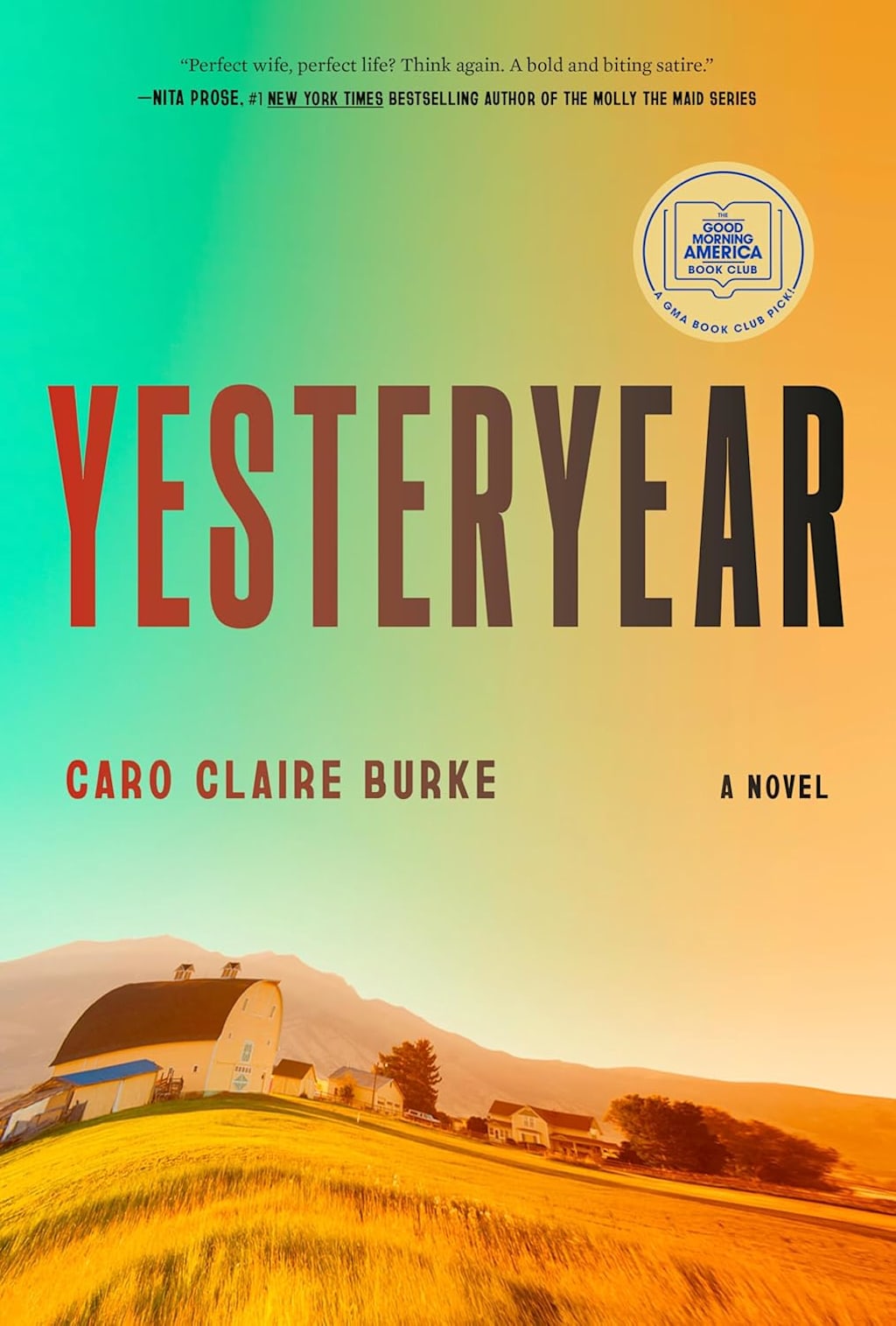
Our story starts with Natalie, a social media influencer and trad wife (a lifestyle choice where a woman focuses on domestic duties like cooking, cleaning, and taking care of the kids while the husband is the breadwinner). She lives on her farm, called Yesteryear, where she posts video blogs about her idealistic homemaking lifestyle while raising children, with her husband handling the physical labor. Everything is perfect until she wakes up one day in the 1800s. Natalie is expected to perform the same duties as women in the 1800s, which is vastly different from her own visionary lifestyle. Will she be able to survive this new time period?
If you read my summary above, what would you think the story was about? I came in expecting it to be sci-fi mixed with either mystery or thriller, depending on how dark the book got. I figured it would be about Natalie learning that the traditional lifestyle she portrays online is not necessarily realistic. After reading it, I realized that I was so far off the mark. I searched for more details on the book after reading it. What I discovered was kind of baffling: the book was supposed to be satire and darkly funny.
However, that is not what I experienced in the book. Instead, I read about a woman who subverted her ideals of Christianity to the point that it causes her to dissociate from reality. Natalie grew up in a broken home. Her father left her mother for another woman. Instead of her mother accepting that her husband left her, she makes up a story to her community where her husband passed away and forces her daughters to lie as well to keep up appearances. In their community, divorce is frowned upon, the number of children you have is a status symbol, and getting married young is ideal.
Natalie decided to leave her community to attend an Ivy League school. I was excited for her. She wanted to be around intellectuals and experience a new world. However, Natalie didn’t use the opportunity to expand her knowledge of the outside world. She instead doubled down on her Christian ideology and judged everyone around her for not having the “right Christian values”.
What makes it worse is that she married young to a guy she didn’t know (Caleb) and dropped out of college. However, her “Christian traditional ideology” didn’t help her. She realizes that the guy she married doesn’t have a work ethic or ambition, and his family thinks he is a dud. Her husband, Caleb, wanted to become a kindergarten teacher and work with kids. However, that messed with her expectations of a Christian marriage. Men were supposed to be masculine and aspire to hard work. She decides to fix her husband’s teaching aspirations by playing on Caleb’s childhood dream of being a cowboy to convince him to start a farm and raise a huge family.
The results of that led to increased disillusionment for Natalie. She starts documenting her growing family and their life on the farm online. She shows only the good aspects of the farming life, and makes sure her family acts traditionally. However, Natalie gets negative feedback from others who think that Natalie is faking aspects of her life. Natalie dubs the commenters as “angry women” because she believes that they are upset because they could never be as perfect as she is.
The thing is that Natalie is faking it for the camera. She thinks it is okay to perform for her blog and fake her way through life. We discover that Natalie is not the happy person she portrays herself to be. She hates her husband and kids, and constantly wishes that she didn’t have them. However, the thoughts immediately go away to her praising God for what she has. Pretending is good for a marriage and family, and Natalie believes that she can push through to keep her superior status online. However, we gradually see how having these negative Christian values led her down a road to despair as she tries to hold onto her fame and notoriety.
The story doesn’t make you feel sorry or root for Natalie. She doesn’t come across as a Christian woman. She is vapid and cruel, especially towards those she deemed who don’t have the same values as her, which is everyone, including her family. She expects her family to maintain the perfect reality she is projecting to viewers, but her kids express discomfort in being in front of the camera all the time. They don’t want their lives constantly documented or to live the same lifestyle as their mother is promoting.
I am not sure if the book makes good satire. Instead of getting a darkly funny and exaggerated story to provoke change, we get a sad and uncomfortable tale about a woman who weaponizes her Christian lifestyle to get her family to do what she wants and gives false information to viewers of her content who seek advice. It gives the message that the trad wife movement, social media, and Christianity are bad, and living in the modern world is the best.
I don’t agree with what this book is selling, though. Everything about social media influencers, trad wives, and Christianity is not evil. I think that there are more nuances which the book doesn’t seem to grasp. There are, of course, bad actors in every part of society. People have used the Bible to support the lack of rights for women and Black people. Some social media influencers portray that their lives are healthy when they really are not. For example, there was the case of Ruby Franke, a parenting vlogger, who promoted strict religious upbringing for her children. However, one of her children escaped captivity to seek help for him and his sister being kept tied up and malnourished.
However, there are good aspects to these things. For example, Ms. Rachel is a vlogger who provides children’s content that promotes education, as well as child advocacy and humanitarian work. I am a Christian woman, yet I don’t think that Christianity makes me superior to others. I believe in equality for all, no matter what race, gender, sexuality, religion, or disability. People should be able to worship the way they see fit (as long as it is not harming others), and not have someone else’s principles or beliefs shoved down their throats.
I wish that the novel focused on the people around Natalie more instead of focusing totally on her inner thoughts. There is a discussion to be had about children in the limelight and whether social media can be toxic. Governments are making rules about what age social media should be available to those under 18, and the working conditions of children in the general entertainment industry. Starting in 2026, we are now seeing protection for children who are in vlogs focusing on their safety and whether they gave consent to being filmed. If the novel had addressed things like that, it would have given it more layers than what we actually got: a story about an unstable woman who thinks she is superior to everyone else.
Considering the book’s popularity, it is only a matter of time before it gets adapted to film or television. What I hope is that they rework the material in the book to illustrate a woman who is facing the difficulties of womanhood and motherhood while grappling with what that means concerning her faith, instead of what the book truly offers: an unhinged woman who loses her grip on reality and hurts those around her. Do you guys think that this novel would make a good movie or TV adaptation, or does it need to be reworked before it makes it to the silver screen?
About the Creator
Enjoyed the story? Support the Creator.
Subscribe for free to receive all their stories in your feed. You could also become a paid subscriber, letting them know you appreciate their work.
Comments
There are no comments for this story
Be the first to respond and start the conversation.