
Trainspotting (1993) and Its Impact on My Writing
BookClub Challenge Entry
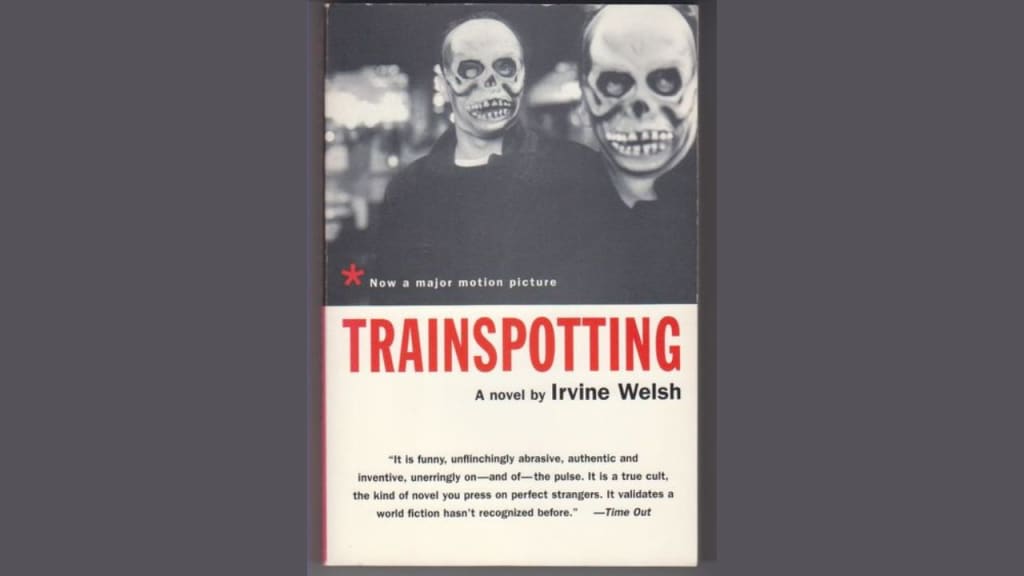
I can honestly say that lots of books I have read over the years have had some impact on me in some way. Some more than others. If I had to narrow it down, there are at least two I will always come back to. In this piece, I am going to talk about Trainspotting by Irvine Welsh and how it affected me.
Before we go any further, I would like to point out that it has nothing to do with the subject matter of heroin addiction or even my own problems with addiction, because I read the book way before I had this illness.
I was a teen during the mid-90s, and truthfully wasn't really aware of Trainspotting until it was announced that the film would be released. I was interested because it was directed by Danny Boyle who had done one of my favourite films from another year, Shallow Grave and it was announced Ewan McGregor and Robert Carlyle were going to be in. Two actors I really liked.
It is possible I had read a review of the book or something - I knew it was important. It was the film, though, that really brought it to my attention. The film was big news for the Scottish and general British film industry.
I distinctly remember talking to friends about going to see the film when it's release date was announced. I had already decided to read the book first, because if this was an important point for Scottish culture and modern history, I wanted to fully immerse myself in it.
My friends thought it was ridiculous, but I set about reading it a week before I was due to see the film. It took that long, because, as anyone who has read the book, will testify too - it's not the easiest book in the world to read.
I have not read the book in many years, decades even, but it still stays with me for a number of reasons.
The Language
Aside from Burns and a few other specifically Scottish things, I was not really familiar with much in the way of books that sounded like me, or at least sounded enough like me and people I knew. I know the book is set in Edinburgh and not Glasgow, but it was enough like me to have me hooked from the world go. For me, it was like reading Shakespeare, or how I imagine people reading Shakespeare or watching one of his plays and it sounding just like them. The same language.
That was what Trainspotting was like for me. I've always been a bit nervous about writing like that. Partially because, time spent in England and being married to a woman from Essex, I've had to naturally dull out some of the slang from regular vocabulary. I am not complaining, it's just something you have to do sometimes, I think. So, to fill it with "frae and tae and ken and kin" would not sound very genuine. It's something I'm trying to get over with my two poems about Glasgow.
I have no idea if Irvine Welsh knew it was going to be a massive hit - how would he? But I like the bravery that comes with "This is how its written. You want to read it, you need to deal with that".
Another reason I will often shy away from writing in full-on Scottish is because it feels like such a pressure to get it right. There are so many nuances.
The language in Trainspotting is actually a mixture of Scots. Scottish English or British English, depending on the characters. It reads beautifully, though I understand for people not familiar with the language it could be a little distracting or intimidating.
So, I learned from Trainspotting, whatever language or dialect or accent you choose to write in, just do it and you will find your readers. That was my takeaway.
The Structure
Another major way that Trainspotting changed my life, or the way I write is the structure. Funnily enough, a few years before reading and seeing Trainspotting, I saw Pulp Fiction, which has a non-linear narrative, and it impressed upon me the fact that you don't need to tell every story in the normal fashion.
So, it was exciting when I came to read Trainspotting and found that it too was non-linear. It is like little scenes, some hilarious, some disturbing, dark and frank, others emotional that are connected together with the storyline that the film follows.
That's why when people say they love the film, I comment that while it's an awesome adaption, and I really think it is. Danny Boyle did a great job with quite a mighty task. But the book is so much more.
As an interesting aside, and it may be because of the visual spectacle of a movie, but I think Trainspotting the novel does more to put you off heroin and addition than the film does, as the film glamourises parts of the culture.
*
I would highly recommend Trainspotting but will warn that if you've seen or heard of the film and some of the harrowing scenes in it, those scenes are even more disturbing when you read them off the page.
So, while it may not seem like a big impact, Trainspotting still inspires me to write authentically, in the voice I choose, without fear and that I don't need to follow the traditional linear structure of storytelling.
About the Creator
Paul Stewart
Award-Winning Writer, Poet, Scottish-Italian, Subversive.
The Accidental Poet - Poetry Collection out now!
Streams and Scratches in My Mind coming soon!
Enjoyed the story? Support the Creator.
Subscribe for free to receive all their stories in your feed. You could also become a paid subscriber, letting them know you appreciate their work.
Comments
There are no comments for this story
Be the first to respond and start the conversation.