
The Wonder of "WONDER"
How a novel for kids and teens has become a hit across all ages, and made adults ask hard questions too.
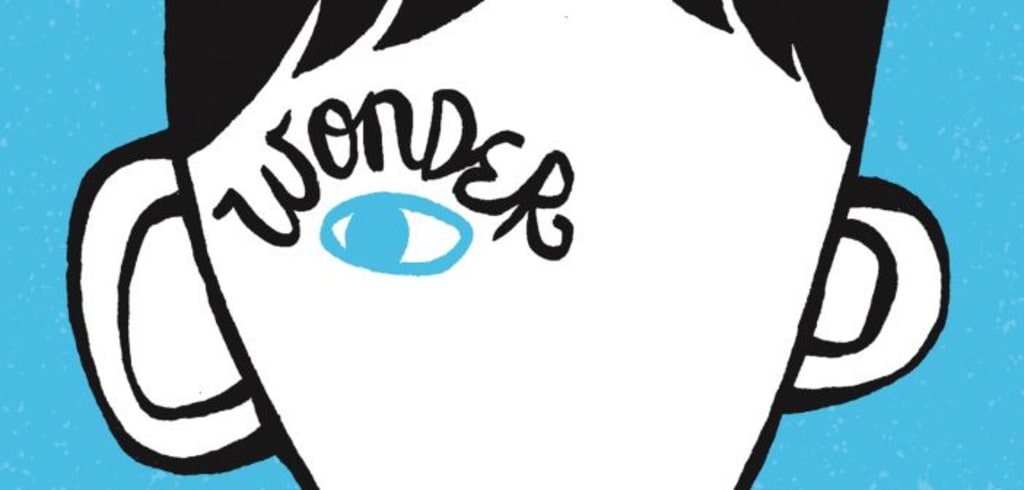
Some books are extra special. Sometimes you find them. Sometimes they seem to find you.
For me, R.J. Palacio's “Wonder” is one of those special books now. It has been developed into a movie, sequels have been written, and additional supplemental books have been written. It’s a hit. For several years, it has been assigned reading for teenagers in middle school and high school. I am an adult, graduated from high school quite a few years ago, and don’t have children, so I missed out on the reading assignment. I found it last week when it came up on a page of available e-books to borrow on Kindle from my local library. It sounded interesting, so I borrowed it. And then I read it in one sitting. And I laughed, cried, laughed through tears, cried through laughter, and came away thinking. It’s one of those stories that stays with you for a while after the last page.
The story is deceptively simple. August Pullman is a young boy with a severe facial deformity, starting middle school, and attending mainstream school for the first time in his life after years of homeschooling and surgeries. The narrative moves through multiple perspectives: Auggie himself, his sister Via, his friends Jack and Summer, and others, including his bullies. This structure is what elevates the story. It’s not just a straightforward disability narrative or a feel-good story; it’s something far more nuanced. We see not just what happens to Auggie, but also how his presence touches everyone in his orbit, forcing them to confront their own capacity for cruelty and kindness.
What strikes me most about the story is how it refuses to be merely inspirational. There is a whole genre of disability fiction stories that seem to exist to make able-bodied readers feel good about themselves, to offer a lesson about overcoming adversity with determination and positivity. Palacio does not do this. Auggie's life is genuinely difficult. The stares and whispers and bullying that he endures are not misunderstandings to be cleared up with a conversation. The pain is real, and it does not resolve neatly.
The story shows goodness the way children and many adults exhibit it: as a choice that must be made repeatedly, and sometimes with a heavy cost. Peer pressure is real, both for children and adults. One of the characters in the story finds himself drawn into participating in cruelty because it’s easier than standing alone. His arc is not about being a saint, but about becoming brave enough to stand up and be kind when kindness is inconvenient. Most of us are not villains, but maybe we are cowards. The story makes you think about being a good person, about choosing kindness, about taking a stand and doing what is right even when you’re standing alone.
Reading this as an adult, I kept thinking about all the “August”s I have encountered. The students who ate lunch in the library or school hallways because the cafeteria was too dangerous. The teenagers who developed elaborate strategies for navigating public spaces. The adults who have learned to make their faces into masks of cheerful indifference so that strangers will not ask what happened to them. The book asks a hard question: How many times have you been the person who looked away?
The famous precept from the book, the one that has been printed on posters and t-shirts, is Mr. Browne's September rule: "When given the choice between being right or being kind, choose kind." It is a lovely sentiment, and I understand why it has become the book's unofficial motto. But I think the deeper message is more specific and more difficult. Kindness in “Wonder” is a series of concrete actions. It is Summer choosing to sit with Auggie at lunch when no one else will. It is Jack taking a stand and punching Julian.
The story’s conclusion is not really about Auggie being healed by acceptance. It is about the community being healed by accepting him. The change happens in the other children, in the parents, in the teachers, who have to decide what kind of people they want to be.
We live in a time when discourse has become more visible and more contentious, when questions of accommodation and representation and identity are being fought in courts and on social media. “Wonder” does not solve any of these debates, or wrap things up in a neat bow. It is not a policy document. But it does something perhaps more valuable: it lets you spend time inside the characters’ heads, and when you emerge, the world looks slightly different. You remember that everyone is carrying something invisible.
I think this is why the book has endured, why it has been translated into so many languages, why it sits alongside books like “To Kill a Mockingbird” and “The Giver” in those summer reading lists that students complain about. It is not because it is easy. It is because it is true. We are all, every day, choosing what kind of people we want to be.
R.J. Palacio said she wrote the book after a chance encounter at an ice cream shop, when her son cried at the sight of a child with a facial difference and she did not know how to respond. That moment of failure became, through imagination and care, a story that has helped millions of children (and some adults) know what to say, what to do, how to be brave enough to be kind. “Wonder” is a story about a boy with an extraordinary face, but it is also about ordinary goodness, and how difficult and necessary it is to practice. We should all be so lucky as to have a Mr. Browne in our lives, or to be one ourselves. We should all be so brave as to choose kind.
.end.
About the Creator
Erin Walker
Female. American. Artist. Writer. Adventurer. Explorer. I love traveling to new places, reading good books, creating stories, and being entertained, loved, and owned by my 3 fur kids (2 cats, 1 dog).
Enjoyed the story? Support the Creator.
Subscribe for free to receive all their stories in your feed.
Comments
There are no comments for this story
Be the first to respond and start the conversation.