
The Walled Mother. Private Revenge in Balzac
A modern reading of La Grande Breteche

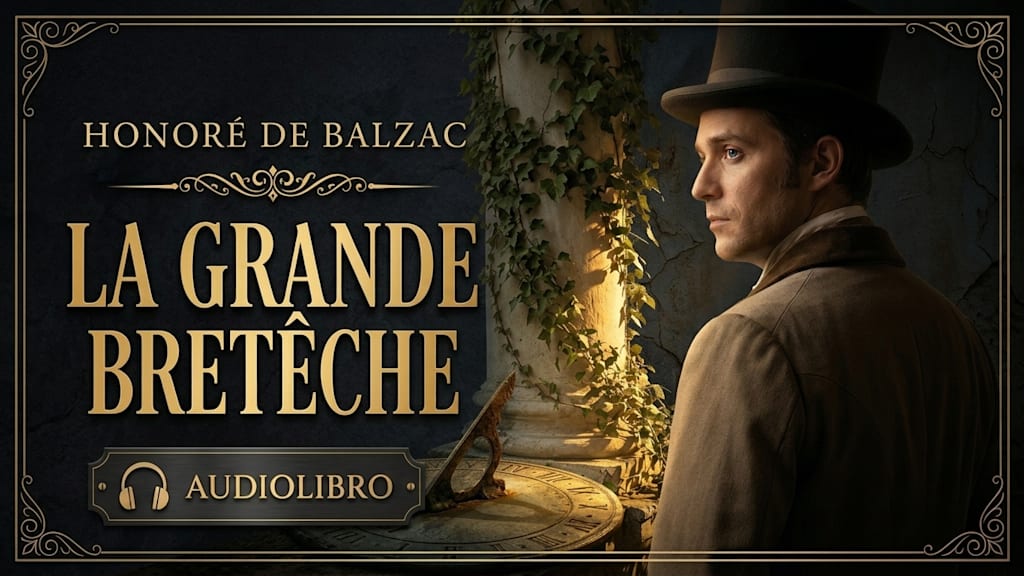
Honoré de Balzac wrote “La Grande Bretèche” in 1831, drawing the setting from an abandoned house he actually saw on his travels from Paris to Versailles, between Auteuil and Point-du-Jour, and the name from a place in Saint-Cyr-sur-Loire, near Tours, where his mother had sent him to be nursed as an infant. As for the bloody ending, no evidence has turned up of a real event drawn from the news of his day; the plot seems instead to descend from earlier works, above all Marguerite of Navarre’s Heptaméron and Bandello’s Novelle. A solid case of hypertext, then, not a contemporary crime story.
The torment of the walled-up lover is said to have sprung from the author’s imagination on seeing a trompe l’oeil painted over a bricked-up window in the abandoned villa outside the city gates, a detail that would inspire, ten years later, Edgar Allan Poe’s “The Cask of Amontillado.” Similar crimes were not lacking in French narrative folklore: think of the White Lady of Puymartin, or the legend of the Moncade Tower at Orthez, where a princess of Navarre was reportedly walled up alive four centuries before Balzac, or the man walled up alive in the Château du Breuil; not to mention the many Italian legends carried into France by traveling players, at court and in literary salons. The theme, in short, was familiar and popular.
Still, literary critics have asked whether the story holds a personal dimension, starting with the protagonist’s name, which in the first manuscript was apparently written as Heredia, then crossed out and reworked into Feredia. It seems that while Balzac was at boarding school in Vendôme, precisely the period the story refers to, his mother carried on a real adulterous affair with a certain Count Ferdinand de Heredia, a political exile from Spain, and that a son was born of it. Seen this way, the tale of the lover walled up alive has been read by some as an indirect message to the mother (who outlived the author and died twenty years after the story’s first publication), and possibly to the count or his son, about whom we have no detailed testimony.
It would no doubt be dull to reduce the tale to a mirror of Balzac’s private life and ignore its moral purpose, in which the story of adulterous passion, jealousy, and ruthless “femicide” (back then they called it a “crime of honor”) serves as a warning about the devastating consequences of betraying the social order and about the destructive power of human passions. The story belongs to Balzac’s larger theme of the femme coupable, a variation on the oldest religious damnation, original sin, with woman as the source of man’s moral decay, which we find in many nineteenth-century authors, among them, in Italy, Giovanni Verga’s “La Lupa” (The She-Wolf) and Luigi Capuana’s “La nemica.”
Now, if we accept the hypothesis that Balzac deliberately carried out, by publishing the story, a private revenge on his still-living mother, we would indeed be looking at literature degraded into an instrument of public humiliation, a defamatory hammer built on an allusion transparent to anyone who knew the facts. It would work much like the case Matilde Serao recounts in the legend of the Devil of Mergellina, in which the face of the bishop’s lover was painted, on the wall of the church of San Michele, in place of the two-tailed devil the archangel pierces. A public revenge, and for what? For an illicit passion. A particularly violent form of stalking, we might say, if we wanted (if!) to borrow a modern vocabulary.
To reconstruct the private affair we have to turn not to the public record but to the private letters Count de Heredia actually sent to Madame de Balzac, now held in the Lovenjoul Collection at the Bibliothèque de l’Institut de France. These documents were never meant for circulation; yet the affair unfolded in a social setting that was anything but private, since Madame de Balzac kept a salon in her own home and her social life was well known to her acquaintances. There is no record of a public scandal around the relationship with the Spanish political refugee, but the liaison must have been well known to witnesses, at least within the circle of those who frequented the family. The message, though indirect, must therefore have been perfectly clear to anyone who knew the woman.
Although the author portrayed her in a contemptible light in several other works, there is no sign she ever gave the impression of noticing, and she never retaliated; we may say that if she did realize it, she cannot have taken it that badly. Even so, the use of literature hinted at here is perfectly clear: the fantastic tale is sown with clues linking it to real places, and digging into the records of those places turns up facts the story plainly alludes to, for those who knew them or had heard them whispered. The transfiguration of a real event into a literary tale is read precisely in this key, exposing a use of literature that leaves a bit of a bitter taste.
About the Creator
Federico Berti
Writer, composer, actor. Internationally known as a performer, one‑man band, and audiobook narrator. Expert in the art of memory.
Enjoyed the story? Support the Creator.
Subscribe for free to receive all their stories in your feed.
Comments
There are no comments for this story
Be the first to respond and start the conversation.