
The Unsocial Justice Gospel, THE MISCOMMUNICATION TRILOGY, “The Tower OF Babble, Vol. III”, Part 7
Book Review

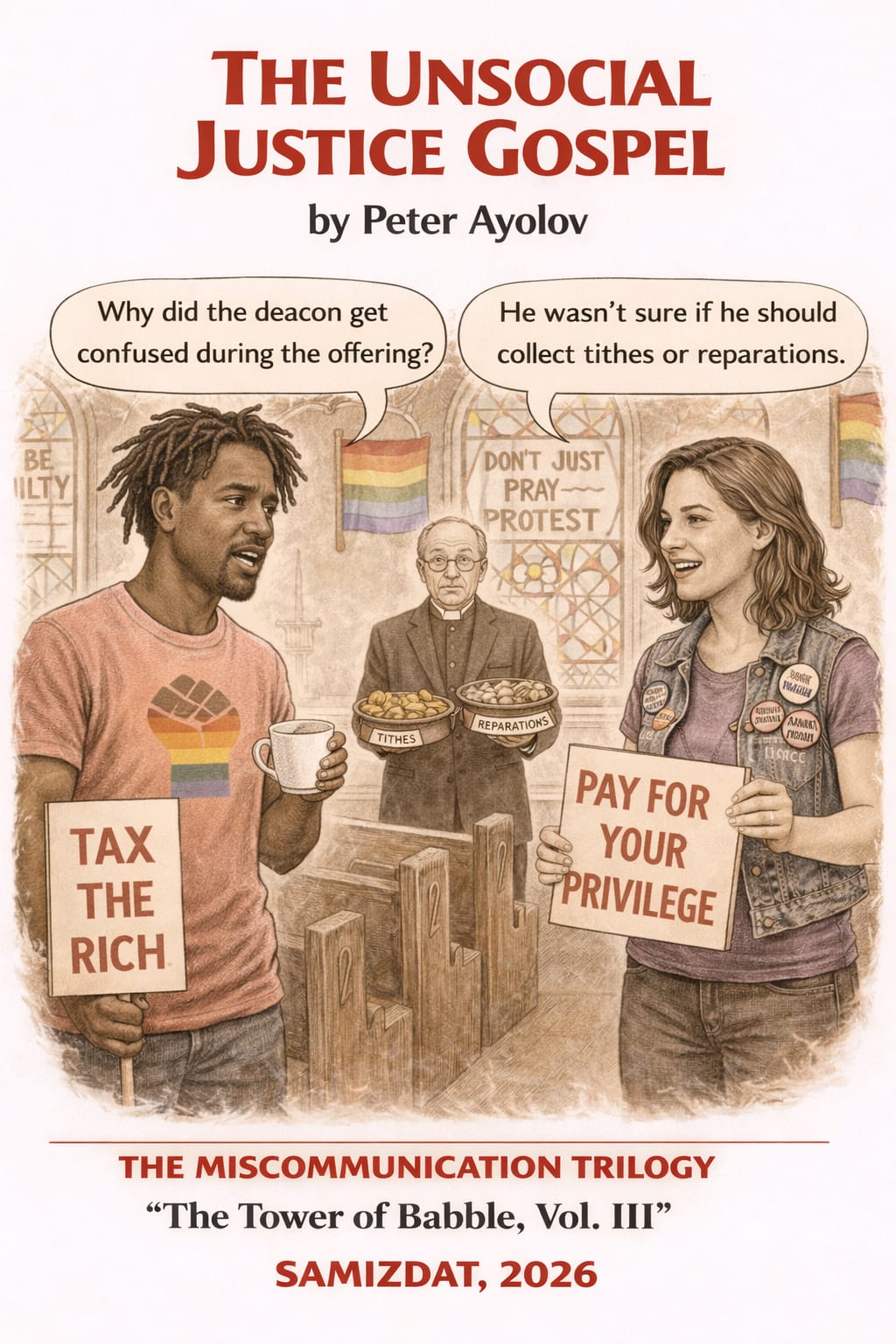
The Gospel of Babel: How Language Became the Battlefield of Modern Society
The Rise of a New Linguistic Faith
The Unsocial Justice Gospel, the seventh installment of The Tower of Babble and the third volume of The Miscommunication Trilogy, is an ambitious exploration of one of the most significant yet least understood transformations of contemporary society: the conversion of language from a medium of communication into a mechanism of political identity, moral authority, and social control. The book begins from a simple but unsettling observation. Modern societies speak constantly about justice, inclusion, diversity, recognition, representation, equality, rights, and empowerment, yet the proliferation of these moral vocabularies has coincided with growing social fragmentation, ideological polarization, and communicative breakdown. Rather than producing greater understanding between people, the expansion of politically charged language often appears to intensify conflict. The author approaches this contradiction not as a partisan critic of social justice movements nor as a defender of traditional hierarchies, but as an investigator of language itself. Drawing from sociolinguistics, anthropology, political theory, discourse analysis, cultural studies, and historical examples from around the world, the book examines how language becomes invested with extraordinary symbolic power. Throughout its chapters, language emerges not merely as a neutral instrument for transmitting information but as a political technology capable of shaping social reality, distributing status, defining legitimacy, and organizing collective identities. The book’s greatest strength lies in its ability to connect seemingly unrelated phenomena into a coherent narrative. Debates over pronouns, bilingual education, linguistic rights, language planning, political correctness, nationalism, colonialism, social activism, and discourse reform are presented not as isolated controversies but as manifestations of a deeper transformation in the relationship between language and power. The reader encounters examples ranging from transgender language activism and social justice linguistics to Soviet language policy, Breton nationalism, anti-apartheid discourse, linguistic anthropology, language revival movements, and contemporary debates over multilingualism. What unites these diverse subjects is the recognition that language functions simultaneously as a resource, a weapon, an institution, and a symbol. The book argues that modern societies increasingly treat linguistic practices as moral indicators, transforming speech into a measure of political virtue and social legitimacy. This shift creates a new environment in which linguistic conformity often becomes more important than substantive dialogue. The author repeatedly returns to the central metaphor of Babel, suggesting that the multiplication of linguistic identities and ideological vocabularies risks undermining the shared communicative foundations necessary for democratic life. Yet the analysis remains nuanced, acknowledging the legitimate grievances and historical injustices that motivate many contemporary language reforms. Rather than dismissing these movements, the book seeks to understand how their linguistic strategies simultaneously challenge existing power structures while creating new forms of symbolic authority. In doing so, The Unsocial Justice Gospel establishes itself as a provocative and intellectually ambitious contribution to contemporary debates about language, politics, and identity.
Language, Identity, and the Architecture of Power
The central achievement of the book is its demonstration that struggles over language are never merely struggles over words. Every linguistic conflict examined throughout the text ultimately reveals deeper contests concerning identity, belonging, status, memory, and power. The author carefully traces how language policies become instruments for shaping national identity, cultural recognition, and political legitimacy. Discussions of assimilationist and pluralist approaches to language policy illustrate how debates about multilingualism often conceal competing visions of the nation itself. Is society a unified political community bound together by a common language, or is it a multicultural collection of linguistic groups deserving equal recognition? The book demonstrates that such questions cannot be resolved through linguistic analysis alone because they involve conflicting conceptions of citizenship, equality, and social cohesion. Particularly compelling is the examination of linguistic pluralism as both a historical reality and a political aspiration. The author explores how minority communities have used schools, religious institutions, media organizations, and cultural associations to preserve their languages against pressures toward assimilation. These examples reveal that language preservation is not simply a matter of communication but a struggle over historical memory and collective identity. At the same time, the book exposes the tensions inherent within pluralist projects. While advocates celebrate linguistic diversity as a source of empowerment and recognition, critics warn that excessive fragmentation may weaken the common linguistic framework necessary for social solidarity. This tension remains unresolved throughout the text, but the author’s refusal to provide simplistic answers strengthens the analysis. Equally impressive is the exploration of language as a mechanism of domination and resistance. The chapters examining colonialism, Soviet language policies, apartheid discourse, and minority language movements reveal how political authorities attempt to regulate language in order to regulate reality itself. Yet language repeatedly escapes complete control. Marginalized communities appropriate, transform, and redefine linguistic forms in ways that challenge official narratives. Whether through the reoccupation of political vocabulary, the revitalization of endangered languages, or the development of alternative discourses, language becomes a site of struggle where power is both exercised and contested. Particularly insightful is the discussion of social justice linguistics and the emergence of language reform movements aimed at addressing inequality. The analysis recognizes that language can perpetuate exclusion, reinforce stereotypes, and legitimize discrimination. At the same time, it questions whether linguistic reform alone can resolve structural injustices. The book repeatedly warns against the temptation to mistake symbolic victories for substantive social change. This argument is especially relevant in contemporary contexts where public debates often focus more intensely on terminology than on material conditions. Throughout these discussions, the author demonstrates a sophisticated understanding of language as both a reflection of social structures and a force capable of reshaping them. Language emerges not as an autonomous system but as a dynamic arena where competing visions of society confront one another. The result is a richly textured analysis that avoids both linguistic determinism and simplistic political reductionism.
The Planned Obsolescence of Meaning
The most powerful contribution of The Unsocial Justice Gospel lies in its connection to the broader theme of The Miscommunication Trilogy: the planned obsolescence of language. According to the author, modern communication systems generate a form of linguistic entropy in which words become increasingly unstable, politicized, and disconnected from shared meanings. Every institution contributes to this process. Governments manipulate language for administrative purposes. Political movements redefine concepts to advance ideological goals. Corporations transform moral vocabularies into branding strategies. Media organizations amplify semantic conflicts for attention and profit. Universities generate specialized terminologies that often remain inaccessible to the wider public. Activists introduce new linguistic frameworks to challenge existing power relations. Each of these developments may serve legitimate functions, yet collectively they contribute to the fragmentation of the communicative commons. The book argues that the result is a society in which language increasingly functions as a marker of tribal identity rather than a medium of mutual understanding. Words become signals of group membership, ideological allegiance, and moral status. Public discourse transforms into a contest over definitions rather than a search for truth. Citizens speaking the same language often inhabit radically different semantic worlds. This condition mirrors the biblical image of Babel, not because people literally speak different languages but because they attach incompatible meanings to the same words. The author’s critique is especially effective because it targets no single ideology. Both progressive and conservative movements are shown participating in the politicization of language. Both seek to establish preferred vocabularies, suppress undesirable expressions, and define the boundaries of legitimate discourse. The problem, therefore, is not located within any particular political camp but within a broader cultural tendency to treat language as an instrument of symbolic domination. Yet the book is not pessimistic. Beneath its critique lies a defense of communication itself. The author repeatedly emphasizes that language remains humanity’s greatest tool for cooperation, understanding, and collective problem-solving. The danger is not that language possesses power but that societies increasingly confuse linguistic control with genuine social progress. Real justice, the book suggests, requires more than new terminologies. It requires institutions capable of fostering dialogue, empathy, and shared understanding across differences. The Unsocial Justice Gospel concludes by challenging readers to reconsider their relationship with language. Rather than viewing words as sacred objects demanding ideological purity, the book encourages a return to language as a bridge between individuals and communities. This final message elevates the work beyond a critique of contemporary discourse and transforms it into a broader meditation on the conditions necessary for democratic civilization. As a contribution to the study of language and politics, the book succeeds remarkably well. It combines historical depth, theoretical sophistication, and cultural relevance while remaining accessible to general readers. More importantly, it invites reflection on a question that may define the future of public life: can societies preserve meaningful communication in an age increasingly organized around competing vocabularies of identity, power, and justice? The Unsocial Justice Gospel does not offer easy answers, but it demonstrates why the question matters and why the future of language may ultimately determine the future of social cohesion itself.
About the Creator
Peter Ayolov
Peter Ayolov’s key contribution to media theory is the development of the "Propaganda 2.0" or the "manufacture of dissent" model, which he details in his 2024 book, The Economic Policy of Online Media: Manufacture of Dissent.
Enjoyed the story? Support the Creator.
Subscribe for free to receive all their stories in your feed.
Comments
There are no comments for this story
Be the first to respond and start the conversation.