
The Unplanned Obsolescence of Writing, THE MISCOMMUNICATION TRILOGY, “The Tower of Babble, Vol. III”, Part 19
Book Review

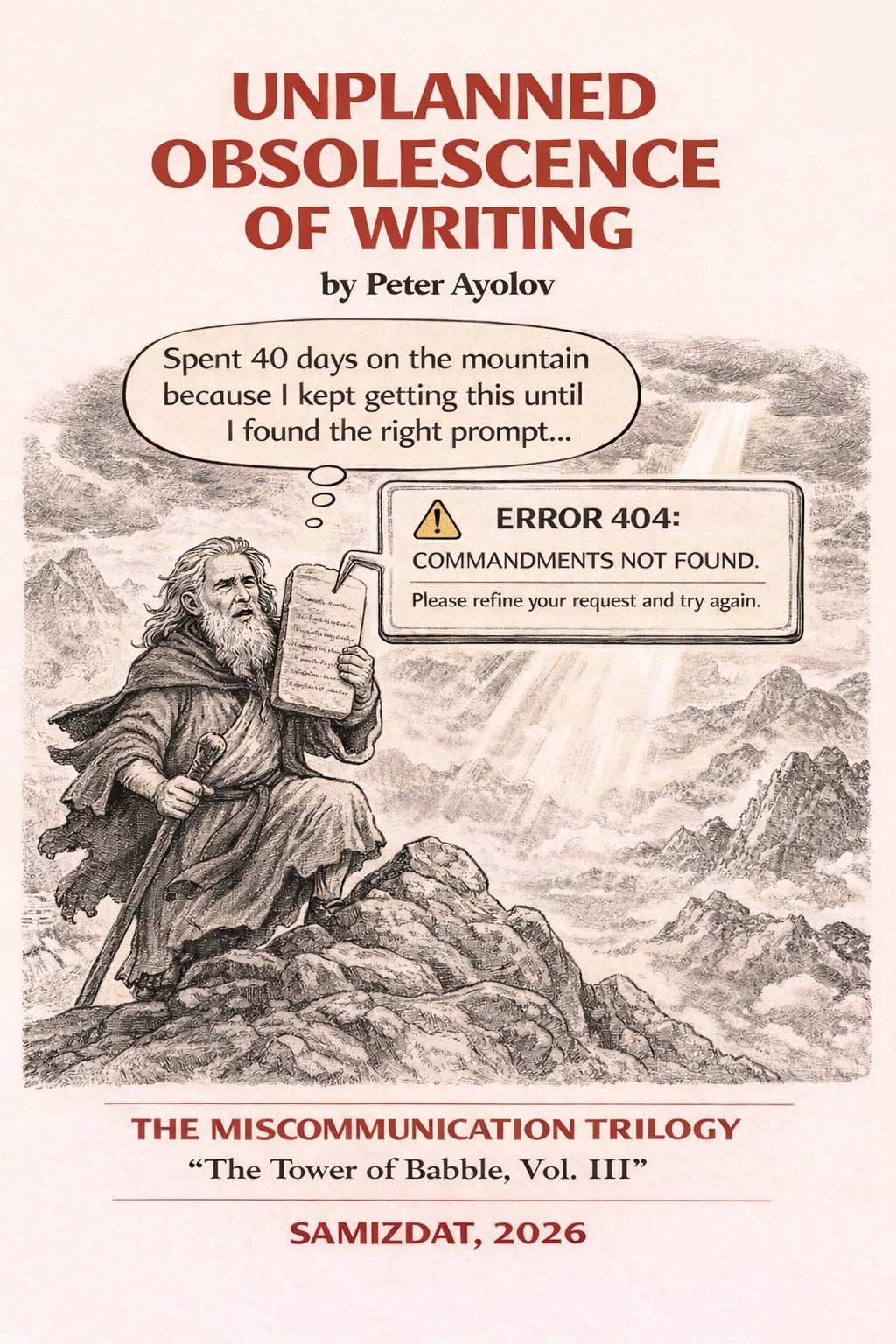
The Archive Against Time: Memory, Forgetting, and the Fate of Civilization
The Problem of Remembering Too Much
The Unplanned Obsolescence of Writing is one of the most ambitious and intellectually provocative volumes in The Tower of Babble, a work that transforms what initially appears to be a narrow topic into a sweeping investigation of civilization itself. Although the title suggests a study of writing and its possible decline in the digital age, the book quickly reveals a much broader horizon. Its true subject is obsolescence in all its manifestations: technological, economic, biological, cultural, institutional, political, and communicative. Through a remarkably wide-ranging exploration of examples drawn from consumer electronics, architecture, education, science, psychology, social institutions, global governance, and cultural memory, the volume demonstrates that obsolescence is not merely a feature of industrial capitalism but one of the fundamental principles through which complex systems regulate themselves. The book’s central achievement lies in showing that every productive system eventually confronts a crisis of accumulation. Factories produce more goods than can be retained. Scientific communities generate more theories than can be absorbed. Political systems accumulate more ideologies than can coexist comfortably. Communication produces more messages than any society can meaningfully process. Obsolescence emerges as the hidden mechanism that makes renewal possible. What distinguishes this volume from many discussions of planned obsolescence is its refusal to treat the concept as merely an economic strategy. Instead, obsolescence becomes a universal principle governing the relationship between abundance and limitation. The analysis moves fluidly between examples of disappearing technologies and fading social institutions, demonstrating that replacement is not simply a consequence of market competition but a recurring feature of human existence. The book repeatedly returns to the paradox that creation itself depends upon disappearance. New things emerge because older things retreat. Progress requires removal. Innovation requires forgetting. In this respect, the volume develops a far more philosophical understanding of obsolescence than is usually encountered in discussions of consumer culture. Rather than condemning or celebrating obsolescence, it investigates its necessity, revealing how every system capable of generating abundance must also develop techniques for managing excess. The result is a work that invites readers to reconsider some of their most basic assumptions about progress, memory, and cultural continuity.
Writing, Forgetting, and the Externalization of Memory
The most original contribution of the book emerges from its treatment of writing itself. Traditionally, writing has been understood as humanity’s greatest defence against forgetting. It preserves memory, records history, and allows ideas to survive the death of their creators. Yet this volume advances a far more paradoxical thesis. It argues that writing is not only a technology of remembrance but also humanity’s most sophisticated technology of forgetting. At first this claim appears counterintuitive. How can a medium devoted to preservation function simultaneously as an instrument of forgetting? The answer lies in the concept of externalization. Once memories are transformed into written signs, they no longer need to remain entirely within the mind. They are transferred into objects, archives, books, libraries, databases, and digital repositories. Writing remembers so that human beings may forget. The implications of this argument are explored with impressive depth throughout the book. Oral cultures depended upon continuous acts of recollection because knowledge survived only through repetition. Writing fundamentally altered this condition by creating external memory systems. What once required permanent mental preservation could now be stored outside the self. Diaries, archives, legal codes, histories, and libraries all become examples of this process. Writing allows individuals and societies to release memory without losing it. Emotional experiences can be recorded and thereby partially relinquished. Historical events can be documented so that communities are no longer dependent upon direct recollection. Knowledge migrates from consciousness into material artefacts. The book’s treatment of this theme is particularly effective because it links personal psychology with cultural history. The same principle that explains why individuals write journals also explains why civilizations construct archives. Both represent efforts to externalize memory. Yet the volume goes further by demonstrating that every expansion of memory simultaneously creates a need for forgetting. The history of censorship, book burning, ideological suppression, and cultural erasure is interpreted not simply as a history of repression but also as a history of attempts to manage excessive remembrance. Religious authorities, political regimes, and revolutionary movements repeatedly sought to regulate memory because they confronted a problem that remains with us today: no society can remember everything. The book’s exploration of these themes gives it a remarkable conceptual coherence. Diverse historical examples become part of a larger argument concerning the relationship between memory and cultural survival. Writing appears not as the opposite of forgetting but as one of its most powerful enablers. This insight alone makes the volume a significant contribution to contemporary discussions of communication, culture, and technology.
Artificial Intelligence and the End of Historical Forgetting
The final sections of the book elevate its argument from a historical and philosophical investigation to a reflection on humanity’s possible future. Having established that civilizations have always depended upon a balance between remembering and forgetting, the volume turns its attention to digital technology and artificial intelligence. Here the discussion becomes especially compelling because it identifies a transformation unlike any previously experienced in human history. For thousands of years forgetting remained unavoidable. Archives were fragile, manuscripts decayed, libraries burned, and information disappeared through neglect, disaster, or deliberate destruction. Material limitations guaranteed that memory could never become complete. Digital technology has fundamentally altered these conditions. Information can now be copied indefinitely, preserved at negligible cost, and retrieved almost instantaneously. Artificial intelligence amplifies this transformation by converting archives from passive repositories into active systems capable of analysing, synthesising, and generating knowledge. Humanity is approaching a condition in which the preservation of nearly everything becomes technically possible. The book presents this development not as a simple triumph but as a profound civilizational dilemma. If forgetting has historically functioned as a survival mechanism, what happens when forgetting becomes increasingly difficult? The archive threatens to become permanent. Every statement remains recoverable. Every error survives. Every ideological position remains accessible somewhere within the informational landscape. The volume argues persuasively that total remembrance may prove as dangerous as total forgetting. Personal identity depends upon selective memory. Political reconciliation often requires the gradual fading of conflict. Cultural innovation frequently depends upon temporary amnesia regarding inherited assumptions. If nothing can become obsolete, then nothing can truly disappear. The future may therefore require new forms of obsolescence capable of managing infinite memory rather than finite archives. The book does not offer simple solutions to these problems, nor does it descend into technological pessimism. Instead, it concludes with a powerful reflection on the fragile balance that has always sustained civilization. Between memory and oblivion, preservation and disappearance, archive and forgetting, human culture has historically found its place. Unplanned Obsolescence of Writing succeeds because it transforms a discussion of writing into a meditation on the future of human memory itself. It is a book that challenges readers to reconsider what it means to remember, what it means to forget, and whether a civilization capable of preserving everything can continue to create anything genuinely new. As a contribution to The Tower of Babble, it stands as one of the trilogy’s most philosophically ambitious and intellectually rewarding volumes, expanding the theory of the planned obsolescence of language into a far-reaching reflection on the destiny of communication, memory, and human culture.
About the Creator
Peter Ayolov
Peter Ayolov’s key contribution to media theory is the development of the "Propaganda 2.0" or the "manufacture of dissent" model, which he details in his 2024 book, The Economic Policy of Online Media: Manufacture of Dissent.
Enjoyed the story? Support the Creator.
Subscribe for free to receive all their stories in your feed.
Comments
There are no comments for this story
Be the first to respond and start the conversation.