
The Unfreedom Of Speech, THE MISCOMMUNICATION TRILOGY, “The Tower Of Babble, Vol. III”, Part 8
Book Review

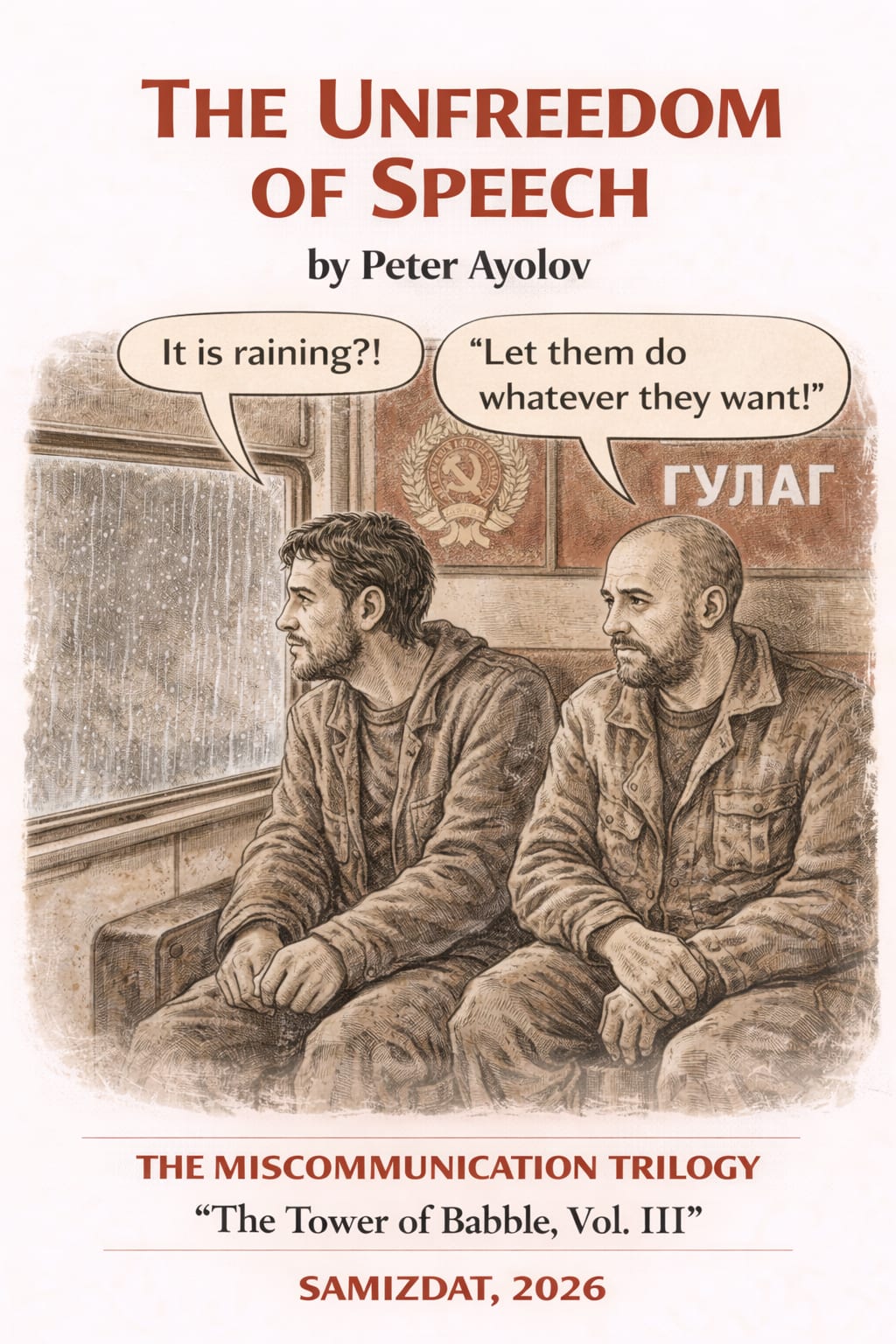
The Tyranny of Permission: A Review of The Unfreedom of Speech
Language Under Siege: The Central Argument of the Book
The Unfreedom of Speech stands as one of the most ambitious volumes within The Tower of Babble and a crucial contribution to the broader intellectual architecture of The Miscommunication Trilogy. At its core lies a provocative and unsettling thesis: modern societies that proclaim an unprecedented commitment to freedom of expression are simultaneously constructing increasingly sophisticated mechanisms for controlling communication. The book explores this contradiction not through a narrow legal analysis but through a sweeping examination of language, culture, politics, media, education, technology, and psychology. Its central concern is not simply whether people possess the formal right to speak but whether they retain the practical ability to communicate freely in an environment shaped by institutional regulation, ideological pressure, and cultural conformity.
One of the book’s greatest strengths is its refusal to reduce the problem of speech to conventional debates about censorship. Instead, it argues that the contemporary crisis of communication extends far beyond governmental restrictions. The author traces the emergence of subtler forms of linguistic control that operate through social expectations, reputational risks, professional incentives, educational norms, media narratives, and technological systems. Throughout the volume, language is presented not as a neutral instrument but as the primary medium through which power organizes reality. Whoever controls language acquires influence over perception, identity, and social behavior. Consequently, struggles over speech become struggles over meaning itself.
The work is particularly effective in demonstrating how communication can be sabotaged without being openly prohibited. Through discussions of communicative sabotage, rhetorical diversion, self-censorship, linguistic standardization, ideological language reform, and media management, the book illustrates the countless ways in which discourse may be redirected while maintaining the appearance of openness. This focus on indirect mechanisms of control distinguishes the volume from traditional defenses of free speech, which often concentrate exclusively on legal restrictions. Here, the emphasis falls upon the everyday conditions under which communication occurs and the invisible pressures that shape what people are willing to say.
Equally significant is the book’s integration of diverse intellectual traditions. Philosophical reflections on liberty intersect with sociolinguistic studies of linguistic diversity, examinations of political discourse, analyses of satire and diversion, and investigations into psychological self-restraint. The result is a multidisciplinary study that presents communication as one of the defining battlegrounds of modern civilization. Rather than treating speech as a specialized legal issue, the book situates it within a broader cultural struggle concerning truth, authority, and social order. This approach provides both depth and scope, allowing readers to understand freedom of expression not as an isolated right but as a condition upon which all other forms of intellectual and political freedom ultimately depend.
The Planned Obsolescence of Language: Communication in the Age of Diversion
The most original contribution of The Unfreedom of Speech lies in its connection to the trilogy’s overarching concept of the Planned Obsolescence of Language. The book argues that contemporary communication is increasingly characterized by processes that diminish language’s capacity to facilitate genuine understanding. Rather than serving as a tool for cooperation, inquiry, and truth-seeking, language is frequently transformed into an instrument of management, distraction, polarization, and control. This diagnosis provides the conceptual framework through which the volume’s diverse subjects are unified.
A recurring theme throughout the book is diversion. Drawing on historical studies of eighteenth-century satire and commercial leisure, the author develops a compelling account of how modern communication environments reward interruption, novelty, spectacle, and distraction. The historical discussion of digressive rhetoric, satire, and commercial entertainment serves not merely as cultural history but as a lens through which contemporary media culture can be understood. Just as earlier writers adapted their works to the tastes of increasingly distraction-prone audiences, modern communication systems operate within an economy of attention where visibility often matters more than substance.
The analysis of diversion extends into contemporary political discourse, where communicative sabotage emerges as a central mechanism of rhetorical control. Politicians evade questions, shift topics, employ strategic ambiguity, and manipulate language to maintain influence while avoiding accountability. The book demonstrates that modern communication frequently functions less as an exchange of ideas than as a contest over attention and perception. Language becomes a means of steering discussion rather than clarifying issues. In this environment, speech remains abundant while understanding becomes increasingly elusive.
The volume’s exploration of self-censorship further strengthens its argument. Rather than depicting individuals as passive victims of external control, the author examines how social pressures encourage people to regulate themselves. Fear of criticism, exclusion, professional consequences, or reputational damage often leads individuals to silence their own opinions before anyone else intervenes. This internalization of restraint represents one of the book’s most important insights. It suggests that the most effective forms of control are frequently those that no longer require overt enforcement. Individuals become participants in their own regulation, transforming freedom into a system of self-imposed limitations.
Throughout these discussions, the concept of planned linguistic obsolescence functions as a unifying principle. The book repeatedly demonstrates how communication systems may continue to expand technologically while simultaneously becoming less effective as vehicles for meaningful dialogue. The problem is not a lack of speech but a decline in communicative integrity. Words proliferate while clarity diminishes. Expression becomes easier while understanding becomes more difficult. By identifying this paradox, the author offers a powerful critique of contemporary communication culture and raises important questions concerning the future of public discourse.
A Philosophy of Resistance: The Significance of The Unfreedom of Speech
Beyond its analysis of language and power, The Unfreedom of Speech ultimately functions as a philosophical meditation on freedom itself. The book repeatedly challenges readers to reconsider assumptions about liberty, individuality, and social responsibility. It argues that freedom of speech cannot be reduced to constitutional protections or legal guarantees. Genuine freedom requires cultural conditions that encourage intellectual independence, tolerate disagreement, and support the pursuit of truth. Without these conditions, formal rights remain vulnerable to erosion through informal mechanisms of conformity and control.
One of the book’s most compelling features is its emphasis on courage. Throughout the text, communication is portrayed not merely as a technical process but as a moral activity requiring willingness to confront uncertainty, criticism, and opposition. The defense of speech is presented not as a matter of abstract principle alone but as a practical challenge facing every individual. Freedom survives only when exercised. Silence may offer temporary comfort, but it gradually weakens the habits of inquiry and independence upon which democratic societies depend.
The volume also succeeds as a critique of modern institutional authority. Governments, corporations, media organizations, educational systems, and cultural movements are all examined as participants in the regulation of communication. Yet the book avoids simplistic conspiratorial explanations. Rather than attributing control to a single source, it depicts a complex network of overlapping pressures that collectively shape public discourse. This nuanced perspective allows the reader to appreciate the subtlety of contemporary communicative power while avoiding reductive explanations.
As a work of cultural criticism, The Unfreedom of Speech is both ambitious and timely. It addresses some of the most pressing issues of contemporary life, including digital communication, ideological polarization, media influence, linguistic reform, and the growing tension between freedom and regulation. More importantly, it situates these developments within a larger historical narrative concerning the evolution of language and society. By linking present concerns to broader questions about communication, meaning, and authority, the book transcends immediate political controversies and contributes to a deeper understanding of the human condition.
Ultimately, The Unfreedom of Speech succeeds because it forces readers to confront an uncomfortable possibility: that the greatest threats to freedom may emerge not from obvious acts of repression but from subtle transformations in the ways people communicate, think, and relate to one another. The book’s enduring value lies in its insistence that language remains civilization’s most important tool and that the preservation of meaningful communication is inseparable from the preservation of freedom itself. As both a critique of contemporary culture and a defense of intellectual independence, it stands as one of the most thought-provoking contributions to the ongoing discussion of language, power, and human liberty.
About the Creator
Peter Ayolov
Peter Ayolov’s key contribution to media theory is the development of the "Propaganda 2.0" or the "manufacture of dissent" model, which he details in his 2024 book, The Economic Policy of Online Media: Manufacture of Dissent.
Enjoyed the story? Support the Creator.
Subscribe for free to receive all their stories in your feed.
Comments
There are no comments for this story
Be the first to respond and start the conversation.