
The Theory of the New Leisure Class
Homo Essentialis

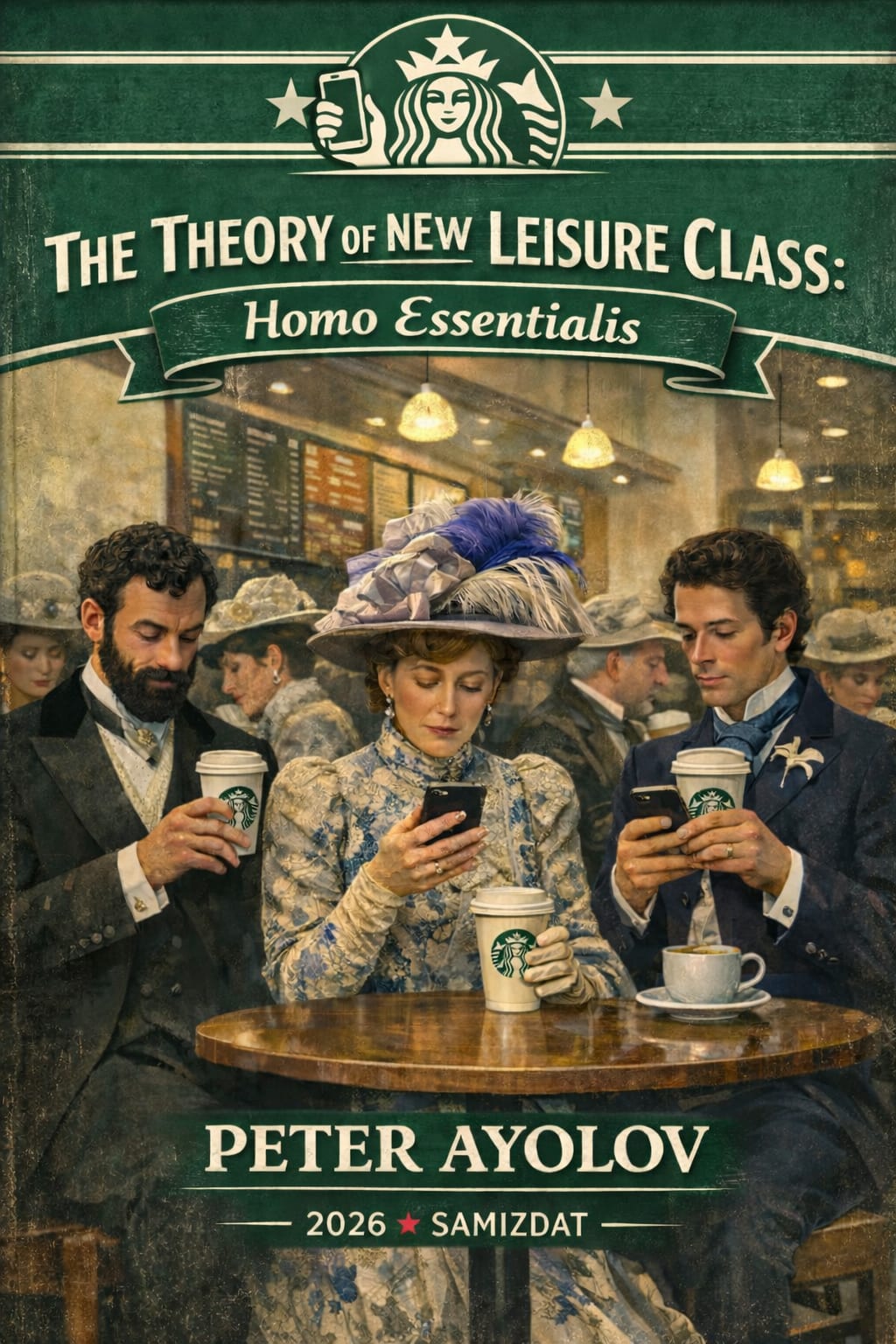
The Theory of the New Leisure Class: Homo Essentialis
Peter Ayolov
2026
SAMIZDAT
The Last Leisure Class: Veblen in the Age of the Cloud
When Thorstein Veblen published The Theory of the Leisure Class in 1899, he created one of the most penetrating analyses of status, prestige, and social distinction ever written. His world was dominated by industrial capitalism, inherited fortunes, conspicuous consumption, and the visible display of exemption from productive labour. Yet if Veblen were alive today, he would immediately recognise that the leisure class has not disappeared. It has merely changed its costume. The silver spoons have become smartphones, the country estate has become the global digital network, and visible idleness has been replaced by performative busyness. The fundamental mechanism remains unchanged. Human beings continue to compete for status, distinction, recognition, and symbolic superiority. What has changed is the language through which these ambitions are expressed. This article begins with a simple question: what would The Theory of the Leisure Class look like if it were written for the twenty-first century? The answer requires moving beyond the industrial society that shaped Veblen's original observations and into a world dominated by information, finance, digital platforms, social media, remote work, and algorithmic management. The contemporary elite rarely owns factories. Instead, it manages flows of information, visibility, attention, data, and symbols. Prestige no longer derives primarily from direct ownership of productive assets but from the ability to occupy strategic positions within networks of communication and influence. The modern leisure class lives behind screens rather than behind palace walls. Its members often describe themselves as indispensable architects of economic progress while remaining increasingly distant from the physical activities that sustain everyday life.
The global pandemic exposed this transformation with exceptional clarity. For the first time in modern history, societies openly divided occupations into essential and non-essential categories. This distinction revealed a paradox that lies at the centre of contemporary civilisation. Those responsible for healthcare, logistics, transport, sanitation, maintenance, food production, and delivery proved indispensable to collective survival. Yet these occupations frequently remained among the least prestigious and least rewarded. Simultaneously, vast sectors devoted to symbolic management, communication, compliance, branding, consulting, and administration continued to enjoy social influence despite their uncertain relationship to material necessity. The result was a profound crisis of legitimacy that exposed the growing gap between social value and social status. The chapters that follow explore the emergence of this new social order. They examine the digital aristocracy, the essential divide, the screen aristocracy, the predators of attention, the spreadsheet aristocracy, and the symbolic economy that increasingly governs contemporary life. The central argument is straightforward. The leisure class has survived every technological revolution because it is not defined by wealth alone. It is defined by its capacity to transform privilege into prestige and prestige into social authority. The story of Homo Essentialis is therefore not merely the story of work. It is the story of how modern societies have come to confuse visibility with value, representation with reality, and status with necessity.
Veblen, T. (1899) The Theory of the Leisure Class. New York: Macmillan.
The Digital Aristocracy: From Silver Spoons to Social Signals
In the contemporary discussion surrounding Thorstein Veblen’s The Theory of the Leisure Class and the scholarly works that revisit it, one discovers not a disappearance of the leisure class but its remarkable adaptation to new technological and cultural conditions. Although recent years have not produced a major popular reinterpretation capable of introducing Veblen’s ideas to a broad readership in the same way that his original work once did, academic inquiry continues to demonstrate the extraordinary vitality of his central insights. What is striking is not the emergence of entirely new concepts but the repeated confirmation that the mechanisms he identified more than a century ago continue to organise social behaviour under altered historical circumstances. The forms have changed, the technologies have evolved, and the symbols have multiplied, yet the fundamental human desire to transform wealth into visible distinction remains largely intact. Contemporary researchers increasingly examine the ways in which consumption functions not merely as an economic activity but as a communicative practice through which individuals announce their place within symbolic hierarchies. The visible acquisition of goods remains inseparable from questions of prestige, recognition, and collective identity. Recent investigations into conspicuous consumption reveal that its moral evaluation is remarkably flexible. Behaviour once condemned as vanity may be interpreted positively when associated with loyalty to a group or commitment to a shared social identity. Such findings suggest that status display is rarely an isolated individual act. Instead, it becomes embedded within larger frameworks of meaning that allow communities to justify, celebrate, or condemn particular forms of expenditure. Consumption therefore appears not simply as an expression of personal preference but as a language through which societies negotiate values, belonging, and hierarchy. The continuing relevance of these studies demonstrates that Veblen’s observations were never limited to a particular historical elite but touched upon enduring structures of social life that remain active even within radically transformed environments.
The persistence of status anxiety becomes particularly visible in emerging economies, where rapid economic development often produces new forms of aspiration and insecurity. Contemporary analyses reveal that material acquisition frequently functions as a response to uncertainty regarding one’s social position. Individuals seek not only comfort or utility but reassurance that they occupy a meaningful place within a changing social order. The desire for recognition becomes inseparable from the desire for consumption itself. Here the logic of compensatory acquisition acquires renewed importance. Goods become symbolic instruments through which people attempt to resolve tensions between their present circumstances and their desired identities. What was once expressed through grand houses, elaborate ceremonies, and visible leisure increasingly manifests itself through luxury brands, technological devices, and carefully curated lifestyles. Yet the underlying mechanism remains familiar. Material objects become signs through which social worth is communicated both to others and to oneself. The emergence of digital culture has expanded these processes rather than diminishing them. Social media platforms create environments in which visibility itself becomes a valuable resource. Influencers occupy positions analogous to earlier social elites, serving as models whose behaviour encourages imitation among followers. The relationship between observer and observed becomes a powerful engine of aspiration. Individuals are exposed continuously to images of success, abundance, and distinction, generating new desires and new comparisons. Status competition no longer requires physical proximity. It unfolds across global networks where symbols circulate instantaneously and where recognition can be sought before audiences of unprecedented size. In this environment, conspicuous consumption becomes increasingly detached from local communities and integrated into worldwide systems of symbolic competition. The digital sphere transforms every screen into a potential stage and every user into a potential performer within an endless theatre of social comparison.
Perhaps the most significant development identified by recent scholarship is the migration of prestige signalling into virtual environments. Social media, gaming platforms, and emerging digital worlds provide new arenas in which symbolic distinctions are produced and displayed. The significance of these transformations extends beyond technology itself. They reveal that status competition is not dependent upon any particular material object but upon the human tendency to convert differences into markers of superiority and recognition. Digital possessions, online visibility, follower counts, exclusive virtual experiences, and carefully constructed personal brands increasingly fulfil functions once performed by tangible luxuries. The leisure class has not vanished; it has become more diffuse, more mobile, and more deeply integrated into everyday communication. This continuing relevance explains why publishers repeatedly return to Veblen’s original text, accompanying new editions with introductions that emphasise its enduring explanatory power. Contemporary commentators observe that as long as societies remain structured by unequal access to resources and recognition, the dynamics described by Veblen will continue to illuminate social behaviour. His work survives because it identifies a pattern that transcends specific historical moments. The symbols may change from jewellery to algorithms, from mansions to digital audiences, from ceremonial display to online performance, yet the quest for distinction remains remarkably persistent. Modern scholarship therefore confirms a paradox. Technological progress has transformed the instruments through which prestige is communicated, but it has not eliminated the desire for prestige itself. The new leisure class inhabits networks rather than drawing rooms, cultivates visibility rather than idleness, and measures influence through metrics unimaginable in earlier centuries. Nevertheless, beneath these transformations one finds the same enduring effort to convert possession into status and status into social power, demonstrating once again the remarkable foresight of an analysis that continues to speak with surprising clarity to the realities of the twenty-first century.
Goenka, S. and Thomas, M. (2020) ‘The Malleable Morality of Conspicuous Consumption’, Journal of Consumer Research, 47(1), pp. 32–55.
The Essential Divide: From Leisure to Necessity
Drawing upon Thorstein Veblen’s The Theory of the Leisure Class and David Graeber’s Bullshit Jobs, one may observe that the early twenty-first century has produced a transformation in social stratification that neither thinker witnessed directly yet both anticipated in principle. The global pandemic did not create new inequalities as much as it illuminated distinctions that had long remained concealed beneath the rhetoric of modern prosperity. During this period societies throughout the world were compelled to classify occupations according to a previously neglected criterion: necessity. Governments, institutions, and corporations suddenly divided populations into categories described as essential and non-essential. What appeared at first to be a temporary administrative measure soon revealed a profound contradiction at the heart of contemporary economic life. Those whose labour sustained hospitals, food supply chains, transportation networks, sanitation systems, and countless everyday functions were frequently among the least rewarded members of society. Simultaneously, many individuals occupying prestigious and highly compensated positions discovered that their activities could be suspended, relocated, or transformed with relatively little effect upon the immediate survival of the social order. This inversion exposed an uncomfortable truth. Economic reward and social necessity had become increasingly detached from one another. The highest prestige was often concentrated in occupations furthest removed from the material foundations of collective existence. The traditional leisure class of the nineteenth century demonstrated status through visible exemption from productive labour. The contemporary equivalent expresses distinction through distance from physical necessity itself. The ability to remain protected, connected, and economically secure while others maintain the material infrastructure of society became a powerful marker of privilege. In this new arrangement the division between essential and non-essential labour emerged not merely as an economic classification but as a symbolic boundary separating different experiences of reality. One group confronted the physical demands of maintaining social continuity, while another increasingly inhabited administrative, informational, and digital environments detached from direct material production.
The emergence of remote work accelerated this transformation and gave rise to new forms of prestige rooted in technological mobility. Leisure no longer signifies inactivity in the classical sense. Instead, it increasingly appears as freedom from geographical constraint, physical exposure, and material dependence. Digital professionals, consultants, managers, content producers, and various knowledge workers often perform their duties from locations chosen according to lifestyle preferences rather than economic necessity. The laptop, the smartphone, and the remote connection have become symbols of a new form of distinction. What earlier elites displayed through estates, servants, and ceremonial consumption is now expressed through mobility, flexibility, and location independence. The image of productive activity conducted from tropical resorts, fashionable cafés, or carefully designed home offices functions as a contemporary equivalent of aristocratic display. The significance lies not in the labour itself but in the conditions under which that labour may be performed. Status increasingly derives from demonstrating freedom from the constraints that shape the lives of those engaged in indispensable physical work. This development has generated a culture in which connectivity becomes a form of conspicuous consumption. Curated digital identities, carefully staged professional environments, and the public performance of flexible work arrangements operate as signals of social position. The visible markers of privilege are no longer limited to luxury goods but extend to modes of living that communicate distance from material necessity. The distinction between labour and leisure consequently becomes blurred. Work itself becomes a form of lifestyle expression. The modern professional does not merely earn income but performs a social identity defined by mobility, autonomy, and symbolic productivity. In this environment, prestige emerges less from what one produces than from the apparent freedom with which one produces it. The result is the formation of a social stratum whose primary asset is not ownership of land or industrial capital but possession of skills and credentials that permit existence within increasingly virtual systems of exchange and recognition.
The conjunction of Veblen’s analysis of status competition and Graeber’s critique of unproductive employment reveals a deeper transformation within contemporary society. A growing proportion of highly rewarded occupations appear devoted not to producing tangible goods or essential services but to managing symbols, procedures, compliance structures, presentations, metrics, and administrative processes. These activities frequently command considerable prestige despite their uncertain contribution to collective well-being. The pursuit of such positions becomes an object of aspiration precisely because they offer social recognition, economic security, and insulation from physical hardship. As a result, a paradoxical social order emerges. Those whose labour remains indispensable often occupy the lowest positions within economic hierarchies, while those engaged in symbolic management enjoy disproportionate rewards. This development creates what may be called the essential divide. On one side stand individuals whose work sustains the biological and material foundations of society. On the other stand those whose professional existence is increasingly mediated through screens, documents, networks, and abstractions. The distinction is not merely occupational but existential. One group experiences reality primarily through bodily engagement with the world, while the other inhabits environments dominated by information and representation. Even the rituals of status have adapted accordingly. The etiquette of elite society no longer revolves around drawing rooms, formal receptions, or ceremonial display. It manifests through digital communication norms, virtual meeting culture, personal branding, and the aesthetic organisation of remote workspaces. The symbols have changed, yet the underlying logic remains familiar. Social groups continue to create visible markers through which distinction can be recognised and reproduced. The contemporary age therefore does not represent the disappearance of the leisure class but its metamorphosis into a more abstract and technologically mediated form. Against this backdrop, Homo Essentialis emerges as the figure whose labour remains genuinely necessary, whose contribution cannot be virtualised, and whose existence exposes the growing distance between social usefulness and social reward.
Graeber, D. (2018) Bullshit Jobs: A Theory. New York: Simon & Schuster; Veblen, T. (1899) The Theory of the Leisure Class. New York: Macmillan.
The Screen Aristocracy: The New Leisure Behind the Glass
Drawing upon Thorstein Veblen’s The Theory of the Leisure Class and David Graeber’s Bullshit Jobs, one may argue that the twenty-first century has witnessed the emergence of a social formation that represents neither the traditional bourgeoisie nor the industrial proletariat but a distinct stratum whose privileges are organised around symbolic rather than material production. The expression "The Theory of the New Leisure Class: Homo Essentialis" captures this transformation because it identifies a profound reversal within the structure of modern society. During earlier periods, social distinction was visibly connected to ownership of land, industrial capital, or inherited wealth. Today prestige increasingly derives from the ability to distance oneself from the physical requirements of social reproduction. The pandemic merely exposed a division that had been developing for decades. Entire populations suddenly discovered that some occupations could continue uninterrupted through digital networks while others required the continuing bodily presence of workers in hospitals, warehouses, factories, farms, transport systems, and distribution centres. The distinction between essential and non-essential activity appeared at first glance to concern public health, yet it revealed a deeper sociological reality. The groups most necessary for maintaining the functioning of society often occupied the lowest positions within systems of prestige and compensation. Conversely, many occupations associated with high status proved remarkably detached from the immediate processes that sustain collective existence. This inversion transformed the language of necessity into a language of hierarchy. The designation "essential" became both recognition and condemnation. It acknowledged social importance while simultaneously exposing individuals to greater risks and burdens. Meanwhile a growing digital elite increasingly occupied a protected sphere characterised by remote communication, symbolic management, and virtual interaction. The new leisure class therefore emerged not through exemption from labour itself but through exemption from material necessity. Its members continue to work, often intensely, yet the substance of their activity consists primarily in organising information, manipulating symbols, and managing representations rather than directly producing the goods and services upon which biological life depends.
The representative figures of this new social order occupy positions that would have been almost incomprehensible to earlier generations. Strategic consultants, brand architects, communication specialists, compliance managers, purpose officers, innovation coordinators, and countless similar professionals inhabit an economic landscape dominated by abstraction. Their labour frequently concerns the circulation of presentations, reports, recommendations, evaluations, metrics, and narratives rather than the creation of tangible objects. Whether such occupations generate genuine social value remains a matter of intense debate, yet their prestige is rarely questioned within elite institutions. In many respects these positions correspond to what Graeber described as forms of employment whose social necessity appears uncertain despite their elevated compensation. The cultural practices associated with this group reveal equally significant transformations. The contemporary elite no longer displays distinction through overt extravagance. Instead, status is communicated through calculated restraint. Minimalism replaces ornament. Simplicity becomes expensive. A plain garment costing hundreds of pounds signals refinement more effectively than conspicuous luxury. Homes are designed to appear empty rather than abundant. Consumption increasingly takes the form of what might be described as the aesthetic of absence. Wealth demonstrates itself through the capacity to reject visible markers of wealth. The same logic extends to bodily practices. Marathon running, biohacking, mindfulness retreats, personalised nutrition programmes, and elaborate wellness routines become contemporary equivalents of aristocratic leisure. These activities communicate that one possesses sufficient time, resources, and autonomy to transform personal optimisation into a central life project. Health itself becomes a status symbol. The body becomes a site of social display. What earlier elites expressed through ceremonial etiquette is now expressed through curated lifestyles and disciplined self-management. The result is a culture in which privilege disguises itself as virtue while structural advantages appear as personal achievement. The new leisure class therefore constructs legitimacy not through inherited titles but through narratives of self-improvement, productivity, and wellness that conceal the material conditions making such pursuits possible.
Perhaps the most important symbolic boundary within this emerging social landscape is what may be called the screen divide. Previous centuries were marked by walls, borders, and visible geographical separations. The contemporary age increasingly organises hierarchy through digital interfaces. The laptop screen functions as a new social frontier separating distinct modes of existence. On one side are those whose primary activity consists of moving symbols across networks. Their work takes place within documents, meetings, presentations, databases, and virtual environments. Their economic value derives from their capacity to manipulate information. On the other side are those whose labour remains inseparable from bodily presence. Delivery drivers, warehouse workers, nurses, mechanics, sanitation employees, transport operators, agricultural labourers, and countless others continue to engage directly with the physical world. Yet an even deeper irony emerges. Those positioned behind screens increasingly possess the power to organise, monitor, evaluate, and direct the actions of those whose work occurs beyond them. Algorithms determine routes. Platforms allocate tasks. Metrics assess performance. Invisible digital systems govern visible physical effort. The screen thus becomes more than a technological device. It becomes an instrument of social organisation and a marker of class position. One group observes reality through interfaces while another experiences the consequences of decisions generated within those interfaces. The defining conflict of the new century may therefore not be the traditional struggle between capital and labour but a confrontation between symbolic and material existence. The new leisure class derives influence from its command over representations, while Homo Essentialis remains bound to the indispensable activities that sustain everyday life. This division reveals a society increasingly detached from the foundations upon which it depends, creating a paradoxical order in which those who are most necessary are treated as most replaceable, while those furthest removed from necessity occupy positions of greatest prestige and authority.
Veblen, T. (1899) The Theory of the Leisure Class. New York: Macmillan; Graeber, D. (2018) Bullshit Jobs: A Theory. New York: Simon & Schuster.
The Predators of Attention: A New Grammar of Distinction
Drawing upon Thorstein Veblen’s The Theory of the Leisure Class and its contemporary reinterpretations, one discovers that every historical elite develops a specialised vocabulary through which its privileges become normalised and its distinctions rendered legitimate. The aristocrat possessed titles, heraldry, and ceremonial etiquette. The industrial bourgeoisie possessed factories, offices, and visible property. The emerging leisure class of the digital age increasingly relies upon a different collection of symbols whose significance is often hidden beneath the language of lifestyle, wellness, flexibility, and personal development. What appears at first as individual preference frequently reveals itself as a social mechanism for displaying status. One of the most revealing examples is the phenomenon that may be described as conspicuous wellness. Earlier elites demonstrated exemption from labour through visible idleness. Contemporary elites rarely possess that luxury. Instead, they display privilege through elaborate investment in health optimisation. Marathon participation, personalised nutrition regimes, mindfulness retreats, wearable biometric technologies, private fitness programmes, and expensive forms of preventative medicine communicate the same message once conveyed by aristocratic leisure. They announce possession of surplus resources. The body itself becomes a prestige project. Longevity transforms into a cultural asset. Wellness is no longer simply a matter of health but a public performance of social position. Closely related to this process is what may be called vicarious essentialism. The privileged individual increasingly delegates the physical requirements of everyday existence to others. Transportation, food procurement, domestic maintenance, package delivery, and numerous practical necessities are transferred to workers occupying lower positions within the economic hierarchy. The essential dimensions of life do not disappear; they are outsourced. The visible result is a life that appears liberated from mundane constraints. Yet this apparent freedom depends entirely upon the labour of those who remain directly engaged with material reality. What presents itself as convenience therefore functions as a hidden relationship of dependence. The contemporary elite demonstrates distinction not by escaping necessity but by transferring necessity onto others.
The same logic extends into the sphere of consumption itself, where prestige increasingly disguises itself as restraint. Pecuniary minimalism has become one of the defining characteristics of the new leisure class. Earlier societies displayed wealth through abundance, ornamentation, and visible luxury. Today social distinction is often expressed through carefully curated simplicity. Empty spaces become expensive. Ordinary objects become exclusive. Minimalist architecture, understated fashion, and deliberately restrained aesthetics function as indicators of economic security. The paradox is striking. Vast resources are expended in order to create the appearance of possessing little. Simplicity itself becomes a luxury good. The same principle appears within professional life through what may be termed slack-idleness. Classical leisure required exemption from productive activity. Digital society introduces a more subtle variation. Individuals maintain positions of influence through perpetual availability rather than visible output. Participation in endless virtual meetings, message exchanges, planning sessions, strategic discussions, and collaborative platforms creates an appearance of constant activity. Yet much of this labour remains detached from tangible production. Presence becomes more important than substance. Connectivity becomes more important than creation. Status increasingly depends upon occupying informational networks rather than producing material value. Another revealing marker of distinction emerges through algorithm-aversion. Lower-status occupations are frequently governed by automated systems that monitor productivity, assign tasks, evaluate performance, and determine schedules. Drivers, warehouse workers, service employees, and countless others operate within algorithmic environments where digital systems exercise significant control over everyday activity. Higher-status individuals increasingly define privilege through freedom from such management. Their schedules remain flexible. Their autonomy appears protected. Their time is organised through personal discretion or human mediation rather than automated oversight. The ability to escape algorithmic supervision thus becomes a contemporary equivalent of earlier forms of aristocratic independence.
Perhaps the most profound transformation concerns the relationship between social hierarchy and the human body itself. In industrial societies physical marks of labour were often accepted as evidence of productive contribution. In the age of Homo Essentialis these marks increasingly acquire the character of stigma. Callouses, repetitive strain injuries, weathered skin, chronic fatigue, and bodily wear reveal prolonged engagement with material necessity. The somatic stigma emerges when visible evidence of physical labour becomes associated with lower social standing. Meanwhile bodies untouched by such demands communicate privilege. The ideal body of the new leisure class appears controlled, optimised, monitored, and protected. This distinction extends into the moral sphere through practices that transform ethical consumption into a form of status display. Expensive environmentally conscious products, premium ethical brands, sustainable luxury goods, and highly visible commitments to responsible consumption frequently serve as indicators of economic capacity. The ability to make purchasing decisions according to abstract moral criteria presupposes financial security. Ethical preference becomes a luxury available primarily to those capable of absorbing additional costs. Closely connected to these developments is the emergence of asynchronous autonomy, perhaps the most coveted privilege of all. The freedom to determine when and where one works has become a defining symbol of elevated social position. In a world structured around schedules, shifts, deadlines, and physical attendance, control over one's own time represents a powerful marker of distinction. Around this autonomy develops what may be called the digital parapet: a network of subscriptions, exclusive platforms, private communities, premium services, and protected informational environments that separate elites from the increasingly crowded public sphere. Yet beneath all these transformations one encounters a deeper continuity. The predatory habits identified by earlier social critics have not disappeared. They have merely adapted to new conditions. The contemporary predator rarely conquers territory or seizes property through direct force. Instead, influence is accumulated through the capture of attention, behavioural data, digital visibility, and informational control. The battlefield shifts from land to consciousness. Wealth increasingly depends upon the ability to organise perception itself. The modern barbarian therefore does not raid villages or annex kingdoms. He harvests attention, accumulates metadata, and transforms human experience into a resource from which power, prestige, and profit may continuously be extracted.
Veblen, T. (1899) The Theory of the Leisure Class. New York: Macmillan; Graeber, D. (2018) Bullshit Jobs: A Theory. New York: Simon & Schuster.
The Cloud and the Body: The Great Reversal of Necessity
Drawing upon Thorstein Veblen’s The Theory of the Leisure Class, David Graeber’s Bullshit Jobs, and contemporary critiques of neoliberal society, one may observe that the most significant transformation of the early twenty-first century concerns not technology itself but the changing definition of what constitutes valuable work. The neoliberal era introduced a profound alteration in the relationship between production, prestige, and social necessity. Industrial capitalism was primarily concerned with the organisation of production. Factories, machines, infrastructure, and physical goods occupied the centre of economic life. The contemporary order increasingly revolves around information, finance, branding, consulting, administration, and symbolic management. Wealth no longer depends exclusively upon ownership of productive facilities but upon ownership of flows: flows of information, flows of capital, flows of visibility, flows of data, and flows of attention. This transition generated an enormous demand for occupations devoted not to creating material objects but to organising representations. Entire sectors emerged whose primary activity consists of advising, evaluating, coordinating, communicating, monitoring, and strategising. The growth of these occupations was often justified as an inevitable consequence of economic complexity. Yet their expansion also created a new social stratum whose authority derives from managing symbols rather than engaging directly with material reality. The neoliberal framework transformed prestige itself into a marketable resource. Social position became increasingly associated with one's proximity to abstract systems rather than one's contribution to tangible production. As a result, the distinction between necessity and status gradually widened. Occupations essential for maintaining biological survival frequently lost prestige, while professions devoted to symbolic administration acquired extraordinary influence. The paradox of the modern era lies precisely in this divergence. The individuals most celebrated by contemporary society are often those furthest removed from the activities that make social existence possible. The economic order therefore generates a peculiar inversion in which visibility becomes more valuable than utility and representation acquires greater prestige than production. This development did not abolish class hierarchy; it merely reorganised it around new forms of symbolic power.
Within this environment labour itself undergoes a remarkable metamorphosis. Classical leisure signified freedom from productive obligation. The new leisure class can no longer openly celebrate idleness because contemporary culture treats inactivity as a moral failure. Instead, privilege disguises itself through the performance of relentless activity. Busyness becomes the new aristocratic costume. Endless schedules, perpetual connectivity, overflowing calendars, and continuous participation in meetings, conferences, strategic discussions, and digital communication create the appearance of indispensable contribution. Yet much of this activity remains detached from immediate material outcomes. What emerges is a peculiar form of performative labour in which visibility often matters more than production. The neoliberal organisation of work rewards signalling, networking, positioning, and self-presentation as much as tangible achievement. The phenomenon described by Graeber as the proliferation of bullshit jobs becomes particularly significant within this context. Such occupations frequently command impressive salaries, considerable prestige, and extensive institutional support despite the uncertainty surrounding their practical necessity. Their importance lies less in what they produce than in the status they confer upon those who occupy them. The contemporary elite therefore experiences work itself as a form of leisure. Travel, networking, wellness retreats, conferences, lifestyle optimisation, and professional branding merge into a single continuous performance of significance. This class increasingly understands itself as essential to economic systems because it occupies positions near the summit of symbolic hierarchies. It interprets influence over markets, brands, institutions, and narratives as evidence of indispensable social value. Yet this perception rests upon a crucial misunderstanding. Essentiality within the symbolic economy is not equivalent to essentiality within biological reality. The ability to manage information does not necessarily imply the ability to sustain life. Nevertheless, the neoliberal order systematically encourages this confusion, persuading those who dominate abstract systems that their position within the hierarchy reflects objective necessity rather than institutional prestige. Consequently, the new leisure class comes to regard itself as the natural guardian of society despite its increasing distance from the practical foundations upon which society depends.
Opposite this symbolic aristocracy stands what may be called the new labour class, the population whose existence remains inseparable from physical reality. The neoliberal imagination often celebrates entrepreneurship, flexibility, and personal responsibility while simultaneously obscuring enduring relationships of dependence. Delivery drivers become independent contractors. Warehouse workers become logistics partners. Service employees become self-managed entrepreneurs. Through linguistic transformation labour is rebranded without fundamentally altering its material conditions. Beneath this rhetoric one finds a class increasingly governed by automated systems. Algorithms assign tasks, calculate productivity, determine routes, monitor performance, and shape everyday behaviour. Unlike the new leisure class, whose autonomy constitutes a major source of prestige, the new labour class experiences growing subordination to technological management. Here the smartphone becomes the defining instrument of authority. Earlier elites summoned servants through bells, signals, and intermediaries. Contemporary elites command labour through applications and platforms. Digital technology functions as a mechanism through which symbolic power translates itself into physical action. The result is a profound division between those who inhabit informational environments and those who remain responsible for maintaining the material infrastructure of existence. The pandemic exposed this reality with exceptional clarity. The interruption of symbolic activities created inconvenience. The interruption of essential labour threatened survival itself. Food distribution, healthcare, sanitation, transport, logistics, maintenance, and countless other practical functions revealed their indispensable nature. The great unmasking of the twenty-first century therefore consisted in exposing the gap between social prestige and social necessity. If the symbolic managers disappeared temporarily, society would continue to function. If the workers responsible for material continuity vanished even briefly, everyday life would collapse. The central contradiction of the neoliberal age lies precisely here. It elevates those most distant from necessity while undervaluing those upon whom necessity depends. Its greatest achievement was not merely economic reorganisation but the successful persuasion of the non-essential that they were essential because they occupied privileged positions within the hierarchy of symbols. The history of the new leisure class is therefore ultimately the history of a society that increasingly mistakes representation for reality and prestige for necessity.
Veblen, T. (1899) The Theory of the Leisure Class. New York: Macmillan; Graeber, D. (2018) Bullshit Jobs: A Theory. New York: Simon & Schuster; Harvey, D. (2005) A Brief History of Neoliberalism. Oxford: Oxford University Press.
The Spreadsheet Aristocracy: Ghost Managers of the Essential World
Drawing upon Thorstein Veblen’s The Theory of the Leisure Class, David Graeber’s Bullshit Jobs, and contemporary analyses of digital labour, one encounters a social phenomenon that may represent the purest expression of the new leisure class. The rise of symbolic occupations devoted primarily to the management of information rather than the production of material goods reveals a profound transformation in the nature of work itself. Titles such as strategic account manager, operations liaison, project coordinator, compliance specialist, process analyst, engagement consultant, and similar designations have become characteristic features of the contemporary economy. Their proliferation reflects a broader shift away from direct production and toward the administration of representations. Unlike the factory worker, engineer, nurse, mechanic, farmer, or driver, these occupations rarely interact directly with the material foundations of social existence. Instead, their activity consists of organising information concerning the activities of others. The typical workday unfolds through a repetitive sequence of meetings, digital correspondence, status updates, performance reviews, spreadsheets, dashboards, and planning documents. Discussions are held regarding previous discussions, reports are generated concerning earlier reports, and systems are created to monitor systems already in operation. This process often acquires an almost ceremonial character. The objective is not necessarily the production of tangible outcomes but the continuous demonstration that management is occurring. Here one discovers a remarkable Veblenian irony. The nineteenth-century leisure class displayed distinction through visible exemption from productive labour. The contemporary equivalent demonstrates distinction through participation in forms of labour whose relationship to production is increasingly indirect. The movement of symbols replaces the movement of objects. Information about activity acquires greater institutional value than activity itself. What emerges is a class whose primary function is not manufacturing goods but generating representations of organisational order. The spreadsheet, the dashboard, the performance metric, and the strategic framework become the ceremonial instruments through which contemporary prestige is expressed. In many respects this symbolic administration functions as the modern equivalent of aristocratic court rituals, elaborate procedures designed less to produce value than to affirm hierarchy.
The pandemic provided an unprecedented opportunity to observe this structure in operation. During the crisis many members of the digital clerisy were designated essential for business continuity despite remaining physically isolated from the practical processes that sustained everyday life. While drivers transported goods, healthcare workers treated patients, warehouse employees organised logistics, sanitation staff maintained public hygiene, and countless others continued to confront material reality directly, a significant portion of the professional class remained engaged in managing information about these activities. The distinction is sociologically revealing. One group moved objects through physical space. The other moved data through digital systems. Yet institutional prestige overwhelmingly favoured the latter. The screen functioned as a protective barrier separating symbolic administration from practical execution. Through remote platforms, communication systems, project management software, and analytical tools, the digital elite maintained authority over processes from which it was physically removed. This separation generated a new form of social distance. Earlier aristocracies relied upon geographical separation through estates, palaces, and exclusive districts. Contemporary hierarchies increasingly rely upon informational separation. The ability to observe without participating, to direct without performing, and to evaluate without experiencing becomes a defining characteristic of privilege. The digital parapet shields managerial classes from the immediate consequences of the systems they oversee. The person entering metrics into a spreadsheet rarely encounters the physical demands experienced by those whose performance those metrics evaluate. Yet the hierarchy remains clear. The individual responsible for communication often receives greater compensation than the individual responsible for execution. This arrangement creates an inversion of traditional notions of necessity. Practical labour becomes economically subordinate to symbolic oversight. The worker who ensures that food reaches households occupies a lower position than the professional who prepares reports measuring delivery efficiency. Thus emerges a peculiar social order in which representations of work acquire greater prestige than work itself. The authority of the manager increasingly derives not from technical expertise or direct experience but from command over informational systems that define organisational reality.
The most revealing aspect of this development concerns the transformation of communication into a status performance. Because symbolic occupations frequently produce few visible material outputs, distinction must be demonstrated through other means. Conspicuous busyness becomes the defining ritual of the new leisure class. Continuous activity within communication networks serves as evidence of importance. Messages sent late in the evening, calendars saturated with meetings, perpetual responsiveness to notifications, and endless participation in collaborative platforms function as markers of institutional significance. Presence itself becomes productive. The appearance of engagement often matters more than measurable outcomes. The spreadsheet acquires an almost sacred character within this environment. It embodies the promise of rational organisation, scientific management, and administrative control. Yet its practical function frequently consists of documenting activities already known rather than generating new forms of value. The ritual resembles a symbolic performance through which organisations reassure themselves of their own coherence. Beneath this system one discovers an emerging tension between two increasingly distinct social groups. The talkers inhabit climate-controlled environments organised around communication, planning, and representation. The doers remain embedded within the material world of movement, maintenance, transportation, repair, production, and care. One group writes instructions; the other executes them. One group manages symbols; the other manages reality. The resentment generated by this division reflects more than economic inequality. It arises from the growing discrepancy between social prestige and practical necessity. These occupations therefore cannot be understood solely as forms of employment. They perform an additional function as mechanisms of social maintenance. They absorb educated populations into symbolic systems that reinforce existing hierarchies while sustaining patterns of consumption upon which contemporary economies depend. Their significance lies not only in what they do but in the social order they help reproduce. The spreadsheet aristocracy thus represents a defining institution of the neoliberal era, a class whose authority rests upon the management of representations within a world increasingly disconnected from the material foundations of its own existence.
Veblen, T. (1899) The Theory of the Leisure Class. New York: Macmillan; Graeber, D. (2018) Bullshit Jobs: A Theory. New York: Simon & Schuster.
The Empire of Symbols: When Necessity Became Invisible
More than a century after Thorstein Veblen identified the mechanisms through which privilege reproduces itself, the social landscape appears radically transformed while preserving many of the same underlying structures. Factories have given way to platforms, aristocratic salons to digital networks, and conspicuous leisure to conspicuous busyness. Yet the fundamental struggle for distinction remains remarkably familiar. The modern world has not abolished hierarchy; it has merely translated it into a new language. Throughout this examination of the digital aristocracy, the essential divide, the screen aristocracy, the predators of attention, the symbolic economy, and the spreadsheet aristocracy, a common pattern emerges. Contemporary society increasingly rewards proximity to symbols while undervaluing proximity to reality. The individuals who manage information, narratives, metrics, brands, and representations often enjoy greater prestige than those who maintain the material systems upon which collective existence depends. The transformation is so complete that many people no longer recognise it as a transformation at all. Symbolic power has become normalised. The management of attention has become a source of wealth. Visibility has become a form of capital. The result is the emergence of a social order in which influence frequently depends less upon what one produces than upon one's position within networks of communication and control. The pandemic served as a historical experiment that exposed these contradictions with unusual clarity. Suddenly, entire populations discovered that civilisation continues to depend upon workers whose labour cannot be virtualised, automated, outsourced indefinitely, or transformed into symbolic performance. Food still requires transportation. Infrastructure still requires maintenance. Illness still requires care. Waste still requires removal. Goods still require movement. The physical world stubbornly refuses to disappear beneath layers of digital abstraction. Yet the crisis simultaneously revealed the extraordinary growth of a class whose authority derives primarily from the organisation of symbols rather than the production of necessities. This development should not be interpreted simply as an economic phenomenon. It represents a philosophical transformation in the way modern societies understand value itself. The contemporary elite increasingly inhabits a world where representation acquires greater significance than substance, where communication becomes more important than production, and where visibility often eclipses utility. The screen functions not merely as a technological device but as a social frontier separating those who manage systems from those who sustain them. One side experiences reality through dashboards, reports, metrics, and algorithms. The other continues to encounter the physical consequences of decisions made within those symbolic environments.
The figure of Homo Essentialis stands at the centre of this contradiction. It represents both the worker whose labour remains indispensable and the unsettling reminder that biological reality ultimately imposes limits upon every symbolic order. The great irony of the twenty-first century is that the least essential occupations frequently command the greatest prestige, while the most necessary forms of labour remain socially invisible. This inversion may prove to be the defining paradox of the neoliberal age. The future will therefore depend upon whether societies continue to confuse representation with necessity or whether they rediscover the distinction between symbolic importance and practical value. The new leisure class may dominate the cloud, the platform, and the network, but every civilisation ultimately rests upon those who keep the lights on, the food moving, the hospitals functioning, and the material world intact. The enduring lesson is therefore simple. No society can survive on symbols alone. Behind every abstraction stands a reality that cannot be outsourced, virtualised, or managed away. The history of the new leisure class is ultimately the history of a civilisation attempting to forget this truth, and of reality continuously reminding it that necessity always returns.
Veblen, T. (1899) The Theory of the Leisure Class. New York: Macmillan;
Graeber, D. (2018) Bullshit Jobs: A Theory. New York:
Simon & Schuster; Harvey, D. (2005) A Brief History of Neoliberalism. Oxford: Oxford University Press.
About the Creator
Peter Ayolov
Peter Ayolov’s key contribution to media theory is the development of the "Propaganda 2.0" or the "manufacture of dissent" model, which he details in his 2024 book, The Economic Policy of Online Media: Manufacture of Dissent.
Enjoyed the story? Support the Creator.
Subscribe for free to receive all their stories in your feed.
Comments
There are no comments for this story
Be the first to respond and start the conversation.