
The Tale of Truth, THE MISCOMMUNICATION TRILOGY, “The Entropy of Communication, Vol. II”, Part 6
Book Review

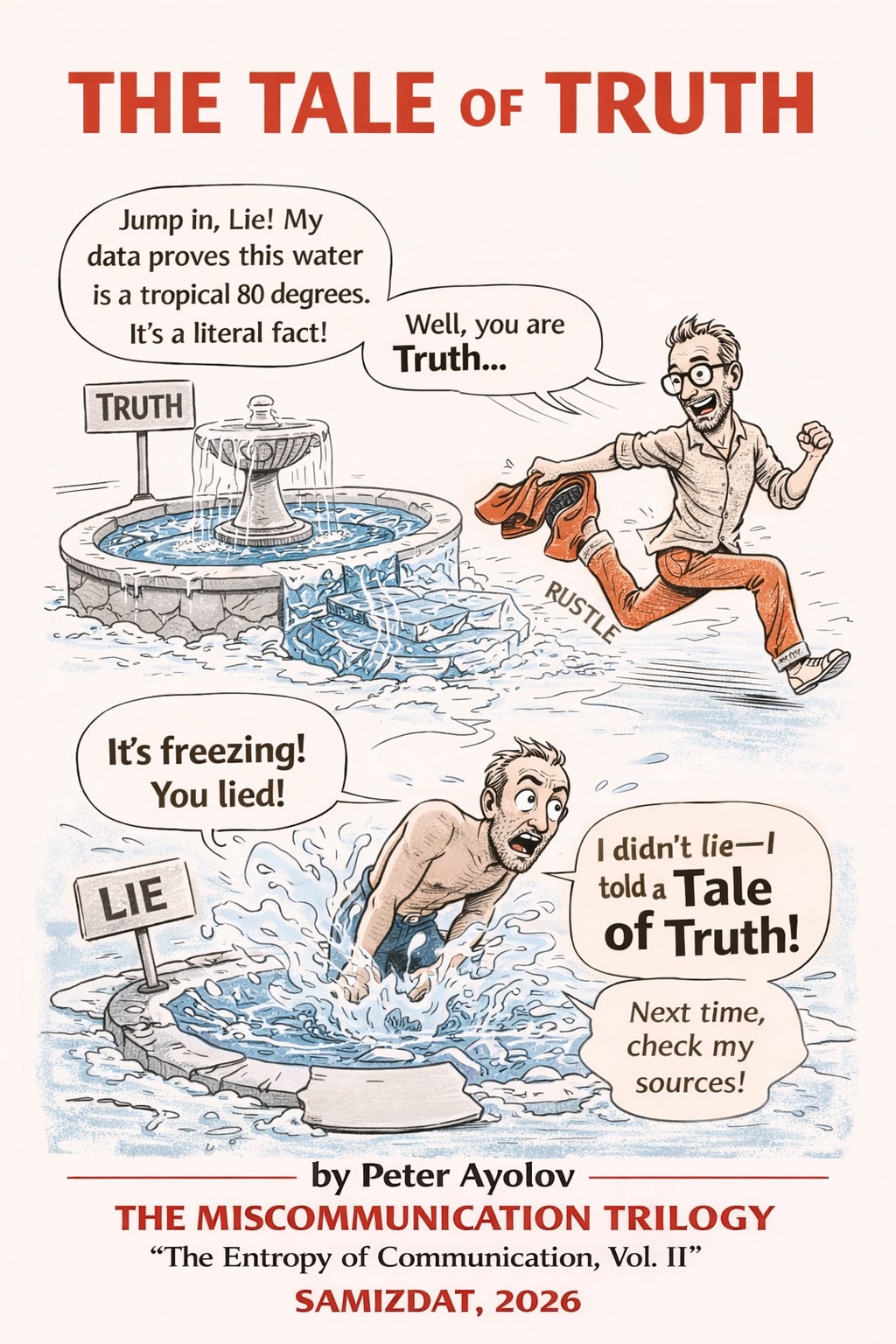
The Vanishing of Meaning: Truth at the Edge of Language
I. The Crisis of Truth in an Age of Linguistic Saturation
The Tale of Truth, Part 6 of the second volume of The Miscommunication Trilogy, enters philosophical territory that is at once ancient and alarmingly contemporary. Its central concern is not merely what truth is, but whether truth can survive the conditions imposed by modern communication. In a world saturated with language—where words proliferate endlessly across digital, political, and cultural domains—the book poses a disquieting possibility: that truth is not being refuted, but quietly eroded through the very medium meant to sustain it. The work distinguishes itself by refusing to treat truth as a static philosophical problem. Instead, it reconstructs truth as a lived process—an unfolding event shaped by human action, interpretation, and historical contingency. From the outset, the reader is drawn into a conceptual landscape where truth is neither purely objective nor merely subjective, but something that emerges through interaction, risk, and responsibility. This approach echoes, transforms, and synthesizes insights associated with figures such as Jean-Paul Sartre, Hans-Georg Gadamer, and Jürgen Habermas, yet the book does not simply restate their positions. It pushes further, situating their ideas within a broader diagnosis of communicative decay.
At the heart of this diagnosis lies the concept of the planned obsolescence of language. Borrowing implicitly from economic metaphors, the book suggests that language, like a disposable product, is increasingly designed for rapid consumption rather than enduring meaning. Words are no longer anchored in stable referents or shared understandings; instead, they circulate as interchangeable units within systems of power, persuasion, and distraction. In such a context, truth becomes difficult not because it is inaccessible, but because the very criteria for recognizing it begin to dissolve. The book’s early sections establish a powerful tension between truth and ignorance. Ignorance is not presented as a simple lack of knowledge, but as an active, often deliberate stance—a refusal to engage with the demands of truth. This idea, reminiscent of existentialist themes, reframes the problem of miscommunication as a moral and political issue. When individuals or societies choose ignorance, they do not merely fail to know; they actively participate in the fragmentation of reality.
What makes this first movement particularly compelling is its insistence that truth retains a normative force even under these conditions. The author argues that truth matters not only because it corresponds to reality, but because it grounds our capacity to judge, to dissent, and to act meaningfully. Without truth, disagreement collapses into preference, and critique becomes impossible. This insight lays the foundation for the book’s broader argument: that the erosion of truth is inseparable from the erosion of freedom itself.
II. Language, Interpretation, and the Fragmentation of Reality
If the first part of the book diagnoses the crisis, the second part explores its mechanisms. Here, the focus shifts to language as the medium through which truth is both revealed and obscured. Drawing on hermeneutic philosophy, the text emphasizes that understanding is not a passive reception of information but an active process of interpretation. Every act of understanding involves a fusion of perspectives, a negotiation between past meanings and present contexts. This hermeneutic insight is developed with remarkable depth. Language is not treated as a neutral tool but as the very horizon within which human experience unfolds. To speak is already to interpret; to understand is already to transform. In this sense, truth is inseparable from the dynamics of language. It is not something that exists independently of interpretation, but something that emerges through it.
However, the book refuses to romanticize this process. Interpretation, while necessary, also introduces instability. Each act of translation, each attempt to communicate across differences, involves selection, emphasis, and loss. Meaning is never fully preserved; it is always reconfigured. This insight is illustrated through discussions of dialogue, translation, and textual interpretation, showing how even the most careful communication cannot eliminate ambiguity. The result is a profound ambivalence. On one hand, language enables the sharing of truth; on the other, it ensures that truth can never be fully fixed. This tension is central to the book’s argument. The problem is not that language fails, but that it succeeds too well—multiplying meanings, generating perspectives, and thereby destabilizing any single account of reality.
The concept of linguistic entropy becomes crucial here. As communication accelerates, meanings proliferate without consolidation. Words lose their depth, becoming detached from the contexts that once gave them significance. In such an environment, the distinction between truth and falsehood becomes increasingly difficult to sustain. Not because everything is equally valid, but because the criteria for validation are obscured. The book’s engagement with analytic and pragmatic approaches further enriches this analysis. It acknowledges the importance of representation—the idea that language refers to an objective world—but insists that this function cannot be separated from communication. Every statement is both a claim about the world and an act directed toward others. Truth, therefore, is not merely a matter of correspondence but of justification within a shared discourse. This leads to a critical insight: truth depends on the conditions of communication. When those conditions are distorted—by power, ideology, or systemic pressures—the pursuit of truth is compromised. The book’s discussion of systematically distorted communication highlights how language can be used not only to convey meaning but to manipulate, obscure, and control. In such cases, miscommunication is not accidental but structural.
The cumulative effect of this second part is a sense of increasing fragility. Truth appears as something that must be constantly negotiated, defended, and rearticulated. It is not given once and for all, but continually at risk. Yet this fragility is not presented as a weakness; it is the very condition of truth’s vitality. A truth that could not be challenged, interpreted, or revised would not be truth at all, but dogma.
III. Freedom, Responsibility, and the Future of Truth
The final movement of the book brings its themes into a broader ethical and political perspective. Having shown how truth is entangled with language and communication, the author turns to the question of what this means for human freedom. The answer is both unsettling and hopeful. Freedom, the book argues, is inseparable from the capacity to engage with truth. To be free is not merely to act, but to act in relation to what is real—to recognize, interpret, and respond to the world as it is. This requires a commitment to truth, not as an abstract ideal, but as a practical orientation. Without such a commitment, freedom collapses into arbitrariness, and action loses its meaning. At the same time, the book emphasizes that this commitment is never guaranteed. Truth demands effort, risk, and responsibility. It requires individuals to confront uncomfortable realities, to question their own assumptions, and to remain open to revision. Ignorance, by contrast, offers an easier path—a retreat into passivity, distraction, or denial. The choice between truth and ignorance is thus a choice between different modes of existence.
This existential dimension is complemented by a political analysis. The book argues that liberal democracy depends on a shared commitment to truth. Institutions such as free speech, transparency, and public debate are not ends in themselves; they are means of sustaining the conditions under which truth can emerge. When these conditions are undermined, the very possibility of democratic life is threatened. The notion of “speaking truth to power” acquires a new significance in this context. It is not simply a slogan, but a fundamental practice through which individuals assert their freedom and hold institutions accountable. Yet this practice depends on the existence of a concept of truth that transcends mere consensus. If truth is reduced to what is accepted, then dissent loses its force, and power becomes self-justifying. Perhaps the most striking aspect of the book’s conclusion is its refusal to offer easy solutions. The problem it identifies—the entropy of communication—is not something that can be resolved through technical fixes or theoretical adjustments. It is a condition of modernity itself, rooted in the very structures that enable communication. The challenge, therefore, is not to eliminate this condition, but to navigate it responsibly.
In this sense, the book ends on a note of cautious optimism. Truth may be fragile, contested, and elusive, but it is not extinguished. It persists in the very act of questioning, in the refusal to accept appearances at face value, and in the ongoing effort to make sense of the world. The pursuit of truth, even when it appears futile, is itself a form of resistance against the forces that seek to dissolve meaning. As a whole, The Tale of Truth is an ambitious and intellectually demanding work. It weaves together existentialism, hermeneutics, and critical theory into a coherent and compelling narrative. Its strength lies not only in its philosophical depth, but in its ability to connect abstract ideas with concrete concerns about communication, politics, and everyday life. The book does not provide definitive answers, nor does it claim to. Instead, it invites the reader into a process of reflection—one that mirrors the very dynamics it describes. In doing so, it achieves something rare: it makes the problem of truth not only intelligible, but urgent.
About the Creator
Peter Ayolov
Peter Ayolov’s key contribution to media theory is the development of the "Propaganda 2.0" or the "manufacture of dissent" model, which he details in his 2024 book, The Economic Policy of Online Media: Manufacture of Dissent.
Enjoyed the story? Support the Creator.
Subscribe for free to receive all their stories in your feed.
Comments
There are no comments for this story
Be the first to respond and start the conversation.