
The Silence of Humanity, THE MISCOMMUNICATION TRILOGY, “The Tower of Babble, Vol. III”, Part 23 (final part)
Book Review

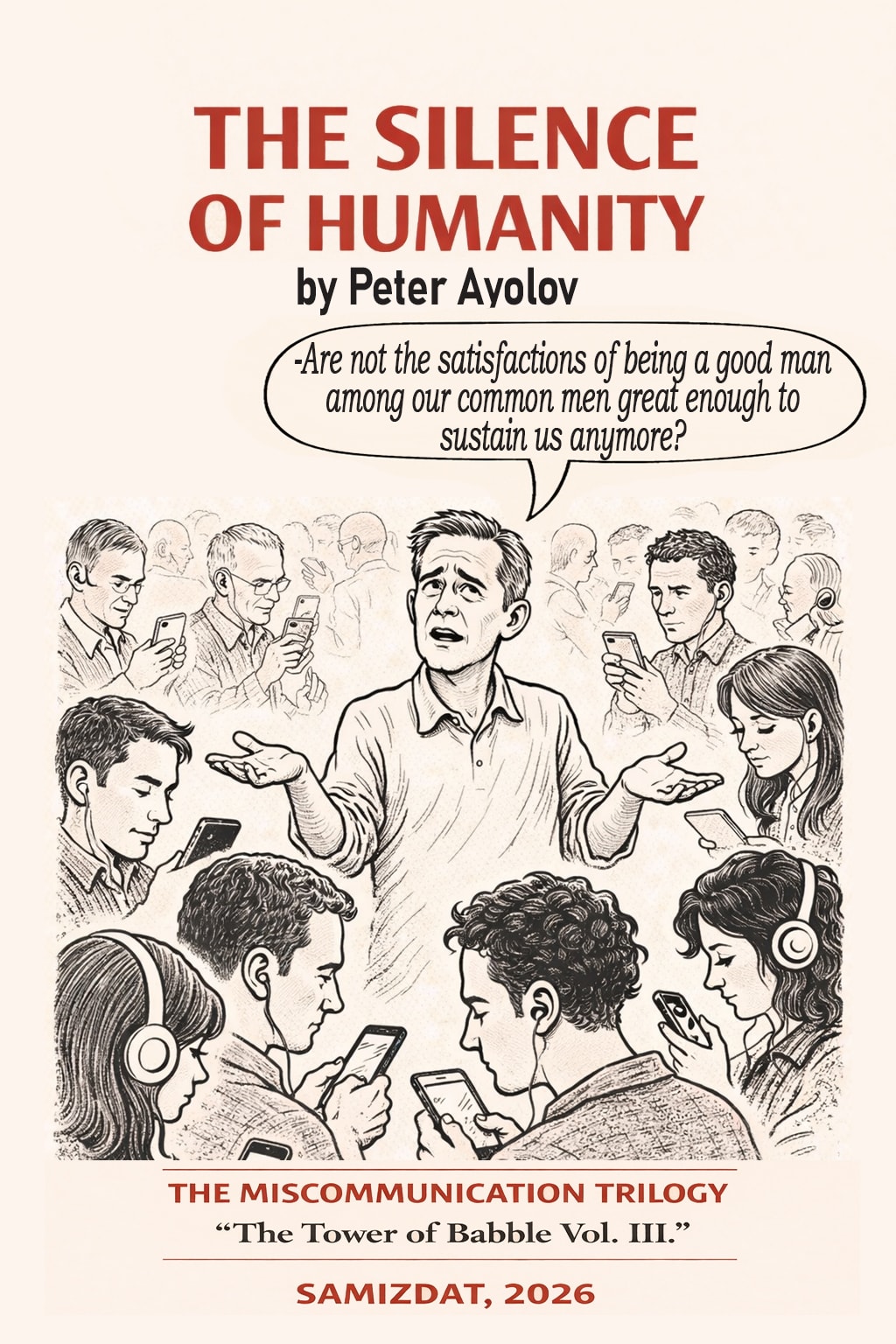
The Great Quieting: Humanity After the Babble of Speech
The Silence Behind Communication
The Silence of Humanity stands as a fitting culmination of a long intellectual exploration devoted to the crisis of communication in contemporary civilization. While many studies of language focus on speech, discourse, rhetoric, persuasion, or information exchange, this volume turns its attention toward the phenomenon that exists beneath, around, and beyond every communicative act. It begins with a deceptively simple observation: silence is not merely the absence of language. Rather, silence is one of the fundamental conditions that make language possible. Throughout the book, this insight unfolds across an impressive range of disciplines, traditions, and historical periods, transforming what appears at first to be a negative space into one of the richest dimensions of human experience. The book’s greatest strength lies in its refusal to treat silence as a singular phenomenon. Instead, silence emerges as a multifaceted reality that assumes different meanings according to context. Silence can be spiritual contemplation, social exclusion, political oppression, artistic expression, psychological withdrawal, legal protection, or interpersonal intimacy. It can signify wisdom, fear, reverence, grief, love, resistance, ignorance, or transcendence. By assembling perspectives from philosophy, theology, linguistics, communication studies, anthropology, media studies, psychology, and cultural history, the work demonstrates that silence possesses a communicative complexity rivaling that of speech itself. The result is a sustained challenge to one of modernity’s deepest assumptions: that communication necessarily improves through the multiplication of words. Particularly compelling is the way the volume situates silence within the broader historical development of communication. The modern world is presented as a civilization increasingly incapable of tolerating quiet. Technological systems have produced unprecedented quantities of speech, information, and symbolic exchange. Yet rather than solving the problems of misunderstanding and alienation, this communicative abundance often intensifies them. The reader is repeatedly confronted with the paradox that more communication does not necessarily produce greater understanding. Social media, mass communication, automated technologies, and endless digital interaction generate an environment saturated with expression while simultaneously eroding the conditions necessary for listening. In this context, silence becomes not merely a topic of academic investigation but a diagnostic tool for understanding the contemporary condition. The volume also succeeds in demonstrating that silence cannot be reduced to a psychological state or cultural convention. It occupies an ontological dimension. Human beings encounter silence not only in social interactions but in the structure of existence itself. The pauses between words, the intervals between generations, the spaces between memories, and the mysteries beyond language all point toward a reality that speech cannot fully contain. Silence becomes the hidden architecture supporting communication while simultaneously exposing its limitations. This insight gives the work a philosophical depth that elevates it beyond a conventional study of language. It becomes an investigation into the nature of meaning itself and into the conditions under which human understanding remains possible in an increasingly noisy world.
The Unspoken Foundations of Human Experience
One of the most remarkable aspects of The Silence of Humanity is its ability to connect highly diverse subjects without losing conceptual coherence. Discussions of religious contemplation sit alongside analyses of legal rights, interpersonal relationships, music, film, technology, loneliness, censorship, and cultural rituals. Rather than appearing fragmented, these seemingly unrelated themes reinforce a central argument: silence is present wherever human beings attempt to construct meaning. The book demonstrates that every communicative system relies upon exclusions, omissions, pauses, and absences. What remains unsaid is often as significant as what is spoken. Meaning emerges not from words alone but from the dynamic tension between expression and restraint. The treatment of interpersonal silence is especially illuminating. The book explores how silence can function simultaneously as a source of intimacy and alienation. Within close relationships, silence may express trust, affection, and mutual understanding. At the same time, silence can become a weapon through practices such as exclusion, avoidance, and the silent treatment. This duality reveals the extraordinary communicative power of non-speech. Human beings interpret silence constantly, assigning meanings that depend upon context, expectation, and emotional investment. The volume repeatedly demonstrates that silence is never truly empty. Even when nothing is said, communication continues. Silence itself becomes a message whose interpretation shapes relationships and social realities. Equally significant is the analysis of technological modernity. The chapters devoted to loneliness, machine companionship, trust in technology, radio, music, and automated communication provide some of the book’s most powerful observations. The argument that contemporary societies increasingly replace human interaction with technological substitutes is developed with considerable nuance. Rather than condemning technology outright, the volume examines how technological systems gradually reshape patterns of attention, trust, and social connection. Machines become companions, interfaces replace face-to-face encounters, and mediated communication displaces embodied presence. The result is a paradoxical condition in which individuals are more connected than ever before while simultaneously experiencing unprecedented forms of isolation. Silence appears here in a new guise—not as the absence of communication but as the absence of meaningful human encounter hidden beneath endless exchanges of information. The exploration of sacred silence adds another important dimension to the work. Religious traditions from diverse cultural backgrounds reveal that silence has long been understood as a pathway toward realities beyond ordinary language. The silence of monastic life, meditation, contemplation, ritual observance, and mystical experience points toward a recognition shared across civilizations: some forms of knowledge cannot be attained through speech alone. The discussions of divine silence are particularly compelling because they extend the analysis beyond social communication into the realm of ultimate meaning. The silence of God becomes a metaphor for every encounter with mystery, every confrontation with the limits of language, and every attempt to articulate realities that exceed conceptual understanding. Throughout these discussions, the book maintains a careful balance between scholarly rigor and philosophical reflection. It neither romanticizes silence nor reduces it to a problem requiring resolution. Instead, silence is presented as an indispensable component of human existence whose significance varies according to circumstance. This refusal to adopt simplistic conclusions gives the work intellectual credibility while preserving the complexity of its subject. The reader emerges with a renewed awareness that communication is not merely a matter of speaking but also of listening, waiting, withholding, and attending to what remains beyond articulation.
Toward the Future of Meaning
As the concluding volume of a larger intellectual project devoted to the planned obsolescence of language, The Silence of Humanity performs a particularly important function. It reveals that the crisis of language is not simply a crisis of words. The deeper problem concerns meaning itself. Modern societies have become extraordinarily effective at producing communication while increasingly struggling to sustain understanding. The expansion of media, information systems, digital platforms, and technological networks has created an environment where speech proliferates endlessly. Yet this abundance often conceals a growing inability to listen, reflect, and engage in meaningful dialogue. The final contribution of this volume lies in showing that silence may offer one of the few remaining spaces in which meaning can still be recovered. The concept of planned obsolescence acquires a particularly profound significance within this framework. Traditionally associated with consumer goods designed for replacement, the concept is extended here to communication itself. Language becomes obsolete not because it disappears but because it gradually loses its capacity to connect individuals with reality, with one another, and with themselves. Words become inflated, repetitive, ideological, commercialized, automated, and detached from lived experience. Communication continues, yet understanding diminishes. The volume suggests that the exhaustion of language may ultimately manifest as a civilization incapable of genuine listening. In such a world, silence becomes both symptom and remedy. It reflects the failures of communication while simultaneously preserving the possibility of renewal. The concluding discussions of divine silence bring this argument to its philosophical culmination. The silence of God represents the ultimate boundary encountered by language. It symbolizes the point at which human expression reaches its limits and confronts realities that cannot be fully captured through speech. Rather than resolving this tension, the book embraces it. Silence remains a mystery, a challenge, and an invitation. It reveals the inadequacy of purely instrumental approaches to communication while preserving the possibility that meaning extends beyond what can be immediately articulated. This perspective gives the volume a depth that transcends contemporary debates about media and technology, situating its concerns within enduring questions about existence, truth, and human understanding. As a final volume, The Silence of Humanity succeeds because it transforms silence from a marginal topic into a central category for understanding the modern condition. It demonstrates that the future of communication depends not solely upon improving technologies or expanding networks but upon recovering neglected capacities for attentiveness, contemplation, and listening. In an age defined by perpetual noise, this work reminds readers that some of the most important dimensions of life emerge only when speech gives way to quietness. The result is a thoughtful, ambitious, and intellectually rich examination of silence as both a human necessity and a philosophical horizon. It serves not only as a conclusion to a trilogy but also as a meditation on the future of meaning in a civilization increasingly overwhelmed by its own words.
About the Creator
Peter Ayolov
Peter Ayolov’s key contribution to media theory is the development of the "Propaganda 2.0" or the "manufacture of dissent" model, which he details in his 2024 book, The Economic Policy of Online Media: Manufacture of Dissent.
Enjoyed the story? Support the Creator.
Subscribe for free to receive all their stories in your feed.
Comments
There are no comments for this story
Be the first to respond and start the conversation.