
The Silence of God
Divine Silence and the Problem of Speaking

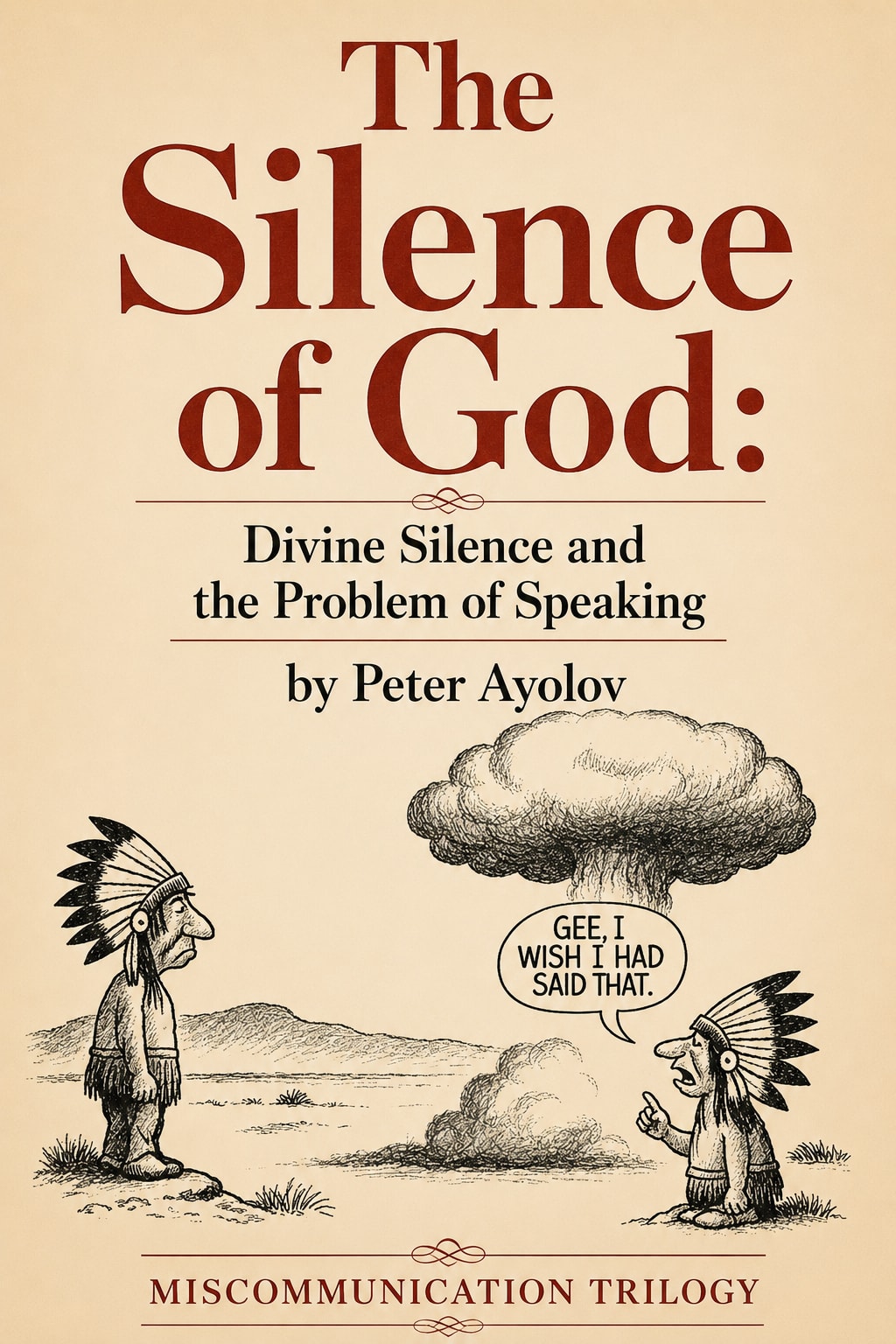
The Unanswered Voice
The journey through silence inevitably arrives at one of humanity’s oldest and most unsettling questions: if language defines our existence, what are we to make of the silence that appears to surround the highest realities toward which language aspires? Human beings have always sought answers through speech. They pray, argue, confess, teach, persuade, and proclaim. Entire civilizations have been built upon the conviction that truth can be spoken, transmitted, preserved, and understood. Yet at the limits of experience, language repeatedly encounters barriers it cannot overcome. Death resists explanation. Love exceeds definition. Suffering often refuses justification. The sacred remains elusive. In each of these domains, speech reaches a threshold beyond which certainty dissolves. It is precisely there that silence emerges—not merely as an absence of words but as a condition revealing the limitations of human expression. Throughout history, divine silence has served as both a source of spiritual insight and a cause of profound anguish. Believers have cried out for guidance only to encounter quietness. Prophets have lamented the apparent absence of response. Philosophers have wrestled with the contradiction between a communicative universe and an apparently silent creator. Skeptics have pointed to divine silence as evidence of cosmic indifference, while mystics have interpreted the same silence as the deepest form of revelation. Between these extremes unfolds one of the central dramas of human consciousness. The problem extends beyond theology. Divine silence functions as a metaphor for every encounter with the unknown. Whenever human beings confront realities that exceed comprehension, they experience a form of silence. Scientific discoveries reveal mysteries beyond existing theories. Personal tragedies expose the inadequacy of familiar explanations. Historical catastrophes challenge inherited systems of meaning. In each instance, silence appears not because nothing exists to be said but because language proves insufficient to encompass what has been encountered. The history of communication therefore contains an enduring paradox. The more humanity attempts to speak about ultimate realities, the more clearly it discovers the limitations of speech itself. Religious traditions repeatedly recognize this dilemma. Sacred texts contain both divine words and divine silences. Revelation is accompanied by concealment. Speech is intertwined with mystery. The sacred appears not only in commandments and declarations but also in pauses, absences, and unanswered questions. This duality reveals that silence is not necessarily the opposite of communication. It may instead constitute one of its deepest forms. Modern societies often respond uneasily to such uncertainty. Surrounded by technologies promising instant access to information, contemporary culture increasingly assumes that every problem possesses a verbal solution. Questions demand immediate answers. Ambiguity becomes intolerable. Yet divine silence challenges this expectation. It reminds humanity that not all realities yield to explanation and that some truths cannot be reduced to propositions. The significance of silence lies precisely in its refusal to become fully transparent. It invites humility where certainty dominates and contemplation where noise prevails. In an age saturated with communication technologies, the ancient question of divine silence remains strikingly relevant. It forces humanity to reconsider whether understanding depends solely upon speaking or whether the deepest forms of insight emerge when speech gives way to attentive listening.
The Limits of Language
The exploration of silence throughout human culture reveals a recurring pattern. Whenever language attempts to grasp the totality of existence, it encounters boundaries. Philosophers, poets, theologians, artists, and ordinary individuals have all discovered that words possess extraordinary power while remaining fundamentally limited. Language can describe, classify, narrate, and persuade, but it cannot entirely capture the fullness of experience. The gap between reality and description becomes especially apparent when confronting transcendence. The sacred, by its very nature, exceeds conceptual containment. This recognition lies at the heart of traditions that emphasize negative theology, mystical contemplation, and sacred silence. Rather than defining ultimate reality through affirmations, these traditions approach it through negation, acknowledging that every statement falls short. The divine becomes known not through exhaustive description but through recognition of what cannot be adequately expressed. This tension between language and silence permeates every dimension of human existence. The legal right to remain silent acknowledges that speech may distort truth as easily as reveal it. Artistic expressions frequently depend upon omission, suggestion, and absence to achieve their deepest effects. Music derives its emotional power not only from sound but also from pauses and intervals. Literature relies upon what remains unsaid as much as upon explicit narration. Human relationships themselves are structured by silences that communicate affection, hostility, uncertainty, reverence, or grief. The world examined throughout this volume demonstrates repeatedly that silence is not an accidental interruption within communication but one of its constitutive elements. Speech and silence exist in a relationship of mutual dependence. Without silence, words lose shape. Without pauses, meaning collapses into noise. Without listening, speaking becomes an exercise in self-amplification rather than communication. The contemporary world presents a particularly striking example of this dilemma. Digital technologies have expanded the volume of human expression beyond anything previously imaginable. Information circulates continuously across global networks. Individuals communicate instantly across continents. Yet this abundance has not necessarily produced deeper understanding. Instead, communication frequently becomes fragmented, accelerated, and detached from reflection. The result is an environment in which speech proliferates while meaning becomes increasingly unstable. Endless commentary often obscures rather than clarifies. Constant expression diminishes opportunities for contemplation. The silence necessary for thought is displaced by perpetual stimulation. In such circumstances, humanity risks confusing communication with understanding and information with wisdom. The problem is not technology itself but the gradual disappearance of the conditions that allow communication to remain meaningful. Every act of listening requires a degree of silence. Every act of reflection depends upon temporary withdrawal from distraction. Every encounter with complexity demands patience. The inability to tolerate silence therefore signals more than a cultural preference. It reveals a transformation in how human beings relate to knowledge, truth, and one another. The silence of God becomes emblematic of a broader reality: meaning cannot always be forced into immediate visibility. Some truths require waiting. Some insights emerge only through contemplation. Some realities remain permanently beyond the reach of language. The recognition of these limits does not diminish communication; rather, it restores depth and seriousness to the human search for understanding. Silence thus appears not as the enemy of language but as the horizon against which language discovers both its power and its limitations.
Beyond the Final Word
The investigation of silence ultimately returns humanity to itself. Beneath discussions of communication, religion, politics, culture, technology, art, and psychology lies a deeper question concerning the nature of human existence. Human beings are creatures of language, yet they are also creatures of silence. They speak because they seek connection, understanding, and meaning. They fall silent because they encounter realities that transcend articulation. Between these two conditions unfolds the drama of human life. Every civilization develops systems of communication, yet every civilization also creates spaces for silence. Every culture teaches speech, but it must also teach restraint. Every individual learns language, yet eventually confronts experiences that resist verbal expression. Silence therefore accompanies humanity from beginning to end. It surrounds birth before language is acquired and remains after words have lost their power. Far from being peripheral, silence occupies a central position within the human condition. The silence of God represents the culmination of this broader exploration because it gathers together all the tensions examined throughout the book. It encompasses the limits of communication, the mystery of meaning, the fragility of language, and the longing for connection. Divine silence confronts humanity with the possibility that reality cannot be reduced to speech alone. Yet it also preserves the hope that meaning exists beyond what can be immediately articulated. The unanswered prayer, the unresolved question, and the hidden mystery become invitations rather than conclusions. They encourage continued searching rather than resignation. In this sense, silence functions not as a termination of communication but as an opening toward deeper forms of engagement. The future of humanity may depend in part upon recovering this forgotten dimension of existence. Contemporary life increasingly rewards visibility, speed, reaction, and continuous expression. Yet the preservation of wisdom requires conditions that cannot be manufactured through acceleration. Listening demands patience. Reflection requires solitude. Understanding grows through attentiveness rather than constant stimulation. The recovery of silence therefore becomes more than a personal discipline; it becomes a cultural necessity. Without silence, public discourse deteriorates into noise. Without silence, relationships lose depth. Without silence, language itself becomes exhausted through overuse and fragmentation. The challenge facing modern civilization is not merely to speak more effectively but to rediscover when speech should yield to quietness. The conclusion of this journey does not resolve the mystery of divine silence. Nor does it eliminate the tensions surrounding communication, faith, or meaning. Instead, it recognizes that some questions remain permanently open. The significance of silence lies precisely in its capacity to preserve these open spaces. It reminds humanity that existence contains dimensions resistant to mastery, explanation, and control. In a world increasingly defined by the demand for immediate answers, silence offers a different possibility. It invites humility before mystery, attentiveness before judgment, and listening before speech. The final lesson of silence is therefore not that words are unimportant. Rather, it is that words achieve their fullest significance only when they emerge from and return to the quiet depths from which all meaning ultimately arises.
About the Creator
Peter Ayolov
Peter Ayolov’s key contribution to media theory is the development of the "Propaganda 2.0" or the "manufacture of dissent" model, which he details in his 2024 book, The Economic Policy of Online Media: Manufacture of Dissent.
Enjoyed the story? Support the Creator.
Subscribe for free to receive all their stories in your feed.
Comments
There are no comments for this story
Be the first to respond and start the conversation.