
The Pugilists and their Public
A Review of A.J. Liebling's "The Sweet Science"

Beware of new habits once you reach a certain age. And if you dare to have one, make sure that you bring along a guide or mentor who can show you the path ahead, and what to avoid and enjoy.
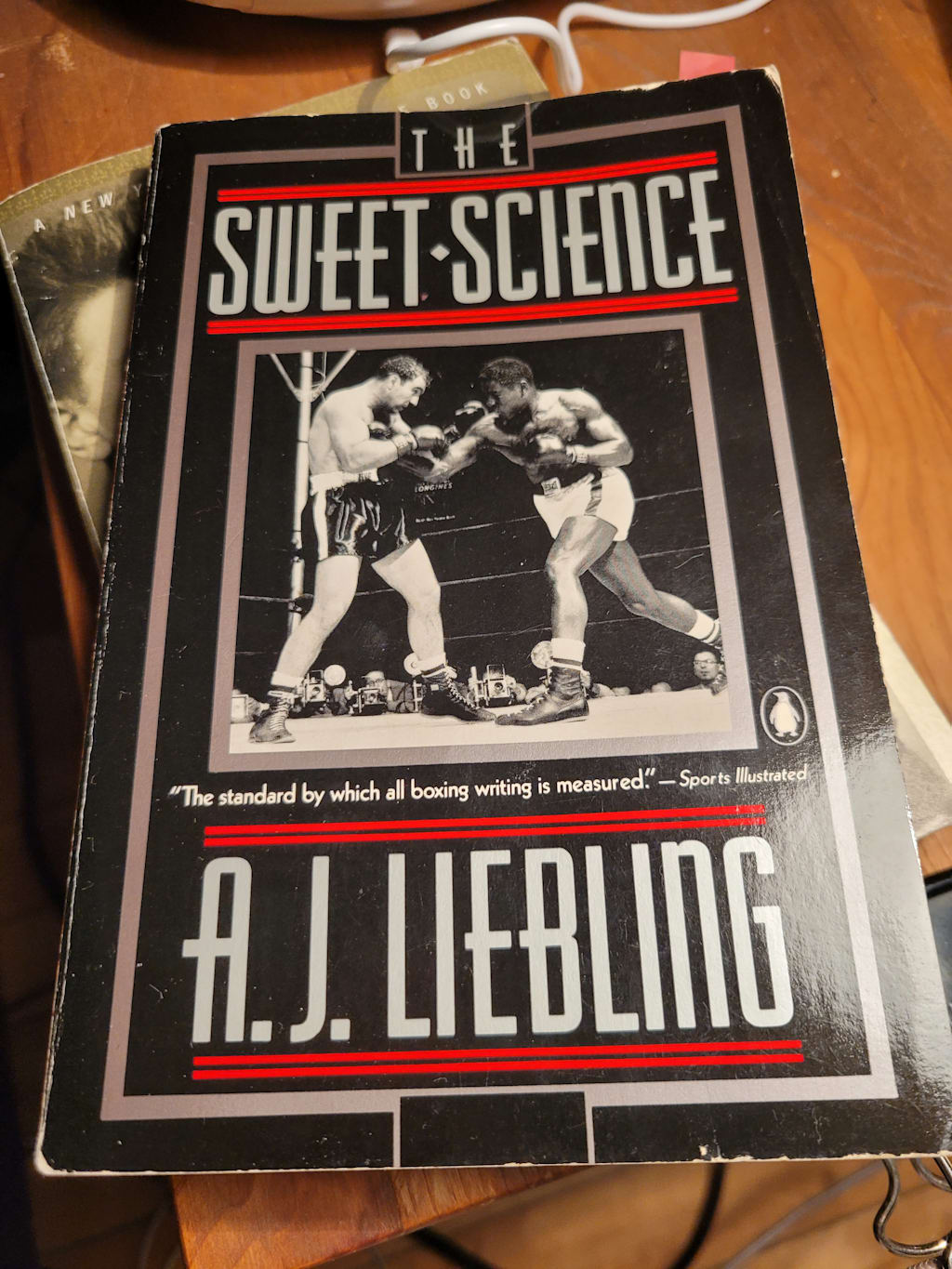
I found a copy of this 1982 Penguin edition of “The Sweet Science” at my favourite secondhand bookstore…on the $1.00 shelf. This seemed odd to me then, and feels even odder now that I have actually read the book. The owner of the store looked inside the cover to confirm that it was placed in the right spot – it was – and I would later discover that Sports Illustrated named it the best sports book of all time (“The standard by which all boxing writing is measured.”) The only reason I can think of for its lack of a higher price is its obvious datedness. The book was first published in 1956, culled together from a pile of articles A. J. Liebling wrote for the New Yorker from 1951 onward, dedicated to a trainer I had never heard of, and it is very much a guide to readers of that era who would like to know more about the sport as it entered the television world and became an even bigger obsession for fight lovers.
And television really is the dividing line. Liebling goes back to the opening of Yankee Stadium in 1923, and how that fine edifice hosted fights right from its opening. You might recognize how many names and matches that you do not recognize: Sandy Saddler, Ezzard Charles, Archie Moore. Even some well-known names – Rocky Marciano, Sugar Ray Robinson, Joe Louis – may need a bit of a push for this generation. This is where Liebling becomes invaluable.
As you read, you have the feeling that you understand those rides on the subway or in a back of a cab to a stadium or arena to mix in with the fans and understand why they are there:
The purpose of going to a fight isn't always to see a close contest. A great many fights are hardly worth looking at, while the development of an interesting performer is always an attraction... (''Wunderkind'' - pp. 226 – 227).
You also learn why weight classes matter...or do they?:
The division of boxers into weight classes is based on the premise that if two men are equally talented practitioners of the Sweet Science, then the heavier man has a decided advantage. This is true, of course, only if both men are trained down hard...If the difference amounts to no more than a couple of pounds, it can be offset by a number of other factors, including luck, but when it goes up to five, six or seven, it takes a lot of beating. (''Kearns by a Knockout'' - p. 66).
And the details of what is happening in the ring are made clear; much clearer than anything I read in Norman Mailer’s “The Fight” (one particular fight between Jimmy Carter (not the president!) and George Arujo is very detailed and vivid):
At the bell Araujo came out on his toes and started circling Carter, jabbing his left to the champion's face as the taller man advanced. They were flicking, fast jabs, usually double, like a cat striking twice at a butterfly, and, since George was generally going away when they landed, they were not stiff enough to set Carter back on his heels...
I have never been the kind of fight-goer who gives a fighter credit for chasing an opponent and getting hit...
The last thing I remember about the fight is Travis's face (trainer for Araujo) as he hauled himself through the ropes to get his boy. It is a big face, and it was wide open, as if he had just seen something he couldn't believe...
(''The Boy from South Main Street'' - pp. 150 – 152).
Ah, Mailer… Those of you who read that earlier review may understand what I mean if you pick up both books and make a comparison. It might be a sweet science, but it does not have to be treated like a final experiment. Liebling understands his audience is and what they expect on the page (he also wrote reviews of fine food and I am still trying to imagine him describing haute cuisine after his detailed descriptions of boxers crashing and mauling each other in the ring). He is a good guide to the “milling coves” (fighters), “daffy and eau de vie” (gin and brandy – also known as “blue ruin” - drinks of choice for fight fans back in the day), “foot-toddlers” (pedestrians), and “Cyprians” (sporting girls – draw your own conclusions with that one). Yes, even then these were dated terms – he took them from classic nineteenth-century accounts of fights – and Liebling knows it, but I found it touching to see him care enough to increase my vocabulary this way.
So why am I worried about new habits?
I now want to see a fight.
It is incredible to me that I have sat through almost all of the “Rocky” films, seen “Raging Bull”, “Million-Dollar Baby”, “Fat City”, “The Champ” and others (look back at classic Hollywood for those last two). And I know that other writers loved the sport more than I ever could (both Hemingway and Camus are mentioned in the book as former pugilists).
So why have I never seen a battle between two fighters up close and very physical?
Liebling has me wondering if I need to find a quiet gym where the upcoming talent gets developed and note the talents out there that may one day be worth a sequel to this seventy-year-old tome.
I need to see the science in all its sweetness.
I’ll get in that ring…
*
Thank you for reading!
If you liked this, you can add your Insights, Comment, leave a Heart, Tip, Pledge, or Subscribe. I will appreciate any support you have shown for my work.
You can find more poems, stories, and articles by Kendall Defoe on my Vocal profile. I complain, argue, provoke and create...just like everybody else.
Give it a look...
About the Creator
Kendall Defoe
Teacher, reader, writer, dreamer... I am a college instructor who cannot stop letting his thoughts end up on the page. No AI. No Fake Work. It's all me...
And I did this:
Enjoyed the story? Support the Creator.
Subscribe for free to receive all their stories in your feed. You could also become a paid subscriber, letting them know you appreciate their work.
Comments
There are no comments for this story
Be the first to respond and start the conversation.